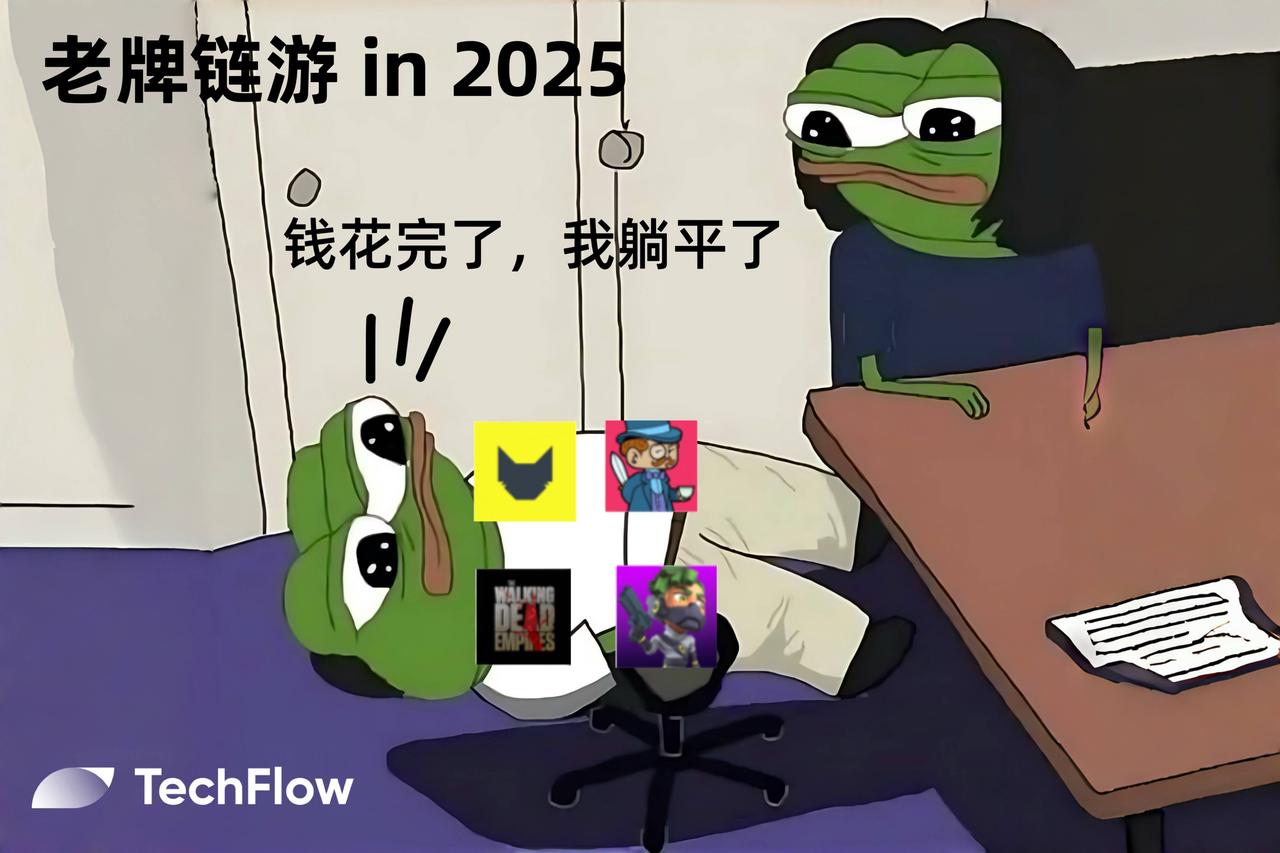
The last cycle's blockchain games are collectively facing death
TechFlow Selected TechFlow Selected
The last cycle's blockchain games are collectively facing death
Players as investors, games as Ponzi schemes—completely at odds with the patience and craftsmanship required for gaming.
 Navigating Web3 tides with focused insights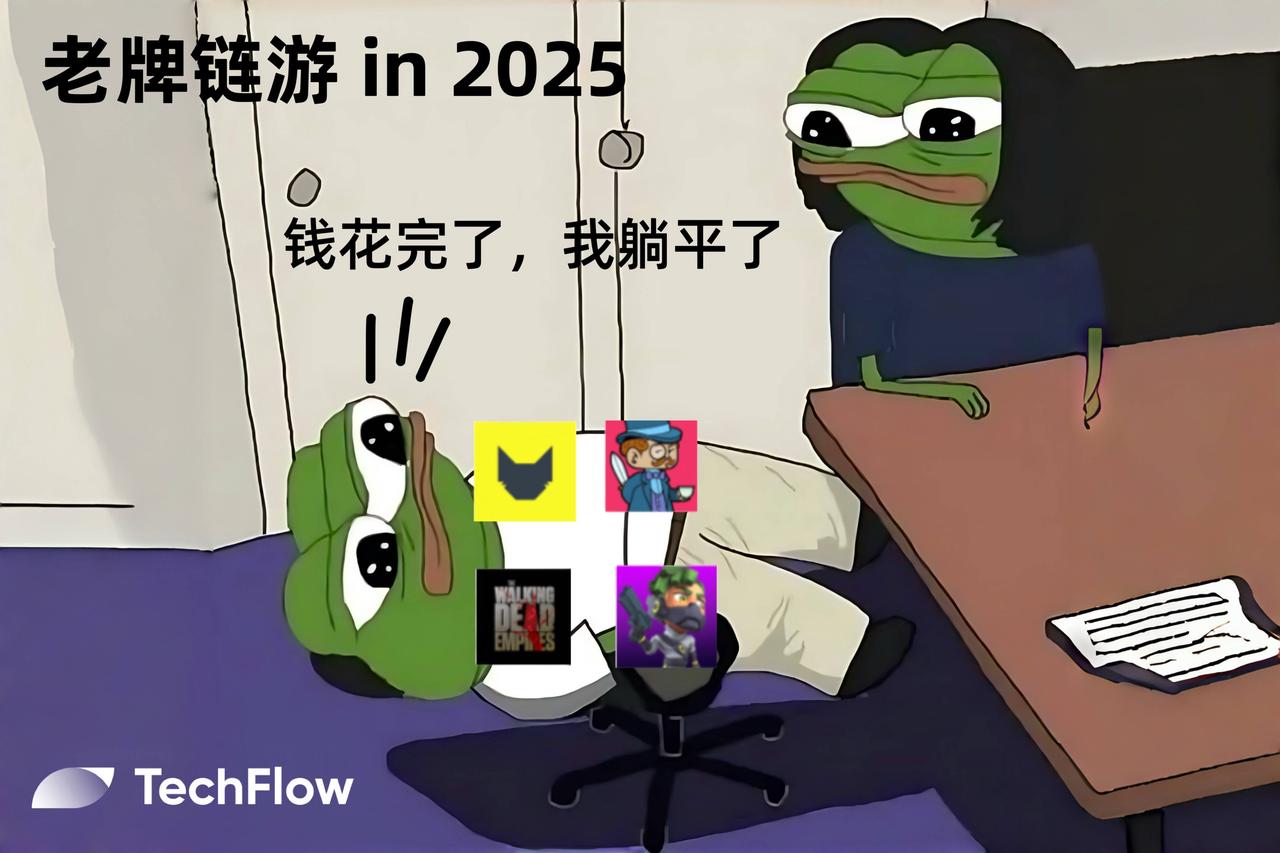
While Meme Launchpads thrive in this cycle, some projects are being left behind as its castaways.
For instance, many blockchain gaming projects that were once red-hot during the last cycle are now facing a wave of shutdowns.
On May 16, Nyan Heroes, once a star game project on Solana, announced it was officially shutting down due to "funding shortages." Developer 9 Lives Interactive stated on X that they "could not secure additional funding to complete the game."
Within just one day, the NYAN token plunged by as much as 37.2%, and its FDV subsequently dropped to around $5 million—nearly 99% below its all-time high.
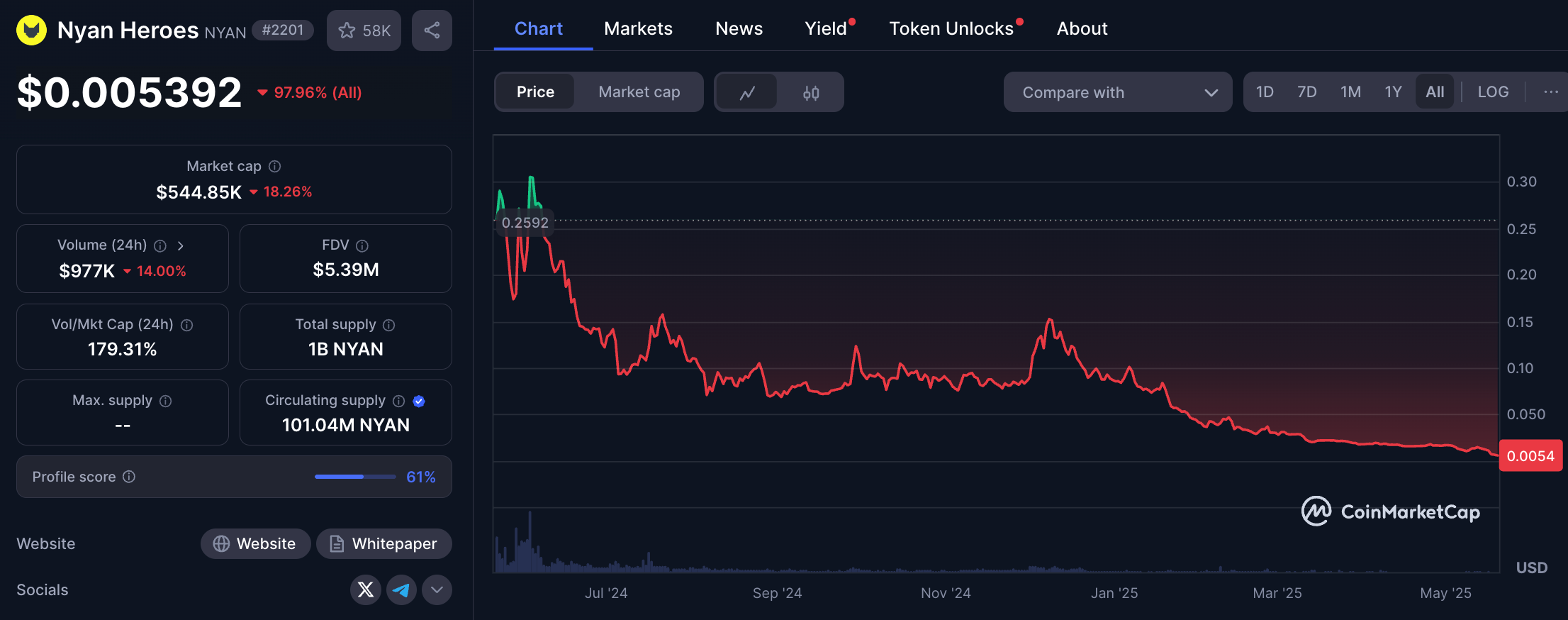
The lower the fall, the higher the peak once was.
Recall that this game once attracted 1 million test players and reached 250,000 wishlists on Steam—yet today its market cap may not even match that of a random Meme coin.
However, Nyan Heroes’ collapse is no isolated case. Recently, multiple blockchain gaming projects have successively announced shutdowns or development halts, with prior funding ranging from millions to tens of millions of dollars—all ending the same way.
The cyclical nature of the crypto industry is vividly reflected in blockchain gaming: raising big funds in bull markets, launching tokens before products, then gradually stalling or collapsing when the tide turns.
As one community member joked, the decline of blockchain games is a form of "natural selection."
A Collective Fall from Grace
Indeed, in 2025, multiple blockchain gaming projects including Blast Royale, The Walking Dead: Empires, and The Mystery Society have successively announced shutdowns or development suspensions.
These projects once drew massive attention through large funding rounds and P2E (Play-to-Earn) models, only to fade into obscurity within just a few years.
Nyan Heroes: The Bursting of a Cat Hero Bubble
This was indeed a flagship project in the Solana ecosystem. With its cat-themed hero shooter concept, it raised a total of $13 million, including a $2.5 million seed round in November 2021, a $7.5 million Series A in May 2022 (at a $100 million valuation), and an additional $3 million raise in March 2024.
Its testing phase attracted 1 million players (per official data) and amassed 250,000 wishlists on Steam and Epic Games Store. The launch of the NYAN token in May 2024 further fueled market enthusiasm. Yet on May 16, 2025, developer 9 Lives Interactive announced it would cease development due to "inability to secure further funding."
Blast Royale: The Quiet Exit of a Battle King
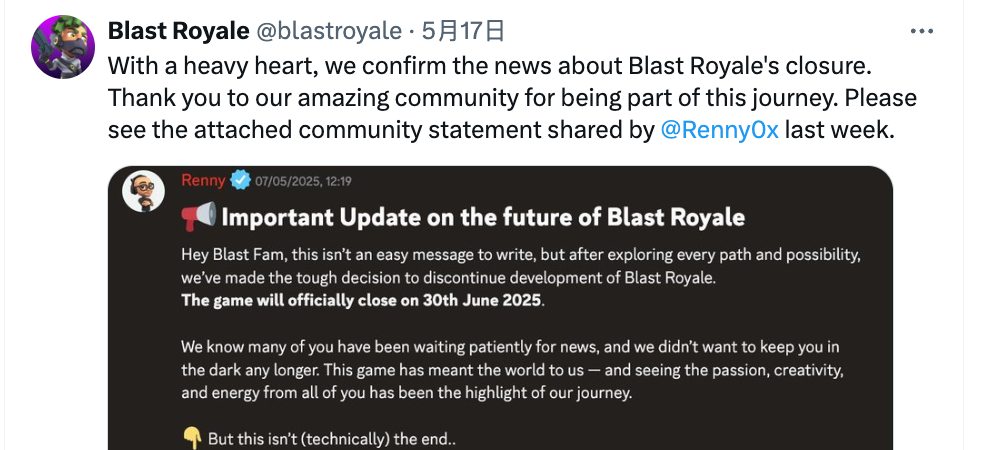
Blast Royale was a mobile battle royale game built on Polygon, featuring fast-paced 6-minute matches and a P2E model. In April 2022, it raised $5 million via ICO, with investors including Dragonfly Capital and Mechanism Capital.
The game attracted early users with its lightweight gameplay but never achieved broad breakthroughs. In May 2025, developer First Light Games announced it would terminate development due to "internal review," with full operations ceasing on June 30.
The Walking Dead: Empires: Even IP Power Fails
A survival MMORPG developed by Ember Entertainment and published by Gala Games, based on the popular TV series The Walking Dead, incorporating NFT ownership mechanics.
Though exact funding wasn't disclosed, backed by Gala Games' financial support and strong IP appeal, the open test lasted over a year, drawing fans to build bases and engage in combat. However, in May 2025, Gala Games announced the project would end on July 31 due to "comprehensive considerations."
The Mystery Society: A Flash in the Pan for Detective Gaming
Created by former Disney and Club Penguin team members, this Web3 social deduction game raised $3 million in a seed round in September 2024, led by Shima Capital. Praised for its community-driven approach and innovative mechanics, it attracted active players during early testing. However, on February 25, 2025, developer Great Big Beautiful Tomorrow announced development suspension due to "industry challenges and insufficient funding."
We’ve compiled a table summarizing these blockchain games that have announced shutdowns or development halts.
It's clear these games mostly secured solid funding in the previous cycle and uniformly adopted mechanisms combining NFTs and tokens with in-game consumption.
Despite heavy backing from top-tier VCs, they still couldn’t escape failure.
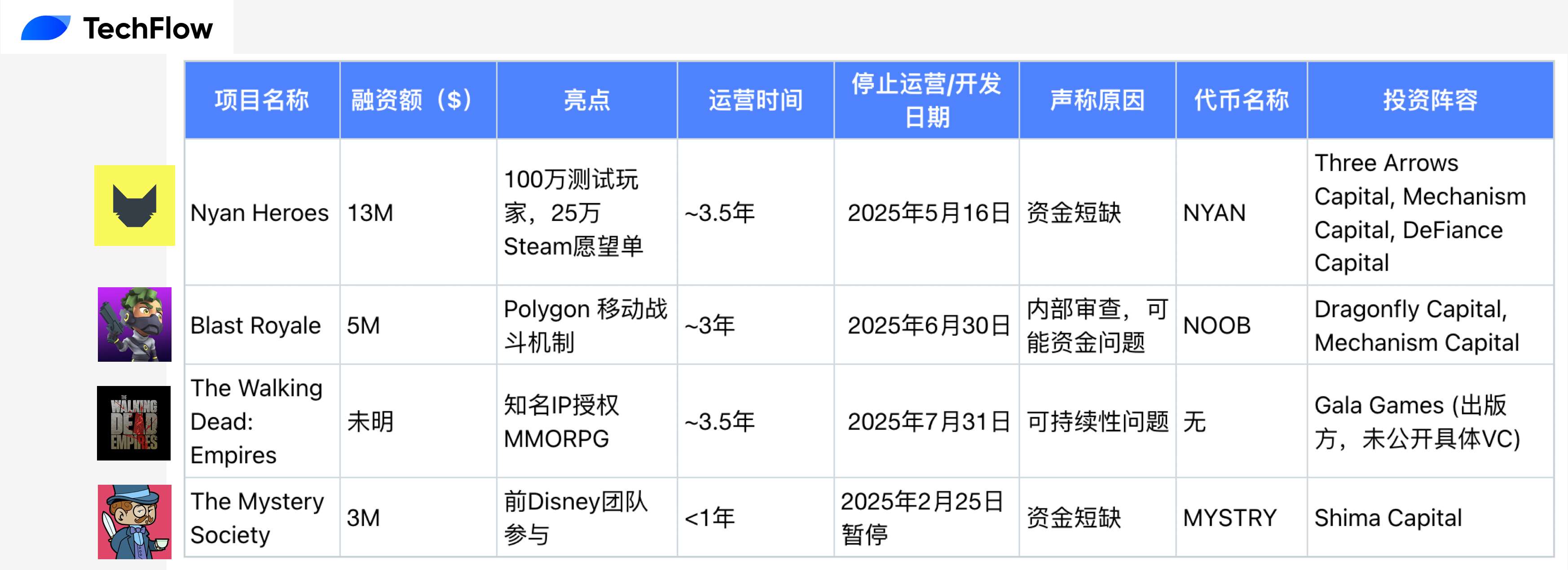
Beneath the surface, player attrition, imbalanced P2E models, and misaligned priorities between asset design and actual development were the real drivers. They boasted fundraising achievements and grand visions, yet delivered few playable products.
There’s also an unspoken industry norm: the product itself isn’t the focus—nobody really intends to play these games. A genre that should compete on creativity and content density instead faces off against grinders chasing quick gains with sheer stamina and money-sense—the outcome is obvious.
Rise and fall: risen on funding, fallen on gameplay.
Genetics Determine Destiny
You may have noticed the irony: the reason these blockchain gaming projects cite for shutdown is almost always—"funding shortage."
Almost every halted blockchain game publicly attributes its demise to lack of funds, claiming they couldn’t build a high-quality game.
Are these blockchain games truly short on money? From a pure game development standpoint, perhaps not.
Take Nyan Heroes, which raised $13 million. Regardless of game quality, what does $13 million represent?
Forget top-tier AAA titles—for comparison, the seventh installment of the renowned domestic single-player IP "Chinese Paladin" reportedly cost 67 million RMB (~$9.3 million) to develop. That means if Nyan Heroes had spent all its funding solely on development, it could have easily produced something on par with Chinese Paladin.

International examples are even more striking.
The acclaimed farming sim Stardew Valley was developed single-handedly by Eric Barone over four years with only about$50,000 in costs. Released in 2016, it has sold over 30 million copies worldwide, becoming an indie legend.
Visually, it’s not far off from some blockchain games that raised millions.
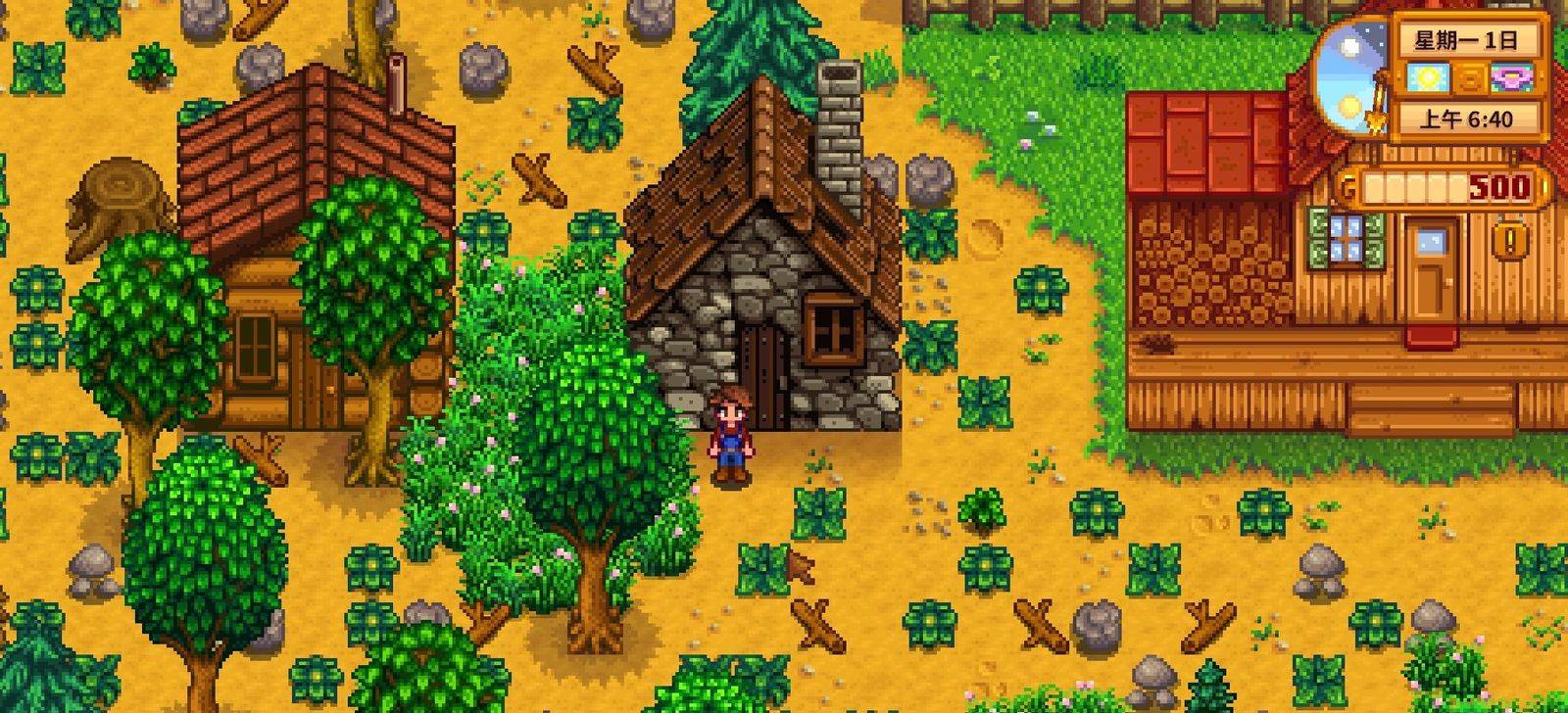
This shows that games are products where creative quality and content density matter most—just one person and $50,000 can triumph through innovation and gameplay.
In stark contrast, numerous blockchain games now claim "insufficient funds" and halt development—making the difference clear: funds are always insufficient—especially when there's no intention to spend them on actual game development.
The very genetics of blockchain gaming prevent it from following traditional game industry paths toward high quality and meticulous craftsmanship. Instead, it resembles a resource scheme or capital pool, requiring carefully designed operational rhythms and investment rules to satisfy various primary and secondary market investors.
Fund first, build later has become the optimal strategy in this space—whether anything actually gets built is secondary.
Compare this to traditional game success stories, which often follow the opposite path: build first, fund later.
For example, Black Myth: Wukong only had a few scenes designed in 2020. After releasing demo clips that amazed players with their quality, it proved its potential and secured subsequent funding.
Meanwhile, domestic rising stars like Genshin Impact and Honkai: Star Rail adopt phased development and iterative releases, introducing new storylines and characters with each update. As players feel immersed and pay for characters, the developers gradually accumulate capital to build more content.
These games place content at the core—story, art, and mechanics take precedence—while funding plays a supporting role, not the goal. Web3 and traditional gaming are nearly polar opposites, with speculation embedded in their DNA:
Players as investors, games as Ponzi schemes—diametrically opposed to the patience and craftsmanship required by great games. The path of "fund first, game later" has proven to be a dead end.
The rise and fall of blockchain gaming is an inevitable result of misalignment between industry genetics and user needs. Capital and hype can generate short-term buzz, but cannot sustain a truly vibrant gaming ecosystem long-term.
As more and more games are proven unsustainable, the wave of shutdowns may ultimately lead to a purification—separating truth from fiction—and that might be something worth looking forward to.
Join TechFlow official community to stay tuned
Telegram:https://t.me/TechFlowDaily
X (Twitter):https://x.com/TechFlowPost
X (Twitter) EN:https://x.com/BlockFlow_News
 深潮TechFlow