Web3 games need outliers to achieve longevity and a sustainable future: Seraph gave me the legitimacy to keep playing Web3 games
TechFlow Selected TechFlow Selected
Web3 games need outliers to achieve longevity and a sustainable future: Seraph gave me the legitimacy to keep playing Web3 games
If you can't earn, treat it as an extension of years-long gaming habits; if you can earn, then justify the so-called "time not worth spending" on games.
 Navigating Web3 tides with focused insights
Author: TechFlow
Recently, blockchain games seem to be out of sync with the broader crypto market trends.
Each wave of hype creates its own set of star projects. Yet after peaking two years ago, blockchain gaming has gradually faded from public attention—so much so that there's now a growing trend of "fear at the mention of blockchain games." What exactly went wrong with this sector?
Short-lived—that’s the stereotype already formed in users’ minds about blockchain games:
From early Ponzi schemes and rug-pull “doggames” to today’s microgames where clicking earns money and token listing marks the peak…
In stark contrast, certain non-blockchain franchises outside the crypto space have demonstrated remarkable longevity:
Take the *Diablo* series—an iconic symbol in ARPG loot-driven gameplay and proof of enduring game design. This IP has thrived for nearly 30 years; if you follow Elon Musk on Twitter, you’ll often see him livestreaming his playthroughs of *Diablo IV*.
And from it emerged an entire genre—Diablo-like—a vibrant category of imitators and innovators alike: *Path of Exile 2* is about to launch, and *Titan Quest 2* is also on the way…
These are IPs aged 10 to 20 years, each with sequels—why can they iterate repeatedly and maintain loyal fanbases?
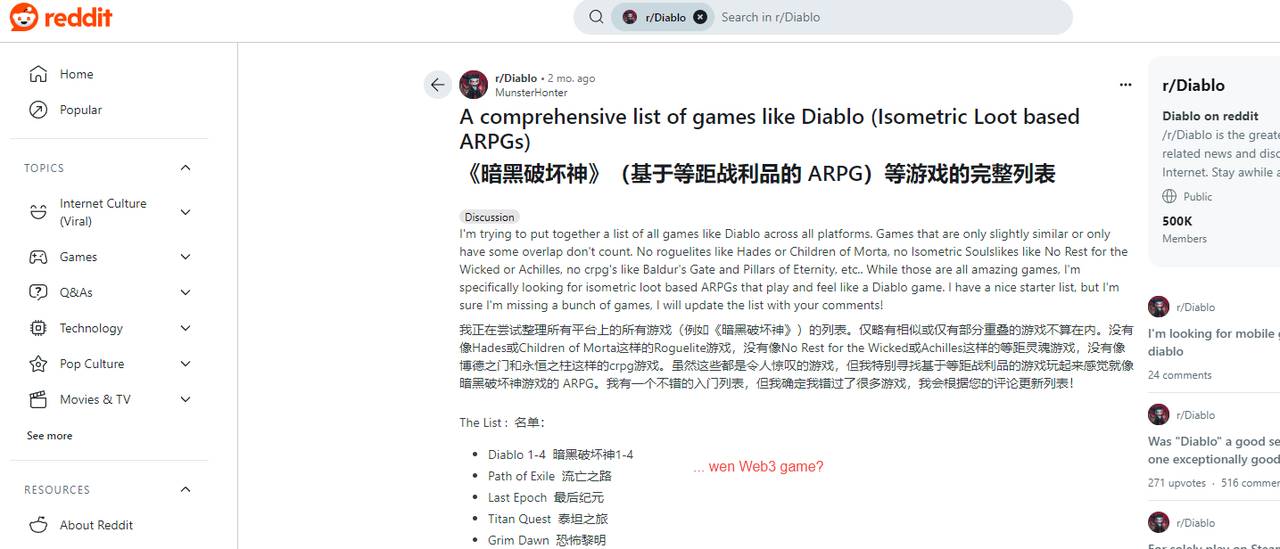
Overseas Reddit forums even feature dedicated lists of Diablo-like games—when will a Web3 title finally appear on one?
With short-lived blockchain games on one side and long-standing IPs on the other, could there possibly be a “contrarian” success story within blockchain gaming?
As someone who started playing *Diablo II* at age 10 and is now a middle-aged veteran player and crypto industry worker, I deeply hope to see a true Diablo-like loot-chasing game emerge from the blockchain gaming space.
Currently, Seraph stands out as the leading contender.
Coincidentally, the game launched its public test server (PTR) on October 17. After eagerly diving into gameplay, a clear feeling arose:
Seraph gave me the “legitimacy” to keep playing blockchain games.
As work and life pressures grow, playing games feels like a luxury indulgence—a waste of time. But Seraph manages to preserve the authentic Diablo feel while avoiding aggressive token sales, frantic gold farming, or forced NFT speculation, giving me a legitimate reason to keep playing:
If I can’t earn, it still extends my long-standing habit of playing loot-based games; if I can earn, it justifies what was once considered “wasted time.”
What I truly desire is a state where earning isn’t the primary goal—but rather a pleasant bonus. A rewarding surprise that comes after preserving the joy of habitual gameplay.
For those under life’s pressure yet still wanting to play, having both hardcore entertainment value and earning potential grants legitimacy—not because you must play-to-earn, but because in a life rhythm dominated by making money, if playing can also generate income, why not give it a try?
If you're curious how the game is evolving, what gameplay features stand out, and what potential rewards exist,
then press the login button and embark on this journey of discovery.
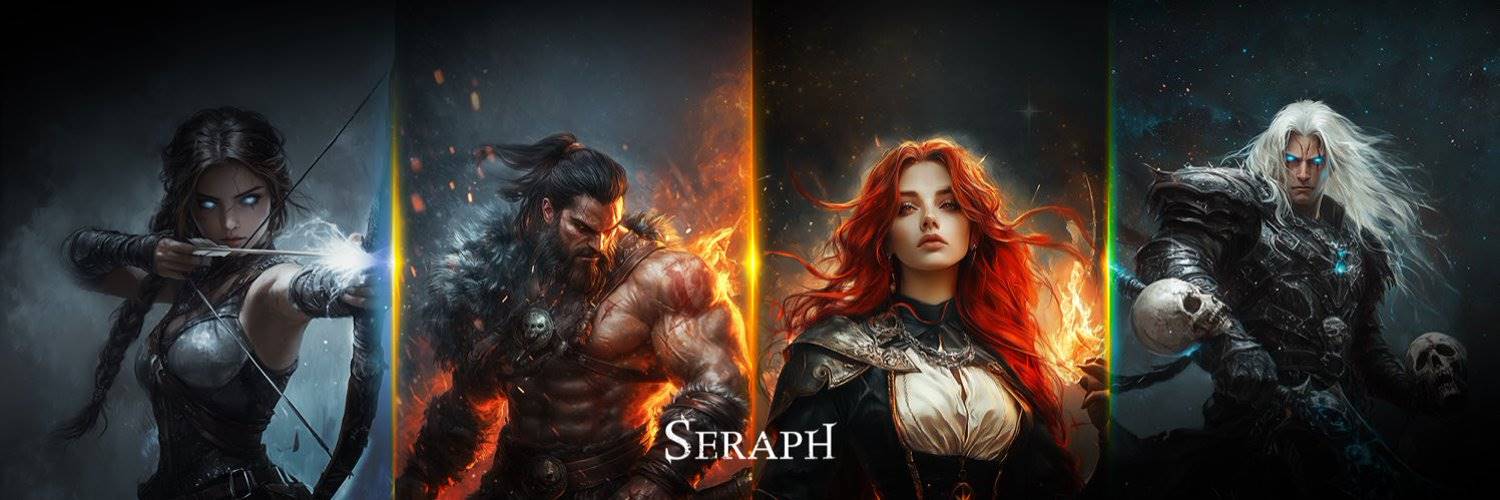
“Loot Grinding”: An Infinite Game of Growth and Surprise
If you’re busy and active in crypto, what would motivate you to try a new blockchain game?
I believe the motivations boil down to two:
First, a non-gamer mindset—focused solely on earning, indifferent to actual gameplay.
Second, a gamer mindset—drawn by familiarity with past experiences, thinking, “This feels familiar, might as well give it a shot.”
Thus, the threshold for convincing crypto-natives who still retain some “gamer spirit” often hinges on classic gameplay mechanics:
Trying entirely new genres is hindered by inertia and limited energy. Therefore, offering familiar, proven mechanics becomes a more persuasive path to attract players.
And Seraph’s core gameplay is as classic as it gets—it mirrors *Diablo* itself: Loot grinding.
Whether you personally find a mechanic “classic” doesn’t matter—the market and sales figures determine what truly endures.
From *Diablo I* in 1996 to *Diablo IV* today, loot-grinding has persisted for nearly three decades, amassing a devoted following and even spawning the Diablo-like genre.
What is loot grinding?
It means leveling up your character, continuously acquiring better gear, strengthening yourself, tackling harder content, obtaining superior equipment, and repeating the cycle endlessly…
Why does this repetitive loop captivate people—even busy individuals like Elon Musk?
A key reason lies in the fact that in these games, you never know what legendary item you’ll get next.
Curiosity and unpredictability are the best antidotes to repetition.
Upon first glance, *Seraph* will thrill any *Diablo* veteran. Its character design, art direction, UI, gear system, and progression structure all closely follow in *Diablo*’s footsteps;
The *Diablo* essence is strong—characters, visuals, and overall style evoke nostalgia and that comforting sense of “youth returned.”
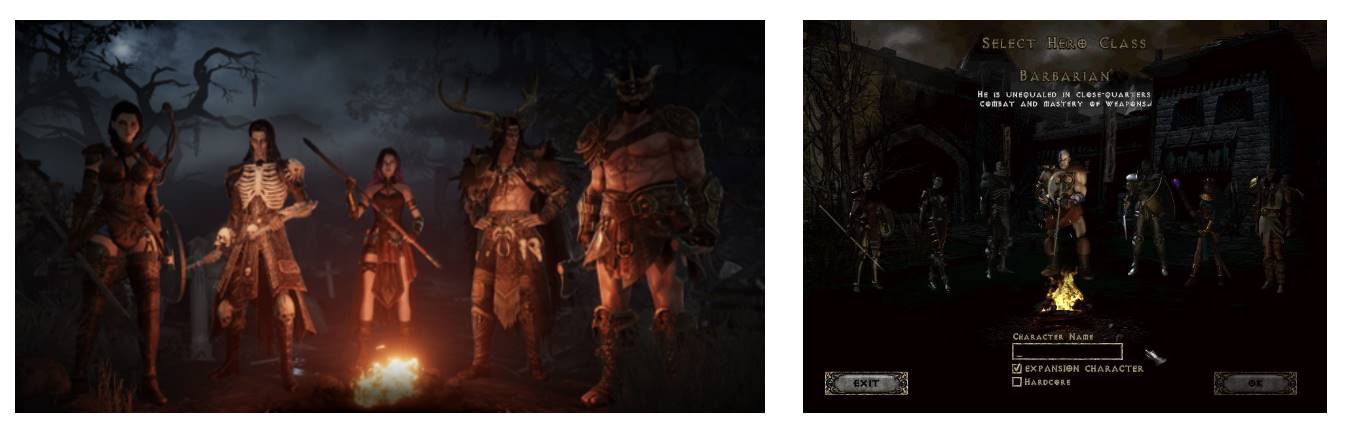
Image: Left – Seraph character selection screen; Right – Diablo II character selection screen
Gameplay-wise, the classic mix of melee/ranged classes and customizable skill builds allows *Diablo* veterans to jump right in;
By selecting a starting character and customizing their build, players embark on an adventure of growth and upgrades, gradually acquiring better loot along the way.

Players familiar with Blizzard’s *Diablo* and *Warcraft* series will instantly recognize the progression design:
-
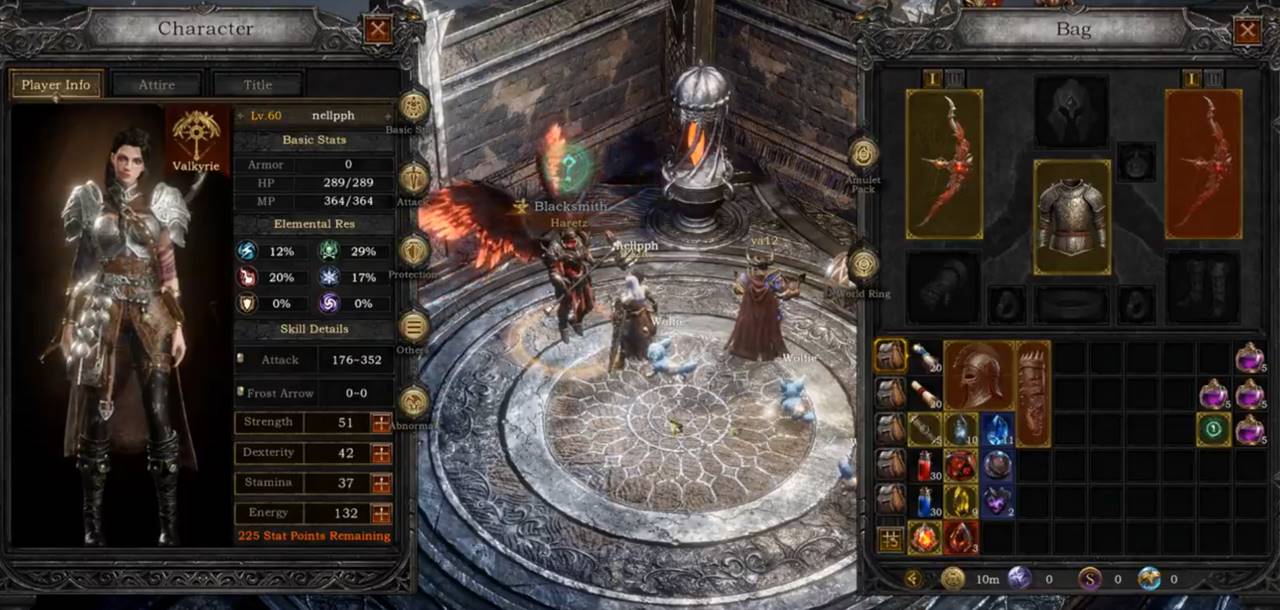
Levels 1–60: Early game focused on experiencing the story and learning character abilities and skills;
-
Level 60+: The “new beginning” (similar to *Diablo* and *World of Warcraft*), marking the start of serious loot hunting—obtaining better gear and diving into the core grind loop.
Beyond this, seasonal updates led by operations bring fresh content.
Each season lasts 4–5 weeks, introducing different gear bonuses, new items, and unique challenges. In short, “same ingredients, remixed dishes”—offering varied loot-grinding fun across seasons.
While traditional Diablo-like games typically reset completely each season, Seraph introduces an innovative semi-wipe seasonal system (retaining NFTs and certain paid tiers). This aligns well with gameplay while optimizing the Web3 economic cycle.
We can thus summarize Seraph’s core gameplay:
BD (building a character build) + Loot grinding (acquiring gear) + Seasons (repeating BD and loot grinding under different themes)
Why is this fun? Let me emphasize again:
First, the thrill of surprise.
In late-game loot grinding, maps are procedurally generated, drops are randomized, and item stats vary randomly. This constant uncertainty creates genuine excitement—you never know what amazing piece of gear you’ll find next.
Second, a sense of progression.
Effective loot grinding requires smart skill combinations and thoughtful build planning. Experimenting with available gear and abilities to optimize your character delivers satisfying feedback—from “I can’t do this” to “Wait, I actually pulled it off!”
Throughout the experience, you’ll notice mature, time-tested Web2 game design principles. If you’re familiar with similar Web2 titles, the learning curve is minimal.
So, how far has Seraph come currently?
In terms of development pace, the PTR test season is live and open to all (click here to download), supporting both PC and Android devices;
In data performance, it ranked third among active applications on BNB Chain last week, first in gaming category, with over 1.5 million on-chain user visits and more than 1 million active wallets in the past 30 days;

From a login and usability perspective, the game integrates an ActPass account and asset management system. With just an email or username login, it abstracts away complex crypto wallet and private key management through built-in MPC wallets, creating a model where you play inside Seraph, manage assets and trades via ActPass—a main game paired with a handy companion tool.
Finally, in user perception, you wouldn’t even guess it’s a P2E chain game—mainstream Web2 game accelerators even support Seraph to prevent disconnections. When have you ever seen a blockchain game supported by such tools?

When “loot grinding” evolves into an infinite game of growth and surprise, why not give it a try?
Another critical factor influencing whether you’ll try it: How exactly does earning work in Seraph?
“Earning”: A Rare Case of Thematic Consistency
When discussing earning, most crypto users today are exhausted.
Where does this fatigue come from? Simply put: thematic inconsistency.
What does thematic inconsistency mean? Most current Web3 games feel artificially monetized—they tack on an optional, tacked-on earning layer atop otherwise unrelated gameplay. Remove that earning component, and the game remains largely unaffected.
Therefore, in most cases, earning plays no essential role thematically.
Users intuitively sense this irrelevance. Once a game becomes purely about earning, the gameplay itself becomes just a superficial shell. At that point, it hardly matters what kind of game it is.
And this shallow facade directly contradicts the fundamental nature of games as products.
Games are interactive, content-rich experiences designed to evoke emotion. They suffer when reduced to mere facades. Earning in unengaging games inevitably leads to imbalance and eventual burnout.
Is there a type of game where earning feels naturally integrated—where earning is the core objective?
In games like Seraph and other Diablo-like loot grinders, the issue of thematic dissonance is largely resolved:
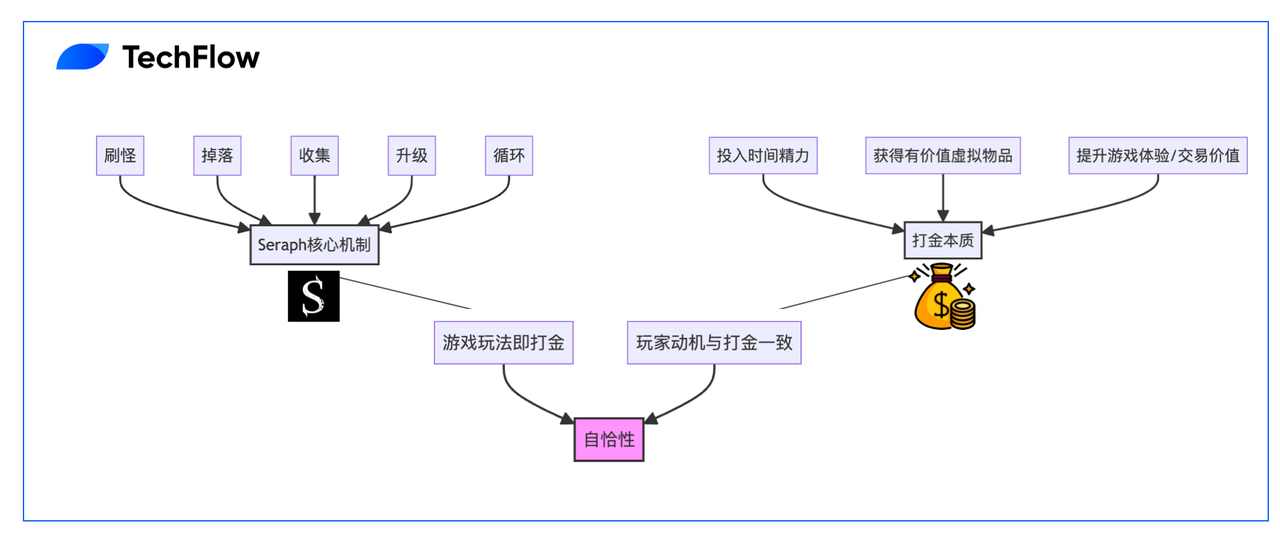
Step back from blockchain for a moment—aren’t Diablo-like games fundamentally about looting and collecting gear?
That’s essentially what earning is—just without blockchain-enabled tradability.
Leveling up your character feels great; finding rare loot feels even better. Every mechanical action serves the ultimate goal of obtaining valuable items—a motivation validated by 20 years of traditional Diablo-style games.
Now, when that loot moves from off-chain to on-chain, it doesn’t suddenly feel “greedy.” It simply means the items you earned in your regular gameplay are now NFTs—with greater scarcity, satisfaction, and tradability.
Even without NFTs, many Web2 Diablo-like games feature robust trading markets. Even when in-game currency can’t be traded officially, gray markets exist, complete with speculation. The genre inherently supports earning mechanics.
Because the game’s sole purpose is “loot hunting,” bringing that loot on-chain enhances the experience—it’s icing on the cake, not a structural overhaul.
Specifically, how does Seraph implement earning mechanics?
Mirroring the main gameplay flow, Seraph adopts a tiered approach to guide players from entry to earnings:
Familiarize → Obtain Entry Ticket → Evaluate ROI
First, levels 1–60 involve standard gameplay—earning in-game gold, leveling up, mastering skills, and gradually acquiring basic gear and currency. None of this involves NFTs or on-chain assets. Think of this phase as the necessary investment to learn the game’s mechanics.
After level 60, players may choose to pursue on-chain earnings—or opt out. However, skipping this step means missing out on core endgame content.
To participate in on-chain earning, players need an “entry ticket,” provided in two forms:
-
Equipment: Chaos Treasures—NFT-formatted gear. Owning one grants a “gear entry pass” to begin earning. Available for purchase on the ActPass NFT marketplace or in-game markets using real funds—essentially the startup cost for earning.
-
Resource: Soul Crystals—consumable in-game resources. Earned by wearing the above Chaos Treasure gear and completing specific challenges.
-
Value as Embodied Labor: Since Soul Crystals require time and effort to obtain, they justify the value of subsequent NFT loot drops—rare gear is “earned through grinding,” reflecting both labor and scarcity.

With these prerequisites secured, players begin the earning journey by consuming Soul Crystals and equipping Chaos gear. A simplified process follows:
First, equip Chaos gear and consume Soul Crystals to enter exclusive earning zones—the Chaos Dungeons, akin to *Diablo*’s Greater Rifts. Each run consumes durability from your gear and depletes crystals, meaning every attempt carries a cost;
Upon completing a dungeon, players receive various chests containing powerful NFT gear or NFT fragments, which enhance their capabilities further.
Since the core loop revolves around upgrading gear to farm better loot, high-tier equipment naturally gains market demand—either for resale profit or self-improvement to boost future earning efficiency.

Due to space constraints, we won’t delve into specific gear utilities, market prices, or detailed ROI calculations here—interested readers should consult specialized farming guides.
In summary, after experiencing both earning and non-earning aspects of Seraph, I believe it genuinely delivers a blockchain-native *Diablo* experience—enabling Play-to-Earn within an enjoyable loot-grinding framework.
To chase better loot, you must commit to the earning path—NFT gear offers superior stat boosts. Repeated grinding for better gear aligns perfectly with classic Diablo-like gameplay, requiring no cognitive adjustment.
Truly a dream come true for loot enthusiasts—grind hard, maybe even make money.
However, it should be noted that earning involves upfront costs. Chaos Treasures are relatively expensive compared to typical Web2 game items, requiring careful cost-benefit analysis.
Current Opportunities: Test Season Activation Codes + Enyu Airdrop
Currently, Seraph’s PTR test season launched on October 17. Interested players can visit here to download the game. Notably, this season is open to all players;
Additionally, Season 1 is即将开启. PTR seasons generally serve as low-cost training grounds—use the free starter gear to learn earning mechanics and rules, preparing yourself for smoother sailing in the official season.
Access requires an activation code, with only 600 distributed daily via email registration. Successful registrants will receive codes to enter the game.
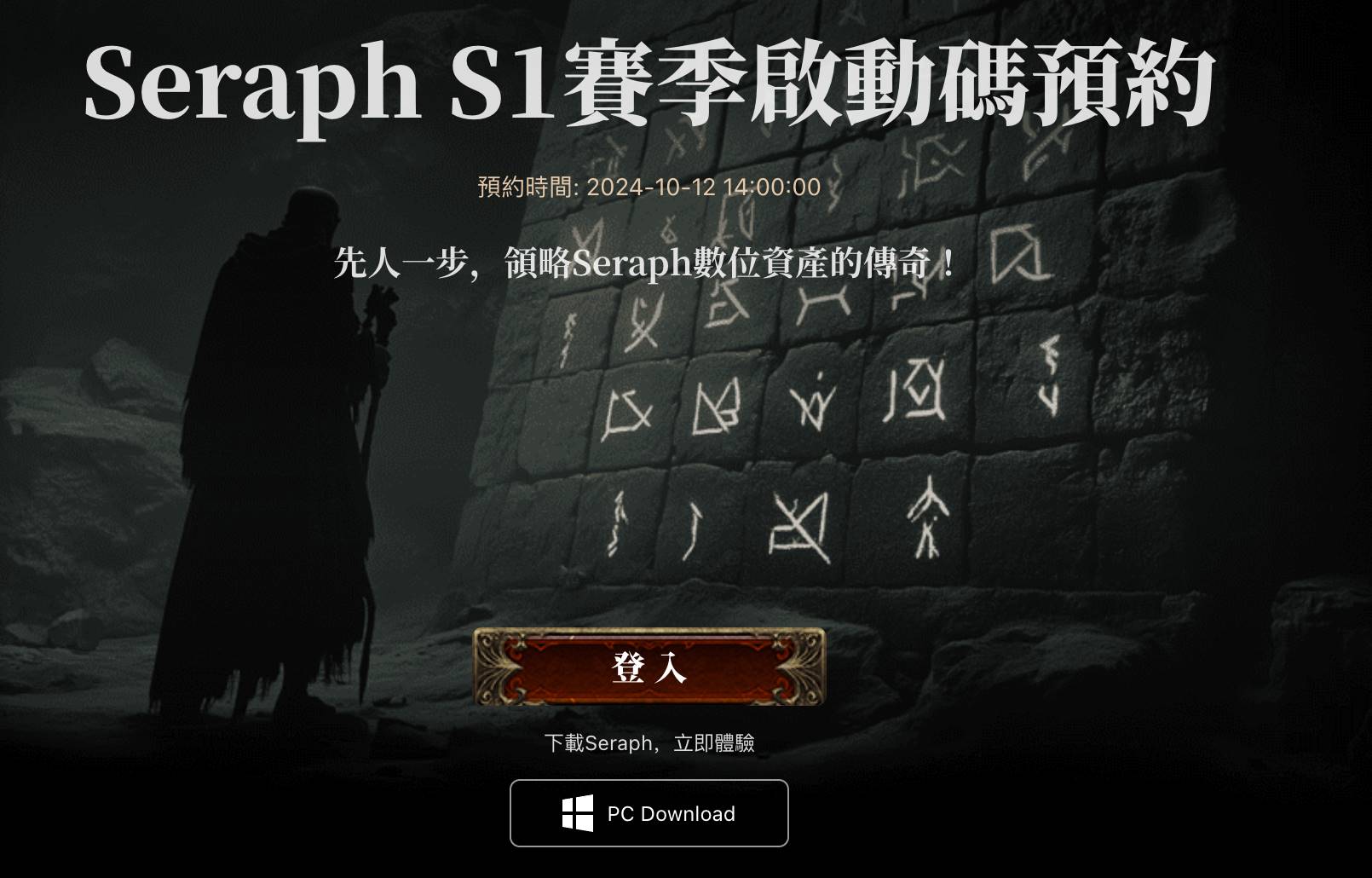
Regarding airdrops and token expectations, although Seraph hasn't announced a TGE date yet, the concurrent RUSH Season 1 event allows players to complete tasks, earn points, and enter raffles to win “Enyu.”
These Enyu tokens can later be redeemed for $SERAPH. Players can visit the event page to claim Enyu treasure boxes via point-based raffles.
Enyu can be immediately minted into NFTs—players may choose to trade or hold them in anticipation of future token airdrops. All activities, including Enyu minting, are managed through the aforementioned ActPass wallet.

Blockchain Gaming Needs Outliers—Longevity Is the Future
Finally, during this supercycle of rampant Meme coin growth, discussing blockchain games feels somewhat out of place.
In this bull run, you’ve likely seen countless Memes and meme-inspired microgames. They peak at launch, fade after airdrops, and often exist solely to inflate valuations for exchange listings.
Within this trend, emphasizing gameplay quality and replayability makes you an outlier.
Games are a mature industrial product category—and should bring joy for the time invested. Today’s trendy microgames often fail to meet the original intent behind game design.
As entertainment products, blockchain games need outliers—if we care about the health of the industry. Some projects must step forward to prove sustainability—not driven by short-term airdrop hype, but by solid game mechanics enabling longevity.
Titles like Seraph and other Diablo-inspired games may possess this potential—new seasons always attract grinders, new gear and completion mechanics keep players engaged… Just like how fans declare *Diablo* dead every few years yet millions keep playing. Achieving lasting relevance with earning mechanics no longer seems impossible.
If they survive into the future, games like Seraph can leverage blockchain to grant players true ownership of gear and expand trading possibilities—preserving the best while discarding the worst;
For individuals, being able to earn while enjoying gameplay provides legitimacy, especially for aging players seeking justification to keep playing. Such genres deserve a chance.
And the spending power, knowledge, and attitudes of these users could influence perceptions both inside and outside the crypto world.
Worth a try—play and observe.
Join TechFlow official community to stay tuned
Telegram:https://t.me/TechFlowDaily
X (Twitter):https://x.com/TechFlowPost
X (Twitter) EN:https://x.com/BlockFlow_News
 深潮TechFlow