Entretien avec le fondateur de Kravata : les secrets d'une entreprise de stablecoin venue d'Amérique latine
TechFlow SélectionTechFlow Sélection
Entretien avec le fondateur de Kravata : les secrets d'une entreprise de stablecoin venue d'Amérique latine
Le véritable concurrent n'est pas une autre entreprise similaire, mais l'argent liquide et le marché informel.
 Dédié à des analyses Web3 approfondies
Source : Zhiwuyan
Opening Note
Overnight, stablecoins have become the talk of the town. What exactly are stablecoins, and could they disrupt the traditional financial system?
Stablecoins aren’t some sudden fad, but rather a giant that has grown steadily alongside the industry. It’s only recently, catalyzed by regulatory developments such as the passage of the U.S. GENIUS Act and the public listing of Circle—the issuer of the regulated stablecoin USDC—that they’ve stepped into the global media spotlight.
Thus, Hazel and her co-host Ivy launching this podcast on crypto payments, Zhiwuyan OurTwoCents, is far from impulsive. At this pivotal moment, we firmly believe history is turning a corner. From niche experiments to essential elements in daily life worldwide, in the coming years we will witness blockchain truly rewriting global payment rules, giving birth to several unicorn companies in the payments space, enhancing the efficiency of global value transfer, and providing financial tools with global reach to populations ignored by traditional banks.
Beyond payments themselves, we’ll also explore adjacent areas like RWA (real-world assets), AI Agent payments, and other emerging innovations. In short, we aim to focus on the intersection between crypto and the real world—where stablecoins are undoubtedly a key medium.
Hazel and Felipe first met at a think tank conference in Moscow. Due to sanctions, Visa and Mastercard were unusable within Russia, giving Hazel—a Chinese national living in Europe accustomed to seamless payments—a firsthand experience of what it means to be “unbanked.” Yet, this is the daily reality for many across Africa, Latin America, and Asia. Felipe founded Kravata after recognizing the transformative potential of stablecoin payments in a country where less than 50% have bank cards and fewer than 10% hold credit cards—and across an entire continent facing similar challenges.
1. Episode Introduction
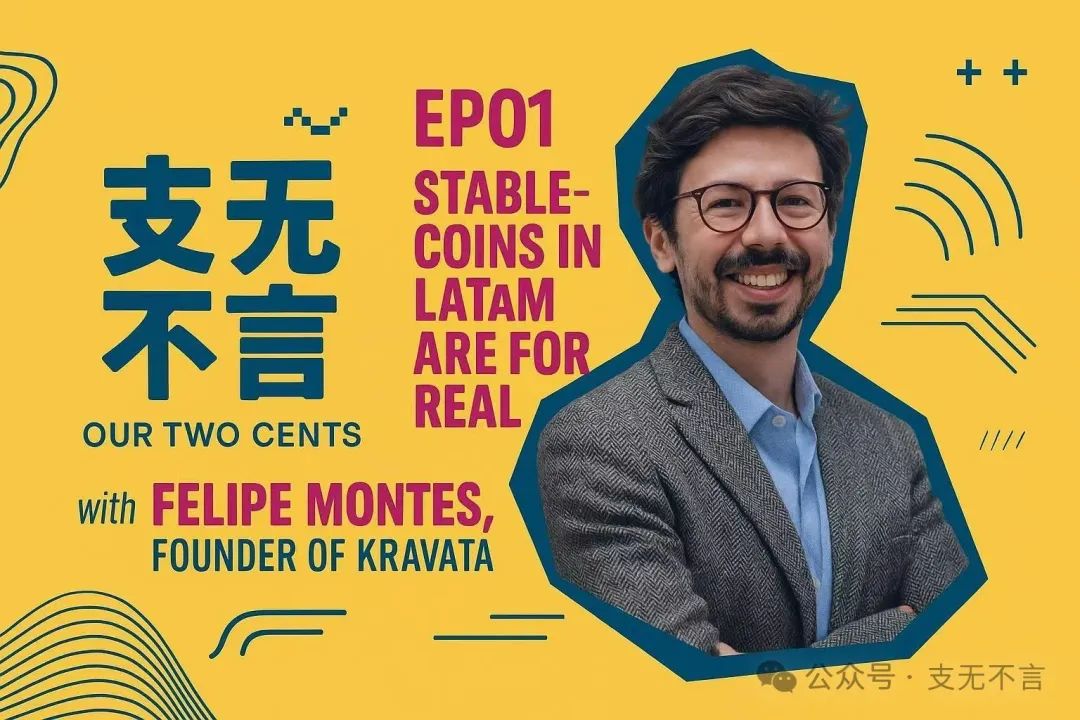
In this debut episode, we welcome Felipe Montes, founder of Kravata, a stablecoin payment company based in Colombia, to dive deep into Latin America’s payment ecosystem and what Kravata is building.
Kravata.co is a Colombia-based fintech headquartered in Bogotá, operating across Latin America to provide fiat-to-stablecoin exchange and payment services. Earlier this year, it raised $3.6 million in seed funding, with investors including Circle Ventures—the venture arm of Circle, issuer of the compliant stablecoin USDC.
The podcast Our Two Cents explores new frontiers in payments and how blockchain is reshaping global finance. This is the first English-language episode of the series.
Guest: Felipe Montes
Founder of Kravata | X: @FelipeMontesJ
Felipe Montes is co-founder and CEO of Kravata, a Colombia-headquartered B2B payments-as-a-service (CaaS) company serving Latin America. He has been involved in crypto since 2013 and brings diverse experience from academia, government, and consulting.
Host: Hazel Hu
Lead of the podcast Zhiwuyan, with over six years of experience as a financial journalist, core contributor at the Chinese Public Goods Foundation (GCC), focused on real-world applications of crypto. X: 0xHY2049; Jike: Une Yue sans conviction
Host: Ivy Zeng
Co-host of Zhiwuyan, formerly worked in VC post-investment, discovered her passion for payments through pop-up cities, now leads growth for Latin America at a neobank. X: IvyLeanIn; Xlog: ivyheretochill
2. Latin American Market Context
Hazel: What is the current state of payments in Colombia? What are the most commonly used tools by individuals and businesses in daily life?
Felipe: Colombia has a population of 48 million, with over 50% unbanked, leading to widespread cash usage. Digital wallets are increasingly entering the market—Nequi and Daviplata (affiliated with the largest banks), for example, allow users to open accounts and transact using just a phone number. These are becoming the dominant payment methods. There's also PSE (Programa de Servicios Electrónicos), part of the ACH group, similar to the U.S. ACH system. PSE enables real-time bank transfers and currently handles about 32% of e-commerce payments, though primarily for deposits (cash-in), not withdrawals (cash-out). Credit card penetration is very low—under 10%—a regional trend across Latin America, although debit cards are used. A new government initiative called Breve is launching soon—an instant payment system enabling real-time interbank settlements for both cash-in and cash-out. Other methods include QR codes and mobile wallets, with roughly one-third of transactions already digitized via payment gateways.
Hazel: What are your observations regarding currency depreciation across different Latin American markets?
Felipe: A key characteristic of Latin American markets is thehigh fragmentation of financial systems. Each country operates its own system with distinct KYC rules, resulting in limited financial interoperability between nations. There is little liquidity directly between Latin American currencies; cross-border transactions typically require conversion into USD first—often via U.S. correspondent banks—before converting into the target currency. This multi-step process involves multiple intermediaries.
One major reason for adopting stablecoins is simplification: reducing the process to two steps—on-ramping local fiat into stablecoins, then off-ramping them into another fiat using local liquidity.
Another critical driver is hedging against currency depreciation. For instance, over the past decade, the Colombian peso has depreciated by more than 50% against the dollar—from 2,000 pesos per USD in 2014 to around 4,170 today. People need alternative savings vehicles, especially since USD-denominated bank accounts are largely unavailable in most Latin American countries. Converting into stablecoins like DAI, USDT, or USDC via on-ramp offers a viable solution. While physical USD cash can be purchased locally through exchange houses, it's difficult to spend domestically. Stablecoins offer usability and ease of transfer or off-ramp redemption.
In Colombia, large inflows of USD from exports and remittances create an oversupply relative to demand. Official exchange rates through banks are settled with the government. However, unofficial physical USD from remittances and exports does not go through this channel, trading at prices 2–3% lower than official rates. This is essentially the inverse of the "kimchi premium." It creates an arbitrage opportunity in crypto: individuals buy stablecoins peer-to-peer below the official rate, convert them to USD on exchanges, then wire the USD back through official channels, netting a 1–2% profit after costs.
Regarding cost of living, while 1 USD equals ~4,000 pesos, its purchasing power in smaller cities may feel closer to 1,000 pesos compared to the U.S. Prices in major cities are rising due to gentrification driven by foreign residents. A Big Mac costs about 5 USD. The minimum wage is approximately 400 USD/month. Earning over 4,000 USD/month places you in the top 1%. Despite high inequality (ranked 7th globally), Colombia is also considered one of the happiest countries in the world.
Currency depreciation is a widespread trend across Latin America. Countries like Ecuador and El Salvador have fully dollarized. Uruguay is smaller, wealthier, and more stable. Argentina faced over 276% annual inflation in 2023. In Venezuela, the bolívar is increasingly sidelined in favor of USD (via U.S. accounts like Zelle), stablecoins, or physical cash. Even stronger economies like Mexico and Brazil have seen around 20% depreciation over the past decade. The pandemic exacerbated economic stress, and monetary expansion by governments intensified depreciation. The U.S. dollar is widely viewed as a hedge and store of value—akin to gold—but stablecoins add the advantage of usability.
3. Kravata’s Business Model
Hazel: What is Kravata? Could you walk our listeners through the user journey? For example, if I’m a merchant in Latin America receiving USDC, how does the full process work?
Felipe: Kravata is an infrastructure company offering APIs that enable any app, super app, banking platform, digital wallet, or business portal to provide stablecoin-based services to their end-users.
For companies needing cross-border currency exchange, they can access Kravata via web app or API to convert between stablecoins and fiat, or even conduct fiat-to-fiat conversions—using stablecoins as an intermediary layer.
Another model is third-party payment capability. A company in Mexico wants to pay a partner in Colombia but lacks a local account or expertise. They send Mexican pesos to Kravata, which then pays the recipient in Colombian pesos. Behind the scenes, Kravata converts the pesos into stablecoins (on-ramp), then converts them back into local currency (off-ramp).
Recently, Kravata has focused on integrating its infrastructure into banks, super apps, and neobanks—entities interested in leveraging stablecoin rails but lacking the technical expertise or internal systems (due to compliance teams, legacy SWIFT channels, or overly localized operations). Kravata provides a widget that can be embedded directly into these platforms. Through this widget, users can convert their local fiat balance (e.g., Colombian pesos) into USD-pegged stablecoins, usually USDC. Later, they can off-ramp back into local currency. USDC is preferred because businesses view it as more compliant. Users can save in USD and off-ramp when the dollar strengthens, effectively locking in gains.
Kravata has also introduced virtual accounts. Users within an integrated app receive a U.S. bank account number and a European IBAN (International Bank Account Number), using their existing KYC data. This allows them to receive international wire transfers directly into their in-app USDC widget, granting the application cross-border payment and remittance capabilities. With received USDC, users can either make international third-party payments or off-ramp into local fiat. Kravata also issues a prepaid debit card funded with USDC, usable anywhere.
Additionally, balances in these accounts can be linked to yield-generating protocols. Returns vary based on agreements with the client (the host app)—from conservative options like Treasury bonds to higher-yield DeFi protocols (currently yielding 4% to 8–9% APY). Kravata takes a small cut but passes most returns to users, making the product more attractive. This represents the full suite of API services offered by Kravata.
Ivy: Does Kravata convert USDC into local fiat? How does the conversion process work? Do you partner with banks?
Felipe: Kravata supports various stablecoins and tokens, but maintains a close relationship with investor Circle. Its corporate entities in Colombia, Mexico, Chile, Poland, and the U.S. hold accounts with Circle. Kravata obtains licenses in jurisdictions with clear regulations and partners with third parties in less-defined ones to access liquidity.
In Colombia, Kravata primarily uses an internal liquidity ledger. Its B2B cross-border payments generate off-ramp demand, while the embedded widget solutions drive on-ramp demand (for savings). Kravata internally settles these flows—using USDC/USDT from off-ramp users to serve on-ramp users, and vice versa—reducing costs. When imbalances occur, Kravata engages banks for FX conversion. It can convert local fiat into USD and mint USDC as needed, or redeem USDC and perform local FX trades to replenish fiat reserves.
Kravata’s operations are built on four key pillars:
Compliance: A dedicated team handles KYC, KYB (Know Your Business), transaction monitoring, customer tiering, and blockchain analytics using algorithms.
Liquidity: An operations team composed of Python developers and neural networks manages settlement and identifies optimal exchange routes.
Custody: Offers segregated wallets for clients, with flexible pricing models based on AUM (assets under management), transaction volume, or active wallets.
Hyper-local Payment Methods: Enables cash-in/cash-out via API using traditional fiat rails across different countries. All products are built upon these models developed since 2022.
Ivy: Besides the Colombian peso, which other currencies does your on/off-ramp support? And which blockchains?
Felipe: Currently, Kravata supports USD, Mexican peso, Venezuelan bolívar, Colombian peso, euro, and stablecoins like USDC and EUROC. We enable all combinations of conversions between these currencies and stablecoins.
For stablecoins, USDT is supported on Ethereum, Tron, Solana, and Polygon. USDC is available across multiple chains.
Ivy: What are Kravata’s latest transaction volumes or annual on/off-ramp throughput?
Felipe: Over the past two years (2023–2024), Kravata has processed a cumulative $260 million in transaction volume. Our highest monthly volume exceeded $50 million, primarily driven by on-ramp and export-related services.
Ivy: You mentioned some clients are cross-border merchants. What types of businesses are they?
Felipe: Kravata initially served crypto-native clients—exchanges, OTC desks, and digital wallets—then expanded to traditional payment firms. Our end-users include companies engaged in service imports/exports (more than physical goods), payroll providers, franchises needing to transfer funds for fees (e.g., Visa/Mastercard charges), lending protocols raising capital internationally to lend locally, and food companies sourcing supplies across borders.
With the rollout of embedded widgets, we’re now integrating with banks, neobanks, and neo-brokers.
Overall, our client base spans four main sectors: crypto-native firms, fintechs, retail companies, and incumbent financial institutions.
Hazel: What are your primary revenue sources? How many employees do you have?
Kravata has 28 employees. Since early 2023, we’ve generated $2.2 million in revenue. Income comes from multiple streams within our infrastructure model:
- On-ramp and off-ramp fees
- KYC service fees
- Custody fees
- Virtual account fees
- Card fees
- Yield-sharing fees
4. Competitive Landscape
Hazel: We must discuss competition—payment spaces are fiercely competitive. Recently, Stripe opened stablecoin financial accounts, and Bridge is partnering with Visa. Does this concern you?
Felipe: Not at all. Our strategy is to collaborate with these large players, leveraging their technology while Kravata handles local execution. This business demands deep local expertise—navigating compliance, banking relationships, cultural nuances, corporate structures, and informal markets (which represent half the economy). Large foreign banks like Citibank and Scotiabank have struggled in Latin American retail banking, proving how hard it is to operate alone.
The real competitors aren’t other startups—it’s cash and the informal economy, where people store savings in physical dollars. That’s where the massive opportunity lies. Companies that understand this will thrive.
Kravata positions itself as middleware, helping banks and fintechs rapidly adopt stablecoin services. We enable clients to integrate stablecoin rails in six months or less—avoiding the years it would take to rebuild everything from scratch. We provide licenses, integration kits, channels, white-label solutions, compliance frameworks, and educational support.
Ivy: Beyond global players, let’s return to Latin America. What’s the current landscape for fintech and crypto payment startups in the region? Is the space crowded?
Felipe: There are fewer companies in this space than a few years ago. Initially, large exchanges like Bitso, Binance, Ripio, Mercado Bitcoin, and Buda dominated and are now expanding. Then came market makers and OTC desks serving crypto arbitrageurs and traders needing off-ramps. Starting around 2022, consumer apps focused on saving digital dollars (like DollarApp, Lithio) began gaining traction. Recently, major financial institutions and neobanks (e.g., Bancolombia partnering with Wibmo, Lulo Bank) have started embedding crypto features into their apps—signaling to regulators that crypto and stablecoins are becoming part of the financial fabric.
Kravata acts as middleware, allowing other financial institutions and fintechs to quickly integrate stablecoin services without extensive development cycles.
Hazel: All the systems we're discussing still rely on Visa and Mastercard, right? Will the entire system remain dependent on these legacy rails?
Felipe: To fully decouple from traditional systems, the entire supply chain must run on stablecoins—farmers paid in stablecoins, suppliers paid in stablecoins. Currently, conversion into fiat remains necessary because most countries’ regulations require traceability and mandate payments in legal tender. This ties into debates around local stablecoins and CBDCs.
Visa and Mastercard are likely here to stay. They’re already entering this space with systems like Visa Direct and B2B Connect, which use blockchain-like layers to transmit cross-border settlement data—even if not always using stablecoins.
However, in regions like Latin America, Southeast Asia, and Africa, there’s a vast market among the unbanked, informal economies, and cardless cross-border transactions. Stablecoins can play a transformative role here. As noted earlier, the true competitor isn't necessarily cards—it's cash.
5. Regulatory Environment
Hazel: What’s the local regulatory situation? For Kravata, what licenses are actually required to operate in Colombia?
Felipe: Local regulation in Latin America has evolved significantly since 2021:
- Brazil has comprehensive crypto legislation, with central bank support for blockchain initiatives.
- Chile enacted a fintech law offering financial intermediary and custody licenses—Kravata has applied for these. Chile is considered the most advanced in the region on regulation.
- Mexico passed an early fintech law including money transmission licenses and a registry for "vulnerable activities" applicable to crypto firms.
- Bolivia initially banned crypto but has since lifted the ban and begun regulating.
- Peru recently authorized its largest banks to custody and sell digital assets.
- Argentina is becoming more open to regulation.
- El Salvador offers VASP (Virtual Asset Service Provider) licenses, sought by many Latin American firms. Bermuda also offers various licensing options.
Generally, three types of licenses are relevant:
- Emission License: For issuing tokens or stablecoins.
- Fiat On/Off-Ramp (VASP) License: For exchanging between crypto and fiat.
- Money Transmission License: For payment services.
Kravata is pursuing the VASP and money transmission licenses. We are not applying for an emission license, as we focus on distribution and transmission—not issuing our own tokens.
Ivy: How do you build relationships with these financial institutions and regulators? They’re so different from web3.
Felipe: Building relationships in Web3 is often more open than in traditional finance. In banking, if you’re not part of the inner circle, open-mindedness and warm introductions are crucial. Kravata has advisors who are former bank executives. My prior role as Deputy Minister of Education helped me build connections with the head of the banking association and government officials—people who can facilitate referrals. Establishing trust requires face-to-face meetings, shared meals, and consistent engagement.
The key is demonstrating that the company is led by mature, business-savvy individuals who prioritize compliance and risk management—not just young tech developers. Compliance officers play a critical role in bank partnerships. Kravata sponsors and participates in risk and compliance events, sometimes collaborating with international organizations, positioning ourselves as a highly compliant local partner.
Banks often perceive new lines like crypto/payments as relatively small compared to their massive credit and lending operations. The challenge is convincing them that collaboration won’t jeopardize their core business. This requires demonstrating strong standards, robust compliance procedures, risk management frameworks, and solid SLAs. Building this trust takes time, but once achieved with a few banks, others are more likely to follow. Key milestones include embedding services into regulated neobanks and partnering with major traditional banks.
Hazel: What kinds of questions do they typically ask?
Felipe: Banks question everything. For example, they express concerns about the risks of holding USDC. This requires explaining USDC’s reserves, where the USD is held, audits by firms like Deloitte, and referencing trusted names like Bank of New York Mellon or BlackRock. Still, they often perceive it as high-risk.
You also need to educate banks on blockchain analysis. Many aren’t familiar with blockchain explorers. You must explain that blockchains aren’t anonymous, wallets can be blacklisted, and tools like Chainalysis and TRM Labs exist. Demonstrating Kravata’s compliance workflows is a frequent topic. Sometimes, banks even propose using Kravata as their compliance provider—but this would create a conflict of interest if we also handle their transactions.
6. Fundraising and Future Outlook
Hazel: You received investment from Circle. I know you also raised from IOSG, a Chinese crypto investor—familiar to many in China. How did you connect with them?
Felipe: I was introduced to the IOSG team through an angel investor from Angel Dao who had previously backed Kravata. After initial online calls, I had the chance to meet some of their team in person. I believe IOSG appreciated our explanation of why Web 2.5—embedding payment and savings services into existing apps—is the right path for Latin America today, as the market isn’t yet ready for complex Web3 activities like DeFi with MetaMask. They saw that Asian VCs value under-penetrated markets and capital-efficient growth models—both of which align with Kravata’s infrastructure approach and its solution to Latin America’s fragmented market. Their investment decision was fast—about one month.
Hazel: You’re also seeking Chinese or Asian investors for your next round.
Felipe: Yes, Kravata is actively targeting Asian investors for our next round. Two main reasons:
- Market Understanding: Asian investors deeply understand Latin America—many see parallels with Southeast Asia and can offer valuable insights based on regional experiences.
- Connecting Worlds: There’s enormous potential in linking commercial and financial flows between Asia and Latin America. Building these bridges is critical for the future.
Ivy: After closing your next round, what will be your top priority?
Felipe: The top priority will be embedding our widget into apps reaching around 100 million users across Latin America. The goal is to connect LatAm users to stablecoins through platforms they already use and trust.
Ivy: My final question: what advice would you give to Chinese crypto/fintech companies considering entering the Latin American market?
Felipe: Advice for Chinese companies entering Latin America:
- Find Local Partners: Essential for understanding the market, accessing infrastructure and channels, and navigating regulation.
- Understand Currency Volatility: Don’t copy Asian models blindly—study the drivers of local currency fluctuations.
- Focus on Infrastructure: Building in infrastructure may offer more long-term defensibility than B2C apps, which require deep consumer behavior insights.
- Clarify Market Strategy:
- If your strategy is cost-driven (common among Chinese exporters), you must understand the informal sector to access the real mass market.
- If pursuing high-value, high-quality offerings, you’ll need connections to reach affluent niche segments.
Build relationships first: In Latin America, personal connections are vital. Going solo is difficult—you need partners. With fewer established pathways, lobbying and meeting influential figures can be harder than elsewhere.
Hazel: Any recommended guests, projects, or questions you’d like us to explore?
Felipe: I have many questions about the Chinese market. I’m particularly curious how Alipay scaled and how its blockchain technology is applied in enterprise contexts. I feel Western markets don’t fully grasp these cases. I’d also recommend looking at other successful Chinese firms—not as large as Alipay but still important players, like Reap.
For Latin American guests, I suggest featuring those involved in local stablecoins, B2C apps (e.g., Lithio, DollarApp, El Dorado), and blockchain/API-based infrastructure providers.
Suggested future podcast topics:
- Growth of Chinese payments/fintech: How did Alipay and Reap succeed?
- How banks view stablecoins—in Latin America, China, Hong Kong. I wonder if Hong Kong mirrors Latin America, with only a few banks showing interest.
- How traditional corporations (large e-commerce, food, retail firms—akin to Walmart in Asia) perceive stablecoins: Are they willing to adopt? What tools do they currently use for treasury management? This insight can help identify ecosystem growth opportunities.
Hazel: It’s hard to say goodbye, but that concludes today’s conversation. Thank you, Felipe, for joining us and sharing your insights on Kravata and the Latin American crypto payments landscape. If you’re an investor building a LatAm crypto payments portfolio, or a project looking to enter the region, we hope this episode was helpful—and we welcome you to reach out. Contact details are available at the bottom of your screen.
Bienvenue dans la communauté officielle TechFlow
Groupe Telegram :https://t.me/TechFlowDaily
Compte Twitter officiel :https://x.com/TechFlowPost
Compte Twitter anglais :https://x.com/BlockFlow_News
 @PodOur2Cents