Cross-chain Oracle SupraOracles: The Future of Blockchain and Agriculture
TechFlow Selected TechFlow Selected
Cross-chain Oracle SupraOracles: The Future of Blockchain and Agriculture
Blockchain technology may not be a panacea, but it can help deliver information and resources to key agricultural stakeholders, and adopting this innovative approach could help address many of these challenges.
 Navigating Web3 tides with focused insights
By Yvaineye, SupraOracles
Blockchain Can Improve Supply Chain Sustainability for Farmers of All Sizes
Agriculture is one of the most important industries on Earth. Without it, meeting the food demands of a growing global population would be impossible. However, agriculture faces widespread and diverse challenges. This means innovation and transformation are essential if the industry is to continue satisfying consumer needs and delivering safe, nutritious food.
Challenges in agriculture include global hunger, climate change and global warming, global supply chain disruptions, resource and soil depletion, water scarcity, food waste, food quality control, and income insecurity for smallholder farmers worldwide.
Blockchain technology may not be a panacea, but it can help transfer information and resources into the hands of key agricultural stakeholders—potentially addressing many of these issues through innovative approaches.
Through its novel distributed ledger technology (DLT), blockchain can enable secure and accurate data sharing among governments, farmers, and nonprofit organizations. It can also offer innovative financial solutions via DeFi protocols, reducing costs and risks for small-scale farmers.
In this article, we will review some of the critical problem areas within today’s agricultural ecosystem while discussing potential blockchain-based solutions. Specifically, we’ll explore blockchain’s potential impact on:
1) Reducing world hunger by improving food distribution mechanisms
2) Enhancing agriculture by mitigating climate change
3) Reducing food waste through improved information sharing
4) Improving food quality through better supply chain management
5) Empowering smallholder farmers with cryptocurrency and blockchain
6) Providing crop insurance to protect small farmers from climate-related risks
Blockchain Could Help Reduce World Hunger
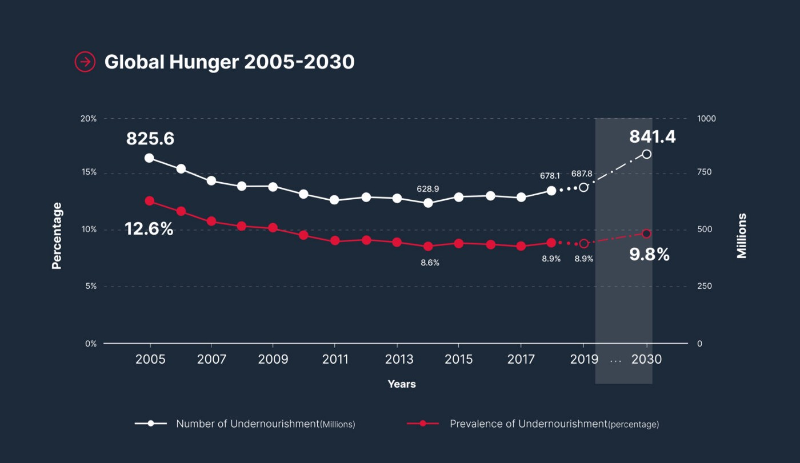
Currently, the United Nations estimates that over 690 million people face undernourishment globally, including 38 million in the United States. Some project that by 2030, the number of hungry people could exceed 800 million. The UN also projects that the global population will reach an astonishing 9.7 billion by 2050, making it increasingly crucial to address agricultural inefficiencies and create fairer food distribution systems.
While poverty is often the direct or sole cause of food shortages, another factor is regional unavailability of food supplies—even in poorer areas of developed countries.
By integrating data across all stages of the food supply chain—from seeds to harvest, packaging, sales, transportation, and resale—crop and livestock yields can be more accurately estimated. This helps balance supply and demand, ensuring food reaches places where it's truly needed, rather than just where farmers or distributors assume it might be.
Fraud further exacerbates food shortages. Agricultural fraud often involves counterfeit, contaminated, low-quality, or partially delivered food products. Widespread fraud in agriculture reduces available supply and drives up prices for already vulnerable consumers. By creating an immutable ledger for every step in the supply chain, blockchain can reduce risks of fraud, data manipulation, and mismanagement, ultimately lowering food prices for the most disadvantaged populations.
Blockchain May Have a Positive Impact on Climate Change and Global Warming
Most scientists agree that global warming is one of the major environmental, social, and political challenges of the 21st century, driven significantly by human-caused carbon dioxide emissions. Global warming is expected to trigger severe environmental and economic consequences, including floods, droughts, extreme weather events, and agricultural problems such as crop shortages.
Although global warming may open new agricultural opportunities in certain regions—particularly colder climates—its overall impact on global agriculture could be catastrophic.
According to research by the EPA, when temperatures rise beyond a crop’s “optimal range,” yields can be severely affected. Moreover, elevated CO₂ levels have been linked to reduced protein and nitrogen content in plants like alfalfa and soybeans, leading to lower nutritional quality. The report adds that declining grain and forage quality could reduce the carrying capacity of pastures and feed crops for grazing livestock.
Additionally, the U.S. Environmental Protection Agency notes that “unusually high nighttime temperatures in 2010 and 2012 impacted corn yields in the U.S. Corn Belt, and in 2012, Michigan cherry growers lost $220 million due to early bud break triggered by a warm winter.” This is just one of many examples showing how rising temperatures can lead to massive crop losses.
While blockchain cannot directly prevent crop losses caused by climate change, it can introduce new methods to incentivize energy efficiency and reduced CO₂ emissions at both individual and institutional levels. At the individual level, blockchain applications already allow energy-conscious users to profit from selling surplus energy, encouraging lower personal energy consumption and reduced carbon footprints.
Blockchain’s Impact on ESG
At the institutional level, ESG (Environmental, Social, and Governance) has become one of the fastest-growing priorities for multinational investors—especially for companies involved in energy production and agriculture. Billions of dollars flow into funds and corporations claiming robust ESG initiatives, yet concerns remain about the validity and accuracy of these claims.
[Through blockchain] granular tracking…has the potential to bring unprecedented transparency to global ESG initiatives.
Using blockchain technology, companies can alleviate investor concerns about the authenticity of their ESG efforts. Thanks to the immutability of blockchain databases, supply chains can be effectively tracked—and even carbon emissions monitored through direct integration with IoT (Internet of Things) devices installed at power plants, manufacturing facilities, or farms.
Global energy company Repsol has already implemented blockchain in its supply chain, converting physical assets like plastic or natural gas into digital assets traceable at every node. Such fine-grained tracking could provide critical transparency for various global ESG programs.
Blockchain can also facilitate the creation and use of digital ESG bonds. In 2018, the World Bank issued its first blockchain bond worth $83 million, attracting investors including the Commonwealth Bank of Australia, which co-issued the bond. These bonds incorporate smart contracts requiring reporting on various ESG metrics such as carbon emissions, pollution, and overall energy usage.
Blockchain Could Reduce Food Waste Through Improved Data and Information Sharing
According to the U.S. Department of Agriculture, between 30% and 40% of food in the United States is wasted—despite nearly 40 million Americans experiencing food insecurity. Wasted food contributes to higher food prices, making it harder for low-income households to afford meals. Yet this issue is not limited to the U.S.; similar food waste rates plague both developed and developing nations.
[Blockchain enables] companies to better understand how much food they should produce during specific periods, thereby reducing waste throughout the supply chain.
Moreover, wasted food imposes significant economic costs—an estimated $218 billion annually spent on producing, transporting, and disposing of uneaten food, much of which ends up in landfills.
By leveraging blockchain to create an immutable ledger tracking the supply chain—combined with predictive analytics based on weather conditions and consumer demand—companies can gain clearer insights into optimal production volumes per season, minimizing waste across the entire supply chain.
Beyond producers, innovative blockchain applications aim to repurpose unused food to aid the hungry. Goodr, for example, developed an app that helps restaurants redirect unsold meals to local charities. The company uses a blockchain database to precisely inform restaurants what and how much food they’re wasting, helping them adopt more sustainable practices.
Municipalities and governments can also leverage such collaborative models, using incentives to discourage food waste, track disposal volumes, and reduce taxpayer burdens.
Blockchain Can Enhance Food Quality Through Better Supply Chain Management
Beyond food shortages, global hunger, waste, and climate change, food safety remains another pressing concern in modern agriculture. According to the World Health Organization (WHO), approximately 600 million people fall ill each year after consuming contaminated food, resulting in around 420,000 preventable deaths annually.
Following a series of high-profile food safety scandals, Walmart mandated the use of blockchain technology across its entire agricultural supply chain. The retail giant partnered with IBM and is now part of the IBM Food Trust initiative, which helps food companies trace products from farm or factory through the entire distribution network.
In many cases, products reaching large retailers like Walmart pass through 20 to 25 or more supply chain checkpoints before reaching consumers, making it extremely difficult and time-consuming to identify the source of contamination. Lack of data forces companies to recall vast quantities of products—sometimes unnecessarily—while still leaving them exposed to future contamination risks.
Walmart now requires most of its suppliers and distributors to use IBM’s blockchain tracking system. The system is reportedly so comprehensive that every sold item can be traced back to its originating farm—or sometimes even the specific field. Other companies collaborating with IBM Food Trust include Nestlé, Dole, Kroger, Tyson, Driscoll’s, and McLane.
Blockchain Can Support Smallholder Farmers via Cryptocurrency, DeFi Microloans, and Crop Insurance
Smallholder farmers are vital components of the agricultural ecosystem, especially in developing countries. In smaller communities, local farmers may be the sole source of food for entire towns.
However, independent farmers often struggle due to lack of access to credit readily available to larger corporations. Many local farmers belong to the 1.7 billion unbanked adults worldwide. According to the World Bank, despite this gap, “two-thirds of them own a mobile phone that could give them access to financial services.”
Farmers can use cryptocurrency apps to access microloans, helping sustain and expand their operations.
With the surge in cryptocurrency exchanges, wallets, and apps—alongside the development of stablecoins—blockchain technology can often replace traditional banking for small farmers. Instead of waiting for barter arrangements, farmers can easily receive payments via Bitcoin or Ethereum wallets.
Local farmers can also use blockchain and crypto-banking apps to purchase essentials like fertilizers and farming tools, sustaining and scaling their agricultural activities. Beyond paying suppliers, crypto-banking can also be used to pay workers, enabling farm expansion, increased food supply, and potentially lower prices.
At the consumer level, individuals can also pay for food using cryptocurrencies—offering a strong alternative to traditional banking in regions where such services are scarce or nonexistent.
Beyond basic transactions, farmers can leverage cryptocurrency platforms to obtain microloans for business continuity and growth. Traditional DeFi platforms like Aave offer crypto lending, while specialized microcredit platforms are beginning to emerge.
Even conventional microfinance institutions can benefit from blockchain, as demonstrated by a study from the Inter-American Development Bank, which used blockchain to streamline loans for toilets, showers, and other essential water purification and safety products in Peru. The study found blockchain highly effective in accelerating loan applications and processing, as well as enhancing KYC (Know Your Customer) compliance, preventing fraud, and improving financial management.
Blockchain-Based Crop Insurance Can Help Small Farmers Cope With Harsh Weather Conditions
Extreme weather is another major challenge in modern agriculture, capable of drastically reducing crop yields with little warning. For example, in February 2021, Winter Storm Uri hit Texas, causing approximately $600 million in crop losses.
While the U.S. supply chain can relatively recover from such losses, similar events in developing countries often trigger food crises and may financially ruin farmers.
Adequate insurance, however, can shield farmers from economic shocks, providing the capital needed to continue farming operations even under adverse weather conditions.
Arbol, a company pioneering blockchain-based agricultural insurance, offers weather insurance to farmers worldwide using blockchain smart contracts.
Specifically, Arbol provides protection against excessive or insufficient rainfall, crop yield fluctuations, heavy snow, wind speed and direction, temperature, and humidity. According to the company’s website, users specify their desired coverage amount, and using GPS and verified weather data, the platform automatically disburses claims within two weeks or less.
As the sector evolves, more crop insurance solutions are likely to emerge, offering broader protections for farmers of all scales.
Blockchain Oracles Will Be Needed to Deliver External Data to Blockchains
Blockchains are inherently closed systems. This is why they typically require third-party data providers—called oracles—to deliver “off-chain” information. In agriculture, this could include weather, climate, rainfall data, and information related to potential food contamination. While oracles are essential for blockchain functionality, they do present vulnerabilities, particularly concerning data security, speed, accuracy, and finality.
Designed to Power Next-Generation Agricultural Production with Robust Blockchain Oracles
SupraOracles offers an innovative oracle solution combining security, accuracy, speed, and rapid finality, enabling both public and private blockchains to operate efficiently. Whether supporting crop insurers adding weather data to their blockchains or helping various suppliers securely input information, SupraOracles delivers secure, decentralized oracles to ensure blockchain data arrives accurately and on time.
Join TechFlow official community to stay tuned
Telegram:https://t.me/TechFlowDaily
X (Twitter):https://x.com/TechFlowPost
X (Twitter) EN:https://x.com/BlockFlow_News
 @SupraOracles