Coin Bureau: Analyzing Polygon's Present and Future
TechFlow Selected TechFlow Selected
Coin Bureau: Analyzing Polygon's Present and Future
The total value locked in all Ethereum layer 2 solutions has surpassed $10 billion, with no signs of slowing down. Polygon accounts for more than half, temporarily surpassing Ethereum in daily active users due to usage demand.
 Navigating Web3 tides with focused insights
Summary: This is a new initiative of ours—transcribing videos from Coin Bureau, a YouTube channel with 1.74 million subscribers, into text format for easier and faster reading. However, we are concerned that individual KOL-style videos may contain excessive "shilling" behavior. Therefore, we urge readers to approach the content rationally. In the future, we will carefully select more video content focused on fundamental analysis.
This article presents Coin Bureau’s introduction and analysis of Polygon’s current development status, primarily divided into the following five sections:
1. Introduction to Polygon
2. Progress and Updates (April–November)
3. Price Analysis
4. Roadmap
5. Concerns About Polygon
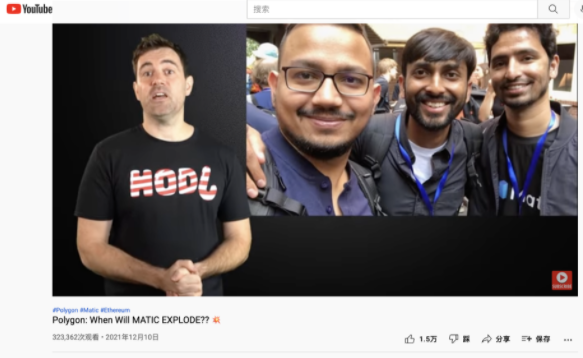
Video content as follows:
Due to investor token unlock schedules, MATIC prices have been fluctuating significantly. What comes next?
With Ethereum gas fees continuing to rise, demand for low-cost Layer 2 scaling solutions is increasing. Recently, total value locked (TVL) across all Ethereum Layer 2 networks surpassed $10 billion, showing no signs of slowing down. Polygon accounts for over half of this, briefly surpassing Ethereum in daily active users due to user adoption.
Today, I’ll walk you through a quick refresher on Polygon, covering project developments and why the MATIC token might be poised for a breakout.
1. Introduction to Polygon
If you’ve never heard of Polygon, listen closely. Polygon was founded in 2017 by Anurag Arjun, Jaynti Kanani, and Sandeep Nailwal.
Originally known as the MATIC Network, it rebranded to Polygon in February 2021. Respected Ethereum developer MahaloGelek joined as the fourth co-founder.
Polygon was built by Polygon Technology, a for-profit Indian software company, and is primarily coordinated by the MATIC Foundation—a nonprofit organization (now renamed the Polygon Foundation, though its foundational structure remains unclear).
In 2019, Polygon raised $5.5 million through a token sale and millions more from prominent individuals and institutions. Despite being technically under development, its mainnet launched in June 2020.
Polygon aims to be an Ethereum-compatible blockchain network while exploring other scalability solutions.
Currently, there are two proposed Polygon solutions, but only one is live—the original MATIC network, now called the Polygon PoS Chain. The system works by regularly submitting snapshots of the Polygon PoS Chain to the Ethereum blockchain. These snapshots are submitted by Polygon’s 100 validators and can be used to recover user funds if the Polygon PoS Chain fails.
Note that Polygon’s 100 validators do not actually process transactions on the Polygon PoS Chain. Transaction processing is handled by a separate group of 7 to 10 block-producing nodes, likely operated by the Polygon Foundation itself.
Although Polygon claims to handle 1,000 to 10,000 transactions per second, its relatively centralized nature allows for theoretical throughput of up to 65,000 transactions per second.
MATIC is an ERC-20 token issued on Ethereum. It is primarily used for staking with Polygon’s 100 validators and can also be delegated. Currently, annual staking rewards for validators and delegators are around 12%. While there is no minimum stake requirement for either party, validators must rank among the top 100 by MATIC holdings. All staked MATIC tokens are locked for 21 days and can be slashed if validators act maliciously.
The MATIC token is also used to pay transaction fees on the Polygon network and fund future development. Its low fees and Ethereum compatibility have attracted many popular Ethereum DeFi protocols to deploy on Polygon, collectively locking nearly $5 billion in value.
2. Progress and Updates
Phase 1 (April–June)
It has been nearly nine months since my last update on Polygon, and a lot has happened. Shortly after my previous coverage (in early April), Aave announced deployment on Polygon—an event widely seen as a key driver behind Polygon’s tenfold user growth in the short term.
At the end of April, Polygon announced a $150 million DeFi fund, pledging that 2% of it would support liquidity mining incentives for DeFi protocols over the next two to three years.
In May, billionaire Mark Cuban publicly endorsed Polygon, though the exact amount of his personal investment remains unknown.
The day after that announcement, Polygon revealed completion of the Polygon SDK, enabling developers to easily build and deploy applications on Ethereum Layer 2.
One day later, Polygon integrated the privacy-focused cross-chain protocol REN, allowing users to mint anchored versions of over six cryptocurrencies—including BTC, DOGE, and LUNA—on Polygon.
Not stopping there, Polygon also announced integration with Google’s BigQuery platform, enabling developers to easily analyze on-chain data from the Polygon network.
In early June, Polygon partnered with AU21 Capital to secure a $21 million fund for Polygon developers.
Polygon also launched PolygonScan, a block explorer built with assistance from EtherScan—the most popular blockchain explorer for Ethereum.
Mid-June, Grayscale indicated it was considering establishing trusts for 13 cryptocurrencies, including Polygon. While a Grayscale Polygon Trust hasn’t materialized yet, given Grayscale’s recent creation of a Solana trust, it may only be a matter of time.
By the end of June, Polygon unveiled Avail, a promising general-purpose data availability layer designed to enhance both chain security and user safety. While I acknowledge Polygon could achieve this, launching it so quickly was beyond my expectations. The day after this announcement, Polygon revealed that The Sandbox game would gradually migrate from Ethereum to Polygon.
Phase 2 (July–September)
Mid-July, Coinbase Wallet added support for the Polygon network.
Polygon also launched its own NFT and blockchain gaming studio, named Polygon Studios, backed by a $100 million fund.
Late July, Binance added support for the Polygon network, allowing users to directly withdraw ERC-20 tokens onto it.
Mid-August, Polygon announced plans to invest $1 billion worth of MATIC tokens into zero-knowledge scaling technologies.
On the same day, Polygon disclosed it had acquired Hermez Network for 250 million MATIC tokens valued at $250 million. As you might guess, Hermez is one of Ethereum’s Layer 2 scaling solutions utilizing zero-knowledge technology. According to Hermez documentation, its zk-Rollup tech can handle 2,000 transactions per second—which is impressive.
Late August, Polygon announced plans to establish the Polygon Ecosystem DAO, granting the community some influence over the project’s direction.
Early September, Coinbase announced it would use the Polygon network and prioritize it among all Ethereum scaling solutions. Officials also hinted at expanded support for Polygon.
Mid-September, Polygon announced a partnership with EY to deploy a privacy-focused scaling solution on Ethereum using zk-Rollups. EY—one of the Big Four accounting firms—is a major corporate player.
Late September, Osprey announced the launch of the Osprey Polygon Trust for accredited U.S. investors.
Crypto.com also added support for the Polygon network, contributing to a brief period where Polygon’s active user count temporarily exceeded Ethereum’s.
Phase 3 (October–November)
Early October, OpenSea announced deployment on Polygon. OpenSea is well-known as the leading NFT marketplace in crypto.
Late October, Bitwise followed Osprey’s lead by launching a Polygon fund for institutional investors.
They identified and fixed a critical vulnerability in the Polygon network that could have led to an $850 million crypto loss—fortunately, it was patched before any damage occurred.
Mid-November, Polygon announced Miden, another zero-knowledge-based Ethereum scaling solution. Compared to Hermez, Miden uses the more complex zk-STARK technology, which I won’t delve into here.
Miden’s key feature is its own virtual machine compatible with the Ethereum Virtual Machine (EVM), enabling support for more complex smart contracts than Ethereum itself. Notably, Miden was developed by a former zero-knowledge researcher from Facebook, and many others are reportedly leaving that company to join similar efforts.
Late November, the NFL (National Football League) announced it would issue NFT tickets via the Polygon network.
Polygon also announced integration with Arweave, a decentralized storage project that permanently stores data in a distributed manner. I happen to hold some AR, Arweave’s native token, because Arweave actually stores historical data from the Solana chain.
3. MATIC Price Analysis
All of Polygon’s announcements and developments have predictably impacted MATIC’s price. Since March, the token’s price trajectory has been largely parabolic. However, it has only increased about sixfold since March—less than many other cryptos during the same period—primarily due to selling pressure.
This selling pressure likely stems from MATIC’s vesting schedule. As you can see, MATIC undergoes large unlocks every six months. The unlock timeline appears closely tied to MATIC’s price movements. Historically, MATIC’s price dropped before and after each unlock event. The most recent one occurred on November 5, indicating early investors are selling their MATIC holdings. Given that MATIC’s all-time high was $2.25, early investors have already realized nearly 1,000x returns, making profit-taking understandable.
Fortunately, much of the MATIC allocated to early investors appears to have already been sold off. Most remaining MATIC will go to the Polygon team and Polygon Foundation. As discussed in my prior videos, the Polygon Foundation is committed to funding ecosystem expansion.
Much of this funding comes from MATIC token sales by the Foundation. If my calculations are correct, the Foundation has sold up to $500 million worth of MATIC since March.
Moreover, in an October report, Dean Thomas, Polygon’s Head of Institutional Investment, stated: “If you let us invest directly, we can cut checks right now from our foundation,” suggesting the Foundation has sold even more MATIC than visible on-chain.
But what about real demand? According to PolygonScan, there are over 120 million unique addresses on the Polygon network. That means active addresses have grown nearly 1,000-fold since March—an insane rate.
However, Total Value Locked (TVL) on Polygon peaked at the end of June and has since stabilized around $5 billion. This suggests most new wallets on Polygon are created automatically through integrations with exchange wallets like Binance and Coinbase, rather than organic user growth.
A bigger concern is that the number of daily active wallet addresses on Polygon’s website has stagnated—and even slightly declined—since last October. This may stem from competition from other Layer 2 solutions like Arbitrum and Optimism, which have seen major exchange integrations and billions in TVL locked within Ethereum protocols.
The good news is that Polygon remains the largest Ethereum Layer 2 network. If you’re wondering how high MATIC might go before the bull market ends, a conservative estimate is 2–3 times current levels. Given MATIC’s large market cap, extremely high growth is unlikely. That said, MATIC could still make significant moves—ultimately dependent on Polygon’s roadmap execution.
4. Polygon Roadmap
Recently, Polygon co-founders revealed the project’s roadmap during a presentation by Sandeep Nailwal. Five key milestones remain unfulfilled:
1) Launch of Avail Chain, mentioned earlier.
2) Rollout of Nightfall, the previously mentioned zk-Rollup scaling solution.
3) Launch of an unannounced Optimistic Roll-up solution.
4) Introduction of Ethereum Application-Specific Sidechains.
5) Launch of Enterprise Chains leveraging Polygon’s PoS sidechain for security.
The Polygon team aims to build and operate all these initiatives by early 2022—a period many believe coincides with the peak of the crypto bull market.
During the Q&A following Sandeep’s roadmap presentation, he stated Polygon ultimately aims to become the third-largest cryptocurrency after Bitcoin and Ethereum. Regarding user numbers, Sandeep hopes for at least 100 million daily active users and billions of total users in the coming years—admitting this is an ambitious goal. To justify this, he referenced a quote: “Ethereum with Solana-like scalability validates my other crypto asset.”
When asked whether Coinbase would integrate with Polygon—even using it for NFT marketplace development—Sandeep said he had nothing to disclose. Personally, I interpret this as a clear sign it will happen.
Additional Polygon milestones can be found in interviews, demos, and operations by other team members. For example, in an interview last November, Dean Thomas mentioned that more institutional investment products based on Polygon would soon list on exchanges worldwide.
Dean also emphasized building partnerships with crypto projects and companies focused on NFTs, the metaverse, and GameFi niches.
Late November, co-founder Mihailo Bjelic submitted a proposal on Uniswap’s governance forum requesting deployment on Polygon. The proposal passed on December 2 with 98% approval, meaning Uniswap’s deployment on Polygon is imminent.
The most recent milestone I found comes from a May interview with Jaynti Kanani, another co-founder. He reflected on the possibility of renaming MATIC to Polygon in the future.
Jaynti also explained that Polygon generates revenue through MATIC token sales—a sentiment echoing Sandeep’s March interview statement: “We’re using our treasury to build the ecosystem.” This raises concerns for me.
5. Concerns About Polygon
My first concern is the ongoing sale of MATIC tokens by the Polygon Foundation and team, which clearly exerts downward pressure on MATIC’s price.
In Polygon’s defense, it has little choice but to expand rapidly. By 2025, when MATIC staking rewards expire, transaction fees will be the only incentive for validators to secure the network.
Still, it would be helpful to know exactly how much MATIC the Foundation and team have spent. To my knowledge, this information isn’t publicly available elsewhere—but I do commend Polygon for labeling some of its wallet addresses on Etherscan.
This ties into my second concern: transparency.
Yes, Polygon has a transparency page, but it only lists wallet addresses already labeled on Etherscan. I want to know who operates the 7–10 block-producing nodes on the Polygon PoS network, as these could represent single points of failure for the sidechain.
I also noticed Polygon claims its submission layer is decentralized, yet founders haven’t elaborated on this in recent talks. Beyond the fact that only 100 validator nodes exist on the submission layer, it’s clear Polygon remains founder-led—my third concern.
Although Polygon announced a DAO, it hasn’t established any governance structure, nor mentioned concrete plans elsewhere. The closest thing to community governance I could find is the governance section on the Polygon and MATIC Network Forum, which isn’t very active.
One notable suggestion: addressing the concentration where the top 10 validators control over 80% of staked MATIC—this is quite concerning.
In fairness, Polygon seems aware of these issues, and decentralization appears central to Sandeep’s vision. Setting concerns aside, Polygon’s adoption is undeniably rising. Exciting updates are coming that could boost MATIC demand, and I believe the project will eventually resolve these outstanding challenges in due time.
Original video link:
https://www.youtube.com/watch?v=OECcDsmmhRg&t=75s
Note: The content reflects only the opinions of the YouTube creator.
TechFlow is a deep-content platform dedicated to alternative asset investment. Follow our official account for more insights, or add WeChat TechFlow01 to join the TechFlow community and participate in discussions.

Join TechFlow official community to stay tuned
Telegram:https://t.me/TechFlowDaily
X (Twitter):https://x.com/TechFlowPost
X (Twitter) EN:https://x.com/BlockFlow_News
 @coinbureau