








SUI Network Launches Permanent Testnet: A Guide to Key Updated Features
TechFlow Selected TechFlow Selected
SUI Network Launches Permanent Testnet: A Guide to Key Updated Features
Today, Sui Network announced the launch of its permanent testnet on its official Twitter account.
 Navigating Web3 tides with focused insights
Original: SUI Foundation
Translation: SUI World
Today, Sui Network announced the launch of its permanent testnet via an official tweet. This is a long-running, decentralized, and permissionless testnet. Unlike previous Waves 1 and Waves 2 testnets, this new testnet will continue operating even after the mainnet launch. Through this permanent testnet, SUI Network will introduce many important feature updates to the community.
Core Network
Dynamic Validator Set: Candidate validators meeting sufficient stake requirements can join the network at epoch boundaries, while active validators may leave at epoch boundaries. This validator access model truly enables permissionless participation.
Support for Protocol Software and Sui Framework Upgrades: Unlike Devnet, Testnet will not be reset with every software update (unless there's a special reason). The community will be notified in advance of any software updates or data resets on Testnet.
Full Node Recovery from Database Snapshots: Node operators can use checkpoints to quickly launch full nodes instead of waiting for full synchronization.
Address and Signature Updates: Account addresses, object IDs, and transaction IDs have been upgraded from 20 bytes to 32 bytes to prevent hash collisions. Additionally, Sui’s default hash function is now Blake2b instead of SHA3 due to Blake2b’s superior performance. To support a wide range of transaction sizes, signatures are now applied to hash digests rather than serialized BCS data, making Sui compatible with hardware wallets whose signer APIs typically allow only limited input sizes.
Developer Experience
To fulfill the vision of making Sui the most developer-friendly platform among public blockchains, Sui views this permanent testnet as the earliest embodiment of Sui DevX 1.0—bringing together many core developer primitives and semantics:
1) Aggregation of feedback from developers and builders throughout SUI’s development;
2) Continuous refinement of foundational elements for developer efficiency;
3) Designed to enable a decentralized yet non-fragmented SUI ecosystem.
These Primitives Are:
1) Programmable Transaction Blocks
https://docs.sui.io/build/prog-trans-ts-sdk
This powerful structure allows a sequence of transactions—splitCoin, mergeCoins, transferObjects, moveCall, makeMoveVec, publish—to be chained together, creating custom atomic transaction blocks tailored to application needs. Since moveCall can invoke any existing on-chain function, programmable transaction blocks essentially provide ad-hoc transaction composition, greatly enhancing the expressiveness of the Sui Move programming model.
Programmable transaction blocks also simplify GAS Coin object management, as applications can pass in a vector of GAS Coin objects and perform coin splitting/merging within the block, eliminating the need for pre-submission coin selection.
2) Sponsored Transactions and Gas Station
https://docs.sui.io/learn/sponsored-transactions
While sponsored transactions have been supported since SUI version 0.27, Shinami’s gas station
https://github.com/MystenLabs/sui/releases/tag/devnet-0.27.0
can now be used with Sui’s permanent testnet!
3) Object Display Standard
https://docs.sui.io/build/sui-object-display
A set of named templates standardizes off-chain display of objects of the same type. Sui Explorer and Sui Wallet now support the Object Display Standard, as do Sui API and Typescript/Rust SDKs. This is the result of extensive brainstorming and contributions from the Sui community—special thanks to Capsules and OriginByte for their dedication to this standard.
4) Kiosk Standard
https://github.com/MystenLabs/sui/blob/main/crates/sui-framework/docs/kiosk.md
Kiosk is a powerful new primitive that supports listing objects for sale and enforcing creator-defined royalty policies upon sale. The combination of Object Display and Kiosk fills two critical gaps for building collectibles and marketplaces on Sui. We encourage wallet, explorer, and marketplace developers across the ecosystem to adopt both the Object Display Standard and Kiosk Standard to ensure seamless cross-platform compatibility.
5) RPC Overhaul
More aggregate-based RPC get* methods are now available: getEpoch, getNetworkMetrics, getMoveCallMetrics, queryObjects. JSON RPC batch requests have been deprecated in favor of MultiGet* methods. System events have been deprecated in favor of dedicated fields in transaction responses. Finally, several legacy RPC methods (marked unsafe_*) have been deprecated and replaced by programmable transaction blocks.
6) Zero-Knowledge Proofs
Move APIs now support verification of Groth16 ZKPs using BN254 and BLS12-381 elliptic curves—the two most widely used curves. This enables computational proofs within Sui smart contracts and supports privacy-preserving applications.
7) Two Granularities of Timestamps
https://docs.sui.io/build/move/time
A fine-grained Clock module supports 2–3 second granularity suitable for near real-time applications, alongside a coarse-grained Epoch timestamp.
8) Move Package Upgrade
This is a fundamental capability for developers to upgrade their Move smart contracts and import updated packages. Move package upgrades will become available on the testnet alongside the next software update (tentatively scheduled for the first week of April)—stay tuned!
In addition to using Devnet and Testnet, we encourage builders to use local environments for initial development and faster iteration. The sui-test-validator binary has been improved to facilitate local development.
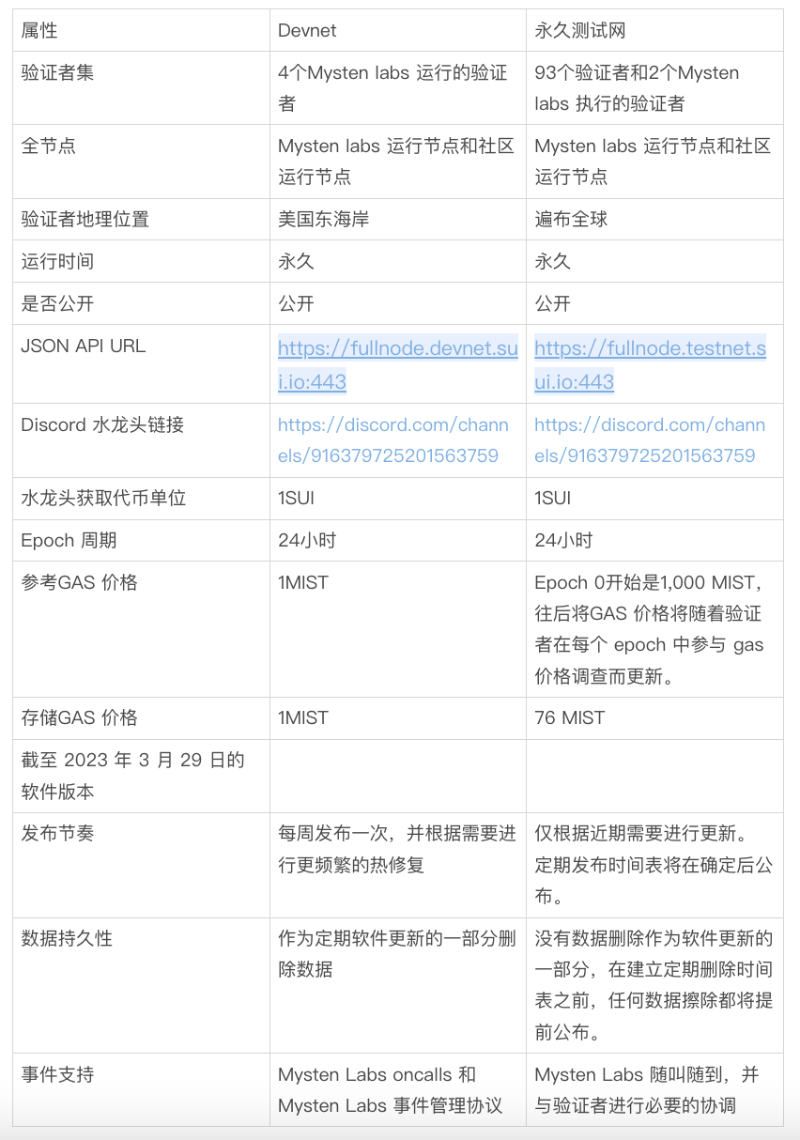
Sui Devnet VS Testnet
The table below outlines the differing network characteristics between Devnet and the permanent testnet as of the publication date of this article.
Join TechFlow official community to stay tuned
Telegram:https://t.me/TechFlowDaily
X (Twitter):https://x.com/TechFlowPost
X (Twitter) EN:https://x.com/BlockFlow_News






