
Nansen Research: How Celo Is Bringing Blockchain to the Mainstream?
TechFlow Selected TechFlow Selected
Nansen Research: How Celo Is Bringing Blockchain to the Mainstream?
Celo's goal is an internet of instant and profound value.
 Navigating Web3 tides with focused insights
Written by: Yasmine Karimi, Nansen
Translated by: Mim, TechFlow
Throughout the history of Web1.0 and Web2.0, hundreds of companies have competed for dominance in the information revolution. Only those that successfully transformed complex technologies into user-friendly products emerged as winners.
While this relates to the internet of information, we now find ourselves at a similar inflection point in today's crypto space. Blockchain technology enables seamless asset transfers within seconds without trusted third parties, yet lacks the user experience required for mainstream adoption. To many, its volatility makes it a store of value rather than a medium of exchange.
On the other hand, existing payment systems such as Apple Pay, PayPal, or Venmo are user-friendly and ensure value stability, but involve intermediaries that not only prolong transaction times but also incur fees. In other parts of the world, individuals may even be excluded from the global economy—either because they lack bank accounts or due to weak local financial institutions.
What if we could combine the strengths of blockchain technology with the user-friendliness of traditional payment systems? Could this finally unlock an instant and profoundly valuable internet? This is precisely the goal of the Celo blockchain.
What is Celo?
Celo is a Layer 1 blockchain launched in 2017 and backed by a16z. Like other blockchains, it is an EVM-compatible chain supporting transactions and decentralized applications (dApps). These dApps leverage blockchain technology to provide financial services. Examples on Celo include Ubeswap (a mobile-first decentralized exchange), PoolTogether (a cryptocurrency savings protocol based on prize bonds), Moola (an asset lending platform), and SushiSwap.
Transaction validation relies on a proof-of-stake consensus mechanism. Unlike proof-of-work models, proof-of-stake selects validators based on the amount of native tokens they hold. Since validators are chosen this way, extensive computational power is unnecessary. There is no competition among miners driving gas fees sky-high. Transaction validation requires significantly less time, as individual nodes do not need to dedicate substantial processing power like PoS-based blockchains such as Solana (50,000 TPS) and Polkadot (1,000 TPS). By comparison, Ethereum handles just 16 test program sets.
To understand the differences between Layer 1 and Layer 2 blockchains and the current blockchain landscape, refer to our article published here.
Transaction Speed and Gas Fees
As mentioned above, the proof-of-stake consensus enables relatively high transaction speeds and low gas fees—5 seconds and $0.00004 respectively on Celo. Over time, the total daily gas expenditure on Celo has consistently remained lower than that of Ethereum, as shown below.
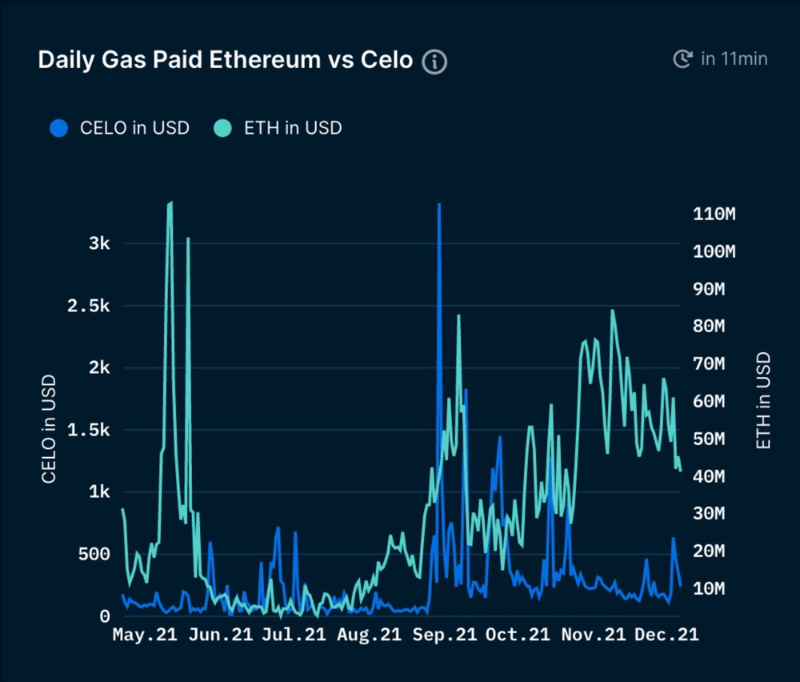
Daily total gas paid over time on Celo vs ETH
Celo achieves a throughput of 200 TPS while maintaining low gas fees—higher than Ethereum’s 16 TPS—but still relatively low compared to blockchains like Solana. Co-founder Marek Olszewski stated that the team continues to work on improving throughput, potentially making Celo the fastest EVM chain by the end of 2022.
Additionally, its network of nodes is capped at 163, making it more centralized than blockchains like Ethereum. Since inception, it has also recorded fewer total transactions and unique addresses. Indeed, it has processed 70.6 million transactions compared to 44 billion on Solana.
However, looking at transaction trends since Celo’s launch reveals organic growth, especially noticeable since late July. Celo has increased from handling 10% of Ethereum’s total transaction volume to 45%, indicating rising adoption.
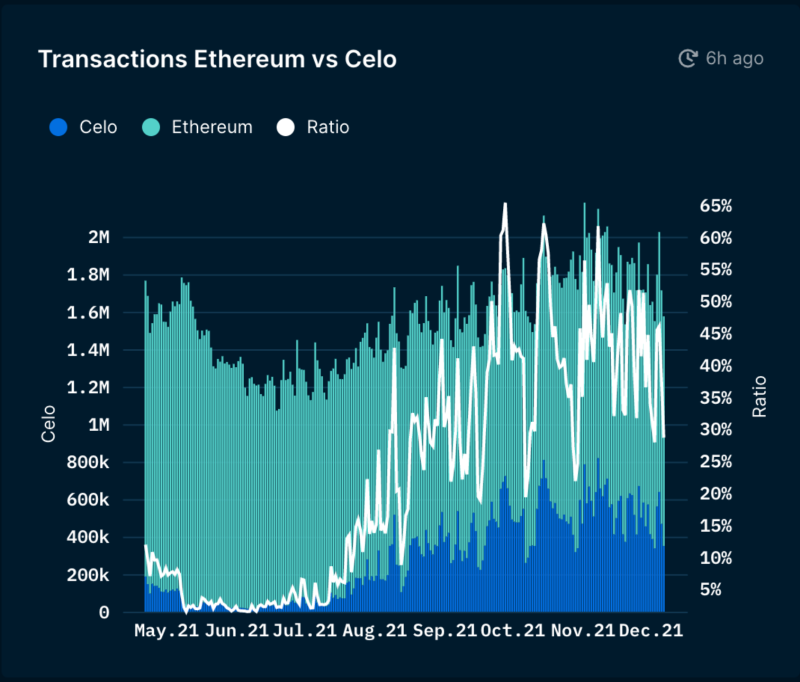
Daily total transaction volume over time on Celo vs ETH
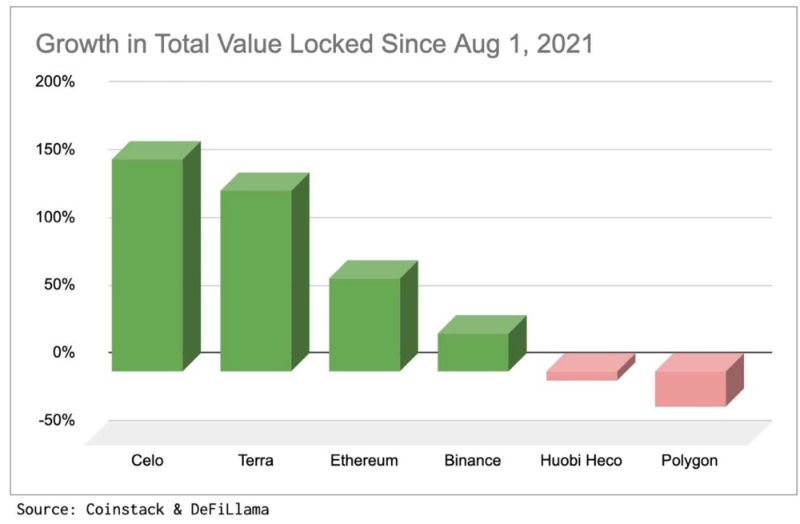
Furthermore, according to CoinGecko and DeFiLlama data, Celo is currently the fourth-fastest growing blockchain in DeFi. Since August 1, its total value locked (TVL) has grown by 157%, increasing from $339 million to $870 million, outpacing major blockchains such as Terra, Ethereum, BSC, HECO, and Polygon—all of which have at least $800 million TVL. Let's explore why Celo is gaining increasing attention.
Celo stands out in two key ways: 1) It functions as a global payment platform accessible to anyone with a mobile phone; 2) It uses stable-value tokens pegged to fiat currencies to minimize volatility. We simplify how these two mechanisms work below.
Globally Accessible Mobile Wallets
Today, approximately 2 billion people remain unbanked. Most have never heard of cryptocurrency wallets, yet nearly everyone owns a mobile phone. Celo allows mobile users to use their phone numbers as public keys instead of traditional long-string addresses. Phone numbers become publicly visible addresses for contacts. Before receiving an SMS verification code, you can link your phone number to your wallet.
This method does not compromise user privacy, as only the hash of the phone number (combined with a pseudorandom seed) is stored in a shared database—not the actual phone number itself.
Moreover, Celo employs an algorithm called EigenTrust to calculate reputation scores for phone numbers. The score is determined by the total number of other phones that trust it, weighted by their respective reputation scores—particularly useful when transacting with individuals outside one’s contact list.
Stable Value
There are two primary types of crypto assets on Celo: CELO and Celo Dollars. Celo (CELO) is the protocol’s native asset. It serves as a utility token enabling users to participate in network consensus (via its proof-of-stake system), pay transaction fees on the blockchain, and vote on governance decisions. Celo Dollar (cUSD) is a stable asset pegged to the US dollar.
Celo’s stability relies on two distinct mechanisms. The first involves elastic-supply stablecoins pegged to fiat currencies, such as Celo Dollar (cUSD) and Celo Euro (cEUR). For additional stability, Celo is also backed by a diversified basket of cryptocurrencies held in reserve to support the peg.
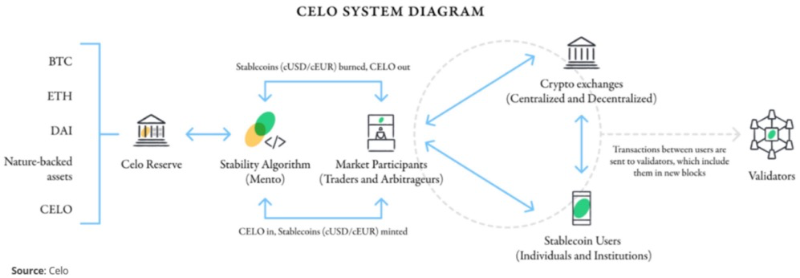
The second mechanism is Mento, a stabilization algorithm designed to capture arbitrage opportunities. When cUSD trades above $1, arbitrageurs buy CELO and redeem it for cUSD, then sell cUSD for profit. Selling cUSD lowers its market price back to $1. Conversely, if cUSD falls below $1, arbitrageurs purchase the token and redeem it for CELO to profit from the price difference. Buying cUSD pushes its price back up to $1.
Navigating Celo with Nansen
Dapp Landscape
Currently, there are around 90 decentralized applications on Celo—either fully deployed or soon to be launched—particularly under initiatives such as Celo Camp (a virtual accelerator) and various competitions organized by the Celo Foundation.
We can categorize these dApps into three main groups: wallets managing Celo assets, decentralized finance (DeFi) dApps, and socially impactful dApps.
As shown in the Nansen chart below, DeFi dApps are more mature than others—for instance, Moola and Ubeswap account for 40% of total daily log occurrences on Celo. Log occurrence refers to the number of times an entity’s smart contract successfully executes code.
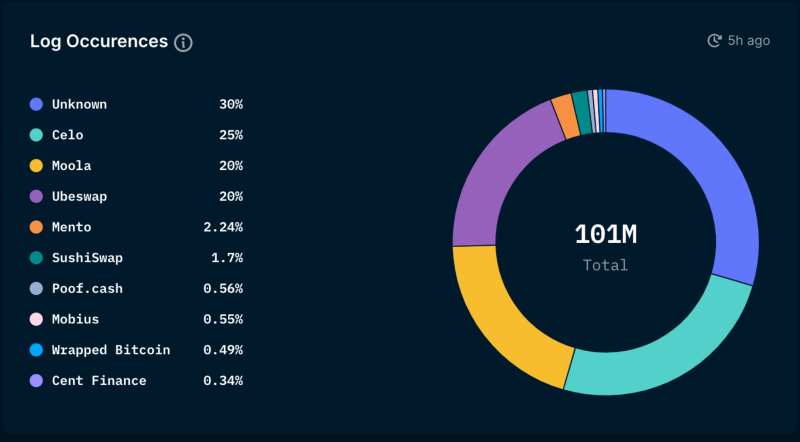 Top Applications on Celo (Ranked by Log Occurrences)
Moola is a mobile-first asset lending platform on Celo, while Ubeswap is a mobile-compatible fork of Uniswap’s decentralized exchange. Other notable DeFi dApps on Celo include Mento, a native automated market maker (AMM)-type DEX on the Celo platform, and Poof.cash, a privacy protocol allowing deposits, earnings, and withdrawals without revealing account balances.
Interestingly, large-scale DeFi protocols like SushiSwap surpass smaller, mobile-native dApps (such as Moola and Ubeswap) in log occurrences, suggesting strong interest in mobile-first crypto services. In reality, however, SushiSwap accounts for only 1.7% of total log occurrences.
Some of these DeFi dApps are tailored for specific use cases. For example, projects like Doni enable community funding and microloans.
Funds used in these dApps are managed through wallets such as Valora, Celo Wallet, Terminal, MetaMask, Abra, and Opera. Note that while some, like Valora, are natively built for Celo, others are browser extension wallets (like Inflibridge) similar to MetaMask.
Contract Activity
We also observe entities generating contracts on Ethereum and Polygon appearing on Celo (e.g., PoolTogether, SushiSwap).
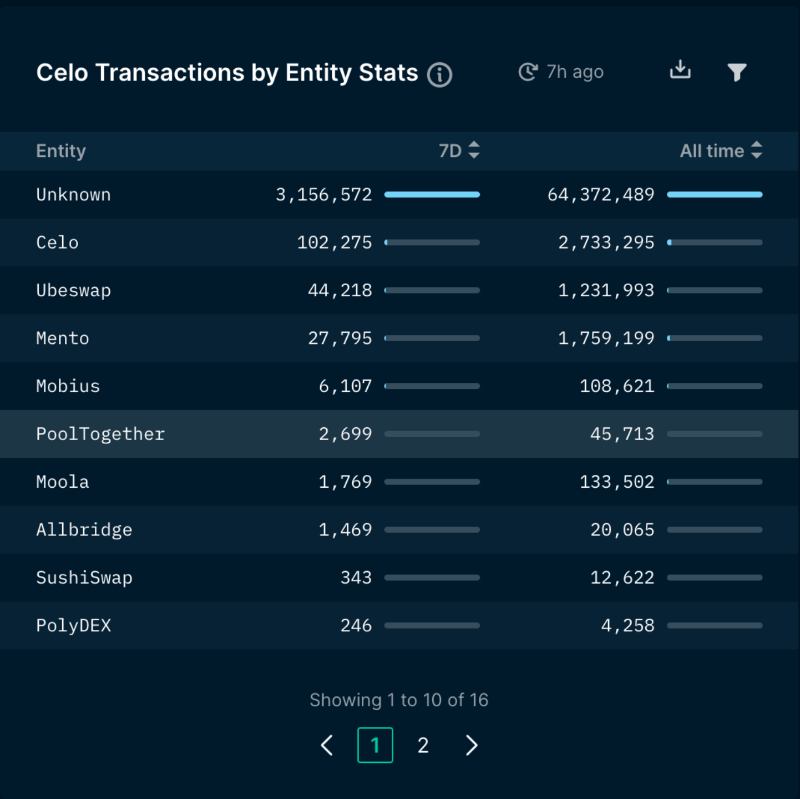
Application transaction volume on Celo
To stay ahead, tracking the latest and hottest smart contracts created on Celo—including trending token launches, staking pools, liquidity pools, and NFT collections—is particularly valuable.
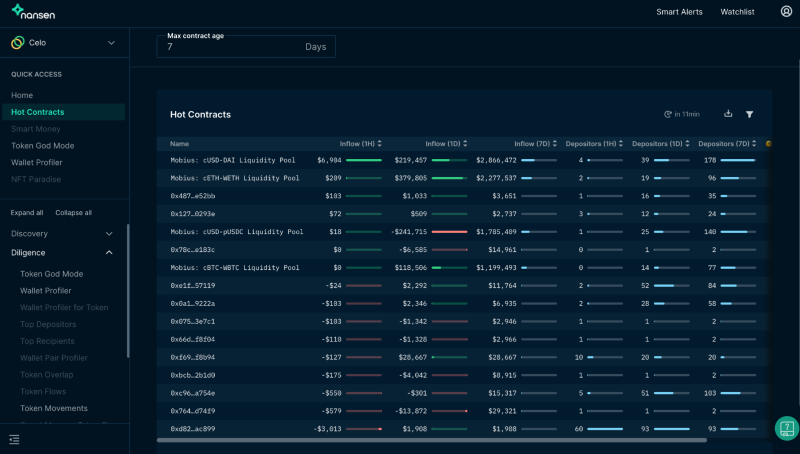
New Contracts Launched on Celo (Sorted by Highest Capital Inflows)
For example, you can identify the most popular liquidity pools. The chart above shows that over the past seven days, the Mobius cUSD-DAI liquidity pool received the highest capital inflows and attracted the most depositors.
Mobius is a bridging swap exchange built on Celo, allowing users to transfer funds from other chains onto Celo and exchange them for theoretically equivalent assets, reducing impermanent loss risk. It also offers yield-incentivized liquidity provision for LPs.
Using Nansen’s X tool, you can determine whether a liquidity pool benefits from “smart money” liquidity. For those unfamiliar with Nansen labels, “experienced investor” refers to crypto entities whose trading or investment behaviors exhibit characteristics of being well-informed or experienced.
Conclusion
Today, we stand at a pivotal moment in cryptocurrency. Blockchain technology has been proven highly successful across multiple fronts, yet lacks the user-friendly experience needed for mainstream adoption. Past revolutions like Web 1.0 and Web 2.0 demonstrated that companies simplifying powerful but complex technologies achieved global reach. Decades later, most users won’t care which smart contracts underlie the decentralized financial services they use—just as most internet users know little about the backbone infrastructure powering the internet. In this regard, Celo clearly understands the challenge, reflected in its mobile-first approach and value stabilization mechanisms addressing volatility.
Celo is undoubtedly one of the pioneering projects aiming to accelerate DeFi adoption and bring more people into the cryptocurrency ecosystem. Watching its ecosystem evolve and seeing what projects emerge next will be fascinating.
Join TechFlow official community to stay tuned
Telegram:https://t.me/TechFlowDaily
X (Twitter):https://x.com/TechFlowPost
X (Twitter) EN:https://x.com/BlockFlow_News
 Nansen