Balance Sheet: The Next Stage of Liquidity Battlefield for Cryptocurrencies
TechFlow Selected TechFlow Selected
Balance Sheet: The Next Stage of Liquidity Battlefield for Cryptocurrencies
The next stage of cryptocurrency adoption is determined not by infrastructure, but by balance sheet flows.
 Navigating Web3 tides with focused insights
By Sebastien Davies, Partner at Primal Capital
Translated by Luffy, Foresight News
For the past decade, global finance has been obsessed with building rails—payment and transaction infrastructure. Discussions around digital assets have focused almost exclusively on blockchain throughput, cryptographic security of decentralized applications, and theoretical elegance of smart contract logic. This was the Infrastructure Era: a period of frenzied construction of “containers.” From 2020 to 2024, the industry built pipelines, vaults, and gateways at breakneck speed, attempting to modernize value transfer.
During this period, crypto market development centered intensely on infrastructure because, without it, institutional participation was simply impossible. We built enterprise-grade custody platforms, standardized exchange APIs, and on-chain compliance services—addressing five core gaps: custody, trading, execution, stablecoin utility, and regulatory reporting.
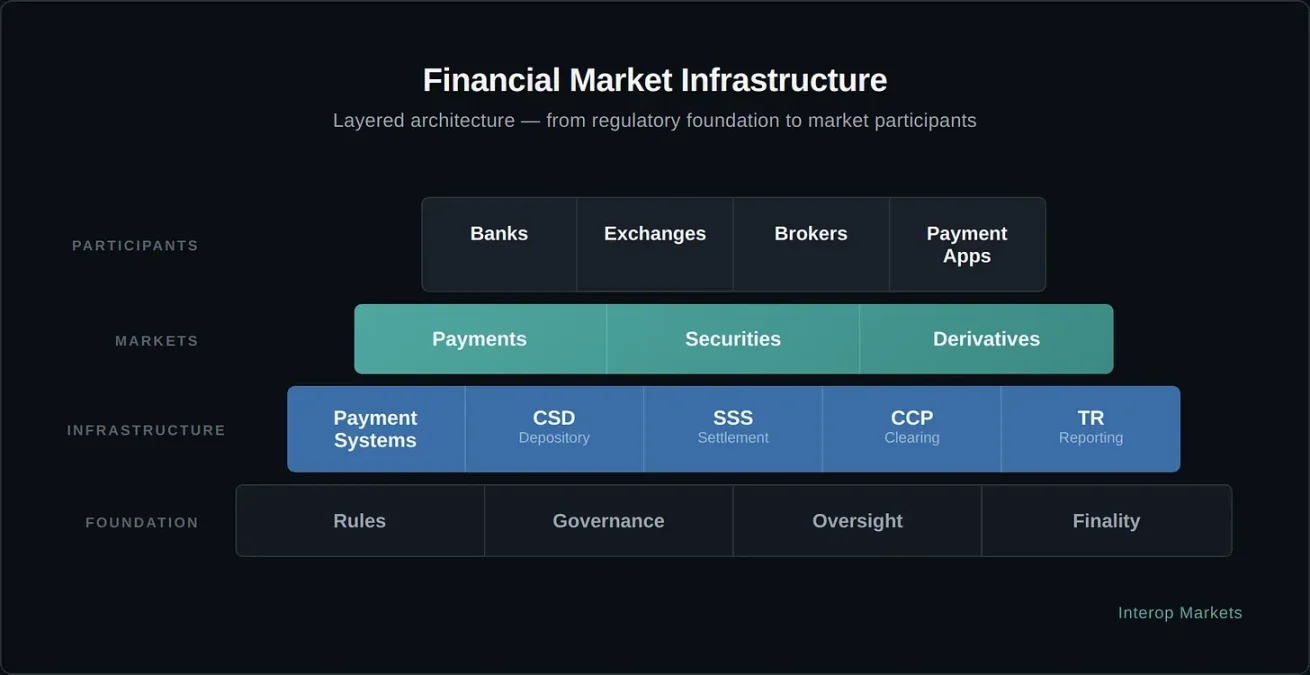
But the industry now confronts a fundamental truth of financial history: infrastructure is a necessary precondition for financial activity—but balance sheets determine who captures economic value.
Merely possessing faster, more transparent rails does not itself shift the gravitational center of markets. Infrastructure solves the technical question of *how* institutions participate—but ignores a far more critical question: *who* captures value.
In the infrastructure-heavy era, value distribution remained stuck in traditional patterns: centralized market makers earned spreads; early holders enjoyed appreciation; validators collected transaction fees. This phase failed to create new balance sheet structures—neither changing where deposits reside nor fundamentally altering the architecture of credit creation.
A common counterargument holds that “rails” are the core driver of value, because they lower entry barriers and democratize finance—naturally shifting economic power toward the periphery. Proponents argue that open-source, permissionless technology is transformative in its own right. This is an alluring narrative for the retail-dominated, crypto-native world—but it fails under the scrutiny of institutional reality.
In mature financial markets, institutions care less about cost efficiency than about capital efficiency and risk-adjusted returns. An institution won’t move $1 billion solely because fees are lower; it moves funds because the balance sheet where those funds reside delivers superior returns—or more efficient collateral utility.
Infrastructure merely makes entry possible; balance sheets are the strategic asset that determines who wins the spread.
Financial history repeatedly confirms: infrastructure does not determine market power—balance sheets do. The rise of the Eurodollar market in the 1960s required no new payment rails or financial technology—only the outflow of dollar deposits from U.S. banking systems. Once those balance sheets migrated, a parallel dollar system emerged—massive in scale and largely outside the reach of domestic U.S. regulation.
We are now entering a new phase—beginning in 2025: the Institutional Balance Sheet Reconfiguration Era. The battlefield has shifted from the protocol layer to the liquidity allocation layer. The prior phase focused on building platforms; the next phase focuses on participant behavior and fund flows.
In 2024, a corporate treasurer choosing where to park cash technically could hold USDC via mature custody infrastructure—but economically, FDIC-insured traditional bank deposits offering attractive interest rates remained more compelling. Infrastructure was ready—but balance sheets had not yet migrated. Only as the regulatory environment moved from abstract policy design to concrete implementation did such reconfiguration become feasible.

The next phase of cryptocurrency adoption will be determined not by infrastructure—but by balance sheet flows.
The On-Ramp to Execution
For most of the past decade, institutional participation was constrained—not by lack of imagination or technology—but by the inability to integrate digital assets into regulated balance sheets. Institutions need more than just a functional wallet; legal clarity, specific accounting treatment, and rigorous governance structures are minimum requirements.
Without an agreed-upon definition of “custody” and without a clear compliance pathway, no regulated entity can afford the risk of balance sheet contamination. Mass adoption stalled in a “waiting game”: banks and asset managers waited for definitive signals confirming they could deploy capital without incurring existential legal risk.
The era of policy debate has finally ended—replaced by operational implementation. The GENIUS Act, passed in May 2025, served as the decisive catalyst—establishing a national regulatory framework for stablecoin payments and, ultimately, providing the legal basis for balance sheet allocation.
The Act establishes a federal licensing process and mandates that stablecoins be fully backed by government-approved instruments, transforming digital assets from speculative novelties into recognized financial instruments. In August 2025, the SEC concluded its protracted investigation into the Aave protocol without enforcement action—fully lifting the regulatory cloud suppressing institutional DeFi participation.
Focus has now shifted to regulatory detail. In February 2026, the U.S. Office of the Comptroller of the Currency (OCC) issued comprehensive proposed rules implementing the GENIUS Act—creating a framework for “Compliant Payment Stablecoin Issuers.” This move is significant: it provides concrete prudential standards covering reserve composition, capital adequacy, and operational resilience—enabling Chief Risk Officers and Asset-Liability Management Committees to formally approve digital asset strategies. The GENIUS Act has embedded blockchain regulation into the governance frameworks of the world’s largest financial institutions.
Yet to understand why change is happening *now*, we must also recognize the balance sheet inertia that defines institutional behavior. Banks operate under strict regulatory capital adequacy constraints—every dollar of risk-weighted assets must be backed by capital. If bank deposits flow into stablecoins, lending must contract proportionally to maintain those capital ratios. Such contraction is painful and costly—and triggers cascading effects across the broader economy. This explains why stablecoin adoption has been so slow. Full technical integration takes six to eighteen months—and governance cycles like audits and board reviews take even longer.
The current environment has entered a phase of compound acceleration. Early movers—including JPMorgan, Citi, and Bank of America—have begun rolling out stablecoin settlement solutions, sending a clear signal: the risk of moving first has been replaced by the risk of falling behind.
We are now in a competitive pressure phase—peer participation has dramatically reduced adoption risk across the industry. As these institutional constraints ease, liquidity migration from traditional systems into programmable digital containers becomes viable. This transformation forces us to reconsider the fundamental ownership of funds—and shifts attention to the “containers” that will carry the next generation of global liquidity.
Where Liquidity Resides
To grasp the magnitude of this transformation, we must first appreciate the historical stability of financial “containers.” In every monetary era, liquidity ultimately requires a home—not just a technical storage solution, but a long-standing global demand for safe, short-term assets.
For centuries, liquidity has concentrated in a few well-defined structures: commercial bank balance sheets, central bank reserves, and money market funds. Each traditional container acts as an intermediary—capturing the economic value generated by the capital it holds.
This reflects the very purpose of financial intermediation: resolving mismatches. Global operations generate far more cash than can be immediately deployed into productive uses—creating a permanent liquidity surplus seeking safe haven.
Traditionally, commercial banks absorb this surplus in deposit form—and invest it in long-duration assets like mortgages and corporate loans—earning substantial net interest margins. This net interest margin is the core metric of commercial banking. Bank shareholders capture most of this spread, while depositors receive only a small portion—in exchange for liquidity and government-backed insurance.
Digital asset infrastructure introduces entirely new types of “containers,” competing directly for this capital. This economic restructuring goes far beyond technological upgrade. When liquidity migrates from banks to stablecoin reserve pools or tokenized Treasury funds, the entity capturing yield undergoes a fundamental shift.
For example, in stablecoin reserve pools, issuers (e.g., Circle, Tether) earn the spread between underlying Treasury yields and interest paid to token holders (often zero). Effectively, this transfers the “habitat economics” of value from the commercial banking sector to digital asset issuers.
Moreover, these new containers offer transparency and programmability unmatched by traditional structures. In March 2026, the market cap of tokenized Treasury funds surpassed $11.5 billion—signaling a structural evolution in which underlying asset yields accrue directly to holders.
This creates powerful economic incentives: senior treasury professionals no longer need to choose between bank safety and fund yield—they can hold tokenized funds that combine yield-bearing assets with high-speed settlement capabilities. By redefining where liquidity flows, digital infrastructure isn’t just building new rails—it’s creating competitive markets for the balance sheets underpinning the global economy.
Stablecoins Drive Capital Reallocation
Stablecoins represent the first large-scale migration of liquidity onto new financial balance sheets—marking the transition of digital currencies from curiosities to core components of financial infrastructure.
The stablecoin market is approaching an all-time high of $31.1 billion—with annual growth of 50%–70%. This growth shatters the notion that stablecoins are “just a speculative phenomenon.” We are witnessing a real “dollar reallocation”: capital exiting traditional banking infrastructure and flowing into programmable settlement systems.
The economic impact of this migration is especially pronounced in the deposit substitution effect.
When a corporation or institutional investor shifts $100 billion from traditional bank deposits into stablecoin containers like USDC, the banking system’s profitability suffers a severe blow. Under the traditional model, that $100 billion supports bank lending—generating roughly $3 billion in annual net interest margin. When funds migrate to stablecoin issuer reserves, this revenue is disintermediated. Banks lose deposits, shrink lending capacity, and forfeit the spread—which is instead captured by stablecoin issuers.
This shift carries profound implications for credit creation and financial stability.
A late-2025 study by Federal Reserve economists emphasized that high stablecoin adoption scenarios could reduce bank deposits by $65 billion to $1.26 trillion—potentially reshaping how economic credit is supplied. Regional banks—highly dependent on stable deposits to fund local lending—are most vulnerable in this migration. As depositors pursue stablecoins’ 7×24 settlement advantages, the “float spread”—a long-standing source of bank revenue—rapidly loses appeal.
In response, banking has shifted from skepticism to active participation.
JPMorgan, Citi, and Bank of America announced proprietary stablecoin settlement infrastructures in late 2025 and early 2026—not to “disrupt” their own businesses, but to preserve their relevance as liquidity containers. These institutions recognize that future economic value accrues to digital container issuers. By issuing stablecoins themselves, banks aim to capture reserve yield that would otherwise flow to new entrants.
Of course, this massive cash reallocation is only the overture. As novel liquidity containers stabilize, the battlefield is shifting toward more complex collateral domains—and the leverage architecture underpinning global finance.
Programmable Collateral
If stablecoin-driven cash migration represents the first wave of transformation, then collateral migration signifies a more fundamental restructuring of finance’s core leverage mechanisms.
Modern financial markets are, at their core, vast networks of secured debt. The U.S. repo market alone sees $2–$4 trillion in daily securities lending. Yet this critical infrastructure remains hampered by traditional banks’ “discrete settlement windows.” In today’s environment, collateral moves only during banking hours—and fragmented custody means securities held at one bank cannot immediately satisfy margin calls at another. This friction locks up capital inefficiently—leaving it unable to respond to real-time market fluctuations.
Tokenization transforms collateral from static, geographically bound assets into programmable, highly liquid instruments.
By converting real-world assets (RWAs)—like U.S. Treasuries—into on-chain tokens, institutions can transfer these assets 24/7 and settle atomically. Market growth is explosive: as of April 1, 2026, the tokenized RWA market stood at ~$28 billion—with tokenized Treasuries comprising nearly half. This growth is driven by institutional-grade products like BlackRock’s BUIDL and Franklin Templeton’s BENJI—enabling holders to earn ~5% yield on underlying government securities while retaining token liquidity and deployability.
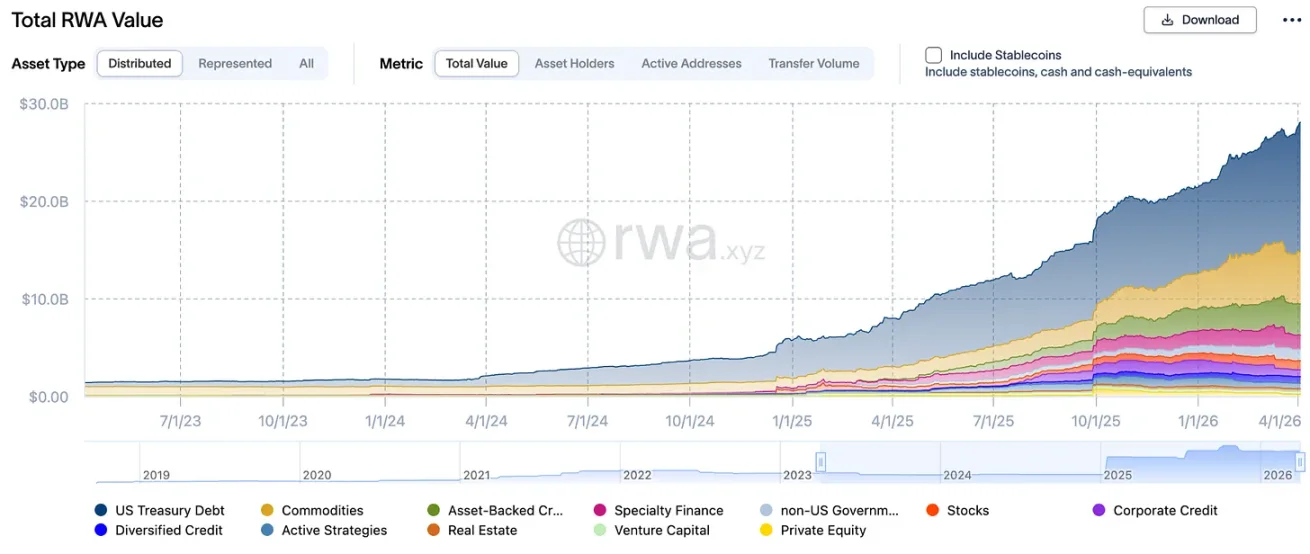
RWA Asset Value, Source: RWA.xyz
The true innovation lies in collateral efficiency.
In traditional repo transactions, investors may face steep haircuts—or wait days to unlock and transfer securities across custodians. Tokenized collateral, by contrast, is composable. An institutional investor holding $100 million in BUIDL tokens can instantly borrow stablecoins at a 95% ratio on protocols like Aave—capturing tactical opportunities. Collateral never leaves the digital environment—instead, automated price feeds continuously revalue it, and margin calls are handled through instantaneous, automatic liquidations.
This shift transforms the “dealer economy” into a “protocol economy.”
In traditional repo markets, large dealer banks act as intermediaries—borrowing at one rate and lending at another, pocketing ~50 basis points in spread. In the tokenized ecosystem, collateral holders match directly in DeFi lending markets—with software acting as intermediary—and capture the full spread. Though scaled implementation may take years, this shift could redirect billions of dollars annually in revenue—from traditional dealer desks to protocol governance and asset holders.
Tokenized collateral’s atomic settlement mechanism dismantles large dealers’ liquidity moats. Institutional workflows now follow roughly this sequence:
- Tokenization: Highly liquid assets—such as U.S. Treasuries—are digitally wrapped (e.g., BUIDL), becoming 24/7 movable tokens.
- Instant submission: Treasury teams can submit tokenized collateral to lending protocols at 10 p.m. on Sunday night—no need to wait for Monday morning wire transfers.
- Real-time valuation: Smart contracts revalue collateral every few seconds via oracles—not once daily—dramatically improving loan-to-value ratios.
- Yield retention: Investors continue earning underlying Treasury yields—even while assets serve as collateral—achieving “yield stacking.”
For corporate treasurers or asset management teams, this represents a fundamental revaluation of idle asset value.
Under the traditional model, treasurers must hold large low-yield cash buffers—to meet sudden margin calls and operational needs. With tokenized collateral, those buffers can remain invested in yield-bearing Treasuries—because the assets can be liquidated in seconds, not days. This eliminates the longstanding “liquidity discount” historically attached to long-duration assets.
The implications for banking are equally profound.
Banks have long profited from the “float” and intermediary spreads in repo markets. As collateral becomes programmable and self-matching, this toll disappears. This is why institutional-grade pipes—like Anchorage Atlas Network and JPMorgan’s internal tokenization projects—are so critical: they represent attempts by financial institutions to build new moats before old ones face competition.
The shift—from cash to collateral—marks finance’s transition from a series of “discrete events” to a “continuous flow.” Institutions failing to adapt their balance sheets to this new velocity will find their capital increasingly static—and increasingly expensive.
Superficially, this is merely faster settlement. Fundamentally, it is a complete restructuring of capital allocation, valuation, and intermediation.
The Adoption S-Curve
Institutional balance sheet migration is not an overnight disruption—but a gradual absorption culminating in accelerated takeoff. It is a “Web2.5” reality: blockchain technology integrates into existing financial architecture—not replacing it.
Current institutional adoption is constrained by balance sheet inertia: regulatory capital requirements, risk committee approvals, and legacy technology systems are massive drags. Banks cannot simply flip a switch to shift assets—they must maintain strict Tier 1 capital ratios, ensuring deposit migration into digital containers doesn’t force lending contraction.
Despite these hurdles, digital asset infrastructure adoption is progressing along a clear S-curve—mirroring the decades-long adoption paths of credit cards and the internet.
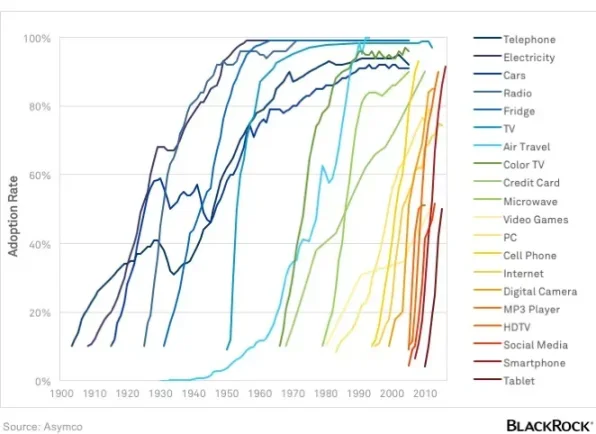
From 2015–2024, the market existed in an experimental, regulatory-chaos phase—growth stifled by uncertainty. We have now entered the Competitive Pressure Phase (2025–2026): regulation is clear, infrastructure is standardized. “You’re not first—but you can’t be last” has become the core motivation for institutional treasurers. As more banks observe peers engaging in stablecoin settlement and tokenized Treasury funds, perceived adoption risk plummets.
Current market scale provides a foundation for accelerated growth: Fireblocks’ annual digital asset transfer volume has surpassed $5 trillion; institutional tokenized asset markets are expanding rapidly; and new system pipelines have reached production-ready maturity. Infrastructure standardization allows banks to build atop mature systems—without reinventing proprietary stacks.
Looking ahead to 2027 and beyond, several “policy levers” remain to further accelerate migration. If stablecoin issuers gain direct access to Fed master accounts—or if the GENIUS Act’s interest restrictions on payment stablecoins are relaxed via consortium “reward” mechanisms—then the pace of deposit migration from traditional bank ledgers to digital containers could significantly accelerate.
The system is poised to enter a virtuous cycle: more stablecoin liquidity attracts more DeFi applications, which in turn attract more institutional capital—culminating in a fundamentally restructured financial landscape. The “rail wars” are over—the focus has shifted entirely to strategic balance sheet management.
The Ultimate Winners
The shift from the Infrastructure Era to the Balance Sheet Era marks digital assets’ transition—from the technical periphery to the core of global macroeconomics.
For years, the industry assumed that building better rails would inevitably produce better systems. Today, we understand: rails are merely invitations—real transformation occurs only when capital itself migrates.
The “rail wars” have, in fact, been won by a standardized, institutional-grade tech stack: MPC custody, tokenized Treasury funds, and federally regulated stablecoin frameworks.
The new battlefield is: balance sheets holding global liquidity and collateral.
Looking ahead to 2027–2030, structural advantage will accrue to entities best able to manage these new “digital containers” with maximum efficiency. As depositors increasingly prioritize stablecoins’ 7×24 settlement and higher yield utility, commercial banks’ net interest margins will remain under sustained pressure. Large corporations and institutional investors may shift primary savings and treasury functions toward DeFi and RWA markets—where protocol transparency will maximize compression of intermediary spreads.
This is not the end of traditional banks—but the end of banks as static, unchallenged warehouses of cheap capital.
Winners in the new era will be “Web2.5” hybrids—those recognizing they are no longer mere lenders, but programmable liquidity managers. By 2030, the stablecoin market is projected to approach $2 trillion—and the boundary between crypto and finance will have effectively disappeared. The system will fully integrate rail efficiency into balance sheet stability.
In this restructured landscape, financial power belongs not to technological innovators—but to those controlling the ultimate containers of global liquidity and collateral.
Over the past decade, crypto has built the infrastructure enabling institutional participation. Over the next decade, it will decide where institutional balance sheets ultimately reside.
Join TechFlow official community to stay tuned
Telegram:https://t.me/TechFlowDaily
X (Twitter):https://x.com/TechFlowPost
X (Twitter) EN:https://x.com/BlockFlow_News