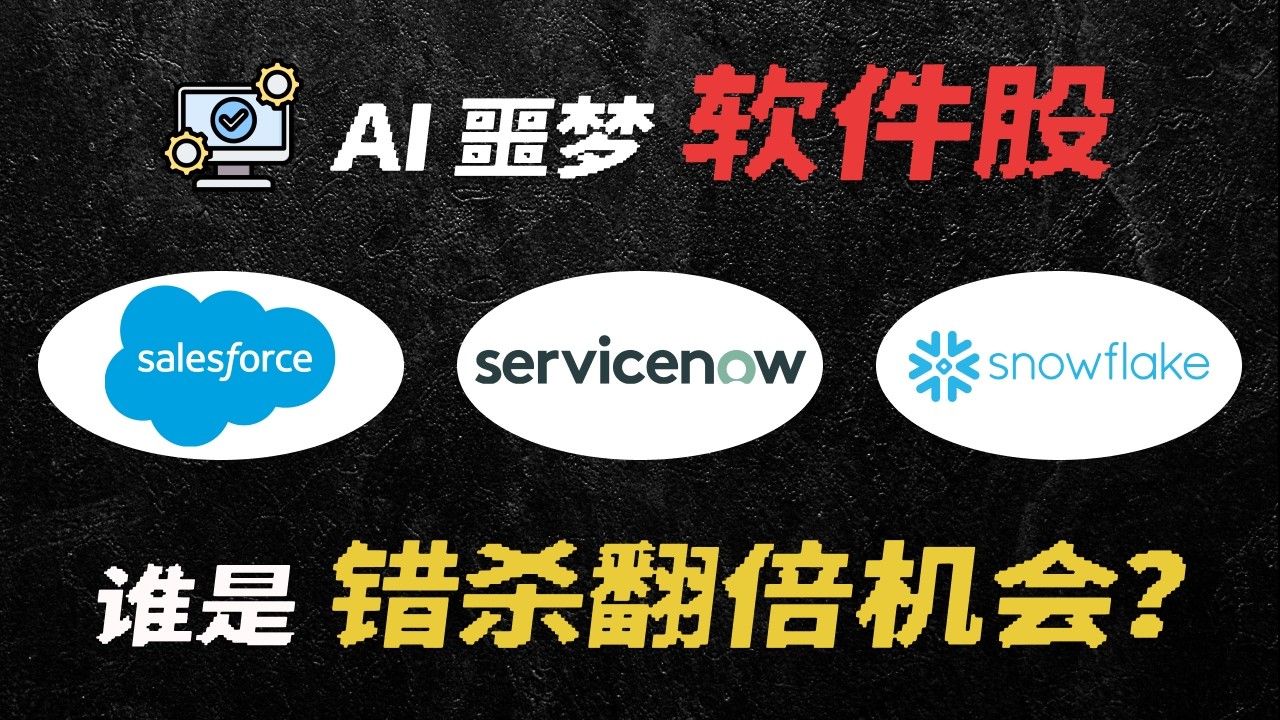
SaaS Software Stocks Amid AI Disruption: Analyzing the Bottom-Fishing Logic for Salesforce, ServiceNow, and Snowflake
TechFlow Selected TechFlow Selected
SaaS Software Stocks Amid AI Disruption: Analyzing the Bottom-Fishing Logic for Salesforce, ServiceNow, and Snowflake
Salesforce is the “margin-of-safety” camp; ServiceNow is the “clearest AI narrative” camp; Snowflake is the “high-leverage, high-risk” camp.
 Navigating Web3 tides with focused insights
Compiled & Edited by TechFlow
Guest: Nico
Original Title: SaaS Software Stocks Under the AI Nightmare: CRM vs NOW vs SNOW—Which Is the Truly Oversold, Double-Up Opportunity? A 10,000-Word Deep Dive Into the Next Wave of Software Stock Opportunities
Podcast Source: Nico’s Frontier Alpha
Air Date: May 21, 2026
Editor’s Introduction
Over the past six months, Wall Street has dubbed a brutal sell-off “the SaaS apocalypse.” Salesforce, ServiceNow, and Snowflake have all been cut in half from their peaks. Meanwhile, JPMorgan’s crowding model shows institutional positioning in semiconductors has surged to 99.3%, while software stands at just 22.8%—a historically extreme emotional divergence. At this inflection point, investor Nico offers a contrarian view: AI isn’t killing the software industry—it’s eliminating companies that merely sell functional UIs, while rewarding platforms that provide infrastructure and governance. Though software’s near-term industry momentum lags hardware, its risk-reward profile and valuation attractiveness are now superior.
The most valuable part of this episode lies in evaluating all three companies under a single analytical framework. Salesforce (13–14x forward P/E, $14.4B free cash flow, $50B buyback authorization) is the “margin-of-safety play”; ServiceNow (AI Control Tower narrative, Jensen Huang’s stage appearances for three consecutive years) is the “clearest AI narrative play”; and Snowflake (usage-based pricing, RPO up 42% YoY, but still GAAP-unprofitable) is the “high-leverage, high-risk play.” On May 27, Salesforce and Snowflake will report earnings on the same day, followed closely by Snowflake’s annual conference and Microsoft’s Build conference—these catalysts will form the most immediate short-term observation window.
Key Quotes
“The SaaS Apocalypse” and Extreme Market Sentiment
- “The software sector has been utterly demolished—not because one company stumbled, but because the entire software sector has been sentenced to death by the market.”
- “JPMorgan’s crowding model shows institutional positioning in semiconductors has spiked to 99.3%, while software sits at only 22.8%—a historically extreme emotional divergence.”
- “The good news for hardware is that everyone has already bought in—it’s fully priced. The bad news for software is that everyone has also largely sold out—leaving room for an upside rebound. Over the next three months, if we look purely at industry momentum, hardware will certainly outperform—but if we assess upside potential, risk-reward, and value, software may actually fare better.”
AI’s Impact on the SaaS Business Model
- “Many functional UIs that SaaS companies once relied on for revenue can now be prototyped in minutes using AI—no coding experience required. What truly worries the market is the erosion of scarcity and moats at the SaaS functional layer.”
- “If one AI Agent can do the work of 10 people, a company that previously purchased 1,000 seats now needs only 100. This is what Wall Street calls ‘seat compression.’”
- “Agents don’t need UIs, dashboards, or polished interfaces—they only need data and APIs. This means SaaS software is being hit with a ‘dimensional downgrade’ by AI: from the primary entry point into enterprise workflows, it’s devolving into a backend data repository.”
Salesforce’s Transformation and Valuation
- “Buying Salesforce isn’t about betting on hypergrowth at dozens of times earnings—or hoping its AI transformation succeeds. It’s a value-oriented trade based on intrinsic worth versus current price. Salesforce is genuinely undervalued today.”
- “Agentforce shifts the monetization logic from ‘per seat’ to ‘per task’: revenue used to scale with headcount; going forward, it scales with total workload. If the per-task billing model proves viable, Salesforce can smoothly transition from a seat economy to a task economy.”
- “Microsoft’s Dynamics 365 plus Copilot represents Salesforce’s biggest medium- to long-term threat. If sales reps no longer open Salesforce at all—and instead use Copilot inside Outlook or Teams to auto-update customer records—Salesforce could degrade from a workflow entry point into a mere backend database.”
ServiceNow’s AI Control Tower Strategy
- “ServiceNow isn’t trying to build another ChatGPT. It aims to become the governance layer, orchestration layer, and execution layer for enterprise-grade AI Agents—regardless of which AI model a company uses, any AI entering corporate processes, calling internal systems, or executing tasks must go through ServiceNow for governance and orchestration.”
- “This positioning resembles Apple’s iOS: Apple doesn’t build every app itself, but every app runs on iOS. ServiceNow intends to follow precisely that path.”
- “Jensen Huang put it plainly: ‘ServiceNow is essentially the enterprise operating system for the AI era.’”
Snowflake’s Consumption-Model Paradox
- “Snowflake fears not that customers stop using it—but that they get *too* proficient. When enterprises realize their Snowflake bill is too high, they push engineering teams to optimize queries, compress storage, or even replace low-value tasks with open-source tools. That’s the double-edged sword of consumption-based pricing.”
- “Snowflake’s net revenue retention rate fell from 131% to 126%, then to the latest 125%. While still healthy, the downward trend signals slowing expansion from existing customers.”
- “Snowflake is the fastest-growing of the three, with the most direct AI data infrastructure thesis—and naturally insulated from traditional SaaS business model pressures. Yet it’s also the most expensive, faces the fiercest competition, and exhibits the weakest profitability. High reward, high risk.”
Historical Analogies and Final Judgment
- “The narrative that ‘AI will kill software’ is dangerously oversimplified. What’s actually happening is AI is eliminating software vendors selling only functional UIs—while simultaneously rewarding infrastructure and governance platforms. Not all software will be disrupted.”
- “During the 2000 dot-com bust, the dominant narrative was ‘the internet will kill all traditional companies.’ But survivors included not only pure internet firms—but also traditional companies that embraced the internet earliest, integrating those tools deeply into their operations. Twenty years later, the AI wave follows the same logic.”
The SaaS Apocalypse and Contrarian Signals
At the start of 2026, the narrative that “AI will kill the software industry” ignited across U.S. equities. Since then, the entire software sector has lived under the nightmare of AI disruption. Even Microsoft—the sector’s blue-chip leader—wasn’t spared, falling over 25% year-to-date and nearing a 40% peak-to-trough drawdown, comparable to the 2022 bear market. Meanwhile, recent darlings like Salesforce, ServiceNow, and Snowflake have each lost over half their market cap. This isn’t a problem confined to one company—it’s the entire software sector receiving a death sentence from the market. Wall Street branded this event “the SaaS apocalypse.”
For nearly six months, both retail and institutional investors have pursued the same strategy: long hardware, short software. The software sector has been crushed. Yet recently, several unusual signals have quietly emerged. JPMorgan’s crowding model shows institutional positioning in semiconductors has soared to 99.3%, while software sits at just 22.8%—a historically extreme emotional divergence. And at this precise moment, President Trump quietly invested several million dollars to buy software stocks; Bill Ackman—the hedge fund manager famed for his bottom-fishing prowess—simultaneously built a massive position in Microsoft, the largest software company; and Jensen Huang, CEO of Nvidia—the world’s most valuable company—flew to Las Vegas for the third straight year to personally endorse a software firm.
So is AI really set to kill the entire software industry—or has it handed us a once-in-a-decade buying opportunity? In today’s episode, I’ll dissect the three most representative software companies: Salesforce, ServiceNow, and Snowflake.
Claude Cowork and the Collapse of the SaaS Sector
The panic over AI killing SaaS—and the resulting software stock crash—traces back to January. On January 30, Anthropic (the company behind the Claude large language model) quietly published 11 plugins on GitHub named “Claude Cowork”: a simple code repository plus a blog post. Within 48 hours of its release, global software stocks hemorrhaged value. Market estimates suggest the software sector collectively lost $285 billion in market capitalization.
Why the panic? A CNBC reporter conducted an experiment that kept SaaS executives awake at night: using Claude Code, he replicated Monday.com—a publicly traded project management platform—in one hour, at a cost of just $5–$15. Monday.com commands a multi-billion-dollar market cap. In one hour and for pocket change, a journalist built a demo nearly indistinguishable from Monday.com.
Of course, this doesn’t mean he cloned a public company. Real Monday.com delivers enterprise-grade permissions, data security, integration ecosystems, and sales channels—none of which AI can replicate in an hour. These take time to build and mature. But the scariest part of this experiment is that many functional UIs SaaS vendors once charged for can now be prototyped in minutes using AI—zero coding experience required. Beneath this story lies the market’s true fear: the erosion of scarcity and moats at the SaaS functional layer. The traditional per-seat SaaS model may no longer hold under AI’s onslaught. This also reveals the underlying ambition of AI model vendors—not just optimizing LLM performance, but directly entering the application layer to claim a slice of this massive pie.
The SaaS Business Model and Two Layers of Panic
SaaS stands for “Software as a Service.” Its essence is simple: moving traditional on-premise enterprise software to the cloud, where customers pay monthly or annually for usage rights. For two decades, this model served as software’s greatest wealth engine.
Nearly all SaaS companies charge per seat. If a company has 1,000 employees using the software, it buys 1,000 seats and pays recurring subscription fees—$10s to $100s per seat annually. The more frequently and extensively the software is used, the stickier the customer becomes—because the company’s entire workflow and data settle into that SaaS platform, making migration prohibitively costly in the short term. This is the fundamental logic enabling light-asset SaaS firms to earn passive profits—and why Wall Street has historically awarded them sky-high P/E multiples of 30x, 50x, or more.
But the AI wave—especially the rise of the Agent era—has begun shaking this foundation. Market concerns about SaaS fall into two layers.
Layer One: Seat Compression
The most immediate panic is agent-driven workforce replacement, causing sharp declines in SaaS subscriptions, revenue, and profits. SaaS vendors charge per user: the more employees using the software, the more seats purchased. But in the Agent era, this logic collapses—if one AI Agent can perform the work of 10 people, a company needing 1,000 seats today requires only 100 tomorrow. This is Wall Street’s widely cited “seat compression.”
The SaaS revenue formula is “customer count × seats per customer × price per seat.” All three variables rose for two decades—but under AI pressure, “seats per customer” now faces structural downside risk for the first time. Markets worry the SaaS business model may be disrupted by AI.
Layer Two: Agent Workflows Bypassing SaaS Interfaces
A deeper level of panic arises when Agent-powered workflows bypass SaaS software entirely—relegating it to a supporting role. This is where markets truly freak out. Traditional SaaS models operate on an implicit premise: the software is designed for humans. Salesforce designs UIs, dashboards, and workflows—all aimed at cultivating user habits and boosting stickiness. But Agents don’t need UIs, dashboards, or polished interfaces—they only need data and APIs.
Once Claude gains direct plugin access to your Salesforce, Notion, Google Drive, and Slack, workflows fundamentally change. Sales reps used to open Salesforce to check customer data, track contracts, and review support tickets—daily operations revolved around Salesforce’s interface. Now, they open Claude to handle these repetitive tasks, while Claude accesses Salesforce via API to read/write data—sales reps never touch Salesforce’s UI.
This means SaaS software is suffering a “dimensional downgrade” from AI—from the primary entry point into enterprise workflows, down to a backend data repository. The terrifying implication is a complete shift in value-chain allocation. Users spent the most time interacting with SaaS software; now they spend more time engaging with Agents. Where users invest the most time, that entity holds pricing power. In this scenario, SaaS software becomes an Agent’s sidekick. SaaS’s strongest moat—decades of entrenched user habits and workflow sedimentation—rested on the assumption that “humans will heavily use UI interfaces.” Agents are changing that. This alone is enough to trigger massive market panic.
Market Crowding and Contrarian Signals
Meanwhile, tightening macro interest rates, massive AI infrastructure capex by Big Tech, and shrinking enterprise software budgets have severely compressed valuations for long-duration software growth stocks. So far this year, the software sector has significantly underperformed the S&P and Nasdaq, leading to a bifurcated market where investors blindly go long hardware and short software.
JPMorgan’s crowding analysis shows semiconductor positioning has reached a historic high of 99.3%—meaning virtually all investors are positioned identically. More notably, short positions in software are rising steadily, pushing squeeze-risk metrics to an extreme 100%. When panic reaches its apex, market inflection points and contrarian signals often begin emerging.
These figures don’t imply funds will immediately rotate out of hardware and into software. Rather, they signal risk: hardware has become the most crowded trading vehicle for both retail and institutions. Blindly going long hardware offers diminishing returns, creating natural demand for sector rotation—from an extremely crowded, fully priced hardware segment to a deeply depressed, story-suppressed, yet fundamentals-improving software segment.
The good news for hardware is that everyone’s already bought in—it’s fully priced. The bad news for software is that everyone’s also largely sold out—leaving room for an upside rebound. My view is clear: over the next three months, if we judge purely by industry momentum, hardware will outperform. But if we assess upside potential, risk-reward, and value, software may actually offer superior returns. Put differently, hardware remains AI’s central theme—but has become overly crowded in the short term; software is the catch-up trade, offering higher near-term elasticity and risk-reward.
This stems primarily from how brutally software has been punished over recent months. Amid AI panic, software stocks suffered broad, indiscriminate selloffs—markets dumped first, asked questions later. This led many high-quality software firms—possessing real business moats, deep data assets, and proactive AI adoption—to be unfairly mispriced.
Moreover, numerous catalysts lie ahead for software in the coming weeks. For instance, on May 27, Salesforce and Snowflake will report earnings simultaneously—these reports will answer a core question: Is AI devouring SaaS—or re-pricing it? Immediately following, Snowflake’s annual conference in San Francisco (June 1–4) will focus on data infrastructure and enterprise AI deployment; Microsoft’s Build conference (June 2–3) will center on AI Agents, Copilot, developer workflows, and enterprise AI applications. These overlapping catalysts may reinforce a software stock rebound. If markets begin believing AI Agents won’t kill software—but instead land through software platforms—ServiceNow, Salesforce, and Snowflake could all benefit.
Company Deep Dive One: Salesforce (CRM)
Company Background
Salesforce’s ticker is CRM—matching its core business. It’s the world’s largest customer relationship management (CRM) software provider and one of the most iconic companies of the SaaS era. In brief, it helps enterprises manage customers—not simply by letting sales reps enter contact info into a web page, but by serving as the central system of record for all customer data.
Who the customer is, which employees engaged them, what products they bought, where their contract stands, whether they filed complaints, how many marketing touches they received—these critical lifecycle data points all reside in Salesforce. They constitute the enterprise’s most vital customer assets. AI can draft emails, summarize meetings, and generate sales scripts—but without a trusted customer database, AI can’t perform these tasks effectively. That’s Salesforce’s core advantage. AI may disrupt Salesforce’s front-end features—but not necessarily its core.
Salesforce embodies both sides of the AI coin: it’s the archetypal traditional SaaS vendor, bearing the brunt of agent-driven seat compression—yet also serves as the foundational data layer for many enterprises, far more than a disposable tool. This duality forms our core analytical lens: Is Salesforce an outdated software firm doomed by AI—or a cash-generating machine mispriced by excessive pessimism?
Salesforce serves over 150,000 enterprise customers—from startups to Fortune 500 giants. Founded in 1999 by Marc Benioff, who previously served as Oracle’s youngest VP and was a protégé of Oracle founder Larry Ellison. He launched Salesforce with a radical idea: enterprise software shouldn’t ship on CDs for on-premise installation—but should run in the cloud, billed monthly or annually.
This notion was radical in 1999. Then-dominant players like Microsoft, Oracle, and SAP sold software for on-premise deployment. Benioff stood alone shouting “No Software”—and ultimately, the SaaS model won, making Salesforce synonymous with the industry.
Benioff’s hallmark is acute intuition and bold directional bets. Last year, when he first unveiled “Agentforce,” the market dismissed it as marketing hype. Yet over recent quarters, Agentforce has delivered impressive results: its latest disclosed ARR stands at $800M, up 169% YoY. Whether you believe Salesforce can execute its AI transformation depends largely on whether you trust Benioff himself.
Product Portfolio
Many assume Salesforce is just a CRM tool—but after two decades of expansion and acquisitions, it has evolved into a vast enterprise software platform.
Its core product is Sales Cloud—the foundation upon which global sales teams manage customers, opportunities, and pipelines. Salesforce’s Sales Cloud underpins the sales operations of countless enterprises. Building on this, Salesforce launched Service Cloud—dedicated to customer service and post-sales support—handling phone complaints, email inquiries, live chat, ticket assignment, and resolution workflows. Beyond that, Marketing Cloud manages digital marketing—precision targeting, email campaigns, and ad-performance tracking—while Commerce Cloud handles e-commerce, enabling online sales.
Together, these four clouds cover every customer-facing interaction: acquisition, conversion, post-sale support, and repeat purchases—end-to-end.
But Salesforce’s ambitions extend further. Over recent years, it has made major acquisitions: MuleSoft (for system integration—connecting data across dozens of disparate enterprise systems), Tableau (for data visualization and business intelligence—turning CRM data into charts and insights), Slack (for enterprise communication and collaboration—akin to Feishu or DingTalk), and last year, Informatica (for enterprise-grade data management—cleaning, integrating, and governing scattered data).
Combined, these acquisitions have built a comprehensive ecosystem centered on customer data: CRM at its core, wrapped by integration, analytics, collaboration, and data governance layers. Salesforce’s newest—and most critical—business unit is Agentforce: its AI Agent platform, launched last year and its most pivotal response to AI disruption.
Business Model: From Seat Economy to Task Economy
Salesforce’s business model epitomizes classic SaaS: per-seat pricing. A company buys seats for its sales, service, and operations staff—each seat costs ~$100+/month, billed annually. Individually inexpensive, but for large enterprises with thousands of users, this becomes highly stable recurring revenue. This is the bedrock of Salesforce’s two-decade “passive income” model—and why Wall Street historically awarded it lofty P/E multiples.
Yet AI’s arrival is loosening this foundation. If AI Agents can autonomously conduct customer research, draft emails, manage sales pipelines, and track leads—do enterprises still need so many sales reps? This is the market’s top concern: seat compression. Salesforce is among the most frequently cited examples in this debate.
Benioff recognized this threat. Starting last year, Salesforce launched an aggressive yet crucial business model pivot: retaining seat-based pricing while introducing a new, AI-era usage-based product—Agentforce. Simply put, the old model charges “per seat purchased”; the new model charges “per AI Agent task executed.” Salesforce terms these units “Agentic Work Units” (AWUs)—quantifying AI Agent workload.
This new model is brilliantly conceived. If AI truly replaces human labor, seat counts may decline—but AI Agent task volume may surge dramatically. One sales rep might manage 20 customers daily; one AI Agent could handle 200. Human seats shrink—but AI-executed tasks may double or increase tenfold. If per-task billing proves viable, Salesforce can seamlessly transition from a seat economy to a task economy—potentially boosting revenue per customer. Revenue shifts from scaling with employee headcount to scaling with total workload. That’s Agentforce’s core significance—it may redefine Salesforce’s entire monetization logic and business model.
Of course, this story remains unproven. Though Agentforce’s ARR has reached $800M with rapid growth, it still accounts for less than 2% of Salesforce’s $41.5B annual revenue. Moreover, Salesforce faces steeper seat compression than any peer: it sells seats to sales, service, and marketing staff—roles AI Agents target first (email drafting, lead follow-up, sales copy generation, customer query handling)—precisely where LLMs excel. Replacing 2% of new revenue against declining legacy seat revenue is extraordinarily difficult.
Given this, why do I still consider Salesforce compelling? Not because I believe Agentforce’s growth will definitively offset legacy seat declines—but because its forward P/E trades at just 13–14x, fully pricing in pessimism. It generates $14.4B in free cash flow and holds a $50B share repurchase authorization.
Thus, buying Salesforce isn’t about betting on hypergrowth at high multiples—or hoping its AI transformation succeeds. It’s a value-oriented trade weighing intrinsic worth against current price. Salesforce is genuinely undervalued today. Of course, this margin of safety isn’t unconditional: if AI causes material seat-revenue erosion and Agentforce fails to compensate, valuations may compress further. But as long as core business remains stable, buybacks continue, and Agentforce delivers even partial success, markets may re-rate the stock upward.
Moat
Salesforce’s strongest moat is the massive customer data accumulated over two decades. A company using CRM for 10 years may house millions of customer records, hundreds of thousands of sales process entries, and tens of thousands of custom fields. Migrating all this equals rebuilding an enterprise’s entire digital foundation—an effort vastly more expensive than continuing subscription payments.
Where does Salesforce falter? Microsoft’s Dynamics 365 plus Copilot poses its biggest medium- to long-term threat. As the world’s largest software company, Microsoft’s B2B office suite already permeates most large enterprises globally. Dynamics 365—Microsoft’s CRM—directly competes with Salesforce’s core product, growing >20% annually for years. Crucially, Dynamics 365 is deeply integrated with Copilot, Teams, and Outlook—the very software interfaces employees use daily. If sales reps never open Salesforce again—and instead use Copilot in Outlook or Teams to auto-update customer records—Salesforce risks degrading from a workflow entry point to a mere backend database. This is Benioff’s deepest fear—and Salesforce’s greatest long-term uncertainty.
Latest Earnings Data
Last fiscal year’s final quarter showed: $41.5B annual revenue (+10% YoY); $72B total RPO (+14% YoY); $14.4B free cash flow (+16% YoY); $14.3B returned to shareholders ($12.7B in buybacks, $1.6B in dividends). Salesforce recently approved a $50B share repurchase program. Agentforce’s ARR stands at $800M (+169% YoY), with 29,000 deals closed.
A caveat: 29,000 deals ≠ 29,000 large customers, nor does it guarantee large contracts. This metric signals rapid product rollout—but ultimate valuation hinges on increasing average deal size and net revenue retention. During this earnings call, the company raised its FY2030 revenue target to $63B.
Overall, Salesforce’s fundamentals remain rock-solid. During the last earnings call, CEO Benioff called it “the most successful year in company history—and the best year ever for the software industry”—adding it presents an ideal marketing and buying opportunity, prompting the $50B buyback authorization. His tone was unmistakable: management is pleased with results—and directly challenging market pessimism, asserting Salesforce’s stock is mispriced.
At the time of this video, Salesforce traded at $180, with a forward P/E of 13–14x. Compared to recent bull-market multiples of 30x–40x+, this reflects significant compression—its lowest valuation in years.
Catalysts and Risks
Bull case is straightforward: cheap valuation, stable cash flow, aggressive buybacks, and accelerating Agentforce adoption. Salesforce’s May 27 earnings report is a key near-term catalyst.
Bear case centers on modest 10% growth (subpar for software), persistent AI disruption concerns, and high uncertainty around Agentforce. The market’s core question remains: Can Agentforce grow large enough to drive overall revenue and profit—and enable full AI transformation? Time will tell.
For the May 27 report, watch for: First, whether Agentforce’s ARR maintains >100% YoY growth. A slowdown would signal AI-transformation risk—and management’s response will be critical.
Second, signs of material contraction in seat-based SaaS revenue. If observed, markets may intensify “AI devouring SaaS” narratives.
Also monitor management’s forward guidance—does it remain optimistic? Do leaders proactively address AI’s impact on SaaS business models? These are all key watchpoints.
Based on last quarter’s results, management’s stance was unequivocally optimistic—they reject the notion that AI will kill Salesforce, instead viewing it as upgrading from a SaaS application vendor to an enterprise Agent platform. Yet data-wise, this story remains in early validation. Personally, I see no need to prematurely conclude whether AI will disrupt Salesforce—or whether its AI transformation will succeed. I prioritize its current valuation—near its most discounted level in years—combined with robust fundamentals, delivering high near-term value and risk-reward. Long-term, AI remains the central narrative—and Salesforce’s ability to withstand AI’s test requires further time to prove.
Company Deep Dive Two: ServiceNow
Company Background
ServiceNow is the software company I referenced earlier—whose annual Las Vegas conference Jensen Huang has attended for three straight years. If Salesforce manages external customer relationships, ServiceNow manages internal enterprise workflows and employees. In brief: it’s the central nervous system of enterprise operations.
Countless internal approval, routing, execution, and logging workflows run on ServiceNow: IT ticketing for broken laptops; HR onboarding for new hires (account creation, laptop provisioning, policy training); incident response for system outages; security alert triage, escalation, and remediation. Thus, it’s far more than an IT ticketing system—it’s a unified platform for enterprise-wide workflows.
Founded in 2004 and headquartered in Santa Clara, California, ServiceNow’s current CEO is Bill McDermott—formerly CEO of SAP—with decades of enterprise software experience. Since taking the helm in 2019, McDermott has expanded ServiceNow beyond IT ticketing into a “full-enterprise workflow platform.” His style is distinct: adept at big narratives, large deals, and enterprise clients—a strength amplified in the AI era.
Product Portfolio
Its foundational product is ITSM—used by IT departments to manage tickets, incident response, change releases, and IT assets/services. In the ITSM market, ServiceNow is the undisputed global leader. Building on this, it launched ITOM (IT Operations Management): while ITSM focuses on “how to fix problems after they occur,” ITOM emphasizes proactive system monitoring, issue detection, and automated remediation.
Expanding further, HR Service Delivery covers onboarding, offboarding, leave requests, transfers, and all employee service needs. Customer Service Management serves enterprise clients (overlapping with Salesforce’s Service Cloud, but focusing on complex B2B scenarios like large equipment, cross-departmental support tickets). Security Operations handles security incident response; Strategic Portfolio Management helps CIOs manage IT project portfolios—deciding which projects to fund or axe.
Collectively, ServiceNow has evolved from a simple IT service management tool into an enterprise internal workflow platform. This explains its 97% renewal rate: once a company migrates IT, HR, security, and customer service workflows onto ServiceNow, replacing it isn’t just swapping software—it’s rebuilding the entire internal operational system, an exceptionally costly endeavor.
Recent Key Acquisitions
Beyond native products, ServiceNow made several critical acquisitions over the past year.
First, Moveworks—a provider of AI-powered employee service assistants. Employees no longer hunt for entry points—they ask AI questions, and AI retrieves policies, files tickets, checks status, or even resolves issues automatically. Post-acquisition, Moveworks’ capabilities were integrated into ServiceNow’s EmployeeWorks.
Second, Veza—focused on identity governance and permission management. In the AI Agent era, “who can access what data” becomes paramount—not just for humans, but for Agents. Veza solves exactly this.
Third, Armis—a cybersecurity firm specializing in real-time asset visibility. Armis identifies every device on an enterprise network, detects vulnerabilities, and maps communications.
All three acquisitions point toward preparing for AI Agents’ enterprise-scale deployment. Agents need to know what employees ask, who’s authorized to access what data, and what assets exist on the network—these acquisitions fill those exact gaps. However, multiple acquisitions in quick succession carry integration risk—especially Armis’ $7.75B mega-deal, which we’ll detail when discussing risks.
Core AI Strategy: AI Control Tower
ServiceNow’s flagship AI strategy is the “AI Control Tower.” This concept starts with a practical reality: enterprises won’t adopt just one AI. They’ll likely use OpenAI’s GPT for customer service, Anthropic’s Claude for contract review, Microsoft’s Copilot for document collaboration, and Google’s Gemini for data analysis—plus internally developed AI Agents.
Then comes the problem: With so many AI Agents operating internally, who governs them? Who decides what data they can access—or cannot access? Who ensures they don’t exceed permissions? How is accountability enforced if failures occur? The AI Control Tower solves precisely this.
ServiceNow isn’t building another ChatGPT. Instead, it aims to become the governance layer, orchestration layer, and execution layer for enterprise AI Agents—ensuring safe, compliant, auditable action within enterprises. This distinguishes it from many other SaaS vendors. Others ask, “Can we build our own AI Agent to compete with ChatGPT, Claude, and Gemini for application-layer entry?” ServiceNow wisely chose a different path: “We won’t compete for foundational models—but we’ll govern and orchestrate how those models execute within enterprises.”
ServiceNow’s goal is clear: regardless of which AI a company uses, any AI entering corporate processes, calling internal systems, or executing tasks must pass through ServiceNow for governance and orchestration.
Why ServiceNow?
This hinges on ServiceNow’s two-decade accumulation of foundational capabilities. It owns a CMDB (Configuration Management Database)—essentially a complete map of enterprise IT assets and system interrelationships: servers, deployed applications, user permission hierarchies—all recorded here. It also operates a mature workflow engine, running all enterprise approvals, executions, and collaboration chains. Plus, it maintains comprehensive audit logs—recording who did what, when, and what changed.
When AI Agents enter enterprises, they need precisely these three things: awareness of callable systems, adherence to predefined workflows, and full audit trails for every action. Additionally, ServiceNow augmented identity/permission verification via Veza and real-time asset visibility via Armis.
At this year’s Knowledge conference, ServiceNow advanced further—launching Action Fabric. This allows any third-party AI Agent—be it Claude, GPT, Gemini, or Copilot—to invoke ServiceNow’s governance engine to execute enterprise tasks. “Use whatever AI model you want—but execution and governance must flow through us.” This logic mirrors Apple’s iOS: Apple doesn’t build every app, but every app runs on iOS. ServiceNow aims to walk precisely this path.
Jensen Huang Endorsement
The most persuasive endorsement comes from Jensen Huang. Nvidia’s CEO has attended ServiceNow’s annual conference for three consecutive years—not just as a partner exchanging mutual promotion, but as a paying customer. Nvidia’s internal supercomputer quotation system runs on ServiceNow: generating a full quotation used to take five days—now completed in five minutes via AI workflows.
Huang stated plainly: “ServiceNow is essentially the enterprise operating system for the AI era.” This year, the two companies jointly launched Project Arc—Nvidia provides secure AI compute sandboxes; ServiceNow supplies enterprise governance. Their deep partnership confirms ServiceNow’s AI Control Tower isn’t an isolated software concept—it’s embedded in the enterprise落地 narratives of Nvidia, OpenAI, Google, and Anthropic.
Latest Financial Data
This quarter: $3.77B total revenue (+22% YoY); $3.671B subscription revenue (+22% YoY), exceeding upper guidance; $27.7B total RPO (+25% YoY); 97% customer renewal rate. These figures confirm ServiceNow’s fundamentals remain solid—it’s still a ~20% growth, 97% renewal, high-margin, high-cash-flow software platform.
AI performance shines brighter. The company raised its AI-related ACV (Annual Contract Value) target from $1B to $1.5B this year. Note: ACV measures contractual commitments—not current revenue—which will convert to realized revenue over time. A 50% upward revision in one quarter signals strong customer adoption and rapid AI-product growth.
Its stock has fallen over 50% from its peak, trading at a forward P/E of ~21–24x. For a high-growth, light-asset software company, this qualifies as a relatively undervalued range.
Catalysts and Risks
Bull case is clear: First, its AI narrative is exceptionally coherent—AI Control Tower as the AI-era enterprise OS means greater AI adoption drives stronger demand for governance, auditing, permissions, and execution platforms. Second, its AI business is demonstrably scaling—AI ACV jumped from $1B to $1.5B, proving real customer traction. Third, its ecosystem partners are elite—OpenAI, Google Gemini, Claude, and Nvidia all integrate with or deeply partner with ServiceNow—bolstering its strategic “enterprise AI control tower” positioning.
Risks must also be addressed. Despite beating expectations, ServiceNow’s stock fell double digits after its latest earnings—reflecting extreme market pessimism. This signals the broader trend hasn’t reversed; skepticism remains around SaaS business models and AI transformations. Also, its three recent acquisitions—especially Armis’ $7.75B deal—require digestion time. Markets will scrutinize whether raised revenue guidance stems from acquisitions or organic growth. External risks include Middle East geopolitical factors—last quarter saw delayed large projects, reducing subscription revenue growth by ~75 bps.
Personally, I’m bullish on ServiceNow. Among the three, it boasts the clearest, most intuitive AI narrative—and one most readily embraced by markets. Its AI Control Tower positioning won’t suffer from AI disruption—instead, it benefits from AI proliferation, positioning it as the most critical software platform for enterprise AI implementation. Valuation-wise, its stock has halved from highs, with a low forward P/E—similar to Salesforce—making current entry highly attractive on value and risk-reward grounds.
Company Deep Dive Three: Snowflake
Company Background
In one sentence: Snowflake is the enterprise data super-warehouse. If Salesforce manages customers and ServiceNow manages workflows, Snowflake manages data. All enterprise data—sales figures, user behavior, financial statements, system logs—flows into Snowflake, where it’s analyzed, modeled, and used to run AI workloads.
Product Portfolio
Snowflake’s foundational layer remains its data warehouse and data lake—where enterprises ingest structured and semi-structured data to run SQL queries and analytics. This is Snowflake’s bedrock—and its primary revenue source. Built atop this is Snowpark, enabling developers to write Python, Java, or Scala code directly within Snowflake to build data pipelines and ML models—eliminating data movement and enabling end-to-end processing and training within the platform.
Next is Cortex AI—Snowflake’s flagship AI suite launched over the past year, featuring two core products. Snowflake Intelligence targets business users: it enables natural-language dialogue with data, automatically querying structured/unstructured data, analyzing, generating insights, and executing multi-step tasks—functioning like an enterprise AI Agent. Cortex Code targets developers: unlike generic coding assistants, it’s Snowflake-native—understanding Snowflake’s data schemas, permissions, and compute environments—to help write data pipelines, debug queries, and build AI apps.
Thus, roles are clear: Snowflake Intelligence empowers non-SQL business users to query, use, and act on data via AI; Cortex Code accelerates developers and data engineers in building data apps, pipelines, and AI applications.
Beyond AI, Snowflake offers two unique capabilities. Snowflake Marketplace is a data-sharing and trading hub—enterprises buy/sell datasets or consume third-party data for analysis. Data Clean Rooms enable privacy-preserving cross-organizational data collaboration: two firms jointly analyze data without exposing raw inputs—advertisers use this for cross-platform attribution, pharma for joint clinical trials, finance for fraud detection. These are hard-to-replicate differentiators.
Collectively, Snowflake is evolving from a data warehouse tool into an AI data platform: data storage/compute at the base; development tools and AI engines in the middle; intelligent assistants and data marketplaces for business users at the top. Snowflake aims not just to store and query data—but to enable enterprises to analyze, share, develop applications, and embed AI directly into their governed data platforms. It currently serves 13,300+ enterprise customers, processing 6.3B data queries daily.
Business Model
This is Snowflake’s key distinction from the prior two. Salesforce and ServiceNow charge per seat—fixed annual subscription fees. Snowflake operates on pure consumption: customers pay for actual compute and storage resources consumed—queries run, compute used, data stored—calculated via Snowflake’s pricing formula.
This model has pros and cons. Pros: In the AI era, enterprise data consumption grows exponentially—every AI task consumes compute and queries—so Snowflake’s revenue naturally surges with AI workload growth. Cons: If enterprises cut budgets or optimize workloads, Snowflake’s revenue falls accordingly.
However, Snowflake has aggressively promoted multi-year consumption commitment contracts. Its latest RPO stands at $9.77B—up 42% YoY—indicating large customers are locking multi-year compute budgets with Snowflake, not maintaining easily reversible relationships.
Moat and Competitive Landscape
Its strength lies in data stickiness. Once data flows into Snowflake, upstream/downstream analytics models, query scripts, and data pipelines are all built atop it—migration costs are extremely high. This is Snowflake’s core moat. Its Data Clean Rooms also excel in privacy-preserving, cross-organizational collaboration—difficult to replicate.
Weakness lies in fierce competition. Its biggest rival is Databricks—whose latest annualized revenue run-rate hit $5.4B (+65% YoY), over twice Snowflake’s 29% growth—and whose latest valuation exceeds $100B. Databricks excels in ML and AI workloads. If Databricks goes public, it will likely rank among the most anticipated enterprise software IPOs—forcing Snowflake to face direct public-market comparisons.
Beyond Databricks, the Big Three cloud providers pose threats. AWS Redshift, Google BigQuery, and Azure Synapse continuously evolve—deeply integrated with their respective cloud ecosystems. They’re both Snowflake partners and potential alternatives. Further down, open-source or emerging tools like DuckDB and ClickHouse chip away at specific niches—local analytics, real-time analysis, low-cost queries. Thus, Snowflake’s competitive landscape is more complex than Salesforce’s or ServiceNow’s.
Counterintuitive Risk of the Consumption Model
Here’s a counterintuitive point: Snowflake fears not customers abandoning it—but customers mastering it too well. Because Snowflake charges per consumption, higher query volume, compute usage, and data storage directly boost revenue. Conversely, if enterprises find bills too high, they’ll optimize queries, compress storage, or replace low-value tasks with open-source tools.
This is the double-edged sword of consumption pricing: rapid growth lifts revenue alongside usage—but usage optimization drags revenue growth. This trend appears in the data: Snowflake’s net revenue retention fell from 131% to 126%, then to the latest 125%. Still healthy—existing customers still increase spending annually—but the downward trend signals slowing expansion from established clients. This reflects both natural deceleration from larger bases and customer-driven cost optimization and usage pacing.
Thus, Snowflake resembles a high-growth, high-leverage, intensely competitive AI data platform. This is its greatest allure—and its greatest risk.
Latest Financial Data
Annual product revenue: $4.47B (+29% YoY)—fastest-growing of the three. Latest quarter: $1.23B product revenue (+30% YoY), slightly above annual growth. RPO: $9.77B (+42% YoY). Net new customers: 740 (+40% YoY). Signed its largest-ever contract—exceeding $400M. These figures show demand remains robust—large customers sign increasingly larger long-term contracts.
But challenges persist. GAAP net loss for the year totaled ~$1.33B—making Snowflake the only one of the three still GAAP-unprofitable. Quarterly stock compensation totals >$400M—$1.7B+ annually—imposing notable shareholder dilution pressure.
Yet Snowflake remains the most expensive of the three—its EV/Sales ratio (based on forward revenue) sits near 9x—significantly above Salesforce’s.
Catalysts and Risks
Upside drivers include: First, Snowflake’s usage-based model—unlike traditional SaaS—naturally benefits from AI workload growth. Short-term, more AI activity means more Snowflake revenue. Second, RPO growth of 42% YoY signals large customers signing bigger long-term contracts—enhancing future revenue visibility. Third, Snowflake Intelligence and Cortex Code are expanding rapidly—9,100+ accounts already use AI features.
Additionally, two key events loom: Snowflake’s May 27 earnings report, followed immediately by its San Francisco annual conference (June 1–4). These tightly clustered catalysts tilt positive for me. Expect heightened stock volatility during this period.
Risks require acknowledgment. First, persistent GAAP losses remain the biggest structural weakness. In a market favoring profitability and cash flow, Snowflake faces greater valuation pressure than Salesforce or ServiceNow. Second, Databricks is Snowflake’s fiercest competitor. Databricks’ eventual IPO could reshape the entire data platform landscape—if it launches with faster growth, stronger AI narratives, and more attractive valuations, capital may rotate from Snowflake to Databricks. Other noise—including shareholder lawsuits and insider selling—may influence sentiment but aren’t core themes.
In one sentence: Snowflake is the fastest-growing of the three, with the most direct AI data infrastructure thesis—and naturally insulated from traditional SaaS business model pressures. Yet it’s also the most expensive, faces the fiercest competition, and exhibits the weakest profitability. High reward, high risk.
Three-Way Comparison and Personal Conclusion
After dissecting these three companies, here’s my subjective assessment.
If you prioritize margin of safety and value investing logic, Salesforce is the most stable choice: ~13–14x forward P/E, $14.4B free cash flow, $50B buyback authorization, and stable profitability—offering substantial entry safety. But its 10% growth implies limited near-term price explosiveness.
If you embrace the AI Control Tower governance-layer thesis, ServiceNow may be the clearest AI narrative among the three: >20% growth, 97% renewal rate, ~22x forward P/E—and Jensen Huang’s three-year personal endorsement adds credibility. Current entry offers strong value. But you must accept integration risks from密集 acquisitions and tolerate short-term price volatility.
If you seek maximum elasticity—and can stomach maximum volatility—Snowflake is the high-reward bet. Its biggest risks are unprofitability, declining net revenue retention, and Databricks’ looming IPO, which could reset valuation anchors across the data platform space. Volatility is genuinely high.
Beyond these three, if you seek the most stable anchor in software, Microsoft remains optimal—it’s arguably the most mispriced large-cap software name in this correction. Still, I emphasize: this is solely my personal framework—not investment advice. You must make decisions based on your own portfolio context and rational analysis.
Conclusion: Who Does AI Kill?
Finally, returning to our opening question: Is AI killing the entire software industry—or handing us a once-in-a-decade buying opportunity?
My judgment: The “AI kills software” narrative is dangerously oversimplified. What’s truly occurring is AI eliminating vendors selling only functional UIs—while rewarding infrastructure and governance platforms. Not all software will be disrupted.
This parallels the 2000 dot-com bust: the dominant narrative was “the internet will kill all traditional companies.” Yet survivors included not only pure internet firms—but also traditional companies that embraced the internet earliest, integrating those tools deeply into operations—successfully completing their internet transformation. Twenty years later, the AI wave follows identical logic. Software firms with real moats, deep data assets, and infrastructure-platform capabilities will emerge as the ultimate winners. Right now, they may stand precisely at the starting line of a new upcycle.
Join TechFlow official community to stay tuned
Telegram:https://t.me/TechFlowDaily
X (Twitter):https://x.com/TechFlowPost
X (Twitter) EN:https://x.com/BlockFlow_News
 深潮TechFlow