This summer, the AI industry's most extreme bet is about to be revealed.
TechFlow Selected TechFlow Selected
This summer, the AI industry's most extreme bet is about to be revealed.
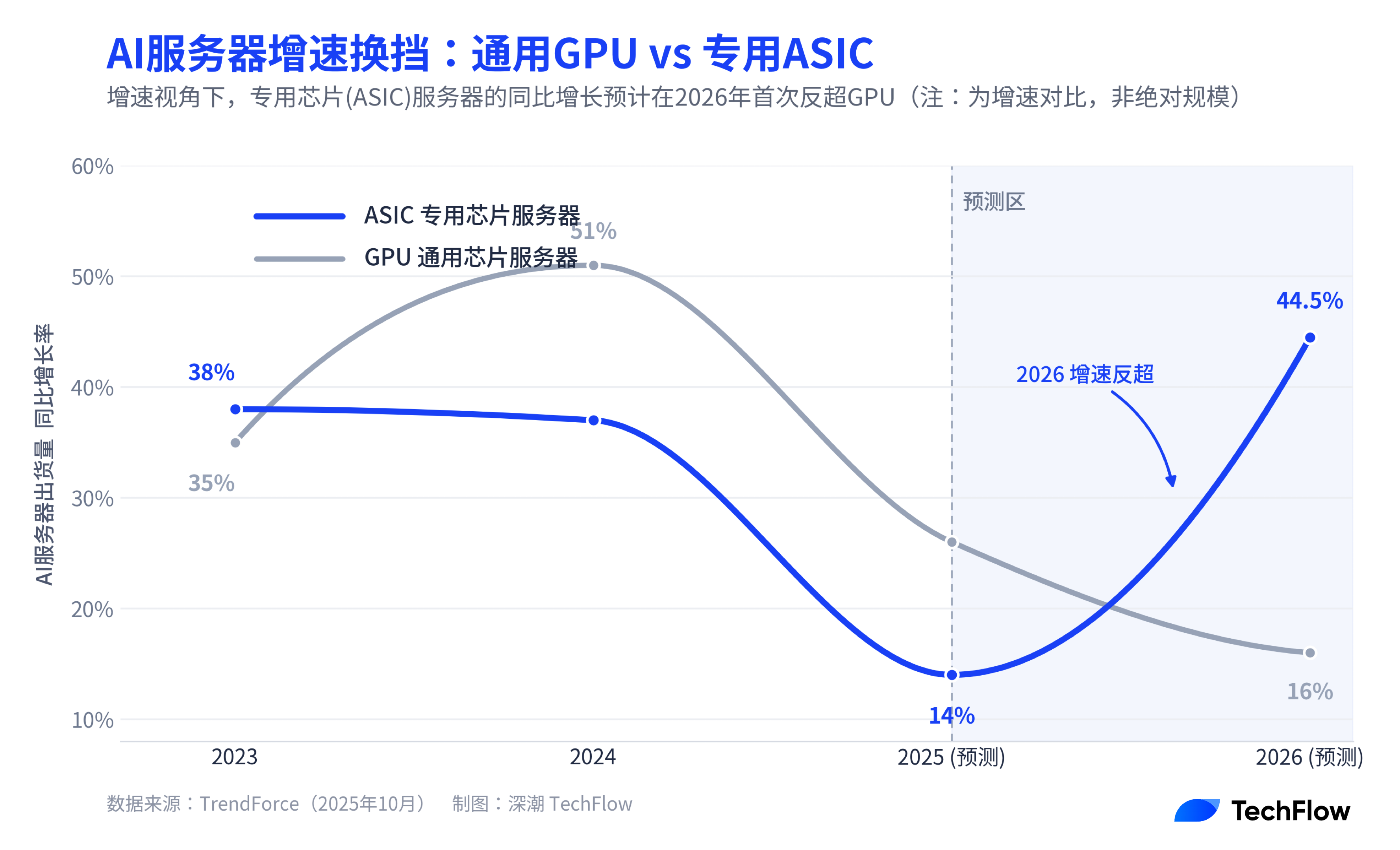
Chips designed specifically for AI inference are shaking the status of general-purpose chips.
 Navigating Web3 tides with focused insights
Author: David, TechFlow
In recent weeks, if you've been watching the chip stocks in your account, you've probably doubted one thing: Has this AI wave already peaked?
In over half a month, the semiconductor sector evaporated more than $100 billion in market cap, memory stocks collectively fell into a bear market, and even when Samsung reported record profits, its stock price fell instead of rising on the day...
Bears dug out the charts from the 2000 internet bubble to make rigid comparisons, while bulls said this was just a correction after rising too sharply. Amidst the back-and-forth arguments, everyone is still fixated on the same batch of companies, the giants selling chips like NVIDIA, Intel, and Micron.
The debate might just be a small slice of a major shift in industry trends; the bigger picture has barely been brought to the table for discussion. Have you ever thought that the chips themselves are undergoing a sea change?
In past years, chips used for AI were general-purpose; NVIDIA's GPUs could compute anything, graphics, training, inference, everything was possible. But the cost of being good at everything is not being extreme at anything.
But now, almost all major tech companies are secretly building something new: specialized chips that do only one thing, but do that one thing to the extreme.
OpenAI is building them, Google's TPU and Amazon's Trainium are examples, and Broadcom's stock surged this year precisely because it helped Google build this kind of chip. This might be a hidden thread most people haven't noticed.
The era of general-purpose chips is being pried open by specialized chips.
On this hidden thread, there is a company whose name you haven't even heard of that is going further than anyone else, even boldly claiming it will replace NVIDIA.
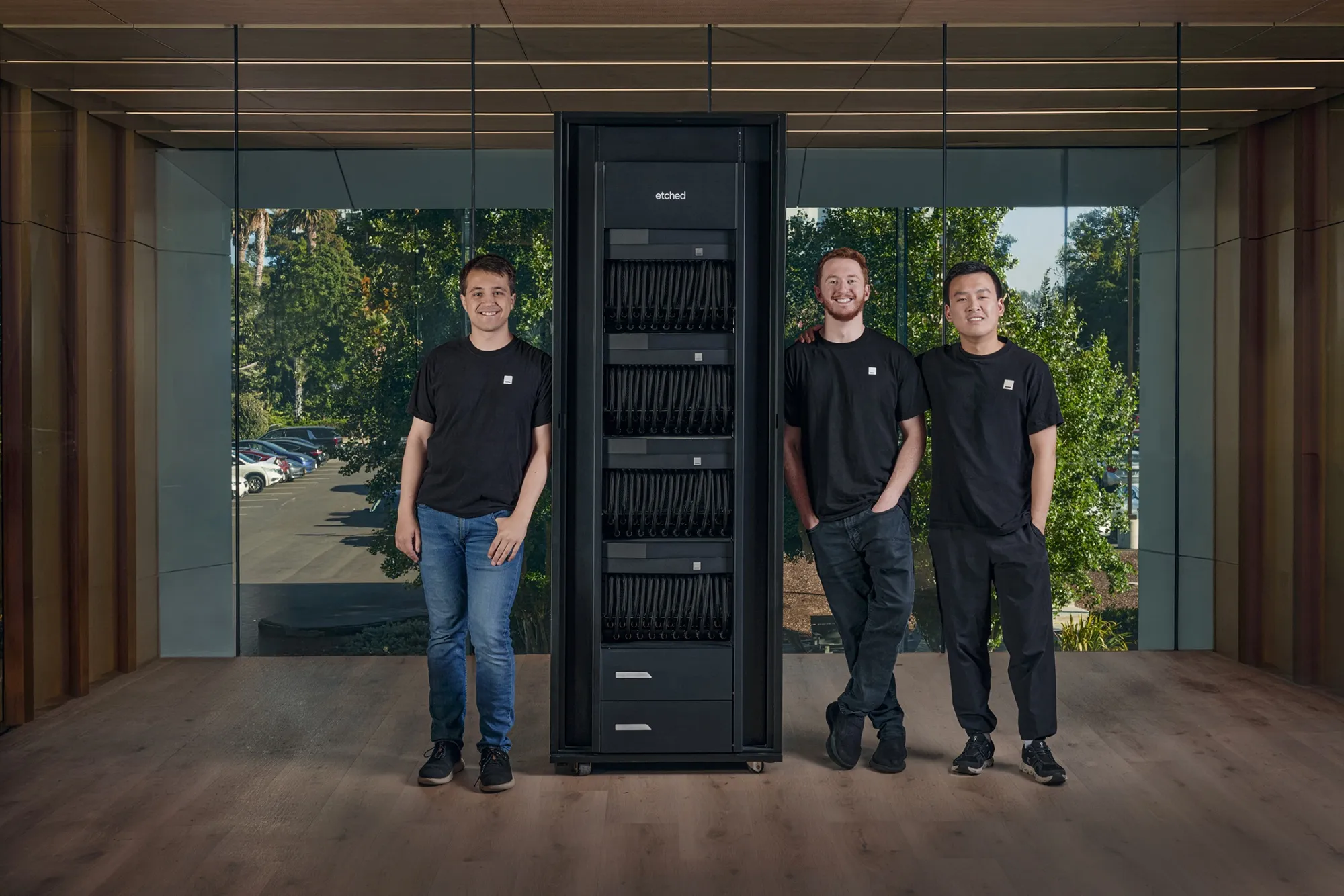
It's called Etched, founded by three young people who dropped out of Harvard, all around 25 years old this year. The company was founded four years ago and hasn't sold a single product to this day.
But those investing money in it are a group of big shots and institutions like this:
Silicon Valley venture capital godfather Peter Thiel, top quantitative institution Jane Street, venture funds associated with TSMC... This company that hasn't delivered a single chip yet has currently raised about $800 million, with a valuation of $5 billion.
Even more unusually, according to public reports from foreign media, it already holds over $1 billion in orders, and what these orders are buying is a chip that hasn't been manufactured yet.
These three guys are convinced that the bulk of AI spending has now shifted from "training models" to "letting models answer questions," which is inference.
Every time you ask ChatGPT or Claude a question, behind the scenes is an inference; this happens billions of times a day, making it the most expensive and highest-frequency link in the entire AI chain.
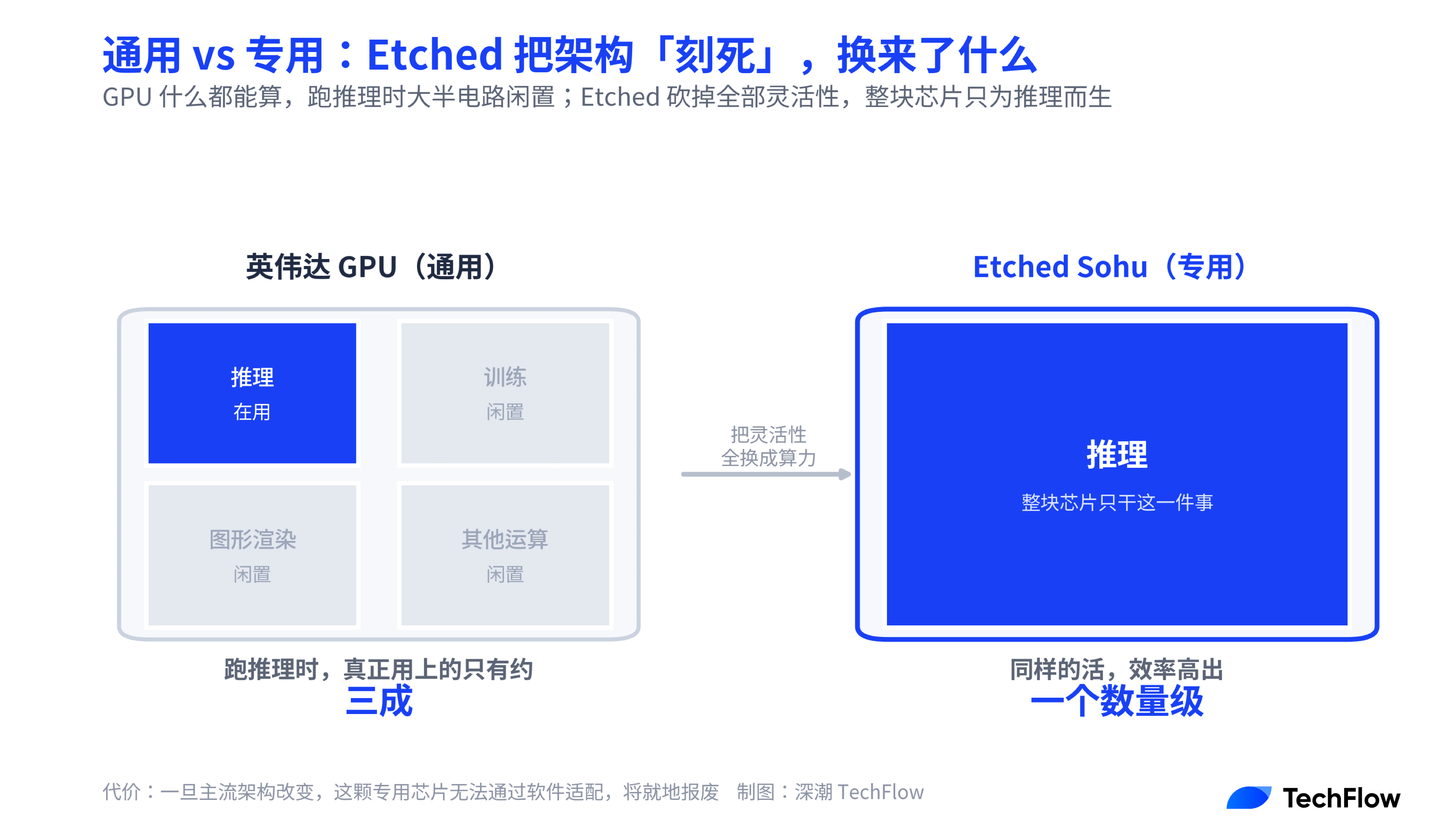
NVIDIA's GPUs can do anything, except they are not tailor-made for this one thing called inference. What Etched wants to make is a chip that runs only inference, carving the architecture of ChatGPT directly into the silicon.
According to its own published data, for the same job, 8 Etched chips can match over 100 NVIDIA H100s. This number hasn't been verified by a third party yet, but it is the entire confidence behind these three young people daring to challenge NVIDIA.
The most expensive thing doesn't need an all-purpose chip at all.
A Gamble With No Retreat
From a product perspective, this is truly a gamble with no retreat. The key lies in the two words "carved in."
Other companies making specialized chips leave themselves some way out; the chips can still adapt to new model structures via software; but Etched didn't do this, it took the underlying architecture shared by large models like ChatGPT (known in the industry as Transformer), and burned it directly into the silicon in the form of physical circuits.
Every inch of space that should have been left for flexibility was saved and used to pile on computing power, which is how they achieved multiplied speed. So the price of power is, once AI switches to a new architecture someday, no longer Transformer, this chip will instantly become a piece of waste silicon, impossible to modify.
The founders know this better than anyone.
When raising Series A in 2024, the company's CEO Gavin Uberti mentioned in a public interview that they are placing the biggest bet in the AI field; if this architecture disappears, the company is done.
But if it survives, Etched will become the largest company in history.
He was 23 when he said this, with just $120 million on the company's books. Two years have passed, now the company has $800 million in financing lying in its accounts, $1 billion in orders pressing from behind, and that chip still hasn't left the factory.
A young man in his early 20s, full of vigor, compressed the company's outcome into two fateful words, zero or largest in history, leaving no inch of retreat in between, which is somewhat unconstrained and imaginative.
It's just that the people investing money in him are all old hands; why do they dare to gamble along with him?
When Inference Becomes the Profit Center
AI training is NVIDIA's moat, but inference is not.
Training is teaching a model from zero to proficiency, burning through massive computing power in one go over several months; while inference is after the model has learned, answering questions for hundreds of millions of people every day, burning money time and again.
The spending methods for these two things are completely different. According to reports from multiple foreign media, inference has already replaced training, becoming the largest continuous cost for AI companies, and also the biggest bottleneck.
There is news that Anthropic might turn profitable this quarter relying on the profit margin from inference. The focus of money is quietly shifting from training to inference.
Today almost all inference runs on NVIDIA's GPUs, but GPUs were not built for this thing, so when running inference specifically, a large amount of circuitry is idle.
Etched founder Gavin Uberti mentioned a number in an interview; when GPU clusters run inference, actual computing power utilization is often only twenty to thirty percent, over half of the capacity is wasted.
That is to say, you spend $50,000 to $150,000 buying an NVIDIA machine to do inference, only thirty percent is truly used on the cutting edge, the remaining seventy percent might just be generating heat and consuming electricity for you.
NVIDIA's moat has always been built on training and its CUDA software ecosystem; the walls there are high and thick, no one can climb over them in the short term. But inference is different; this is a more singular, more repetitive job, not needing an all-purpose chip, NVIDIA doesn't have the same walls here.
You can say NVIDIA is the chip company with the highest market cap globally, but the most profitable, fastest-growing part of the business is built precisely where it is not fully proficient and adapted.
The investors putting money into this Etched are betting on this shift in focus.
The one least likely to invest in chips among them is longevity maniac Bryan Johnson, the tech billionaire who measures over a hundred metrics on himself every day and wants to reverse aging.
According to his public statements, a few years ago two founder dropouts from Etched found him, saying they could build faster AI chips to accelerate longevity research; the faster the chips spit out tokens, the faster the speed of finding drugs and cracking diseases.
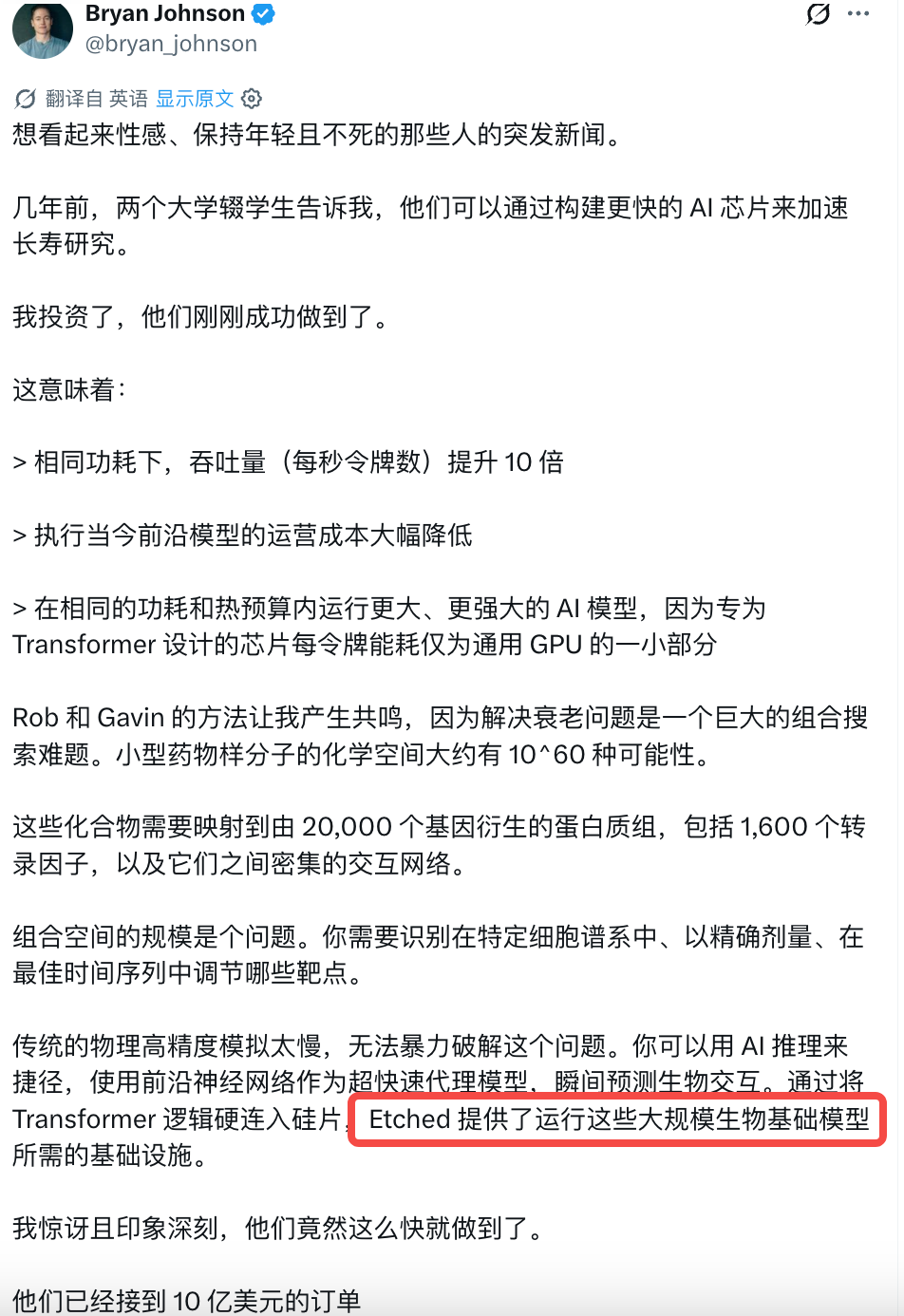
Whoever makes inference fast and cheap can reprice all industries that rely on AI for their livelihood.
You might ask why NVIDIA doesn't make inference specialized chips itself; actually, of course it can. But with a general-purpose GPU family and large business, why go all-in and turn around to make specialized GPUs?
So, this is a prototype story of edge disruption.
This Summer, The Bet Is Revealed
The chip Etched bet on for four years is going to be delivered this summer.
For a company founded four years ago that hasn't sold a single product, this is the moment to finally deliver. When the chip is installed in the customer's server room, whether it is born for inference as said in the PPT, the truth will be seen on the spot.
It's just that nearing the reveal, the card table itself quietly underwent a little change.
What Etched welded into the silicon is the look of AI it identified three years ago. But just in the years it was buried building chips, some AI changed the gameplay itself. In the past, a model was a whole block, calling upon all of it for any problem; in the past two years, the strongest batch of open-source models changed structure, broken into many small blocks, each time only temporarily picking a few blocks to work. DeepSeek, Qwen, these Chinese open-source models running at the forefront, are all uniformly this new architecture style.
Software changes a version in a few weeks, but chips take two years from blueprint to mass production. Welding the architecture dead, to some extent, is shorting the speed of change.
This flavor, people who experienced the previous crypto cycle will find familiar. In early years, Ethereum also relied on hardware mining competition; a batch of specialized mining machines that only calculated Ethereum and did nothing else left general-purpose graphics cards far behind; this is exactly the story Etched tells investors: Specialized crushes general-purpose.
That night in September 2022, Ethereum changed the mining rules entirely, from competing on hardware to competing on coin holding; mining machines built for it globally along with countless graphics cards collectively turned into bricks, billions of dollars in hardware went to zero overnight.
Mining machines bet on algorithms not changing, Etched bets on architecture not changing, and the company's three founders are also clear about this hurdle.
Their response method is to race for time.
One word Uberti repeatedly said in interviews is "too late"; he is convinced Etched is at least 18 months ahead of giants like NVIDIA and Google on specialized inference chips; by the time big companies come to their senses and build similar products, Etched will have iterated to the second generation and tied up the customers.
In other words, he is betting not just that the current mainstream AI inference architecture Transformer won't die, but also betting he runs fast enough, fast enough to deliver this summer's goods and eat up the market before the architecture changes to where chips can't reach.
This is a race about speed, and in this race, it is not just one company that has placed bets.
Investment, Is Betting on Technology Blooming and Bearing Fruit
Looking back, Etched's story is actually not just about Etched.
It pushed something everyone is doing but rarely says aloud to the extreme. If you hold chip stocks like NVIDIA, Broadcom, Cambricon, Cerebras in your hand, what you buy is never just a company's performance; you are buying a judgment, betting that a certain technical route can last long enough, long enough for the money smashed down around it to be earned back.
Etched just placed this bet in the position with no retreat. It welded the architecture into the silicon, win or lose is clear at a glance; while most bets are soft, slow, you don't even realize you are betting.
Buying a "specialization" story, to some extent, is shorting the speed of change.
The slower the change, the steadier you win; once change speeds up, the more dead it is welded, the harder the fall.
This summer, Etched's chip will naturally give its own answer. But this is also a wind vane and signpost worth paying attention to; the gamble also tests every position in your account that quietly bets "it won't change."
The cards in your hand should also be turned over and looked at by yourself.
Join TechFlow official community to stay tuned
Telegram:https://t.me/TechFlowDaily
X (Twitter):https://x.com/TechFlowPost
X (Twitter) EN:https://x.com/BlockFlow_News
 深潮TechFlow