Ten People Redefining the Boundaries of Power in Cryptocurrency for 2025
TechFlow Selected TechFlow Selected
Ten People Redefining the Boundaries of Power in Cryptocurrency for 2025
From Wall Street to the White House, from Silicon Valley to Shenzhen, a new power network is emerging.
 Navigating Web3 tides with focused insights
By Ada, TechFlow
If one word must summarize the cryptocurrency industry in 2025, it is certainly not "bull market," nor "compliance," but institutionalization.
This year marked the first time cryptocurrencies ceased to stand in opposition to the global financial system and were formally integrated into its institutions, capital flows, and power structures.
Traditional financial giants—including Wall Street firms, sovereign wealth funds, and pension funds—began systematically entering the crypto markets. Led by Strategy (formerly MicroStrategy), publicly traded companies started adding Bitcoin to their corporate balance sheets. Combined with large-scale capital inflows from ETFs, Bitcoin broke its previous all-time high in 2025, reaching $126,000.
Meanwhile, USDT’s market cap surpassed $183.4 billion, making Tether a key component of the global “dollar-based alternative payment system.” Visa, Mastercard, and PayPal expanded their on-chain payment capabilities. USDC became widely used for e-commerce settlements, overseas remittances, and cross-border payments for small and medium enterprises, marking the first real penetration of stablecoins into the real economy.
The passage of the GENIUS Act, shifts in U.S. regulatory leadership, and systematic ETF inflows collectively constituted a deep structural transformation:
The crypto world has moved from its wild west phase into an era of institutions.
Behind these major advances were indispensable industry leaders whose vision brought crypto into a new age of “institutionalization, globalization, and corporatization.”
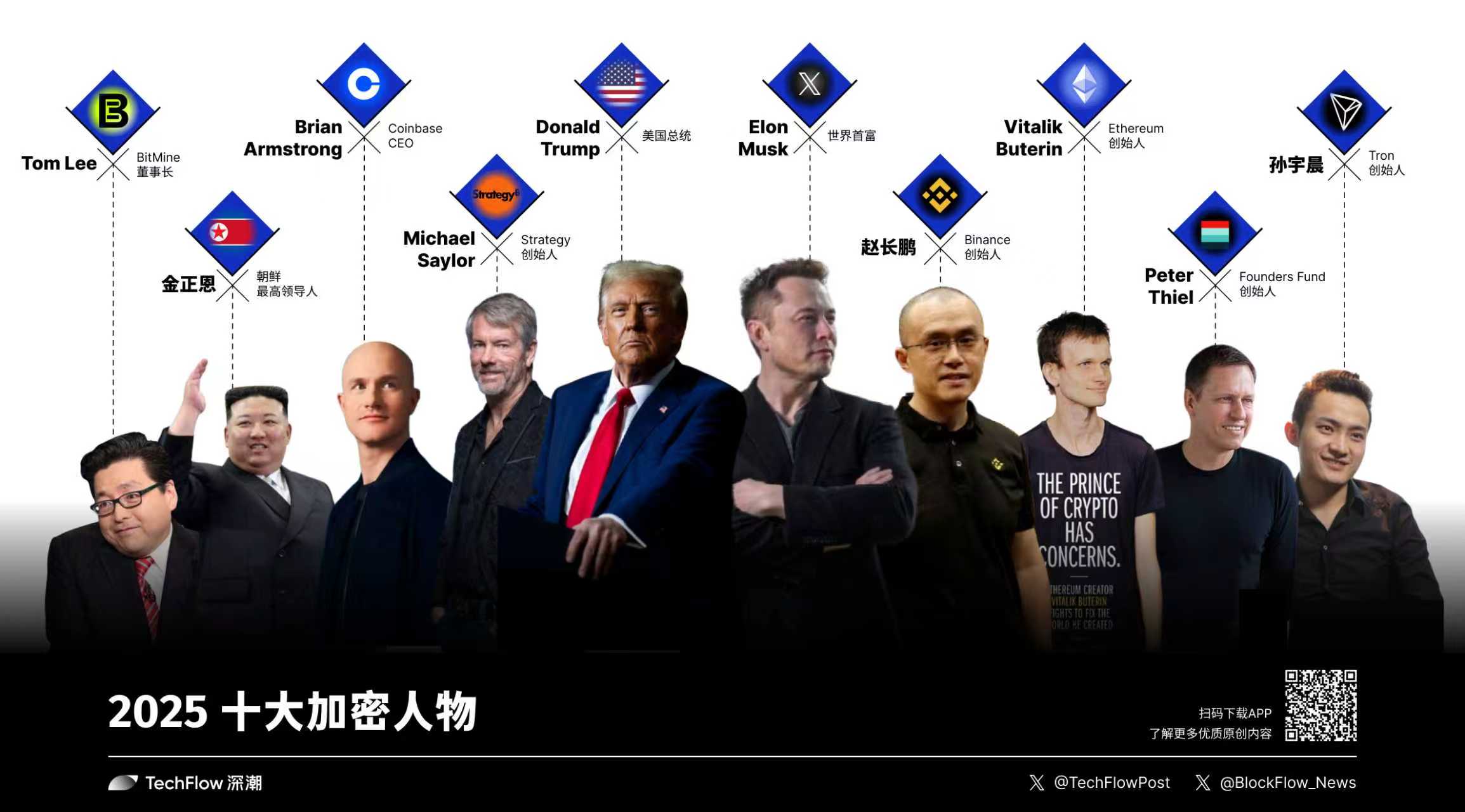
As the year ends, we review and summarize 2025, highlighting ten individuals who profoundly influenced the crypto industry this year.
1. Trump: The Monetization of Political Capital in Crypto
On January 20, 2025, Donald Trump was sworn in as the 47th President of the United States, signaling a fundamental shift in Washington's stance toward cryptocurrencies.
During his campaign, Trump pledged to make the U.S. the “crypto capital of the world,” earning broad support from crypto businesses and investors. More strikingly, he demonstrated how political influence could be directly converted into economic gain.
Three days before his inauguration, Trump launched a token named “Trump” on the Solana blockchain. Backed implicitly by his presidential status and marketed as the “official meme coin,” it quickly attracted massive speculative capital, surging to around $75. According to a March 2025 Financial Times analysis, the project netted $350 million through token sales and transaction fees, temporarily boosting Trump’s personal net worth to $20 billion.
Trump’s administration also reflected institutional thinking. On January 23, he signed Executive Order 14178, establishing the “Presidential Working Group on Digital Asset Markets,” explicitly banning the federal government from creating, issuing, or advancing a central bank digital currency (CBDC), while pledging to promote the development of dollar-pegged stablecoins.
The executive order issued on March 6 carried even greater strategic weight: the creation of a “U.S. Strategic Bitcoin Reserve and Digital Asset Inventory,” designating Bitcoin seized by the Department of Justice and Treasury as national “strategic reserve assets.” This move effectively established Bitcoin’s formal role within the U.S. financial system.
On July 18, the signing of the GENIUS Act became a milestone in crypto institutionalization. This federal law provided the first comprehensive regulatory framework for stablecoins, enabling deeper integration between crypto assets and mainstream finance.
However, Trump’s tariff policies also introduced significant market volatility. After the April “Liberation Day tariffs” announcement, markets plunged into panic, sending Bitcoin down to around $85,000. This policy-driven price movement was mockingly dubbed “TACO trading” (Trump-driven Cryptocurrency Operations).
Beyond his personal token venture, Trump’s family also reaped substantial gains through World Liberty Financial, a company they founded. It operates the governance token WLFI and the dollar-pegged stablecoin USD1. According to the Financial Times, the company earned $550 million from WLFI sales and $2.71 billion from USD1 operations, with the Trump family holding a 38% stake.
The Trump phenomenon can be summarized as: political authority is becoming a key anchor for crypto value, and the traditional ideal of decentralization is gradually giving way to an orderly reality.
2. Michael Saylor: Pioneer of the Crypto Reserves Revolution
If Trump symbolizes the crypto monetization of political capital, then Strategy founder Michael Saylor represents a paradigm shift in corporate financial management.
In August 2020, Strategy announced the purchase of approximately 21,454 Bitcoins for about $250 million in cash, officially adopting a strategy of using Bitcoin as a treasury substitute for cash. This decision went far beyond mere investment—it redefined the concept of value storage for the corporate world.
Saylor systematically developed the theoretical framework for corporate Bitcoin reserves. In numerous public appearances, he emphasized that companies were not speculating on new technology but making deliberate, long-term asset allocation decisions to protect shareholder value. This narrative successfully reframed Bitcoin from a “speculative tool” into “financial infrastructure.”
In 2025, the trend of public companies buying Bitcoin exploded, with Strategy continuing to expand its holdings. To date, the company holds 671,268 Bitcoins, with its most recent purchase on December 15—acquiring 10,645 BTC for approximately $980 million.
Thanks to Bitcoin’s soaring price, Strategy’s stock reached a peak of around $414 during the year. More importantly, other public companies began emulating this model, further driving up Bitcoin’s price. According to BitcoinTreasuries data, 192 public companies now hold approximately 1,087,857 Bitcoins—about 5.45% of the total Bitcoin supply.
ARK Invest’s research report first coined Strategy as a pioneer of the “DAT model” (Digital Asset Treasury) and labeled imitators as DAT companies. This conceptualization marks Bitcoin’s transition from “alternative investment” to a foundational asset in corporate finance.
Yet, the Strategy model faced market stress. As the market turned bearish recently, Strategy’s stock fell to around $200, pushing its market-to-net asset value ratio (mNAV) close to the critical threshold of 1. If mNAV drops below 1, Strategy’s “BTC appreciation loop” will face severe challenges.
Nonetheless, Michael Saylor remains committed to the long-term strategy. On November 17, in a media interview, he stated that Strategy would not sell any Bitcoin unless its price falls below $10,000.
3. Tom Lee: The Bridge Between Wall Street and Crypto
In the historic shift of traditional finance toward crypto assets, Fundstrat Global Advisors founder Tom Lee played a pivotal bridging role. As one of Wall Street’s earliest and most influential Bitcoin bulls, his views have shaped institutional investors’ understanding of crypto.
In 2017, when mainstream finance largely dismissed Bitcoin, Lee appeared on CNBC and predicted Bitcoin could exceed $25,000—a forecast that earned him the title “Wall Street’s most famous crypto bull.” More significantly, his 2018 introduction of the Bitcoin Misery Index (BMI), cost models, and network effects models laid a serious valuation foundation for Bitcoin—frameworks still widely cited today.
In 2020, as Strategy, Tesla, and others began allocating to Bitcoin, Lee repeatedly stated: “Corporations will adopt Bitcoin as treasury assets—a irreversible trend.” His prediction of the 2021 bull run ultimately proved correct.
In 2025, Lee expanded his focus to the Ethereum ecosystem. In interviews, he suggested Ethereum had entered the early stage of a “super cycle,” similar to Bitcoin’s trajectory after 2017. His advocacy fueled bullish sentiment, helping Ethereum break its all-time high in August and approach $5,000.
Lee is not just a theorist but also a practitioner. BitMine, the Ethereum treasury company where he serves as Chairman, continued accumulating ETH. By December 21, 2025, the company disclosed holdings of 4,066,062 ETH—approximately 3.37% of Ethereum’s total supply.
Despite Ethereum falling below $3,000 and BitMine’s stock dropping to $32, Lee maintains his year-end target of $10,000.
Lee’s impact lies in successfully introducing Wall Street’s analytical frameworks and investment logic into crypto, while conveying crypto’s innovative value to traditional finance—making him an essential catalyst in the convergence of two worlds.
4. CZ: The Unwilling Silence of Will to Power
For CZ (Changpeng Zhao), 2025 was a pivotal year of rebirth from legal shadows and regaining control over industry discourse.
Trump’s presidential pardon not only restored CZ’s freedom but also showcased his elite-level political lobbying skills. However, what matters more is how CZ reestablished dominance in the crypto world within months.
A man once at the pinnacle of crypto power cannot fully relinquish it. CZ’s return was marked by imperial foresight and restlessness. Binance’s Alpha 2.0 platform, launched in March 2025, was ostensibly a launchpad for early Web3 projects, but in reality, a meticulously orchestrated commercial revolution. It not only leapfrogged OKX Wallet and brought on-chain asset issuance into Binance’s ecosystem but also reshuffled the entire industry landscape.
Reviving the BSC chain, challenging Solana’s position, and launching a disruptive assault on listings at mid-tier exchanges—indeed, quite impressive.
Even more striking was his precise manipulation of market sentiment. When the “Binance Life” meme coin surged 6,000x in 96 hours to a market cap exceeding $500 million, CZ’s seemingly casual tweet with the hashtag “#BNB meme szn” instantly ignited a full-blown meme coin frenzy across the BNB chain.
In 2025, CZ increasingly engaged with various KOLs, and his tweets spawned numerous meme coins. Though he later claimed these were “pure coincidences,” the fact that a single tweet could redistribute hundreds of millions in wealth is a clear sign of power.
Every public move CZ made bore the mark of will to power. His $2 million investment in the Aster project in November was ostensibly a bet on decentralized perpetual contracts, but in truth, a declaration to the market: even after heavy regulatory pressure, he still possesses the ability to redefine industry direction. He no longer needs to control the market directly through Binance but instead wields influence more subtly and effectively through investments, social media presence, and ecosystem building.
This shift from direct rule to indirect control has made his power even more unshakable. CZ has proven a fundamental truth: real power does not depend on specific positions or titles, but on the ability to shape rules and market expectations.
5. Vitalik Buterin: Balancing Decentralized Ideals with Institutional Realities
On July 30, 2025, Ethereum celebrated its 10th anniversary, with founder Vitalik Buterin continuing to navigate a delicate balance between decentralized ideals and institutional trends.
Ethereum experienced dramatic price swings in 2025. In April, its price dipped to around $1,793, amid widespread pessimism. However, with Circle’s IPO and the rise of stablecoins and RWA narratives, Ethereum regained attention as core infrastructure.
On June 2, Consensys founder Joseph Lubin initiated an “ETH reserve” strategy via the U.S.-listed company SharpLink Gaming (SBET), followed by BitMine, Bit Digital, and GameSquare—driving Ethereum’s price upward. July saw a 40% monthly gain, and in August, ETH hit a record high of $4,946.05.
On the symbolic date of July 30, Vitalik published “Ethereum 2035: Vitalik’s Vision for the Next Decade.” In this “decade vision” piece, he outlined Ethereum’s future path—scalability, privacy, governance evolution, and preserving Ethereum’s experimental culture—painting a roadmap for Ethereum’s transformation from a crypto application platform to global critical infrastructure.
On October 20, Vitalik announced the GKR protocol (Goldreich–Kahan–Rothblum), a Proof-of-Stake/ZK computing framework designed for high-speed proof generation, applicable to both blockchain and AI-scale computation. This is seen as Ethereum’s next-generation “super proving system” and a foundational technology for Ethereum’s lightweight strategy.
Yet, Vitalik remains cautious about institutionalization. While treasury companies and institutional holdings have driven price growth, he warns of two risks: first, such accumulation may alienate users and core developers who care about decentralization, leading to community erosion; second, institutional pressures might push inappropriate technical decisions, deviating from Ethereum’s roadmap.
At this year’s Devconnect conference, Vitalik issued a stark warning: quantum computing could break elliptic curve cryptography before the 2028 U.S. presidential election, urging Ethereum to upgrade to quantum-resistant algorithms within four years.
Regarding emerging applications like prediction markets, Vitalik recommends distributed oracles to prevent malicious manipulation.
Vitalik’s thinking reflects a deep dialogue between native crypto philosophy and institutional realities. He must ensure Ethereum can serve as global financial infrastructure while preserving its decentralized and experimental essence.
6. Kim Jong-un: Taxing the Entire Crypto Industry
Beneath the polished surface of 2025’s crypto institutionalization, a hidden force from the Korean Peninsula is reshaping the global risk landscape of digital assets.
Multiple hacker groups under North Korea’s Reconnaissance General Bureau (RGB)—including Lazarus Group, APT38, and Kimsuky—have shifted from traditional espionage to economically motivated systemic attacks.
In 2025, North Korean hackers demonstrated alarming technical sophistication.
In February, a North Korean hacking group breached Bybit, stealing around $1.5 billion in crypto. In November, South Korea’s largest exchange, Upbit, was infiltrated, losing $30 million.
Additionally, North Korean agents began mass-applying for jobs at crypto firms under fake identities. Investigations suggest that 30% to 40% of job applications received by some crypto companies may come from suspected North Korean operatives attempting infiltration.
According to late-2025 tracking reports from Chainalysis and TRM Labs, North Korean hackers stole approximately $2.02 billion in crypto assets throughout the year.
A UN expert panel estimates that about 60% of these stolen digital assets fund nuclear programs by circumventing international sanctions; 30% sustain regime stability; and 10% are reinvested into upgrading cyberattack infrastructure.
For decades, the international community has tried to cut off North Korea’s foreign currency access through financial sanctions—but the emergence of crypto has changed the game’s fundamental rules.
In a sense, this represents an extreme form of “national crypto-fiscalism”—not relying on taxes or market financing, but directly extracting value from the global open financial system.
It reminds the entire industry of a harsh truth:
Once cryptocurrencies become global infrastructure, they inevitably become extensions of statecraft and geopolitical competition.
7. Musk: Symbol of Centralized Power Trends
In crypto’s institutionalization, Musk’s influence highlights a crucial trend: the immense market power wielded by individual authority.
On August 14, 2025, reports revealed that SpaceX, Musk’s company, held Bitcoin worth over $1 billion. In contrast, Tesla sold 75% of its Bitcoin holdings at an inopportune time, missing out on massive potential gains.
Musk’s influence extends beyond Bitcoin. As a long-time Dogecoin supporter, though he didn’t actively promote DOGE in 2025, his social media activity still triggered significant market reactions. Merely retweeting content related to the “Green Octopus” concept caused a violent rally in Solana-based meme coins.
In early 2025, Musk entered politics, leading the Department of Government Efficiency. Although he clashed fiercely with Trump over the “Great Beauty Act” and briefly announced the formation of the American Party, the two eventually reconciled, allowing Musk to refocus on business.
The most notable event in the second half was Tesla shareholders approving Musk’s $1 trillion compensation package with over 75% of votes. If fully realized, Musk would become the world’s first “trillionaire.”
The deeper implication is that Tesla’s valuation, strategy, brand, and technological pace are now entirely tied to one person’s will. In the crypto world, many protocols similarly revolve around a “core founder + token narrative.”
The world is entering an “era of strongmen,” where individual authority becomes a key driver of value creation and market volatility—creating a fascinating tension with crypto’s original decentralized ideals.
8. Sun Yuchen: Learning the Rules, Then Using Them
In March 2025, Sun Yuchen graced the cover of Forbes English edition, hailed as the “crypto billionaire who helped the Trump family earn $400 million.”
This year, his moves were equally striking: in April, he injected $456 million to stabilize TUSD and prevent de-pegging; Canary filed an application for a staked TRX ETF; in June, TRON completed a reverse merger listing through an investment bank linked to the Trump family; in July, he spent $28 million to become the youngest Chinese commercial astronaut…
Yet the most remarkable shift in 2025 was the profound change in public perception of Sun. On platforms like Zhihu and Xiaohongshu, his past courses and statements were re-examined—such as his 2016 call to buy Tesla and Bitcoin, and his advice to avoid marriage and home ownership before 30 to focus on asset accumulation.
Ideas once dismissed as “provocative” gained fresh interpretations. As one Zhihu user commented: “Sun Yuchen embodies a maritime civilization mindset—embracing the unknown, not seeking shelter on islands or behind walls, but mastering balance amidst storms, re-evaluating all values, indifferent to external notions of good or evil. He is true chaotic neutral—a superman loyal only to his own will to power.”
This reversal in public opinion also reflects the disillusionment of young people today. Following traditional rules and routines no longer guarantees success, leaving youth enveloped in a sense of invisible despair.
Sun Yuchen remains the familiar figure who knows the rules—and exploits them perfectly, hitting every beat of the era with precision.
9. Brian Armstrong: Spokesperson for Compliance Infrastructure
Coinbase CEO Brian Armstrong’s actions in 2025 perfectly illustrate how a crypto firm can redefine itself amid institutionalization.
At the start of 2025, Armstrong endorsed the creation of a U.S. national “Bitcoin strategic reserve” via Coinbase’s official blog. On January 21, at Davos, he stated that if U.S. leadership embraced crypto, it would attract massive investment. On January 25, he boldly predicted Bitcoin could surpass gold’s $18 trillion market cap by 2030.
On March 20, Coinbase’s validator report revealed it operated approximately 120,000 validator nodes, staking 3.84 million ETH—about 11.42% of all staked Ethereum—making it the largest single node operator on Ethereum and a key infrastructure provider for the network.
On May 8, Coinbase announced plans to acquire Dubai-based crypto derivatives exchange Deribit for $2.9 billion—$700 million in cash and 11 million Class A shares—with the goal of building the “most comprehensive crypto derivatives platform globally.”
The same month, a data breach tested Armstrong’s crisis management. When hackers threatened to leak 70,000 users’ personal data unless paid a $20 million Bitcoin ransom, Armstrong publicly refused to pay. Instead, he allocated $20 million to a “bounty fund” to catch the perpetrators and promised compensation to affected users. The estimated cost ranged from $180 million to $400 million, but the move preserved the company’s reputation and principles.
Mid-year, Coinbase hosted the State of Crypto Summit 2025, where Armstrong unveiled a suite of enterprise-focused products—Coinbase Business, Coinbase Payments, DEX Trading on Coinbase—emphasizing stablecoins (especially USDC) in solving “real pain points” like reducing settlement costs, accelerating cross-border payments, and expanding financial access.
In November, Coinbase announced relocating its corporate registration from Delaware to Texas. Armstrong praised Texas for being “pro-economic freedom and crypto-friendly.” This move, beyond tax and legal considerations, signaled a clear alignment with pro-crypto political forces.
Armstrong’s strategy embodies the hallmark of a successful crypto firm: operating compliantly within regulations, advancing industry infrastructure, and maintaining sharp innovation instincts—all at once.
10. Peter Thiel: Building a Crypto Financial Empire
In 2025, PayPal co-founder Peter Thiel demonstrated how top Silicon Valley investors build systemic advantages in the decentralized crypto world.
In July 2025, an SEC filing sent shockwaves through the crypto space: Thiel’s firm quietly acquired a 9.1% stake in BitMine Immersion Technologies, becoming the largest investor in this Ethereum treasury company.
A month later, Bullish—a company Thiel invested in back in 2021—successfully listed on the NYSE. Bullish (BLSH) debuted at $37, opened near $90, surged 170% intraday, and closed up ~84%, achieving a market cap over $13 billion.
Beyond asset holdings, Thiel supported the creation of Erebor Bank—a specialized bank for crypto firms planning to issue stablecoins—and controls industry discourse through CoinDesk.
In his book *From 0 to 1*, Thiel repeatedly argues that competition is for losers, while monopolies yield outsized profits. In a decentralized world, the path to monopoly is controlling foundational infrastructure. When all transactions rely on stablecoins, controlling the stablecoin protocol equals acquiring “seigniorage rights.”
Reviewing Founders Fund’s portfolio reveals a clear strategy. The fund avoids investing in decentralized apps (DApps), dabbles only slightly in GameFi and NFTs, and focuses instead on Layer 2 scaling (Caldera), compliance infrastructure (Paxos), derivatives protocols (Avantis), and stablecoin networks (Ubyx).
In November, DeFi perpetual DEX Lighter raised $68 million in a round led by Founders Fund, reaching a $1.5 billion valuation and joining the unicorn ranks. Through diversified positioning, Peter Thiel is constructing a complete crypto financial empire.
Recently, in media interviews, Thiel expressed cautious views on Bitcoin’s outlook. He believes that after being “adopted” by institutions like BlackRock and governments, Bitcoin’s upside is significantly constrained, though volatility will remain high. He describes the future path as “a bumpy and volatile road”—opportunities exist, but the era of 10x or 100x returns is over.
Peter Thiel’s strategy reflects the long-term thinking of a top-tier investor: building infrastructure dominance during an industry’s chaotic early stages to ultimately command influence over the entire ecosystem.
Conclusion
Looking back from the end of 2025, the mood is reflective.
This year, as Wall Street giants added Bitcoin to their portfolios, the U.S. government established a strategic Bitcoin reserve, and stablecoins became vital international payment infrastructure, cryptocurrencies completed their elegant transformation—from “anti-system tools” to “core components of the system.”
More importantly, 2025 revealed the complex flow of power between old and new worlds. Traditional financial elites like Tom Lee paved the way for institutional capital into crypto; political figures like Trump directly participated and profited; native builders like CZ and Vitalik adapted innovation to institutional demands.
This institutionalization also prompts deep reflection. When decentralized technologies are widely adopted by centralized institutions, and when individual authorities (like Musk and CZ) can heavily influence supposedly “decentralized” markets, are we heading toward a more centralized future?
Cryptocurrency’s impact now transcends technology and finance, becoming a key element of geopolitics and cultural soft power. From Wall Street to the White House, from Silicon Valley to Shenzhen, new power networks are forming.
Join TechFlow official community to stay tuned
Telegram:https://t.me/TechFlowDaily
X (Twitter):https://x.com/TechFlowPost
X (Twitter) EN:https://x.com/BlockFlow_News
 深潮TechFlow