








The "court politics" of crypto exchanges: power struggles and games of loyalty
TechFlow Selected TechFlow Selected
The "court politics" of crypto exchanges: power struggles and games of loyalty
The essence of power is the craving for loyalty and the fear of betrayal.
 Navigating Web3 tides with focused insights
Author: TechFlow
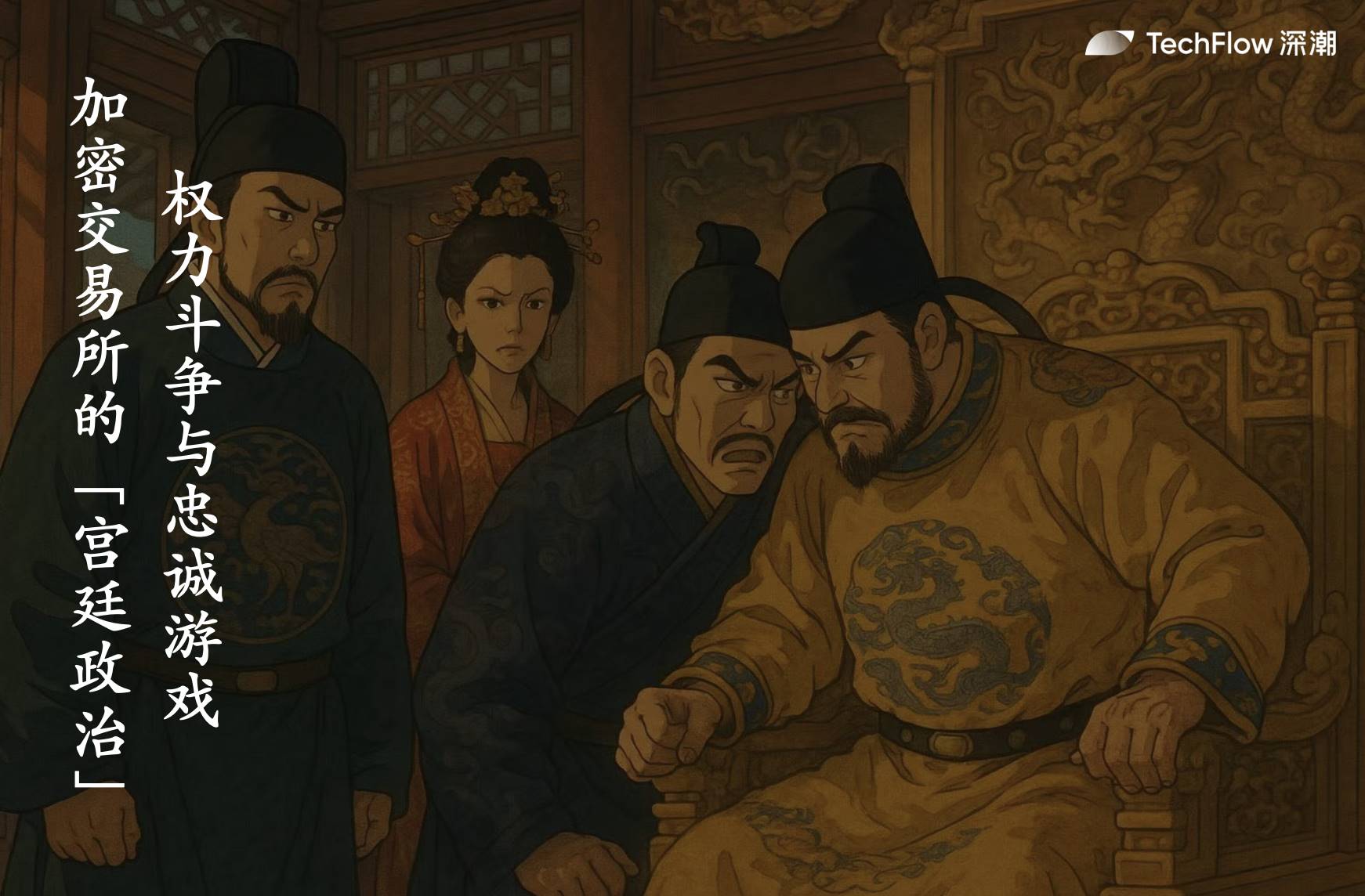
I have a bold claim: all Chinese-run crypto exchanges are essentially "digital Forbidden Cities," with exchange founders treated as "emperors." All exchange drama can thus be understood as "court politics."
Some emperors resemble Emperor Jiajing—focused on cultivation, skilled in imperial tactics, pitting two factions against each other, turning a blind eye to internal corruption, willing to share limited power, allowing their allies to rise along with them.
Others demand absolute loyalty, acting decisively and ruthlessly. They allow no negotiation; anyone seeking greater benefits or challenging authority is swiftly removed.
A brief take on the court politics within crypto exchanges—purely fictional, for entertainment only.
Power Struggles
To understand court politics, first abandon the naive idea that there’s a clear distinction between good and evil, loyal and treacherous.
In The Ming Dynasty 1566, Yan Song was later labeled a treacherous minister, yet he maintained his position as Chief Grand Secretary for years through exceptional political skill, significantly replenishing state coffers. Yet when the so-called "upright" officials took over and launched anti-corruption campaigns, the imperial treasury became even emptier.
Where in the world are there purely loyal or treacherous ministers? There are only those currently useful to the emperor, and those who aren’t—those who win power struggles, and those who lose.
Wherever people gather, there will be江湖 (jianghu) conflicts.
Power must be exercised through personnel. The core of Yan Song’s struggle with Xu Jie was control over appointments in the Ming court. Whoever could place their allies in key ministries would hold real power and steer government operations.
The same applies to crypto exchanges—the essence is competition for critical positions.
For example, the most crucial departments: token listings, finance, investments. With too many contenders and too few roles, intense battles are inevitable.
As a boss, you often welcome such infighting among subordinates.
When subordinates compete, they struggle to form strong coalitions, eliminating any threat to your authority.
Rival factions will each report negative information about the other, giving the boss broader, multi-angle intelligence while also providing leverage over each subordinate.
Of course, this infighting must remain within controllable limits. Excessive conflict wastes resources, reduces efficiency, and may even threaten organizational stability.
When one faction grows too powerful, threatening the boss’s authority, the boss may employ certain "imperial tactics"—promoting someone internally or bringing in an external professional manager, granting them significant power to purge the opposing side.
For Emperor Jiajing, the central question was: How does one select absolutely reliable ministers in a court where loyalty and treachery are hard to distinguish?
Exchange founders face the same dilemma.
Competitive attacks and regulatory raids are visible threats, but in the eyes of exchange bosses, the greatest danger often lies hidden nearby—betrayal by those closest. Thus, nepotism becomes the optimal strategy—key roles are often filled by the founder's friends, classmates, or even family members, even if they lack professional competence.
Experience shows that nepotism or family-run operations are actually the safest model in the crypto market.
Corruption and Anti-Corruption
Power struggles inevitably involve corruption and anti-corruption—they are two sides of the same coin, both tools for gaining power.
Court politics hinge on reading the situation correctly and choosing the right side.
To form alliances, you need a "bond"—shared hometown, alma mater, or career background. These can serve as connection points, but more importantly, it's about shared interests. Even regional or academic ties require money to sustain.
How do you gain the "big brother’s" trust?
Besides offering emotional value, what matters more is handing over some compromising information—exposing your own weaknesses. “Big brother, here are all my flaws—do whatever you want with me. I’m loyal to you from now on.”
Thus, bribery—or participation in collective corruption—is the most effective way to prove loyalty, a test of allegiance. When money ties several people together, won’t they naturally unite and support each other?
In crypto exchanges, internal corruption and insider trading are hard to eliminate for two reasons.
First, whether trading or working, most people enter the crypto space for one reason: making money.
This is especially true for employees at such "high-risk companies" as exchanges. Many staff, particularly those transitioning from traditional industries, feel no sense of identity or belonging toward the company. They only care about maximizing earnings in the shortest time possible.
Second, crypto exchanges operate in a gray area. Compared to traditional corporate corruption, embezzlement at exchanges faces less legal consequence—easier to downplay serious issues, cover up minor ones, and simply disappear if needed. But by then, their goal has already been achieved.
This remains a persistent hiring challenge for exchanges.
The Emperor’s Vulnerability
Crypto exchange bosses and emperors share the same tragedy: the higher one rises in power, the harder it becomes to establish genuine trust.
Everyone approaching them may have ulterior motives: some covet core power, others desire wealth, some harbor secret agendas. In such an environment, suspicion becomes instinct, vigilance becomes habit.
This deficit of trust ultimately shrinks the decision-making circle.
Watching historical dramas, I’ve always wondered: Why does every emperor have a “treacherous minister” by his side—and why are they so favored?
Emperors are lonely. They lack neither money nor power. What they lack is love and loyalty—this is their vulnerability.
When someone offers the ruler love and loyalty, creating a warm, comforting presence, even if their talent is average, they still have value.
In the digital Forbidden City of a crypto exchange, technical talent isn’t scarce, marketing experts aren’t scarce, even capital isn’t scarce. What’s truly rare is genuine loyalty.
Love and loyalty are simply shown by supporting everything the emperor does—the more absurd the action, the stronger your support, the more sincere your loyalty appears.
Running a crypto exchange is exhausting. It drains both mind and body. Beyond competing with peers, you must fend off hackers and outmaneuver regulators. At such times, exchange bosses are mentally drained, even plagued by self-doubt—wondering whether their success stems from brilliance or mere luck. They desperately need emotional validation and psychological comfort—someone tirelessly telling them, “You’re right. Everything depends on you. We’re all grateful to you.”
Man is not wood or stone—who can be without emotion? To be recognized, loved, and needed—these are innate human desires.
Ordinary people also deeply crave love and loyalty, but they remain stuck in the lower layers of Maslow’s hierarchy of needs, too busy struggling for survival to pursue higher-level fulfillment.
The Women Around the Emperor
This section isn’t gossip about a literal harem—it refers to female executives.
Exchanges often have many female executives, which makes perfect sense.
A prominent traditional finance tycoon preferred appointing women to top roles. In his view, women are more loyal than men. No matter how much you pay a man, he’ll never be satisfied. Many men, once promoted and enriched, feel little gratitude or loyalty. Instead, their confidence rises, and they start thinking, “I could do this too.”
Power is fundamentally driven by the craving for loyalty and fear of betrayal.
In the hyper-competitive environment of an exchange, the boss’s greatest fear is “raising their own gravedigger.”
Male executives, after gaining power and wealth, often see their current role as a stepping stone to greater heights. They tend to credit personal ability rather than leadership for their success. Given the right moment, they may leave to launch a competing business or seek higher positions.
Female executives, by contrast, typically demonstrate stronger organizational loyalty and prioritize long-term, stable careers over risky entrepreneurship. They are more likely to attribute success to teamwork and mentorship, thus valuing existing roles and relationships more deeply.
Additionally, crypto exchanges frequently face crises requiring user communication. In this domain, female executives often possess unique strengths.
Women generally excel at recognizing, understanding, and responding to others’ emotions—an essential skill when calming angry users, handling complaints, and managing crisis PR. By comparison, men dealing with public crises are more prone to emotional escalation and confrontation with users.
Therefore, in my view, the power of women in the crypto world is vastly underestimated.
Interestingly, looking back at history and today, no matter how technology advances—whether in traditional business or the digital crypto world—the essence of power remains unchanged.
Wherever people gather, there will be江湖 (jianghu).
The moon wanes after fullness, water spills when the cup is overfilled—this is the ultimate fate of all power games.
Join TechFlow official community to stay tuned
Telegram:https://t.me/TechFlowDaily
X (Twitter):https://x.com/TechFlowPost
X (Twitter) EN:https://x.com/BlockFlow_News
 深潮TechFlow






