What crypto decisions has Fidelity's CEO made over the past decade?
TechFlow Selected TechFlow Selected
What crypto decisions has Fidelity's CEO made over the past decade?
Fidelity CEO Abigail Johnson shares insights on Bitcoin, early mining, crypto custody, stablecoins, innovative investment models, and the "build vs. acquire" strategy.
 Navigating Web3 tides with focused insights
Compilation: Bibi News
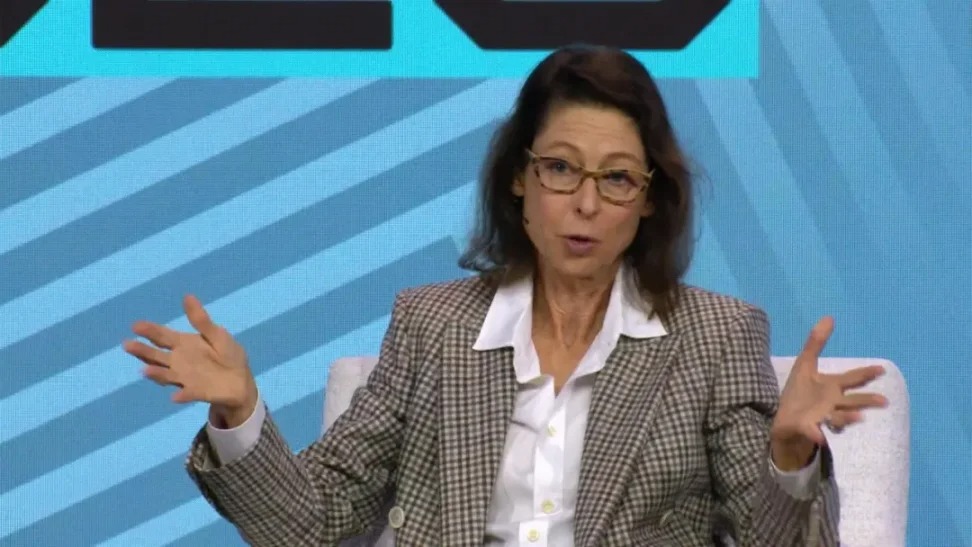
This interview was recorded at A16Z's recent Founder Summit, hosted by Anthony Albanese, CEO of A16Z Crypto, with guest Abigail Johnson, Chairman and CEO of Fidelity Investments. The discussion covered key topics including Bitcoin and early mining, crypto custody, stablecoins, innovative investment models, and the "build vs. acquire" dilemma.
In what is being called the "year of institutional adoption," this conversation offers a representative look at how traditional finance is approaching and embracing crypto assets from a fresh perspective.
Anthony: Good morning, everyone. I'm thrilled to have with us today the CEO of Fidelity Investments—Abigail Johnson. Abigail, welcome.
Abby: Thank you all. I’ve heard many were looking forward to this, so I’m glad we’re finally sitting down together.
Anthony: Let’s dive right in. You know, my background is in traditional finance. Before joining A16Z, I worked at the New York Stock Exchange. I know firsthand how difficult it used to be for large financial institutions to get involved in crypto. But you started pushing Fidelity into this space a decade ago.
Why did you do it? And how did you make it happen?
Abby: It really began with curiosity and learning. Fidelity has always emphasized a culture of learning, and when we first heard about Bitcoin, like many others, we had one question: What exactly is this? How does it work? Is it real?
Back in 2012 and 2013, there weren’t many people answering these questions. So I gathered a group of colleagues to study and discuss it regularly. Eventually, we realized: something real and important was actually happening here.
We started brainstorming how Bitcoin might impact our business, even listing 52 potential use cases. Later, we assigned these projects to various internal teams for validation. Only one direction ultimately proved viable—but it was critical enough.
Someone suggested that Bitcoin was generating significant new wealth, and these individuals needed a way to use their crypto assets for charitable giving. Fidelity already had a donor-advised fund, so we became one of the first major institutions willing to accept Bitcoin donations. At the time, no other large institution was doing this. This move helped us build credibility within the early crypto ecosystem and raised Fidelity’s profile.
At the same time, I insisted that if we were going to enter this space, we should start from the ground up—like mining. We analyzed it and found mining looked like a solid business. As it turned out, starting to mine in 2013 delivered extremely attractive returns (laughs). When I proposed spending $200,000 on early Antminers, some tried to block it, but in the end, it became one of our highest-return projects.
That was the beginning of the story.
Anthony: How did things evolve after that? When did you begin offering trading services to clients?
Abby: We kept exploring those use cases, even though most didn’t materialize. Still, they pushed us to keep learning and experimenting.
The first client-facing business that truly took off was custody.
To be honest, this surprised me. Custody is one of the oldest businesses in traditional finance, and it seems almost opposite to the “crypto ethos.” Yet advisors and clients showed massive demand for custody solutions. Many early holders wanted to plan for the future: If something happened to them, how could their families inherit these assets? That required a trusted custodian.
So we entered the custody business. As an institution deeply focused on security, we built rigorous cybersecurity and physical protection systems, further strengthening our reputation in crypto.
As these foundational capabilities matured, crypto initiatives are now spread across multiple divisions at Fidelity: custody runs alongside traditional brokerage; digital asset management drives crypto ETPs; incubation and lab teams explore new technologies; innovation projects emerge throughout the company. This distributed model of innovation keeps Fidelity ahead.
Anthony: You just mentioned the Genius Act—it’s a major breakthrough in crypto policy this year. After years of fighting for regulatory clarity, we’ve finally taken a big step forward. What do you think its impact will be on Fidelity and your clients?
Abby: In past regulatory environments, the crypto industry received almost no attention during its early days. Many saw it as some strange, absurd new tech. When you went to Washington, you’d often get that look—the “what are you even talking about?” expression. They either didn’t understand, or they disliked it, but most often: they simply didn’t know.
As crypto grew louder without proportional understanding, that lack of comprehension only deepened resistance. Then, as crypto scaled further, it triggered various “negative immune responses.” Some pre-existing, even clearly outdated regulations were retroactively applied to crypto. Though inappropriate and legally shaky, they created a highly hostile regulatory atmosphere.
For established firms like ours, we have core businesses and long-term responsibilities to existing clients. Yet we kept getting asked: “When will Fidelity offer crypto investing? I want to participate, but my assets are mostly with you. I’d prefer to do it through Fidelity rather than open accounts elsewhere.”
We even tracked how many customer calls were related to crypto inquiries. More surprisingly, many employees internally volunteered: “I want to be part of this.” That organic enthusiasm was incredibly energizing.
So we formed a small internal team—entirely made up of volunteers—willing to engage in what was then largely Bitcoin-focused conversations. We started building foundational capabilities, maintaining our core business while watching and waiting for regulatory shifts. But regulation didn’t improve—in fact, in certain phases, it moved toward stricter, more adversarial directions.
That’s why now, finally entering a phase where policy is catching up and becoming clearer, feels especially exciting.
Anthony: I personally loved Fidelity’s recent report on stablecoins. With the passage of the Genius Act, interest in stablecoins has never been higher. Where do you see the most promising aspects of stablecoins? Why is everyone talking about them now?
Abby: My first impression of stablecoins was years ago—I don’t remember exactly when. At the time, stablecoins seemed almost the opposite of custody logic. I wasn’t even sure at first whether they made sense.
But once I realized Fidelity had natural advantages in “bridging assets,” I became genuinely excited. If more smart people join us in this space, even better.
We advocated strongly—and for a long time—for the ability of stablecoins to earn interest, speaking up loudly. Internally, this sparked intense debate because it challenged our long-standing business principles. We’ve always aimed to generate returns for investors—either capital appreciation or yield. Holding client funds without delivering any return goes against Fidelity’s values.
So we fought hard until the very end for the possibility of interest. But frankly, if we had held out longer, the project might have stalled. I eventually stepped in. While disappointed, I recognized we had to compromise on this point.
But the key thing is: progress was made, and that’s positive. So we started asking, “Is there an alternative?” Because we weren’t ready to leave it at that.
I believe we found a solution: we launched an on-chain tokenized money market fund, with yields matching our traditional money market funds—which have consistently ranked among the best in the industry. This product was designed from day one to integrate with the stablecoin ecosystem.
The idea is simple: funds can sit in the tokenized money market fund earning top-tier liquidity yield, then instantly switch to stablecoins when needed. It’s a powerful combination.
The path didn’t unfold exactly as I originally envisioned, but this evolution is exciting.
Anthony: Within the banking system, crypto has always been controversial. But I admire your correct interpretation of it. Yesterday we released our latest State of Crypto Report—one edition each year. One of this year’s conclusions is that 2025 will be the year institutional adoption of crypto assets becomes truly widespread.
Over the past year, we’ve met with many large institutions, including Fidelity—you and your team were part of those discussions. A common theme kept emerging: many institutions want to enter crypto but struggle with the “build vs. buy” decision—whether to develop technology in-house or acquire/procure external capabilities.
Abby: This is a recurring topic inside Fidelity. Sometimes it’s build vs. acquire, sometimes acquire vs. partner. Compared to other large financial institutions, we lean more toward building in-house, but no company can do everything internally.
The key is identifying which capabilities are strategically differentiating and ensuring you maintain long-term control over them.
That’s what truly determines long-term viability.
Anthony: There are many founders here who hope to collaborate with Fidelity. What advice would you give them?
Abby: Several members of our team are actually here today.
First, we’re very open to hearing your ideas, and we welcome visits to Fidelity. Internally, we have a very active “Bits Enthusiasts Club” (BITS Club) with 4,500 members. We host numerous events to encourage exchange—participants include both crypto professionals and Fidelity employees from any role who are interested in the field.
We also hold regular executive forums, inviting external partners to share updates, and individual business units run frequent technical or product deep dives.
So the answer varies by context, but we’ve indeed established partnerships with many teams. Crypto is inherently about open collaboration—everyone contributes a piece, and together they connect.
We aim to keep this dialogue open. Fidelity doesn’t have rigid partnership rules—we remain highly flexible in this area.
Anthony: Over your nearly ten years as leader, president, and CEO, what is the most important lesson you’ve learned about leadership?
Abby: I’ve learned a great deal along the way. First: stay curious and never stop learning. If I stopped learning, I wouldn’t be able to do my job.
In organizational operations and culture-building, it’s an ongoing iterative process. One important policy I championed is internal “mandatory mobility”—rotating employees periodically, preventing long-term stagnation in one role.
It’s extremely valuable. It gives people multidimensional perspectives instead of locking them into a single mindset.
Besides, we’ve spent a lot of time cultivating a culture where people bring “bad news” quickly. I often say: “Don’t just tell me good news—that leaves me with nothing to do.” Making this cultural shift requires real effort.
Anthony: Looking back, is there anything you wish you had known from the beginning?
Abby: So much. If I had to pick one thing: trust your instincts. Everyone has an inner voice that brought you this far. Learn to listen to it, and follow it.
Now let’s move to the Q&A session. We have many enthusiastic audience members eager to ask you questions. To allow more people to participate, please keep your questions brief. Hello everyone.
Q&A Session
Audience: Hi, I’m Abby Banks, former IDEO employee. Actually, you founded the IDEO Cryptocurrency Collaboratory in 2015, and Fidelity launched its team the same year. Thank you so much for your contributions to the industry over the past decade.
There was one point yesterday that particularly intrigued me: people discussed how the “Genius mechanism” could drive stablecoin development and institutional adoption, and the Market Structure Bill is also coming soon. If this bill passes this year or next, what new chapters might it open? Looking ahead, what’s your view?
Abby: Our team is closely tracking the Market Structure Bill. Honestly, every time we get an update, the content is almost completely changed. So I often tell colleagues: “Maybe I don’t need such frequent updates—just tell me when things settle.”
Of course, I hope to start engaging in deep discussions before the protocol is officially signed. But we still need consensus on several key issues. Right now, I’m somewhat “waiting,” but we have dedicated teams monitoring it closely. I believe if contact hasn’t been made yet, they’d be very open to it.
Audience: Thank you for everything you’ve done. In the crypto-native community, there’s a belief that the entire financial system will be rebuilt on a new foundational architecture. On the traditional finance side, some previously thought “this won’t happen.” But there’s also a middle view: traditional finance will adopt and integrate these technologies. Which path do you see the future taking?
Abby: We can now fully rule out the “won’t happen” option, because it’s already happening. Ten years ago, when we studied those 52 use cases, I leaned more toward the first path you described—how these technologies could replace many cumbersome processes in today’s systems.
If you look at traditional finance in practice, it’s essentially a vast, complex web of reconciliation systems. From a macro view, it’s quite terrifying. No one would deliberately design a system like this today—it’s the result of decades of layered technological iterations, each built on the tools of its time, and interconnectedness locks everyone into the lowest common denominator of past tech levels.
This is a survival-level challenge for the industry. Large institutions want to accelerate infrastructure upgrades, but the industry is “democratic”—smaller and mid-sized players often lack the capacity to upgrade. So it’s not a matter of “if,” but “how it will evolve.”
In the end, it will be a hybrid path—gradual, driven by competitive pressure and regulatory standards.
From our own perspective, we focus more on projects that allow the company to try entirely new approaches and create opportunities previously impossible.
Anthony: Absolutely. The inertia in finance is enormous, and ironically, it’s precisely due to the high level of interconnectivity.
Audience: Thanks for sharing, and thank you for bringing legitimacy to this field since 2013. Back when I was at MIT, most of my colleagues thought I was “crazy” for researching crypto. Then Fidelity came to our workshop, and people suddenly realized, “Oh, Fidelity is here—this must be real.”
My question is about Bitcoin. You’ve witnessed the emergence of different asset classes and driven many financial products. Where do you see Bitcoin going next—not in price, but in terms of its role within your overall asset framework?
Abby: I don’t know if it’s because I got in early, or because I’m getting older and more “old-school”—but I really like Bitcoin. I don’t hold many cryptocurrencies, but Bitcoin is the one I’ve always kept.
I believe Bitcoin will continue playing a key role in many people’s savings systems. It’s the “gold standard” of crypto—long-standing, highly stable, having weathered multiple cycles, and proven to be a robust system.
Long-term, I feel very confident about Bitcoin. I believe it will remain an essential asset in our overall product suite. And I hope we can be one of the enablers making Bitcoin more accessible and easier to use. Because while Bitcoin’s design is brilliantly elegant, if only some IDEO user experience resources had joined earlier, more people might have participated sooner and more easily.
Audience: I received my first internship paycheck at IDEO CoLab, so hearing this is really special. Thank you. As a CEO, you constantly balance between bold bets and daily operations. When facing internal resistance, how do you build unwavering conviction around a new direction?
Abby: That’s a great question. As I mentioned earlier, through employee rotation and team recombination, we bring diverse perspectives and beliefs into teams. A natural byproduct is extensive internal debate, which I believe is essential for a healthy organization.
Of course, there’s a fine line between healthy debate and “religious wars.” Crypto has triggered primitive, emotional reactions in many. For a while, it really felt like a religious war. You may have seen some traditional finance leaders vocally and immaturely rejecting crypto-related matters.
During that time, I felt I had to remain patient and keep moving forward. The noise would pass. Much of the resistance stemmed from misunderstanding, combined with seeing this trend gain momentum, leading to frustration. My goal was to prevent escalation and help the team gradually absorb and adapt.
This included our explorations into Bitcoin and other crypto projects at the time.
Structurally, we leveraged our R&D Lab—founded decades ago by my father—and the internal incubator I later formalized, creating a “safe space” for experimentation, failure, and even expected failure.
I often tell the team: if all our lab projects succeed, we’re not taking enough risk. We need some fast failures—otherwise, we’re not pushing far enough.
Once institutionalized, these mechanisms grant teams permission to pursue initiatives not everyone agrees on, and that’s where innovation truly happens.
Anthony: That’s fascinating—and very similar to venture capital. If every company we invest in succeeded, it would mean we’re not casting a wide enough net, that we’re not taking enough risk. Brilliant. I love that. Anyone else with questions?
Audience: If digital and traditional assets eventually converge, what’s your vision for this “intersection”? What will we bring from traditional finance into digital assets? And what will traditional finance learn from digital assets?
Abby: Simply put, both sides contribute.
As I said earlier, I’m more excited about the entirely new things we can create, rather than just redoing what we already do on a new underlying technology.
But it’s not that simple. If you accept my earlier premise—that our industry faces long-term secular deflation—then all technologies will eventually be forced to change.
We started migrating our core operations to the cloud years ago. It took several years of exploration to find approaches that were both highly reliable and secure. Fortunately, we tested in lower-risk scenarios first and learned a lot.
This has been a massive structural transformation for us—and it’s still ongoing.
So you naturally wonder: will there come a time when blockchain replaces today’s huge, complex “reconciliation web” in finance?
Yes, you can clearly see that trend. The real questions are: what will the migration path look like? And how fast will it happen? Those we can only observe and sense as we go.
Our current approach is to build technologies we believe are most likely to succeed in the short term, while maintaining a longer-term vision.
To my surprise, we’re now closer to the “bridging phase” than I expected—where clear use cases exist for combining old and new.
Stablecoins, for example, or “tokenized money market funds.” You need stablecoins to participate in DeFi, but if you want yield, you need a digitized version of a traditional-world product.
Honestly, I wish I could give a more “scientific” answer, but this is an extremely difficult question. It’s one everyone must simultaneously think through and push forward. In a way, we are both cause and effect.
Audience: You mentioned “long-term structural deflation” twice today. My understanding is that technology keeps driving prices down across everything. But externally, it seems different financial institutions vary greatly in their willingness to adopt new technologies like crypto assets. What determines whether an institution embraces such innovations?
Abby: That’s an excellent question. The answer lies in a combination of two factors: time horizon, and willingness to take a little risk.
Not regulatory risk—but what’s commonly called “reputational risk” in traditional finance.
During the “most controversial years,” we often debated internally: “What reputational risk does participating in this space pose?” Even though what we were actually doing was quite limited.
For instance, when we first accepted Bitcoin donations via our charitable fund, those donors were people who had just made money from Bitcoin. To me, that sounded a bit crazy; but to many others, it wasn’t just crazy—it was “untouchable.”
So I think it’s largely personal. You all here are creative, healthily risk-tolerant people. But in large corporations, especially in finance, these traits aren’t naturally nurtured—they’re not typical breeding grounds.
Certainly, some investors—portfolio managers or hedge fund operators—enjoy risk. But their risk-taking happens within an established framework. And they probably don’t think—actually, I’m confident they don’t think—about the technical details and foundational infrastructure enabling their operations.
I think this is where Fidelity is somewhat unique: we place strong emphasis on understanding the technical details underpinning our operations.
Over the years, we’ve learned that the more technology we personally build, customize, or adapt to our needs, the greater the competitive advantage—especially sustainable advantage. Because then we can continuously update the tech and have the freedom to make our own adjustments.
And this isn’t a mindset I often see in traditional financial services.
Anthony: Well, Abigail, this has been an outstanding discussion. Thank you again for joining us—it’s been truly insightful.
Abby: Thank you for having me, and thank you all.
Join TechFlow official community to stay tuned
Telegram:https://t.me/TechFlowDaily
X (Twitter):https://x.com/TechFlowPost
X (Twitter) EN:https://x.com/BlockFlow_News