Dragonfly Partner: Crypto has fallen into financial cynicism; those using PE to value public chains have already lost
TechFlow Selected TechFlow Selected
Dragonfly Partner: Crypto has fallen into financial cynicism; those using PE to value public chains have already lost
People overestimate what will happen in two years, and underestimate what will happen in ten years.
 Navigating Web3 tides with focused insights
Author: Haseeb >|<
Translation: TechFlow
In Defense of 'Exponential Growth'
In the past, I often told founders that the reaction you get after launching your project won't be "hate"—it will be indifference. By default, no one cares about your new blockchain.
But now, I have to stop saying that. This week, Monad launched, and I've never seen a newly released blockchain receive such intense "hate." I've been professionally investing in crypto for over seven years. Before 2023, almost every new chain I saw go live was met either with enthusiasm or indifference.
Now, however, a new chain is immediately surrounded by a chorus of hate. The sheer number of critics I’ve seen toward projects like Monad, Tempo, MegaETH—even before their mainnets launched—is genuinely a new phenomenon.
I’ve been trying to analyze: why is this happening now? What does it reflect about the market’s psychology?
"The Cure Is Worse Than the Disease"
Full disclosure: this might be the vaguest article on blockchain valuation you’ll ever read. I don’t have any flashy metrics or charts to impress you. Instead, I’m going to try to push back against the dominant sentiment on Crypto Twitter (CT)—a sentiment I’ve mostly opposed over the past few years.
In 2024, I feel like I’m pushing back against what I call “financial nihilism.” Financial nihilism is the belief that these assets are meaningless—that everything is ultimately just meme culture, and what we’re building is inherently worthless.
Luckily, that atmosphere of financial nihilism has largely dissipated. We’ve finally moved past that phase.
But the current mainstream mindset could be called “financial cynicism”: okay, maybe these things do have some value, maybe it’s not all just memes—but their valuations are wildly inflated, and Wall Street will eventually figure this out. It’s not that blockchains have zero value, but their real value might be only one-fifth or even one-tenth of current prices (have you seen those P/Es?). So you’d better pray Wall Street doesn’t expose our bluff, because once they do, it’ll all collapse.
There are many bullish analysts who’ve tried to counter this mood by aggressively promoting optimistic L1 valuation models—jacking up P/E ratios, gross margins, DCFs—in an attempt to reverse this pessimistic trend.
At the end of last year, Solana proudly adopted REV (Realized Economic Value) as a metric that would finally justify its valuation. They proudly declared: we—only we—are no longer bluffing Wall Street!
Yet, of course, almost as soon as Solana adopted REV, the metric quickly imploded (though interestingly, $SOL performed much better than REV itself).
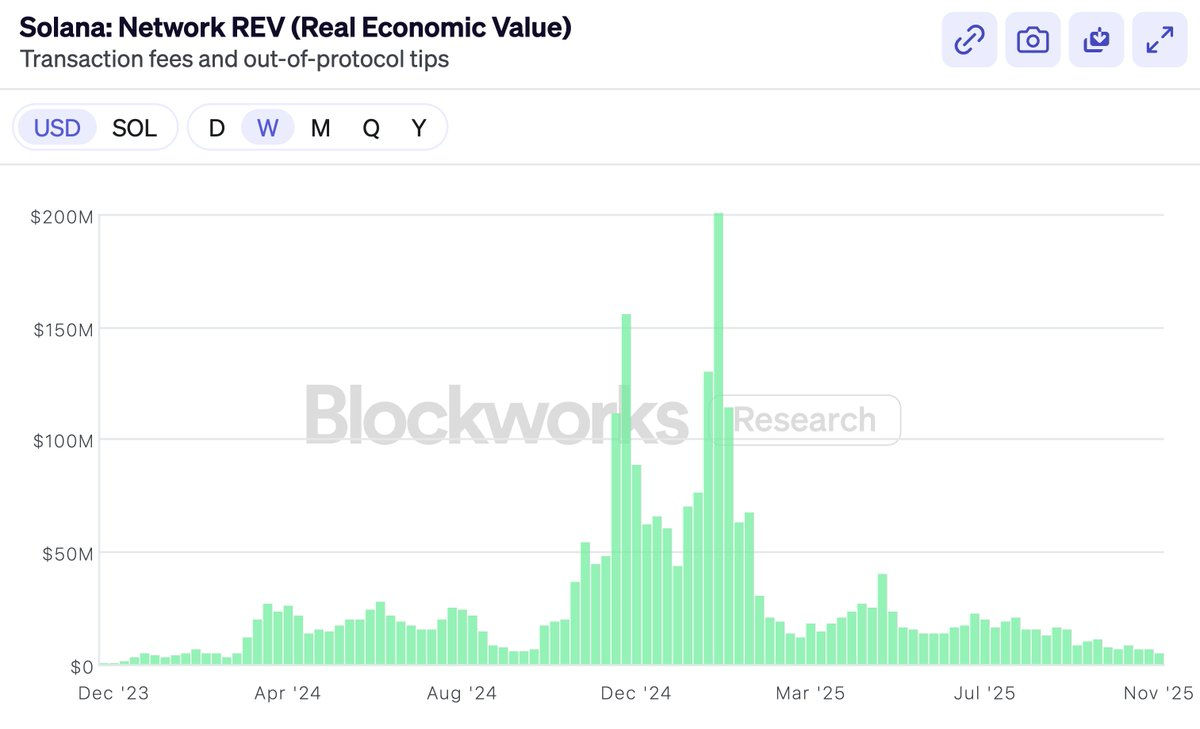
This isn’t to say there’s anything wrong with REV (Realized Economic Value). REV is actually a very smart metric. But that’s not the point of this article.
Then came Hyperliquid’s launch—an actual decentralized exchange (DEX) with real revenue, buybacks, and a P/E multiple. The market response? “See, I told you! Finally, for the first time, there’s a token that’s truly profitable with a reasonable P/E.” (Don’t bring up BNB—we’re not talking about it.) Hyperliquid will eat everything, because clearly Ethereum and Solana aren’t really making money, and now we can stop pretending to value them.
Tokens centered around buybacks—Hyperliquid, Pump, Sky—are great. But markets have always had the ability to invest in exchanges. You can buy Coinbase stock, or BNB, or similar products at any time. We also hold $HYPE, and I agree it’s a fantastic product.
But that’s not why people invest in ETH and SOL. L1s aren’t bought because they offer high profit margins like exchanges—if that’s what you want, just buy Coinbase stock.
So if I’m not criticizing blockchain financial metrics, maybe you think this article is going to attack the supposed “sins” of the token industrial complex.
Clearly, everyone lost money on tokens over the past year—including VCs. Altcoins performed terribly this year. So the other half of CT’s mainstream narrative began arguing about who’s to blame. Who got greedy? Were VCs greedy? Was Wintermute greedy? Was Binance greedy? Were yield farmers greedy? Were founders greedy?
Of course, the answer is the same as it’s always been.
Everyone was greedy. Every single one—VCs, Wintermute, yield farmers, Binance, KOLs—they were all greedy. And so were you. But that doesn’t matter. Because a normally functioning market doesn’t require participants to act against their self-interest. If we’re right about crypto’s future, then even if everyone is greedy, investments can still succeed. Trying to explain market downturns by analyzing “who was greedier” is like holding a pointless witch hunt. I guarantee no one only started being greedy in 2025.
So that’s not what I want to write about either.
Many want me to write about why $MON should be worth X or $MEGA should be worth Y. But I have no interest in that, nor will I advise you to buy any specific asset. In fact, if you don’t already believe in these projects, you probably shouldn’t buy them at all.
Will challenger chains succeed? Who knows. But if there’s even a chance they do, their pricing will reflect that probability. If Ethereum’s market cap is $300B and Solana’s is $80B, then a project with a 1%-5% chance of becoming the next Ethereum or Solana will be priced accordingly.
CT is shocked by this, but it’s no different from biotech. A drug with less than 10% chance of curing Alzheimer’s—even with a 90% chance of failing Phase 3 trials and going to zero—still gets a multi-billion dollar valuation. That’s just math—and markets turn out to be quite good at math. Binary outcomes are priced probabilistically, not based on current earnings or moral judgment. That’s the “shut up and calculate” approach to valuation.
I don’t find this a particularly interesting topic to write about. “5% chance of success? No way—it’s 10%!” For any individual token, the market—not articles—is the best mechanism for assessing such probabilities.
So what I really want to write about is this: Crypto Twitter seems to have stopped believing that blockchains themselves have value.
I don’t think it’s because people don’t believe new chains can gain market share. After all, we just witnessed Solana rise from the ashes and dominate market share in under two years. It’s hard, but clearly possible.
The deeper issue is that people now believe that even if a new chain wins, there’s nothing worth winning. If $ETH is just a meme, if it can never generate real revenue, then even winning wouldn’t make it worth $300B. The race itself isn’t worth running, because the valuations are fake—the whole thing collapses before you even collect the prize.
Being optimistic about chain valuations has become unfashionable. Of course, that doesn’t mean no one is optimistic—clearly, someone always is. After all, every seller has a buyer. Despite CT’s “cool kids” mocking L1s, people still buy SOL at $140 and ETH at $3000.
Yet there’s now a prevailing view that all smart people have abandoned smart contract chains. Smart people know the game is over. If not today, then soon. Anyone still buying is seen as a sucker—Uber drivers, Tom Lee, or KOLs shouting “multi-trillion dollar market.” Maybe even the U.S. Treasury. But “smart money” is staying out.
This is complete nonsense. I don’t believe it, and neither should you.
That’s why I feel compelled to write a “manifesto for smart people,” explaining why general-purpose blockchains have value. This isn’t about Monad or MegaETH—it’s a defense of ETH and SOL. Because if you believe ETH and SOL have value, everything else follows naturally.
As a VC, defending ETH and SOL valuations usually isn’t my job—but damn it, if no one else will step up, I’ll write it myself.
Feel the Power of Exponential Growth
My partner Bo lived through China’s internet explosion firsthand as a VC. Over the years, I’ve heard countless “crypto is like the internet” analogies, to the point of numbness. But whenever I hear his stories, I’m reminded how costly it is to be wrong on major trends.
One story he often tells is from the early 2000s, when all the early VCs investing in e-commerce (a small group at the time) gathered for coffee. They debated: how big could e-commerce really get?
Would it focus mainly on electronics (maybe only tech nerds would shop online)? Would women use it (perhaps they care too much about touch and feel)? What about food (maybe fresh produce is impossible to manage)? These questions were critical for early VCs, as they determined which projects to back and what prices to pay.
Of course, in the end, they were all spectacularly wrong. E-commerce ended up selling everything, and its users became the entire world. At the time, no one truly believed this. Even if someone did, saying it out loud sounded absurd.
You just have to wait long enough for exponential growth to reveal the truth. Even among those who believed in e-commerce, very few thought it would become this massive. And those rare few who truly believed it—almost all became billionaires by simply refusing to sell. The rest of the VCs—as Bo told me, including himself—sold too early.
In crypto, believing in “exponential growth” has become passé.
But I still believe in crypto’s exponential growth. Because I’ve lived it.
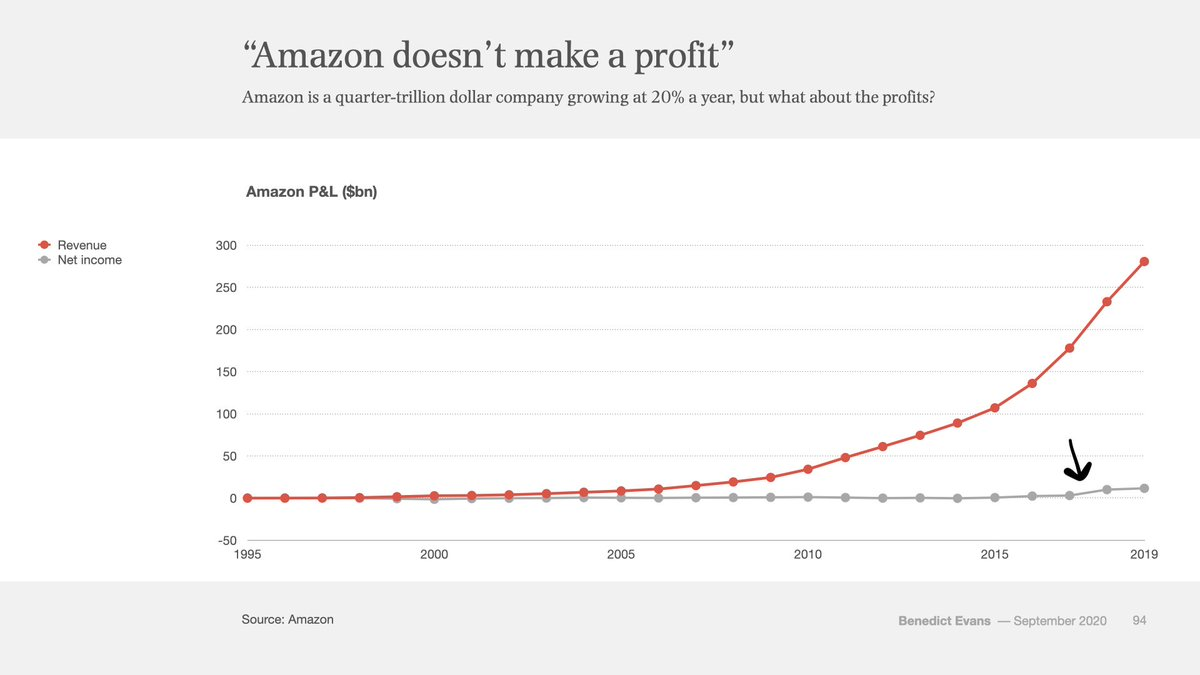
This is Amazon’s profit & loss statement from 1995 to 2019—24 full years. Red is revenue, gray is profit. See that tiny flicker at the end? That upward tick in the gray line marks the first time Amazon truly became profitable—after 22 years.
Amazon’s net profit line didn’t rise above zero until year 22. For every year before that, there were column inches, critics, and short-sellers calling Amazon a Ponzi scheme that would never make money.
Ethereum just turned 10. And here’s Amazon’s stock performance in its first 10 years:
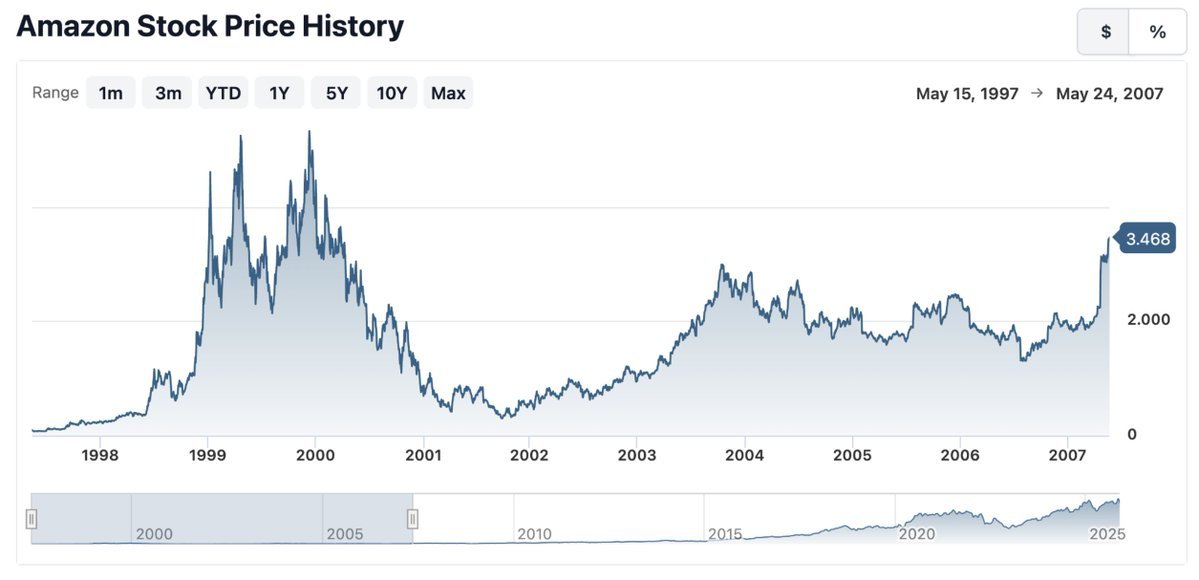
Ten years of volatility. Throughout, Amazon was surrounded by doubters and skeptics. Is e-commerce just a VC-subsidized charity? Are they just selling cheap, low-quality junk to bargain hunters—what’s the point? How could they ever make real money like Walmart or GE?
If you were debating Amazon’s P/E ratio back then, you completely missed the point. P/E belongs to linear thinking, and e-commerce wasn’t a linear trend. Everyone who argued based on P/E over those 22 years was utterly wrong. No matter how much you paid, no matter when you bought—you weren’t bullish enough.
Because that’s the nature of exponential growth. With true exponential technologies, no matter how big you think they’ll get, they always get bigger.
This is where Silicon Valley understood something Wall Street didn’t. Silicon Valley grew up with exponential growth; Wall Street was used to linear growth. Over the past few years, crypto’s center of gravity has gradually shifted from Silicon Valley to Wall Street. The difference is obvious.
Of course, crypto’s growth doesn’t look as smooth as e-commerce. It’s more volatile, marked by intermittent bursts. That’s because crypto deals directly with money, is deeply affected by macroeconomic forces, and faces far more intense regulatory battles than e-commerce ever did. Crypto strikes at the heart of the nation—its currency—so its impact on governments is far greater and more unsettling.
But that doesn’t diminish the exponential trend. This may be a crude argument—but if crypto is indeed exponential, then this crude argument is correct.
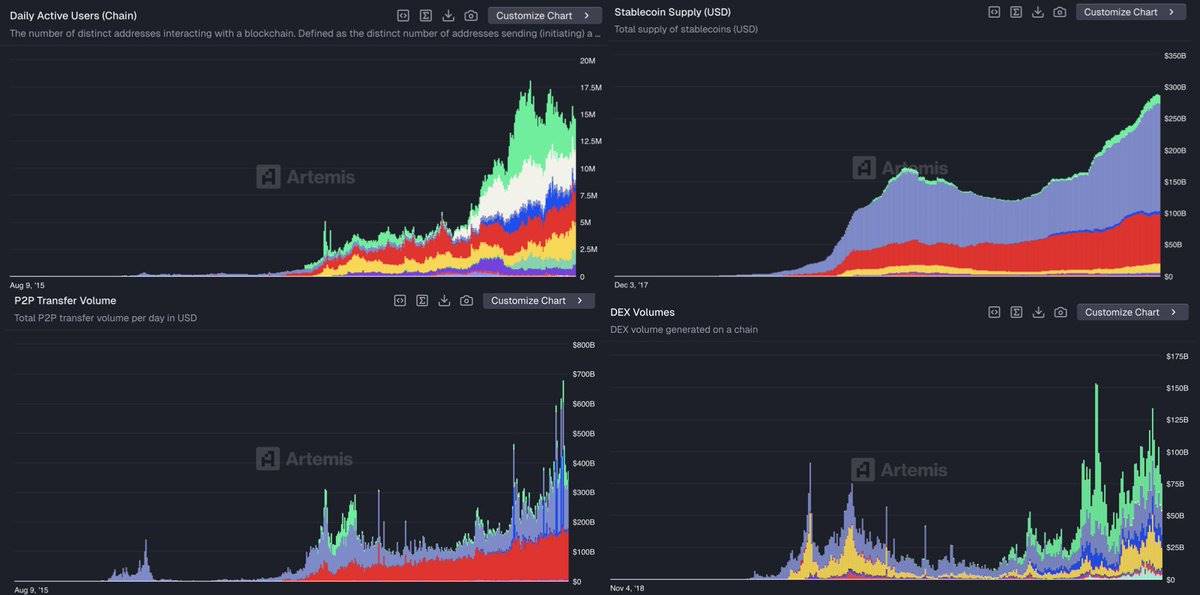
Zoom out.
Financial assets crave freedom. They crave openness, interconnectivity. Crypto turns financial assets into file formats, making sending a dollar or a stock as easy as sending a PDF. Crypto lets everything talk to everything—making finance operate 24/7, global, interconnected, open.
This model will win. Openness always wins.
If the internet taught me one thing, it’s this. Incumbents will fight hard. Governments will scream. But in the end, they’ll give in to the accessibility, creativity, and sheer efficiency this technology brings. That’s exactly what the internet did to every other industry. And blockchain will swallow finance and money the same way.
Yes—given enough time—everything.
There’s an old saying: “People overestimate what they can do in two years and underestimate what they can do in ten.”
If you believe in exponential growth, if you zoom out, everything still looks cheap. And what should humble you is that every day, holders are outperforming sellers and skeptics. Big capital has a time horizon far longer than what CT’s short-term traders would have you believe. Big capital has learned from history not to abandon big technological bets too soon. Know what? That compelling story that made you buy $ETH or $SOL in the first place? Big capital believes in that story too—and never stopped believing.
Join TechFlow official community to stay tuned
Telegram:https://t.me/TechFlowDaily
X (Twitter):https://x.com/TechFlowPost
X (Twitter) EN:https://x.com/BlockFlow_News
 @dragonfly_xyz