Who Can Become the Technical Foundation for China's Stablecoin? Four "National-Level" Public Blockchains Compete on the Same Stage
TechFlow Selected TechFlow Selected
Who Can Become the Technical Foundation for China's Stablecoin? Four "National-Level" Public Blockchains Compete on the Same Stage
From the global connector BSN and industrial foundation "Spark·Chain Network," to the technological cornerstone "ChainMaker," and further to Conflux—a public blockchain that serves as a special case—they together form China's unique blockchain landscape.
 Navigating Web3 tides with focused insights
By: Frank, PANews
Stablecoins are emerging as a new strategic frontier for major global economies, with the U.S., EU, Hong Kong, and others racing to introduce regulations to gain an early advantage. However, any stablecoin issuance relies on one critical underlying infrastructure—public blockchains.
In this context, the industry view that "China currently lacks globally influential public chains and should have state-owned enterprises lead their development" has sparked debate. This perspective is not baseless but may overlook a fact: since blockchain technology was elevated to a national strategic level in 2016, a blockchain infrastructure network led by China's "national team" and aimed at serving the real economy has already taken shape.
From the global connector BSN and industrial foundation "Spark·ChainNet," to the technical cornerstone "ChainMaker," and the public chain "exception" Conflux, they collectively form China’s unique blockchain landscape. As demand for stablecoins grows increasingly urgent, which of these networks is most likely to break through and become the trusted foundation carrying China’s stablecoin vision on the global stage?
To accurately understand China’s strategic intent, the term “public chain” must be redefined within the Chinese context. Equating it directly with permissionless chains leads to serious conceptual misunderstandings. In China, state-promoted “public chains” are essentially closer to nationally guided, multi-party participatory, yet ultimately controllable “public infrastructure” or “trust infrastructure.”
Among them, several currently influential networks include the Blockchain-based Service Network (BSN), Spark·ChainNet, ChainMaker, and the recently discussed public chain Conflux. PANews analyzes these blockchain networks to assess which is most likely to become the foundation for China’s stablecoin?
Blockchain-based Service Network (BSN): Multi-framework compatibility, emphasizing a tokenless approach
Launched in 2018 by the State Information Center, China Mobile, China UnionPay, Beijing Date Technology, and other institutions, BSN is a public blockchain infrastructure. It currently consists of BSN private networks and BSN public networks. The BSN private network primarily serves enterprises through the "BSN Distributed Cloud Management Platform," supporting deployment across physical IDC data centers, public clouds, and private clouds to establish blockchain-based distributed cloud environments.
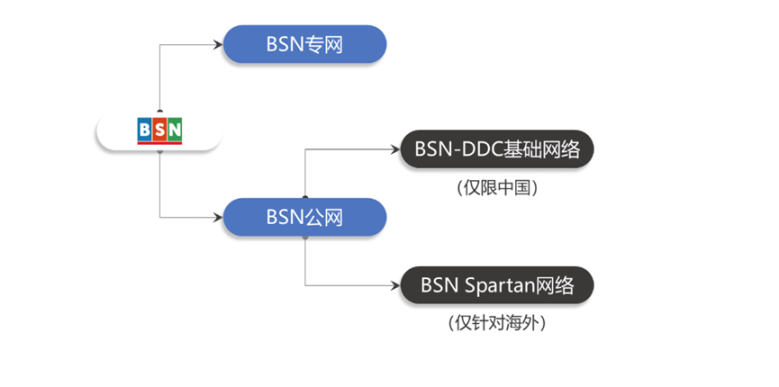
The BSN public network aligns more closely with familiar concepts of public and consortium chains. Within the BSN public network system, there are two components: the BSN-DDC Basic Network (an open consortium chain面向 China), and the BSN Spartan Network (a public distributed cloud service network composed of tokenless public chains面向 overseas markets).
Currently, the DDC network includes multiple open consortium chains such as Yan'an Chain, Wenchang Chain, Taian Chain, Wuhan Chain, and CMCC Chain. These networks adopt frameworks like Ethereum, EOS, FISCO BCOS, and Corda, with primary applications including NFTs (digital collectibles), decentralized domain names, decentralized identity (DID), and trusted data provenance. The DDC network is a consortium chain system without token design; regular on-chain service fees require fiat currency top-ups and are oriented toward the domestic market.
The consensus mechanism of the BSN Spartan Network leans toward public chains like Ethereum, but remains tokenless. BSN Spartan currently comprises three sub-chains based on Ethereum, Cosmos, and PolygonEdge. As of August 4, the daily transaction volumes of these three chains were 1,068, 844, and 938 transactions respectively.
Overall, BSN’s core innovation lies in its multi-framework adaptability—the ability to uniformly integrate and manage dozens of mainstream global blockchain frameworks (including both consortium and public chains). Through a standardized adaptation mechanism, developers can “plug-and-play” different underlying chains without dealing with complex deployment and operational details, functioning like a universal “operating system” for the blockchain world. However, for the growing demand for stablecoins, BSN’s lack of an open token mechanism could become a constraint. He Yifan, Executive Director of the BSN Development Consortium and CEO of Date Technology, has repeatedly expressed strong opposition to virtual currencies, calling them massive Ponzi schemes.
Spark·ChainNet: Supported by MIIT, focused on industrial applications
According to official descriptions, Spark·ChainNet is a national-level blockchain-based integrated infrastructure system initiated under the leadership and special support of the Ministry of Industry and Information Technology (MIIT), led by the China Academy of Information and Communications Technology (CAICT) and jointly built with Beihang University, Beijing University of Posts and Telecommunications, China Unicom, and other major institutions.
Architecturally, Spark·ChainNet has two layers. The first layer consists of a mainchain formed by super nodes, used to manage identifiers, public data, or other future statutory assets and regulatory functions provided by the state. The second layer comprises sub-chains connected via backbone nodes, linking various industry- or region-specific applications.
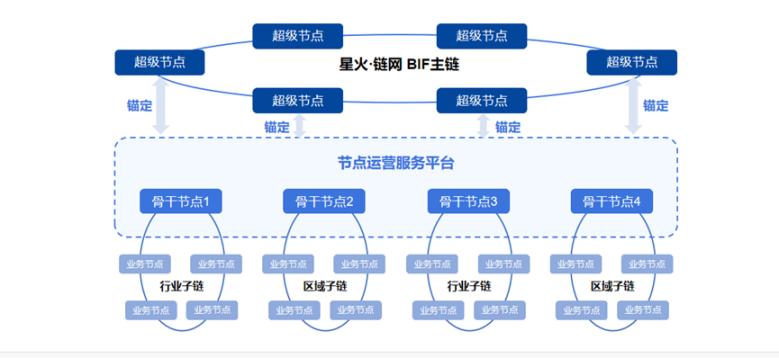
Notably, Spark·ChainNet is a permissioned public blockchain network, and according to current information, it also lacks token design. Similarly, Spark·ChainNet is divided into a domestic mainnet and an international version known as the ASTRON network. Currently, completed super nodes include Xiamen and Liuzhou; backbone nodes include Jiaozhou, Hengqin, and Suzhou; international nodes include Malaysia and Macau. Node admission to Spark·ChainNet has relatively high thresholds, requiring promotion and construction by local governments.
Spark·ChainNet’s application scenarios are highly focused on industrial domains, including full lifecycle traceability of high-end manufacturing products, collaborative management of complex supply chains, digital identity authentication and predictive maintenance for industrial equipment, and trusted sharing and trading of industrial data.
ChainMaker: Repeatedly included in policy plans, involving SOEs and internet giants
ChainMaker is led by the ChainMaker Ecosystem Alliance, initiated by the Beijing Microchip Blockchain and Edge Computing Research Institute ("Microchip Institute") under the guidance and support of the Beijing municipal government.
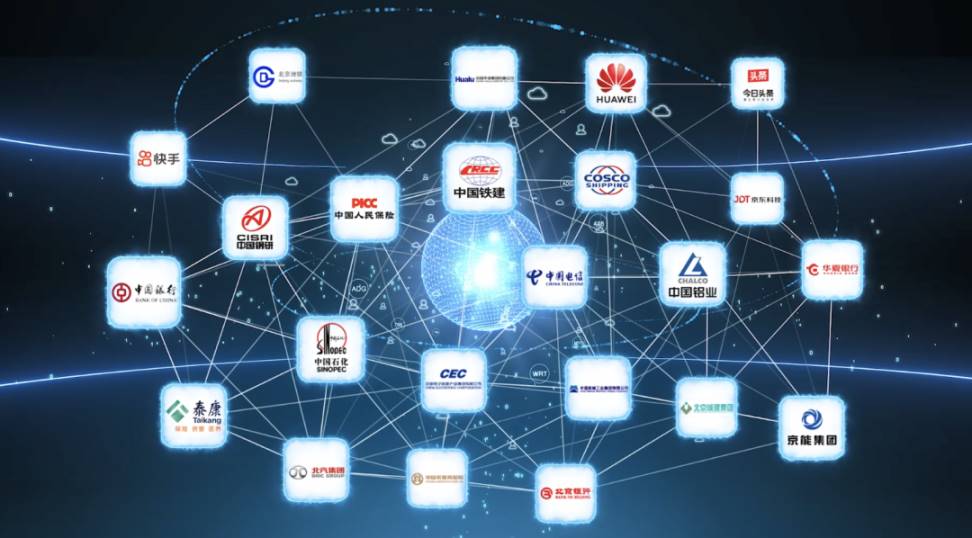
The ChainMaker Ecosystem Alliance includes central SOEs from key sectors such as State Grid, China Construction Bank, Industrial and Commercial Bank of China, China Unicom, and COFCO Group, as well as internet giants Tencent and Baidu. The alliance now includes over 50 members.
In November 2021, ChainMaker was included in the "Beijing 14th Five-Year Plan for International Science and Technology Innovation Center Construction." In January 2022, it was mentioned in Beijing’s government work report. In 2025, ChainMaker was again referenced in the "Beijing Action Plan for Blockchain Innovation and Application Development (2025–2027)."
Beyond its strong backing, ChainMaker also boasts notable technical advantages. Official claims state its transaction throughput (TPS) can reach up to 100,000, meeting high-concurrency demands in large-scale financial and governmental scenarios.
Conflux: Built by Tsinghua "Yao Class" team, mainland China’s only token-issuing public chain
Different from the above networks with clear consortium chain characteristics, Conflux is considered the only public chain in mainland China that meets regulatory requirements. Founded in 2018 by Fan Long, a graduate of Tsinghua’s "Yao Class" and MIT PhD, with Academician Andrew Yao personally serving as chief scientist and participating in core algorithm design. In January 2020, the Conflux team officially established the Shanghai Conflux Blockchain Research Institute. In October of the same year, the Conflux blockchain mainnet launched.
As a complete public chain, Conflux also has a governance token, CFX. Despite China’s strict regulatory policies on cryptocurrencies, Conflux successfully issued and operates its token CFX—a unique "exception."
CFX, as a global crypto asset, is listed on several major cryptocurrency exchanges such as Binance, OKX, and Gate.io. Its market price and capitalization are influenced by various factors including technological progress, ecosystem development, and macro market conditions. For instance, recent positive news such as the Conflux 3.0 upgrade and plans for offshore RMB stablecoin support have caused its token price to surge significantly in the short term.
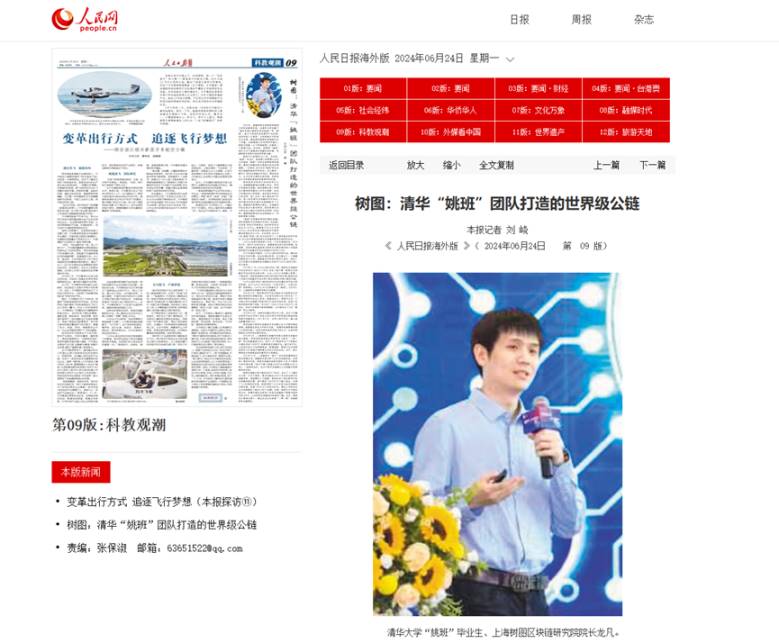
Additionally, Conflux’s endorsements are significant. It has been featured multiple times in mainstream official media such as People’s Daily and has deep collaborations with central SOEs like China Telecom and China Mobile. Moreover, Conflux is partnering with fintech company AnchorX to explore issuing an offshore RMB-pegged stablecoin (AxCNH) to support cross-border payment needs along the Belt and Road countries.
Which is most likely to become the technical foundation for stablecoins?
Besides the above strongly backed blockchain networks, China also hosts numerous consortium chains such as State Grid Chain (State Grid), Unicom Chain (China Unicom), CMCC Chain (China Mobile), ICBC Chain (Industrial and Commercial Bank of China), AntChain (Ant Group), Zhixin Chain (Tencent), and Zhongxiang ChainNet. Most are initiated by central SOEs or tech giants and hold unique strengths and influence within their respective domains.
But returning to the original question: does China currently have a public chain with international influence? The answer so far appears to be no. The main reason is that most Chinese blockchain networks operate as consortium chains, differing significantly from overseas public chains like Ethereum and Solana in terms of consensus mechanisms and economic models.
Among existing public blockchain infrastructures, Conflux is the most likely candidate to become a domestically developed, internationally recognized public chain. From a technical standpoint, Conflux exhibits internationally recognized public chain characteristics, with originality and performance advantages. Its official affiliations and clear exploration into offshore RMB stablecoins position it ahead in the stablecoin race.
Among other blockchain networks, ChainMaker also has the potential to serve as the underlying architecture for stablecoin issuance. In 2021, its research institute, the Microchip Institute, signed a strategic cooperation agreement with the PBOC Digital Currency Research Institute to jointly promote enterprise-level applications of digital RMB based on ChainMaker. Furthermore, ChainMaker’s technical features support token design, meeting the technical requirements for stablecoin issuance. Its robust SOE ecosystem gives it natural advantages in promoting inter-institutional or specific-scenario stablecoin applications.
Of course, beyond these options, as publicly traded companies in multiple Western countries begin holding cryptocurrencies in treasury and participating in public chain governance, China might have a third path—participating in the governance of mainstream international public chains. After all, in a decentralized world, national boundaries often come down to just a percentage of computing power.
Join TechFlow official community to stay tuned
Telegram:https://t.me/TechFlowDaily
X (Twitter):https://x.com/TechFlowPost
X (Twitter) EN:https://x.com/BlockFlow_News
 PANews