








Huobi Growth Academy | Cryptocurrency Market Macro Research Report: U.S. Government Shutdown Causes Liquidity Contraction, Cryptocurrency Market Faces Structural Turning Point
TechFlow Selected TechFlow Selected
Huobi Growth Academy | Cryptocurrency Market Macro Research Report: U.S. Government Shutdown Causes Liquidity Contraction, Cryptocurrency Market Faces Structural Turning Point
With the end of the U.S. government shutdown and the recovery of macro liquidity, a structural bull market may be launched and will continue to accelerate alongside the synergy of innovation and capital.
 Navigating Web3 tides with focused insights
Executive Summary
In November 2025, the crypto market is undergoing a structural turning point: as fiscal stimulus recedes and interest rates peak, liquidity flows back into the private sector, risk assets diverge further, and the U.S. Treasury General Account (TGA) balloons from about $800 billion to over $1 trillion due to the U.S. government shutdown—effectively withdrawing approximately $200 billion in liquidity from markets and exacerbating banking system funding stress. BTC becomes a stable collateral layer, ETH serves as a settlement hub; incremental capital flows along the "narrative × technology × distribution" axis toward L2, AI/Robotics/DePIN/x402, InfoFi, DAT and Presales, and Memecoins. Market cap pullback and declining fear index correspond to mid-cycle rotation and value accumulation zones. Key risks lie in regulatory uncertainty, on-chain complexity and multi-chain fragmentation, information asymmetry, and emotional burnout. The next 12 months will be a “structural bull” rather than a broad bull market—the key lies in mechanism design, distribution efficiency, and attention management. Prioritize disciplined allocation around long-curve themes such as AI×Crypto and DAT through early participation and execution closure.
I. Macroeconomic Overview
In November 2025, the global crypto market stands at a structural inflection point—not a full-blown new bull run nor a defensive retreat into bearish depths, but a critical window of “transitioning from speculation to substance, from narrative to technology, and from pure speculation to structural participation.” The root driver behind this shift is not a single price move or policy decision, but an overarching macro paradigm change. Over the past two years, post-pandemic demand management driven by fiscal expansion has gradually faded, while monetary policy’s neutral-to-tight cycle has clearly peaked. Government-led liquidity traction weakens, allowing the private sector to reclaim dominance in capital allocation. New tech narratives and reassessments of production functions are beginning to reshape the foundational logic of asset pricing. Policy focus has shifted from “subsidies and transfers boosting nominal demand” to “efficiency and technological progress driving potential growth.” In this transition, the market increasingly rewards assets with verifiable cashflows and demonstrable technology adoption curves, while becoming more cautious toward leveraged, pro-cyclical assets reliant solely on valuation expansion.
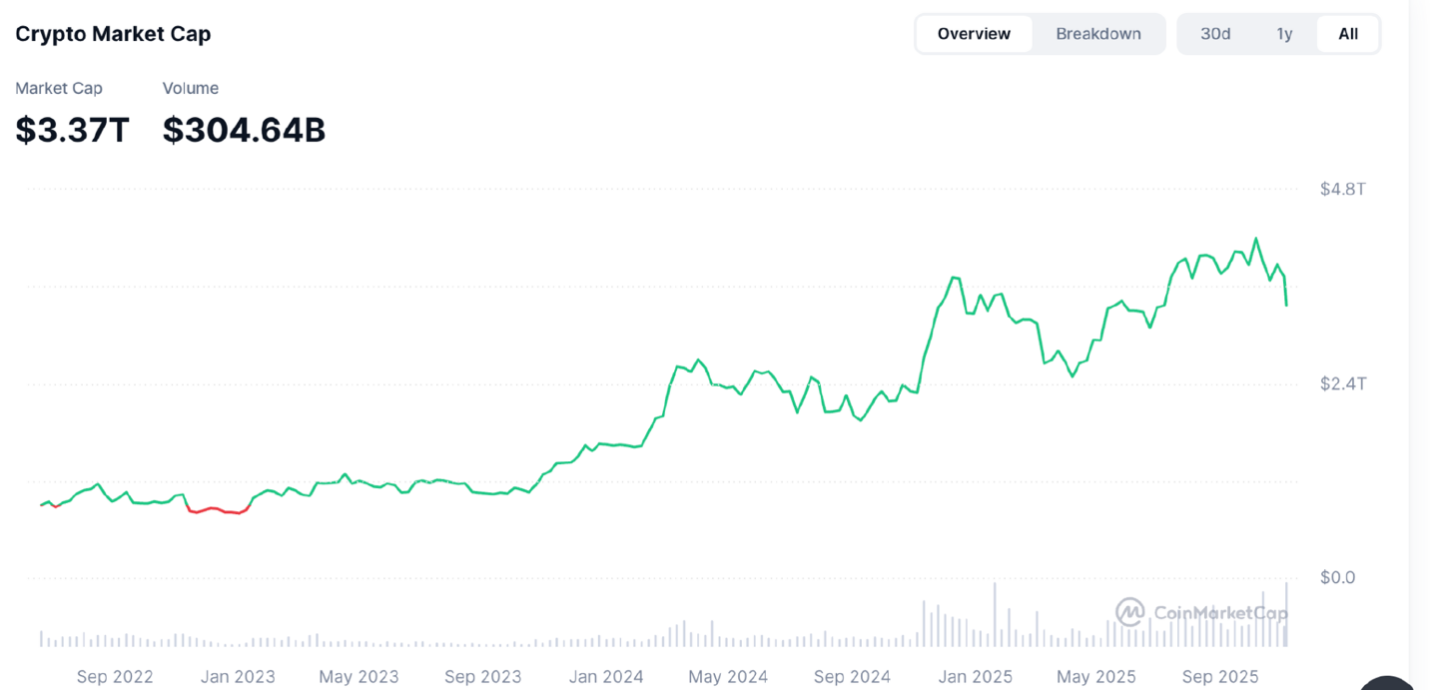
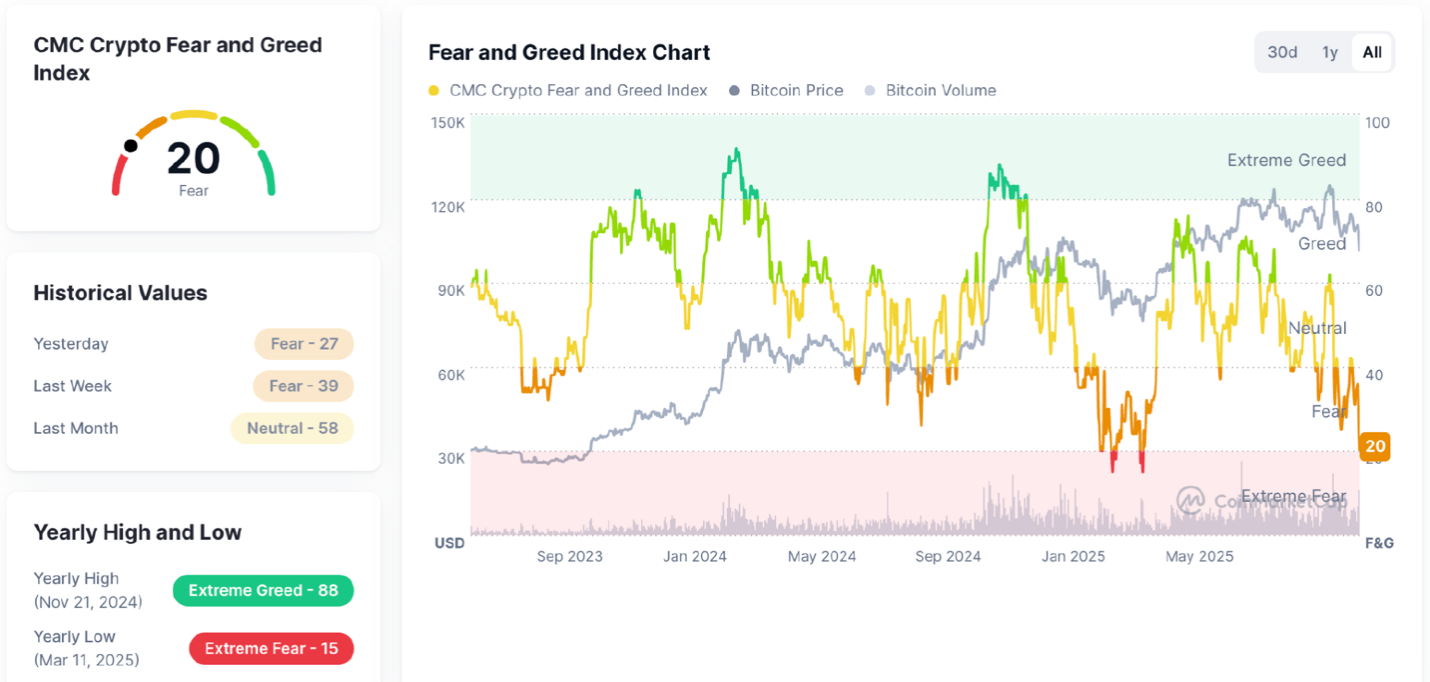
Current data shows the total crypto market cap at ~$3.37T, down from prior highs, indicating阶段性 capital withdrawal and lower risk appetite. Combined with a Fear & Greed Index at 20 (Fear), sentiment remains weak. Overall, the market remains within a long-term upward structure experiencing a mid-cycle correction: the 2023–2025 uptrend remains intact, but short-term uncertainties in macro expectations, profit-taking, and liquidity contraction have pushed markets into a consolidation phase. The trend itself is not broken—sentiment has cooled, placing us in a “fear-driven correction zone,” resembling a period of turnover and divergence within a bull market.
The current Crypto Fear & Greed Index = 20, firmly in the fear zone, continuing to weaken week-on-week and month-on-month. As shown in the chart, Bitcoin prices have pulled back from recent highs, sentiment rapidly shifting from “greed” to “fear,” accompanied by declining volume—indicating investor caution and reduced risk appetite. Yet this area historically corresponds to multiple mid-cycle bottoms or value accumulation zones—the worse the sentiment, the more likely long-term capital begins accumulating. In other words: short-term pessimism and increased volatility; medium-to-long term, fear zones often incubate opportunity for contrarian capital.
From a macroeconomic perspective, take the U.S.: after the Fed’s aggressive rate hikes from 2023–2025, although inflation hasn’t fully returned to its long-term anchor, marginal stickiness in core prices has weakened. Supply-side recovery and inventory cycle declines jointly drive a structural moderation in inflation. Policy communication has gradually shifted from the hawkish “higher for longer” stance toward a “data-dependent watch-and-mild-easing” path, with the rate expectation curve loosening downward. Meanwhile, the U.S. Treasury is making a “second adjustment” to the legacy effects of pandemic-era large deficits and short-duration debt issuance—tighter budget constraints, optimized maturity structures, and marginal reductions in subsidies and transfers—meaning liquidity is flowing back from public to private sectors. But this isn’t unconditional flooding—it enters more efficient and growth-oriented asset classes via market-based credit and equity/debt risk premium reallocation. On another front, the U.S. government shutdown sets a historical record, causing the Treasury General Account (TGA) to only receive funds without spending, swelling from ~$800B to over $1T—effectively draining ~$200B in liquidity from markets and intensifying pressure on bank funding. This explains why traditional high-leverage cyclical commodities are under pressure, while foundational tech, AI chains, and digital infrastructure enjoy higher “valuation tolerance”: the former relies on low rates and strong nominal demand tailwinds, while the latter depends on improvements in production functions and leaps in total factor productivity—shifting benefits from “price-driven” to “efficiency-driven.”
This macro shift manifests in risk assets as structural divergence: on one hand, the lagging effects of high interest rates persist, credit spreads haven’t converged to extreme lows, and capital remains distant from unprofitable, uncertain-cashflow, high-leverage balance sheet assets; on the other hand, sectors with visible cashflows, high demand elasticity, and alignment with tech curves gain active capital allocation. In crypto, this translates into a shift from the previous “Bitcoin-only bloodsucking rally” single-core logic to a multi-core model of “Bitcoin stability → capital下沉 → accelerated narrative rotation.” Bitcoin, supported by rising institutional ownership, mature spot ETF channels, and improved on-chain derivatives structure, sees significantly reduced volatility and increasingly assumes the role of a “risk-free collateral base”—not absolutely risk-free, but relatively the deepest, most transparent, and cross-cycle-stable collateral across the market. Ethereum hasn’t seen explosive gains comparable to Bitcoin, but its systemic importance in settlement layers and developer ecosystems positions it as a “conduit for risky liquidity”—when market risk appetite rebounds, capital no longer lingers in large caps but flows through ETH and L2s into earlier-stage, higher-beta ecosystem assets. Thus, the clearest structural trend in November can be summarized by three inequalities: Rotation > Consolidation, Active Participation > Passive Holding, Hotspot Capture > Large-Cap Waiting. Capital behavior shifts from “waiting idly” to “organized pursuit,” and the key trading skillset evolves from “value discovery” to “narrative identification + liquidity tracking + mechanism anticipation.” Among all narratives, sectors that simultaneously satisfy “tech-driven and attention-momentum” criteria attract the most meaningful inflows: Layer-2, due to high launch density, cost advantages, and incentive design, becomes the most effective “innovation distribution channel”; AI/Robotics/DePIN, linked to real-world production functions and machine economy (M2M) closed loops, exhibit high “curve convexity” the earlier they’re adopted; InfoFi, exploring financialization of knowledge and data value, aligns with the era’s rule that “attention is the scarce resource”; Memecoin represents the ultimate expression of “attention monetization,” enabling rapid emotional and social capital realization at minimal friction; NFT-Fi transitions from “profile picture hype” to more practical models of “on-chain rights and cashflows,” unlocking new collateral, leasing, and revenue-sharing scenarios via structured finance tools; Presales occupy the sweet spot of “low valuation—weak distribution—high convex return,” becoming the highest-value volatile factor within risk budgets. The common thread across these directions is the convergence of “four forces”: attention, developer contribution, incentive mechanisms, and narrative consistency—attention provides visibility and momentum, developer input ensures sustainable supply, incentives solve cold-start problems during expansion, and narrative consistency aligns expectations with execution paths, lowering discount rates.
More broadly, traditional financial assets face long-term return constraints on two fronts: first, Treasury yields, though peaking, remain high, compressing equity valuation elasticity; second, global real growth momentum is weaker than in prior cycles, forcing corporate earnings expansion to rely more on efficiency than pricing power. By contrast, Crypto’s advantage lies in the synchronization of “technology cycles and financial innovation cycles”: on one hand, end-to-end improvements in on-chain infrastructure—from performance and fees to development tools—significantly reduce application marginal costs and experimentation radius; on the other hand, tokenization mechanisms and incentive engineering provide a consensus coordinator among capital, users, and developers, solving the internet-era cold-start problem in a measurable, iterative, distributable way on-chain. In other words, crypto’s risk premium is no longer driven solely by volatility and leverage, but increasingly by “the ability to turn attention, data, and compute into redeemable cashflows via mechanism design.” When combined with structurally released macro liquidity, crypto’s risk-adjusted return curve exhibits relative advantages over traditional assets. On the monetary front, markets are transitioning from “nominal easing expectations” to “actual neutrality” and then into “structural partial easing.” Policy rate direction is no longer unilaterally tightening, Treasury supply structures are becoming more refined, and marginal improvements in credit conditions are lowering private financing costs and easing refinancing pressures on existing assets—making tech and innovation chains the primary beneficiaries. This rhythm suggests crypto is entering the early-middle stage of “risk appetite recovery”—unlike past rallies purely fueled by quantitative easing, this cycle resembles a “marathon” propelled by “technological progress + narrative evolution + mechanism optimization”: the rise won’t be a “single spike,” but “multi-core driven, phased advancement.” Therefore, the most apparent market phenomenon isn’t “Bitcoin surging alone,” but “BTC stabilizing the base, ETH maintaining the hub, and L2/AI/InfoFi/NFT-Fi/Memecoin rotating in clusters.” Within this landscape, “early positioning → staged realization → re-rotation” becomes the dominant theme, while the logic of “holding one sector forever” loses effectiveness—capital requires a “war-sustained-by-war” strategic capability.
In summary, the current macro transmission chain can be expressed as: fiscal retreat and deficit management → liquidity returns to private sector → falling rate expectations and credit condition repair → capital preference shifts to “efficiency and curve convexity” → tech narratives gain higher discount rate tolerance → crypto shifts from single-core to multi-core → structural rotation becomes dominant. At this November juncture, our view is: global macro has not yet fully turned accommodative, but structural incremental liquidity is being released, amplified by technological cycle breakthroughs and maturing distribution mechanisms. Crypto assets are moving from “single-market driven” to a mid-term structure of “coexisting group narratives,” characterized by “local bulls · structural bulls.” Its sustainability doesn’t depend on a single asset’s weekly chart, but on mutual validation across multiple subsystems: developer retention and toolchain maturity validate supply, user growth and fee curves validate demand, incentive budgets and governance upgrades validate mechanisms, and cross-chain settlements and compliance channels validate funding sources. Under sustained positive feedback among these variables, the market becomes healthier, more diversified, and demands more professional and disciplined “active participation.” Therefore, mastering this phase isn’t about guessing “which coin will blow up next,” but building an integrated framework of “macro → narrative → mechanism → liquidity → distribution”: identifying directional changes in rates and deficits at the macro level, assessing whether tech curves and demand-side dynamics are synchronized at the narrative level, reviewing the sustainability of incentive designs at the mechanism level, tracking real migration in fees, market-making, and social flows at the liquidity level, and evaluating the comprehensive efficiency of presales, airdrops, leaderboards, points, NFT-Fi, and social media matrices at the distribution level. Only when this framework achieves closure do the three inequalities—Rotation > Consolidation, Active > Passive, Hotspot > Large-Cap—cease to be slogans and become executable, trackable, reusable strategy methodologies.
II. Sector Analysis and Macro Outlook
Entering 2025–2026, the key drivers of the crypto market have quietly undergone structural transformation. While interest rates and macro variables still constitute the underlying Beta, the true source of substantial alpha has shifted from “macro sentiment → asset pricing” to the triple resonance of “narrative × technology × distribution mechanism.” The new cycle’s hallmark is an accelerating tech foundation, shortened narrative dissemination pathways, and more decentralized capital distribution—yielding unprecedented price elasticity and style rotation speed. Against this backdrop, Presales, Memecoins, AI×Robotics×DePIN×x402, InfoFi, and DAT (Digital Asset Treasury quasi-listed companies) emerge as the most directionally certain themes over the next 6–18 months.
Presales will be the clearest and most structurally rewarding opportunity window over the coming year. Their advantage doesn’t stem from traditional “undervaluation,” but from time and distribution structure. Early-stage tokens typically carry lower valuations, operate in relatively opaque information environments, and have high entry barriers—creating significant information and execution gaps. Many know of a project but can’t secure allocations; some get allocations but don’t know how to distribute or reinvest post-TGE; others understand exits but fail to find the next entry point. Real alpha lies not in “knowing,” but in the complete chain of “knowing → securing → exiting → recycling.” Whether it’s new L2 asset launches, AI-native projects, InfoFi builders, or meme primitive experiments, their early phases offer 20×~50× return potential via presales. The key to presales isn’t “picking winners,” but deeply embedding oneself in information, capital, and distribution networks—transforming informational edge into executable profit cycles. This means top participants in the new cycle must be not just researchers, but operators. Closely tied to presales is the eternal narrative of Memecoins. Memes are never value investments—they’re concrete expressions of attention economics and narrative arbitrage, the most agile alpha carriers in crypto. Over past cycles, we’ve clearly observed battlefield shifts: 2021 on BSC, 2023–2024 on Solana, and 2025 entering a bipolar era of Solana and Base. The logic is simple: the faster, cheaper, and more community-mobilizing the chain, the better suited for meme execution. The essence of memes isn’t “what it is,” but “who tells it, who pushes it, who distributes it,” forming a high-speed loop of “narrative → attention → liquidity → pullback → reconstruction.” Once a breakout narrative forms, assets can achieve massive gains in weeks and rapidly complete distribution. At its core, it’s the market achieving short-term consensus on a symbol and executing speculative behavior concretely on-chain. Despite high risk, their agility, iteration speed, and explosive potential make them unavoidable expressions in every cycle.
Compared to these tactical sectors, AI×Robotics×DePIN×x402 represent the most certain technological主线 of the new cycle, poised to generate long-term mega-trends akin to Bitcoin’s early days. AI’s value was never limited to cognition alone, but lies in its integration as an economic agent into production systems. When AI models evolve into autonomous agents capable of executing tasks, signing transactions, settling payments, and self-maintaining on-chain, machines become economic units—forming a “machine-to-machine (M2M)” economic structure. Blockchain provides machines with identity, settlement, and incentive systems, granting them permission to participate in economic cycles. x402’s significance lies in creating internet-native automated payment and settlement infrastructure, enabling value exchange between AIs—giving rise to new asset forms like machine wallets, on-chain leasing markets, robot asset rights, and auto-yield systems. The current phase remains extremely early, with business models not yet solidified—but precisely because of this, expectation gaps are vast, making it the most promising “tech × finance” intersection for years ahead. Key assets such as CODEC, ROBOT, DPTX, BOT, EDGE, PRXS are building around machine identity, compute incentives, and AI agent economies. AI×Crypto is essentially immune to regulatory cycles because it’s driven by technological expansion, not policy will—making it a structural trend on par with “internet birth” or “smartphone proliferation.” Meanwhile, InfoFi (Knowledge Finance) emerges as the most creative narrative of the new cycle. It’s not merely “selling information,” but transforming knowledge contribution, verification, and distribution into measurable, incentivized economic behaviors. In traditional internet, information’s economic returns were largely captured by platforms; in InfoFi, contributors, validators, and distributors all gain rights, forming a “three-party win-win” structure. Core mechanisms: Contribution (Create) → Validation (Validate) → Ranking (Rank) → Reward (Reward). Once value is expressed on-chain, it becomes a tradable, composable asset form—enabling entirely new market structures like a Crypto version of TikTok (traffic) × Bloomberg (analysis) × DeFi (incentives). It solves Web2’s problems of high information noise and distorted incentives, opening possibilities for analysts, judges, and organizers to profit. Notable platforms include wallchain, xeetdotai, Kaito, cookie3—transforming information from “private intellectual property” into “public digital rights,” a highly significant narrative convergence point.
Of particular note is the DAT (Digital Asset Treasury) direction—commonly known as the “Crypto-equity” sector—which will become one of the structural investment themes over the next 6–18 months. The core logic of DAT does not rely on operational business, but on importing on-chain asset valuations into traditional capital markets via listed company shells holding crypto assets. The mechanism: companies allocate cash reserves into major cryptos like BTC, ETH, SOL, SUI, manage assets through holdings valuation, staking yields, and derivative strategies, and reflect this value in stock prices—creating a “on-chain assets → public equity markets” cross-market price transmission. MSTR (MicroStrategy) was the earliest example; starting in 2025, SUIG—the SUI treasury company—will become a new representative, holding over 100 million SUI (~$300–400M), leveraging “listed entity + treasury strategy” combined with ecosystem narrative to offer investors a new asset allocation vehicle. DAT’s advantages: it provides traditional capital a compliant bridge into crypto, and maps Crypto Narratives onto TradFi pricing frameworks—establishing a novel two-way capital flow of “Web3 assets → Nasdaq consensus.” Over the next 6–18 months, DAT will revolve around “SUI, SOL, and AI Narrative,” with potential areas including treasury structure optimization, staking yield growth, asset diversification (BTC, ETH), and synergy with L1/L2 strategies. These assets possess composite traits of “longing the ecosystem + longing the token + longing risk premium,” making them powerful new capital instruments.
In sum, the future crypto market’s main theme will be “narrative rotation × distribution efficiency × execution capability.” Presales and Memes deliver high-frequency alpha, AI×Crypto offers long-term beta plus structural alpha, InfoFi redefines value capture mechanisms, and DAT builds a capital bridge between Web3 and traditional finance. Winners in the new cycle won’t be those who “know the most,” but those who complete the loop from “cognition → participation → distribution → reinvestment.” Information is not an asset—execution and circulation are. The real growth model involves continuous early participation, binding into distribution systems, and compounding capital across narrative cycles. Over the next 6–18 months, crypto will shift from “macro-driven” to “tech- and narrative-driven.” This is not a cycle for patience alone, but for action. Narrative × Technology × Distribution will shape the next generation of winners—and the acceleration structure has already begun.
III. Risks and Challenges
Looking ahead one year, while structural opportunities in crypto are clear, the macro environment still presents unavoidable external risks and systemic challenges. These variables determine not only the pace of liquidity release but also deeply impact narrative strength, asset valuations, and industry expansion boundaries. The biggest uncertainties stem from regulation, on-chain operational complexity, multi-chain fragmentation, user cognitive load, narrative timing, and information asymmetry—within which lies a mismatch between institutional and retail cycles, forming intrinsic strategic barriers. Even against a long-term structural bull backdrop, these risks won’t necessarily halt trends, but will shape the steepness of return curves and volatility ranges.
Regulation remains the key variable affecting crypto’s long-term resilience. Despite positive signals like U.S. spot ETF approvals, regulatory frameworks still exhibit fragmentation, multipolarity, and lag. Legislative efforts struggle to keep pace with asset growth. For institutions, regulatory clarity determines allocation ceilings; for retail, regulatory direction affects confidence and risk appetite. Frictions persist in Europe and the U.S. over exchange regulation, anti-money laundering, custody standards, and DeFi compliance liability—unlikely to unify soon, potentially triggering localized policy headwinds or disruptions. Conversely, Asian markets show relatively proactive progress in licensing and regulatory sandbox systems, but structurally remain in a cycle of “increased openness → regulatory probing → institutional caution → application exploration.” It’s foreseeable that regulatory uncertainty will continue shaping cross-border capital flows, sustaining market pricing stratification between “compliant” and “gray-zone” assets. While no systemic regulatory shock is expected in the coming year, gradual regulatory constraints will act as valuation suppressors—especially for high-volatility, untraceable assets lacking clear structural returns.
On-chain operational complexity similarly hinders mass adoption. Despite significant progress in dev tools and UX over the past two years, on-chain interaction still involves multiple steps and barriers: signatures, authorizations, cross-chain actions, gas management, and risk assessment require active user understanding. Wallet logic has improved but still falls short of Web2’s implicit workflow experience. For on-chain apps to reach “internet-scale,” the vast majority of users must access them seamlessly—not relying on high-knowledge cohorts. Current wallet-protocol interactions remain engineer-centric, requiring users to navigate “wallet → signature → gas → risk → execution” steps—any error risks loss, and existing safeguards can’t fully prevent damage. In short, operational complexity causes real participant numbers to be underestimated; under narrative-driven surges, real capital fails to quickly convert into active users, creating a “traffic-to-value” bottleneck. For projects, this limits growth and distribution capacity; for investors, it delays narrative realization; for institutions, it raises compliance and user protection challenges. Multi-chain competition accelerates innovation but also fragmentation. The L2 boom brings ecosystem prosperity, but also disperses capital and users across multiple execution environments. Inconsistent standards, incomplete data interoperability, and bridge-related risks in cross-chain asset movement increase systemic uncertainty. With liquidity fragmented, individual chain ecosystems struggle to achieve the “scale → depth → innovation” virtuous cycle, while cross-chain bridges introduce security gaps. Most major hacks in recent years involved cross-chain components, deterring institutional use of cross-chain assets and discouraging retail from liquidity migration—resulting in structural inefficiencies. Simultaneously, multi-chain environments cause narrative overload—users struggle to quickly grasp real connections between “ecosystems, assets, mechanisms,” leading to scattered attention and soaring research costs, further deepening information asymmetry.
User comprehension cost remains an internal barrier to industry development. From payment logic, asset management, risk modeling, incentive design to narrative judgment, crypto demands not only financial literacy but also understanding of cryptography, game theory, and economic mechanisms. The industry lacks mature financial education and mechanism transparency, causing most participants to enter with “speculative mindsets,” unable to form stable engagement structures. Amid rapidly evolving narratives, user education constantly lags—making high-knowledge users the primary beneficiaries, while low-knowledge users become liquidity providers for others. The heavier the cognitive burden, the greater the centralization risk. Uneven capital distribution creates a barbell structure: one end elite executors, the other end uninformed speculators—leading to severe imbalance in returns.
Shortened narrative cycles and emotionally intense competition push markets toward “ultra-short-termism.” In high-speed information environments, core narrative updates outpace actual project development, causing price-value decoupling, premature exhaustion of expectations at narrative peaks, and failure to translate into lasting outcomes. Projects are forced to chase narratives for attention, sometimes using high incentives to buy short-term activity instead of building structural value. Emotional burnout degrades user behavior from “research → judge → act” to “follow trends → speculate → flee,” resulting in pulse-like rotations. While generating short-term alpha, this harms developer ecosystems and capital retention over time—undermining fundamentals. Unequal alpha information distribution is one of the industry’s core structural challenges. On-chain data may be transparent, but information structures are highly stratified. Advanced players possess complex insights—fund flows, incentive designs, distribution paths, development timelines, social expectations—while ordinary participants rely on secondary media and social noise. With the rise of presales, points, airdrops, and leaderboard competitions, information asymmetry hasn’t narrowed—it’s widened: on-chain capital moves faster, positioning happens earlier, and the “research → participate → realize” cycle advances relentlessly. Those who understand mechanisms, master distribution tactics, and decode capital structures can enter during project infancy; average users often learn only when narratives go mainstream—structurally late. Clearly, information inequality is not a technical issue, but a game-theoretic one—and will continue to grow. A deeper challenge arises from the “cycle mismatch” between institutions and retail. Institutional capital prefers stability, safety, and sustainable cashflows; retail favors volatility, narratives, and quick exits. Due to differing behavioral models, market volatility structures split: institutions allocate mid-to-long-term to collateral-layer assets like Bitcoin, while retail chases mid-to-short-term plays in L2, AI, memecoins, and emerging apps. They’re not targeting the same assets, mechanisms, or timelines. When macro liquidity fluctuates, institutions steadily buy while retail frequently exit amid volatility—creating unequal returns; when narratives peak, institutions often stay out, causing markets to eventually cool. This structure puts retail at a disadvantage if lacking strategic capability.
Returning to market dynamics, Bitcoin’s role is shifting from “speculative asset” to “stable collateral layer.” This isn’t a negative signal of slowing growth, but a sign of maturation: volatility convergence, deeper liquidity, rising institutional share—pushing BTC closer to its target as a “risk-free on-chain collateral,” aiming long-term to become a cross-ecosystem value anchor. ETH holds a core position in structural growth as a settlement layer, but struggles to outperform high-momentum narratives. Real alpha comes from earlier, lighter, faster-distributing sectors: L2 ecosystems, AI machine economy, presales, short-cycle memecoins, InfoFi, NFT-Fi. The market is in a structural bull, not a universal bull—liquidity flows directionally, no longer lifting all boats. This means competition over the next year must shift from “holding” to “sector selection + rotation execution.” Future capital will favor mechanism design, liquidity distribution, attention architecture, and real adoption—not just products, whitepapers, or imagination. Narrative creates Liquidity, Liquidity brings Opportunity, Opportunity becomes Alpha. In other words, narrative isn’t the goal—it’s the channel guiding liquidity into mechanisms. Sustained returns come from synergistic structural design, ecosystem buildup, and user adoption. Thus, risk and opportunity coexist. Macro uncertainty will continue testing crypto’s internal resilience. Those who truly understand structure, command liquidity, and possess execution capability will gain advantage in future rotation cycles.
IV. Conclusion
In November 2025, the crypto market stands at a structural turning point. The U.S. government shutdown has caused liquidity contraction, draining ~$200B from markets and intensifying funding stress in risk capital markets—macro conditions remain challenging. On the other hand, the crypto market has evolved from “single-core driven” to “multi-track advancement,” with structural rotation replacing broad euphoria—narrative, mechanism, and distribution capability now dominate. BTC remains a foundational reserve, but no longer captures all growth upside; new curves like AI, L2, InfoFi, machine economy, and Memecoins absorb most elasticity, shifting market focus from assets themselves to ecosystems, use cases, and distribution systems. Presale, AI, InfoFi, and Memecoin will become the four main engines of the next cycle. Over the next three years, AI×Crypto, M2M machine economy, and knowledge finance will collectively form the foundational logic of the next long-term growth wave. Winners in this cycle won’t be those with earliest info or largest capital, but those who achieve the most effective distribution within the right narratives. The market has shifted from “holding” to “executing,” from “emotional hype” to “structural delivery.” As the U.S. government shutdown ends and macro liquidity recovers, a structural bull market may ignite—and accelerate continuously with innovation and capital synergy.
Join TechFlow official community to stay tuned
Telegram:https://t.me/TechFlowDaily
X (Twitter):https://x.com/TechFlowPost
X (Twitter) EN:https://x.com/BlockFlow_News
 @HTXAcademy






