Token Burning VS Redistribution: Which Is the Healthier Pump Therapy?
TechFlow Selected TechFlow Selected
Token Burning VS Redistribution: Which Is the Healthier Pump Therapy?
When economic value directly affects system security, a healthier redistribution occurs.
 Navigating Web3 tides with focused insights
Author: Pavel
Translation: TechFlow

Summary
We are exploring whether burning or redistributing assets is better for maintaining system health and ensuring rational incentive mechanisms.
-
When slashing is the initial stage of punishing malicious behavior, redistributing assets is typically more efficient than simple burning.
-
When burning is a core feature in design and does not involve slashing (e.g., deflationary economic models), there is no reason to implement redistribution.
-
When redistribution is a core feature in design but functions like a vulnerability, it should not be replaced with burning; instead, the design must be fundamentally improved.
Definitions
Many seem confused, assuming that when a token is heavily slashed, the slashed stake is automatically burned, reducing supply. But this is not true.
-
Slashing: Refers to "reclaiming" assets from malicious actors.
-
Burning and redistribution: Describe what happens to these reclaimed assets afterward.
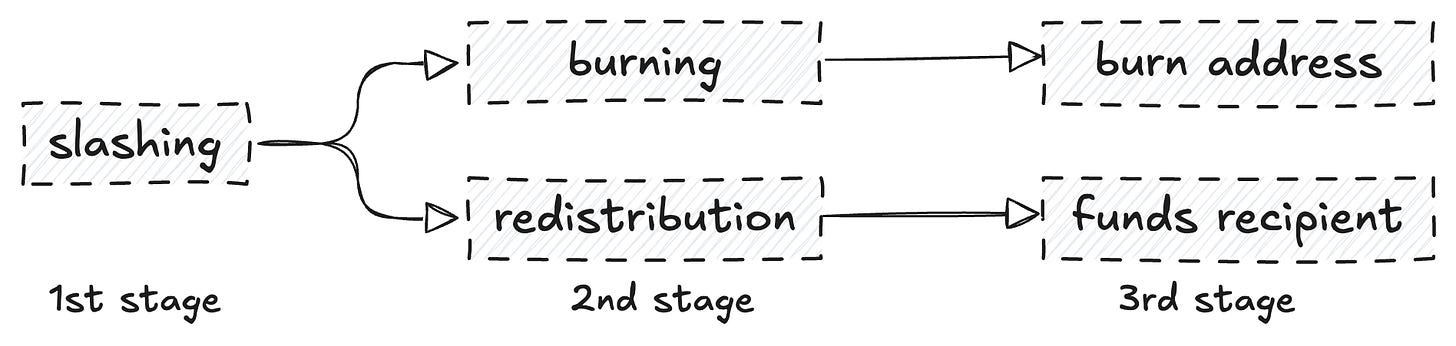
As previously stated, slashed assets can either be burned or redistributed:
-
Burning reduces total supply;
-
Redistribution transfers value to another party (not necessarily the victim). Additionally, burning may also occur independently via built-in protocol mechanisms without slashing.
How Redistribution Enhances Economic Security
Let’s take one of today’s most prominent crypto protocols—EigenCloud—as an example. Its operators were slashed for failing to fulfill obligations, which is good: malicious actors were punished. However, before introducing redistribution of slashed funds, these funds were typically burned (and still can be).
We believe burning slashed funds in such systems is akin to cutting off one’s own legs. When an operator's stake is slashed, the operator is punished (justifiably), but:
-
The victims receive no compensation (imagine someone gets hit by a car, the driver is sentenced, but the victim receives no help).
-
The system’s security weakens (because the assets securing the system are reduced).
If we can retain this value and transfer it to victims, why burn it? Through redistribution, reliable participants gain greater rewards, affected users receive compensation, value remains within the ecosystem—only reallocated. This also unlocks new application scenarios for apps, such as:
-
New permissionless on-chain insurance protocols;
-
Faster and guaranteed decentralized exchange (DEX) trades, e.g., compensating traders when requests fail, expire, or aren't completed timely;
-
Greater incentives for operators to operate honestly and transparently;
-
Protecting lenders by offering guaranteed annual percentage rates (APR), higher transparency, and potentially native fixed interest rates.

Economic security can directly protect users not only before incidents (e.g., via burning mechanisms) but also after. Protocols like Cap have already implemented redistribution, where funds from slashed operators are redirected to affected cUSD holders.
Challenges of Redistribution
Burning assets is simpler than redistributing them—it requires no follow-up handling; just destroy them, with neither gain nor risk. Burning offers fewer benefits but significantly lower risks. Redistribution, however, dramatically changes the game: transferring value from malicious actors to victims isn't as straightforward as it sounds.
Misbehaving operators might now collude with malicious Actively Validated Services (AVS). Currently, AVS can implement any custom slashing logic, even if unfair or subjective. Under slashing-only mechanisms, AVS has little incentive to act maliciously, because operators won’t stake if they know they could be slashed arbitrarily.
But under redistribution, an AVS could transfer one operator’s stake to another malicious operator (with whom they collude), effectively extracting value from the system. Similarly, if AVS keys are compromised, similar outcomes occur, potentially affecting the overall “attractiveness” of operators or AVS.
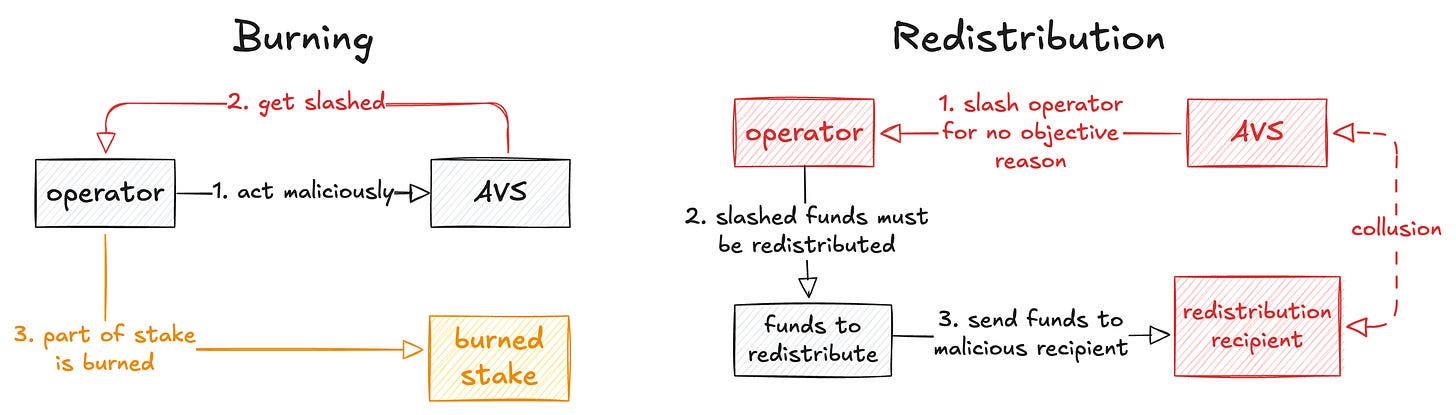
Here, additional mechanism evaluation is required:
-
Operators should not have a “switch type” option after creation;
-
A method must exist to identify compromised (malicious) operators and redistribute value (if it ultimately flows to malicious parties), along with continuous monitoring, etc.
While burning funds is simpler, redistribution is fairer—but it introduces additional complexity.
Fixing Broken Redistribution
The Maximal Extractable Value (MEV) scenario can be viewed as follows: innocent users and liquidity providers (LPs) may be unfairly slashed. For instance, when users want to swap assets, they may suffer frontrunning or sandwich attacks, resulting in worse output prices.
We can confidently say they are slashed because they submitted stakes (assets for swapping) to the system (DEX) and held them over a period (swap time), yet received far less than expected.
Two core issues arise:
-
LPs are slashed without cause (they committed no wrongdoing).
-
Users are slashed without cause; they acted innocently, neither trying to profit from nor contribute to the system—they simply wanted their transactions executed.
Here, value is extracted and redistributed: exploiters are rewarded, while blameless parties are penalized.
-
This issue can be mitigated through certain ordering rules (e.g., Arbitrum Boost), making it easier for users.
-
For LPs, the problem is more complex, as they are often victims of LVR (Loss versus Rebalancing).
Can Burning Solve These Issues?
Burning provides diffuse benefits to all token holders but cannot specifically compensate LPs who directly lose due to arbitrage activities. Theoretically, burning could solve the issue—once arbitrage profits are destroyed, there’s no incentive for arbitrage.
However, once arbitrage profits are extracted, identifying such activity becomes harder: while on-chain transactions are visible, CEX data doesn’t reveal exact trader addresses.
In this case, flawed redistribution designs can be addressed via application-specific ordering rules, such as Angstrom’s solution, allowing LPs to capture value otherwise taken by extractors. This approach works quite well.
In this specific MEV case, neither redistribution nor burning is truly viable—they only treat symptoms, not root causes. The problem requires fundamental redesign at the architectural level.
Scenarios Where Burning Outperforms Redistribution
It must be clear: redistribution is not a panacea. Burning is preferable in cases where slashing is not involved, and burning serves as a core mechanism feature.
Take BNB, for example. BNB’s quarterly burn is central to its deflationary tokenomics and cannot be replaced with redistribution, as it involves neither exploiters nor victimized users.
A similar process occurs in ETH’s design (EIP-1559), where base fees are burned, creating deflationary effects. Given Ethereum’s mechanism design, fees may become extremely high during network congestion. Some might argue that instead of burning base fees, they should go into a treasury fund to partially reimburse users during congestion. Yet, drawbacks outweigh potential benefits:
-
Redistributing fees may dilute deflationary effects, leading to higher inflation and potentially depressing token value over time;
-
Poor allocation decisions, reduced income (e.g.: which transactions should the fund prioritize? Is it fair for users to pay priority fees if those can be reimbursed from funds? etc.);
-
If users know fees will be reimbursed, spam transactions may increase, worsening congestion;
-
Assuming Ethereum’s base fees were redistributed to stakers, this might incentivize validators to prioritize high-fee transactions, ignoring unsponsored or unpaid ones.
There are many other similar cases, but the key point is: redistribution isn’t a magic fix. If burning occurs independently (without slashing), there’s almost no reason to replace it with redistribution.
Conclusion
In conclusion, we emphasize that in scenarios without slashing, redistribution generally underperforms compared to burning, whereas in slashing-involved scenarios, redistribution typically outperforms burning.
Incentive alignment remains a long-standing challenge in crypto, varying across protocols. When economic value directly impacts system security or other critical aspects, it’s best not to burn such value, but rather find ways to properly redistribute it to honest participants, thereby incentivizing fairness and integrity.
Join TechFlow official community to stay tuned
Telegram:https://t.me/TechFlowDaily
X (Twitter):https://x.com/TechFlowPost
X (Twitter) EN:https://x.com/BlockFlow_News
 @paramonoww