








From "Air" to "Cash Flow": The Rise of Utility Tokens After the VC Bubble Burst
TechFlow Selected TechFlow Selected
From "Air" to "Cash Flow": The Rise of Utility Tokens After the VC Bubble Burst
Countless山寨 coins keep plunging to new lows, while some utility tokens attract funds flowing逆势 upward, with both price and on-chain income rising together.
 Navigating Web3 tides with focused insights
Author: Yinan
In early 2025, as secondary market liquidity tightened, the bubbles of numerous altcoins driven by "stories + airdrops" were ruthlessly burst.
Countless altcoins continued to fall to new lows—while Bitcoin's market dominance rose to a five-year high of 62.1%, and the Altcoin Season Index even hit a record low of 4 in May 2023.
Yet, "utility tokens" such as Uniswap (UNI), Aave (AAVE), Pendle (PENDLE), and Hyperliquid (HYPE) attracted capital inflows against the tide, with both prices and on-chain revenues rising.
They share one common feature: real, auditable protocol cash flows that return value to token holders through buybacks, revenue sharing, or staking.
This article attempts to outline the logic behind capital migration after the VC bubble burst, and using four representative projects as case studies, explores how the "on-chain P/E era" is reshaping crypto valuation frameworks.
Market Context: When Narratives Recede, Cash Flow Becomes Scarce
VC Slowdown: In Q2 2025, global crypto funding plummeted to $4.99 billion, down another 21% quarter-on-quarter—the lowest single-quarter figure since 2020—investors growing cautious toward "concept炒作."
Capital Flows Back to Blue-Chip DeFi: While Bitcoin strengthens its dominance, fragmentation within the DeFi sector deepens; protocols with closed-loop "revenue-distribution" models see continuous growth in TVL and trading volume. Pendle’s TVL surpassed $5.59 billion in July, nearly tripling year-to-date.
Valuation Anchor Shift: During periods of declining traditional risk appetite, investors increasingly favor quantifiable cash flows over pure narrative premiums.
What Are “Utility Tokens”?
Definition: Token holders share in protocol revenue (Fee Capture), or benefit indirectly via buybacks/burns or staking rewards, thereby increasing each token’s "on-chain EPS" (verifiable earnings per token).
Typical Models
-
Fee Switch / Trading Revenue Sharing: Return or repurchase a portion of protocol fees (GMX).
-
Lending Spread & Liquidation Fees: Channel interest spreads and liquidation rewards into treasury for buybacks (AAVE, Maker).
-
Yield Tokenization: Split and trade future yield streams, with protocol taking a cut (Pendle).
-
Infrastructure Fuel: Instantly repurchase and burn transaction fees from high-frequency matching engines (HYPE).
Four Case Summaries
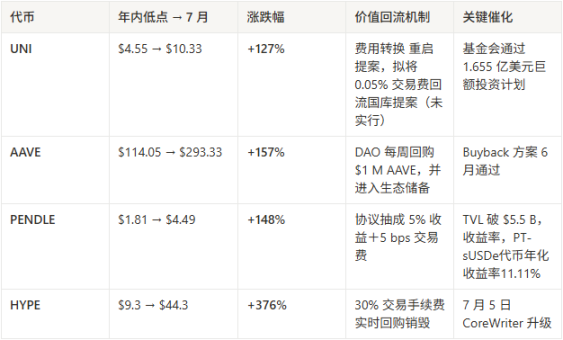
Breakdown: How Cash Flow Drives Valuation Recovery?
Uniswap (UNI)
Previously, the market viewed UNI as a "pure governance token." Later, the Uniswap Foundation passed a vote to approve a massive investment plan totaling $165.5 million.
The Uniswap Foundation proposed allocating $165.5 million across the following areas:
-
$95.4 million for grants (developer programs, core contributors, validators);
-
$25.1 million for operations (team expansion, governance tool development);
-
$45 million for liquidity incentives.
Currently, $UNI has no tangible token value capture or token buyback program!
Aave (AAVE)
The Aave DAO approved weekly buybacks of approximately $1M worth of AAVE using protocol surplus, locking the purchased tokens into the DAO treasury:
-
The first week's execution drove a 13% intraday gain and doubled trading volume.
-
Stable cash flow from lending spreads and liquidation fees, combined with a 32% annual increase in V3 TVL, ensures long-term sustainability for the buyback program.
Pendle (PENDLE)
Pendle turned the derivative narrative of "future yield" into a functioning marketplace:
-
Takes a 5% cut of yield plus 5 bps in trading fees, generating daily auditable revenue for the protocol.
-
High-yield strategies (e.g., stETH YT yields once exceeding 11%) become more attractive in a low-interest-rate environment, drawing sustained capital inflows.
Hyperliquid (HYPE)
As a high-frequency matching DEX, Hyperliquid launched CoreWriter precompiles in July, enabling HyperEVM contracts to directly place orders, settle, and call CLOB functions, along with an on-chain fee-based buyback and burn mechanism:
-
In the week of the upgrade, on-chain active addresses and trading volume reached all-time highs.
-
Immediate value recycling combined with large-scale high-frequency trading fees makes HYPE a strong β for the "on-chain cash flow" narrative.
Three Moats for Surviving Bear Markets
-
Deterministic Cash Flow: On-chain income and expenses are auditable, DAO decisions are transparent, reducing information asymmetry.
-
Buyback / Revenue Distribution Loop: The path from "protocol revenue → token value" is codified into smart contracts, creating effects equivalent to stock buybacks or dividends.
-
Institutional Friendly: Quantifiable metrics (P/S, P/E) reduce valuation uncertainty, facilitating market making and structured product design.
Conclusion
After the retreat of VC-driven narratives, the market is re-pricing based on "verifiable cash flows."
Utility tokens unify on-chain revenue, token value, and governance rights, becoming scarce assets capable of enduring market cycles.
As major DeFi protocols gradually adopt Fee Switches, buybacks, or surplus distributions, it signals a potential shift in crypto market valuation—from a "narrative market" to a "cash flow market."
Join TechFlow official community to stay tuned
Telegram:https://t.me/TechFlowDaily
X (Twitter):https://x.com/TechFlowPost
X (Twitter) EN:https://x.com/BlockFlow_News


