Troy's Trojan Horse Returns: Stable Ignites the Stablecoin Revolution
TechFlow Selected TechFlow Selected
Troy's Trojan Horse Returns: Stable Ignites the Stablecoin Revolution
Stable's strategy is clear: attract users with free USDT transfers and a simple user experience, gradually building a payment ecosystem centered on USDT.
 Navigating Web3 tides with focused insights
Authors: Ryan Yoon and Chi Anh
Translated by: Baicai Blockchain
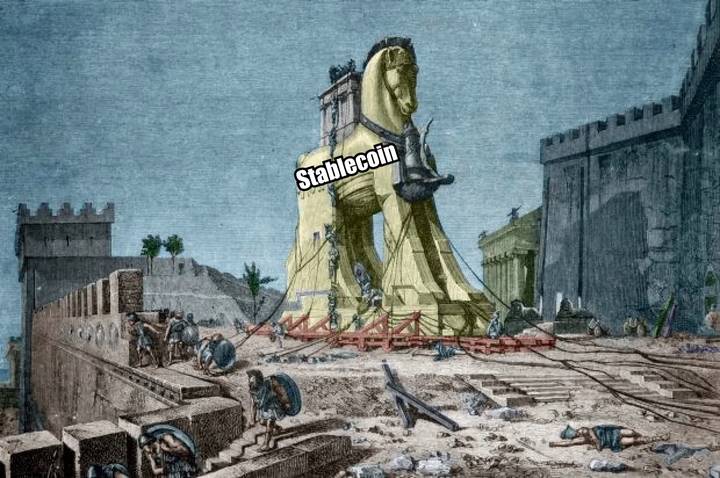
This report, written by Tiger Research, provides an in-depth analysis of Stable—a blockchain platform centered around USDT—and its strategic positioning. Stable aims to drive mass adoption of stablecoins by offering zero Gas fee peer-to-peer (P2P) transfers, transaction confirmations within one second, and a simplified user experience.
Executive Summary
Stable positions itself as the "Trojan horse" of the stablecoin market, with USDT at its core, aiming for widespread adoption.
It addresses key pain points currently facing stablecoins through:
-
Zero Gas fee USDT transfers, eliminating high transaction costs;
-
Sub-second transaction confirmation, meeting real-time payment demands;
-
A simplified user experience, making it accessible even to non-technical users.
Stable’s strategy is to attract users with free, seamless transfer experiences, then gradually expand into payments, decentralized finance (DeFi), and institutional partnerships—building a global payment ecosystem anchored by USDT.
1. Stablecoins: The Quietly Rising "Trojan Horse"
Stablecoins have quietly entered the crypto market like a "Trojan horse." Initially seen as tools to reduce price volatility, they are now central pillars of the cryptocurrency ecosystem.
The stablecoin market, led by USDT, has surpassed $150 billion in scale, serving over 350 million users, with trading volumes exceeding those of Visa. This not only makes stablecoins representative assets in crypto but also integral components of the global payment network.
Stablecoins serve as a "bridge" in the following scenarios:
-
Centralized Exchanges (CEX): Acting as the primary medium between fiat and cryptocurrencies;
-
Decentralized Finance (DeFi): Providing standardized assets for liquidity provision and lending;
-
Cross-border Payments: Offering faster and cheaper transfers compared to traditional banking.
Shifts in market behavior are evident. In the past, crypto trading primarily relied on volatile token pairs such as BTC/ETH, with prices quoted in Bitcoin. Today, stablecoin pairs like BTC/USDT and ETH/USDT dominate, and DeFi yields are often denominated in USDT. In regions like Southeast Asia and Latin America, USDT is even replacing physical U.S. dollars for daily transactions.
Stablecoins have evolved from initial safe-haven instruments into the "common currency" of the crypto ecosystem.
2. Shadows Behind Growth: Three Major Bottlenecks of Stablecoins
Despite the booming stablecoin market, its infrastructure faces three structural challenges:
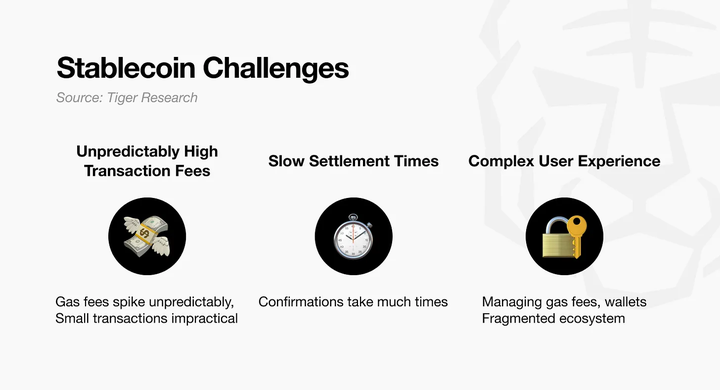
High and Unpredictable Transaction Fees
Stablecoins operate across multiple blockchains, but during network congestion, Gas fees can spike. For example, transferring $10 worth of USDT might incur a $20 fee—contradicting the goal of stablecoins as everyday payment tools.
Slow Transaction Confirmation Times
On Ethereum, confirming a stablecoin transfer may take several minutes or longer. This delay severely limits usability in real-time settlement scenarios such as online or in-person payments.
Complex User Experience
Managing Gas fees, wallets, and private keys remains challenging for average users. Compared to simple and intuitive tools like PayPal, current stablecoin interfaces are not user-friendly for non-technical individuals. These infrastructural limitations hinder further adoption. While stablecoins have become default assets in the crypto world, their practicality in mainstream markets still requires significant improvement.
The stablecoin "Trojan horse" has successfully infiltrated the crypto market; next, it must overcome technical barriers to enter traditional finance and mainstream payment domains.
3. Stable: The Next "Trojan Horse"
Rather than creating a new stablecoin, Stable chooses to optimize the ecosystem of the existing market leader—USDT.

Stable is not a general-purpose blockchain but a high-speed network purpose-built for USDT, designed to solve the three major pain points of existing stablecoins.
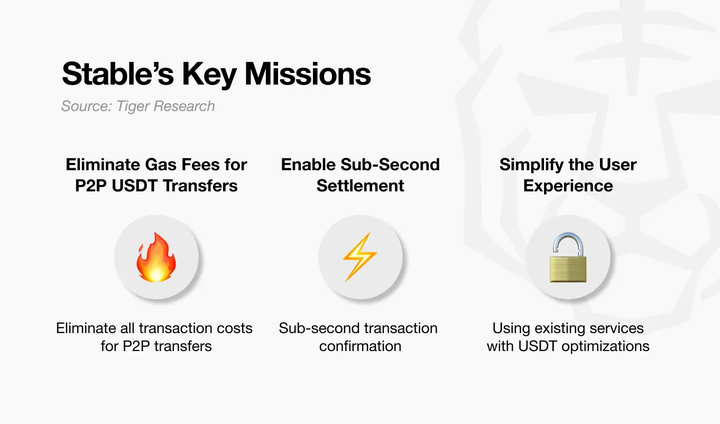
Stable's three core objectives:
-
Zero Gas fee P2P transfers: Eliminating high costs for small-value transactions;
-
Sub-second transaction confirmation: Enabling near real-time payment experiences;
-
Simplified user experience: Allowing ordinary users to use it easily without technical knowledge.
These elements work together: Zero Gas fees lower entry barriers, fast confirmations enhance utility, and simplified UX attracts a broader user base. Stable is not just a blockchain—it is infrastructure built around the $160 billion USDT ecosystem.
4. Stable’s Technical Architecture: How It Achieves Its Goals

Stable is currently in testnet phase, progressing toward mainnet launch. Its technical architecture is designed around core functionalities to ensure its vision becomes reality.
4.1. Zero Gas Fee USDT Transfers: EIP-7702 and Account Abstraction

The Stable network supports two tokens:
-
USDT0: USDT bridged from other networks (e.g., Ethereum);
-
gasUSDT: A token used to pay transaction fees, pegged 1:1 with USDT0, exclusively for internal network fee payments.
Using EIP-7702 and account abstraction (Account Abstraction), Stable enables zero Gas fee P2P transfers. Account abstraction merges traditional externally owned accounts (EOAs, like MetaMask) with smart contract accounts (CAs), allowing users to access smart contract features without additional setup. For instance, users can directly pay Gas fees with USDT or use a "Paymaster" service to cover fees on their behalf.
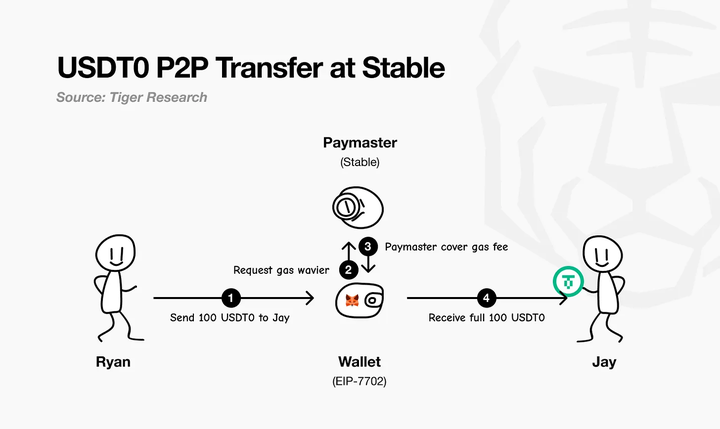
Example workflow:
-
User Ryan sends 100 USDT0 to Jay via MetaMask;
-
The wallet automatically requests Gas fee exemption, paid by the Paymaster service;
-
Ryan is debited 100 USDT0, Jay receives 100 USDT0, with no extra cost.
This experience resembles PayPal—users don’t need to manually calculate or hold Gas tokens, greatly simplifying operations.
4.2. Sub-Second Transaction Confirmation
Stable uses the StableBFT consensus algorithm, generating a block every 0.7 seconds, with finality achieved after just one confirmation—eliminating the common "pending" state. Additionally, Stable is developing Block-STM parallel processing technology, enabling independent transactions to be processed simultaneously, improving network efficiency—similar to opening multiple checkout lanes in a supermarket to reduce queues.
In the future, Stable plans to upgrade to Autobahn DAG consensus, supporting parallel block proposals. Internal testing has already achieved up to 200,000 TPS (transactions per second), laying the foundation for real-time payment applications.
4.3. Simplified User Experience
Stable is compatible with the Ethereum ecosystem, allowing users to continue using familiar tools like MetaMask and Etherscan—but with enhanced experiences:
-
MetaMask supports zero Gas fee USDT0 transfers;
-
Etherscan displays USDT transaction history in an intuitive format.
-
Using the LayerZero cross-chain bridge, USDT can be seamlessly imported onto the Stable network via the OFT (Omnichain Fungible Token) standard, eliminating asset fragmentation across chains. For example, whether bridged from Ethereum or Arbitrum, the resulting token is unified as USDT0.
Additionally, Stable plans to launch the Stable Name System, replacing complex wallet addresses with human-readable names like "ryan.stable," further enhancing user-friendliness.
4.4. Other Technical Highlights
StableDB: A database leveraging memory-first storage and memory-mapped file I/O to significantly reduce write latency and boost transaction processing speed.
Guaranteed Blockspace: Offers enterprises dedicated transaction capacity, ensuring stable performance during peak times—akin to bus-only lanes on highways.
Confidential Transfer: Supports hidden transaction amounts while complying with anti-money laundering (AML) and know-your-customer (KYC) requirements.
StableVM++ Engine: Upgrades the existing Go-based engine to C++, optimizing memory management with an expected 6x performance gain.
5. Stable’s Ecosystem Expansion: Three Key Scenarios
Stable uses zero Gas fees, fast confirmations, and simplicity to attract users—acting as a "loss-leader" strategy. Once a user base is established, its business model expands through the following scenarios.
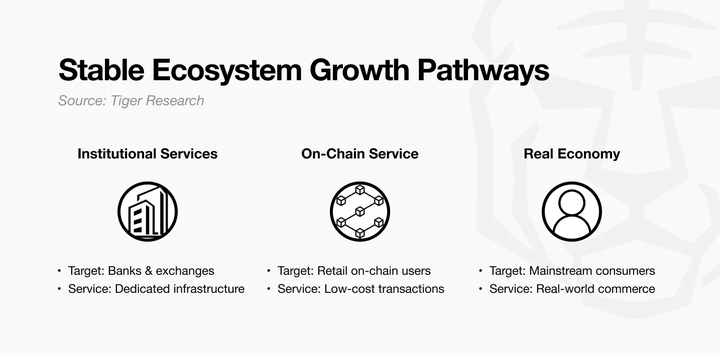
5.1. Scenario One: Enterprise Services and Partnerships
Stable can partner with enterprises via premium services like Guaranteed Blockspace, especially in cross-border payments. Compared to traditional international wire transfers, Stable drastically reduces cost and time. For example, fintech firms (like Wise) could integrate Stable’s infrastructure to improve customer experience, while Stable earns revenue based on transaction volume.
Crypto exchanges can also leverage Stable to streamline USDT deposits and withdrawals, attracting high-frequency institutional traders.
5.2. Scenario Two: Rapid Growth of On-Chain Services
Zero Gas fees and fast transactions will accelerate DeFi and on-chain service adoption. Small-scale DeFi activities (e.g., providing $100 in liquidity) become economically viable, drawing in more users. Micro-payment use cases (e.g., content subscriptions, in-game purchases, tipping) will flourish. For instance, tipping a YouTuber $1 or paying $0.10 to read an article will become feasible.
As transaction volume grows exponentially, Stable can profit from smart contract execution fees.
5.3. Scenario Three: Integration into Real-World Economies
In Southeast Asia and Latin America, USDT is already used for some offline payments. If Stable solves cost and speed issues, offline usage will rapidly expand. For example, buying a $2 coffee in Vietnam or shopping at a convenience store in the Philippines with USDT could become everyday habits.
By providing merchants with payment terminals and consumers with digital wallets, Stable can build a global payment network, charging small transaction fees. If central bank digital currencies (CBDCs) progress slowly, Stable’s convenience could make it a mainstream choice.
6. Stable’s True Strategy
Stable’s strategy is clear: Use free USDT transfers and a simple experience to attract users, then gradually build a USDT-centric payment ecosystem. Through network effects, both user count and transaction volume will grow rapidly—similar to Amazon’s early days of attracting customers with low-priced books, then monetizing via cloud services and advertising.
Free transfers are merely the "loss-leader"; the real goal is to become the central hub of the USDT ecosystem, routing all transactions through Stable. Once network effects take hold, users will find it difficult to leave, solidifying Stable’s market position. This is the power of the new "Trojan horse."
Join TechFlow official community to stay tuned
Telegram:https://t.me/TechFlowDaily
X (Twitter):https://x.com/TechFlowPost
X (Twitter) EN:https://x.com/BlockFlow_News
 @tiger_research