








Tether’s “Gold Standard” Ambition: Dissecting XAUt—How the Stablecoin Dominator Is Accumulating Gold
TechFlow Selected TechFlow Selected
Tether’s “Gold Standard” Ambition: Dissecting XAUt—How the Stablecoin Dominator Is Accumulating Gold
According to Bloomberg’s calculations, Tether purchased over 70 tons of gold last year alone to replenish its reserves and support the issuance of its gold-backed stablecoin.
 Navigating Web3 tides with focused insights
Author: imToken
Can you imagine a crypto-native company continuously purchasing gold at a scale approaching that of central banks?
According to Bloomberg, Tether—the issuer of USDT—has become one of the world’s largest holders of gold reserves: it currently holds approximately 140 metric tons of gold, valued at roughly $2.3 billion, including over 70 tons acquired last year alone, to bolster its reserves and back its gold-backed stablecoin. This volume exceeds the reported gold purchases of most national central banks.
Behind this massive gold accumulation, however, Tether is not speculating on gold prices. Instead, it is building a long-term, scalable physical gold supply infrastructure for its tokenized gold product, XAUt.
I. What Is XAUt?
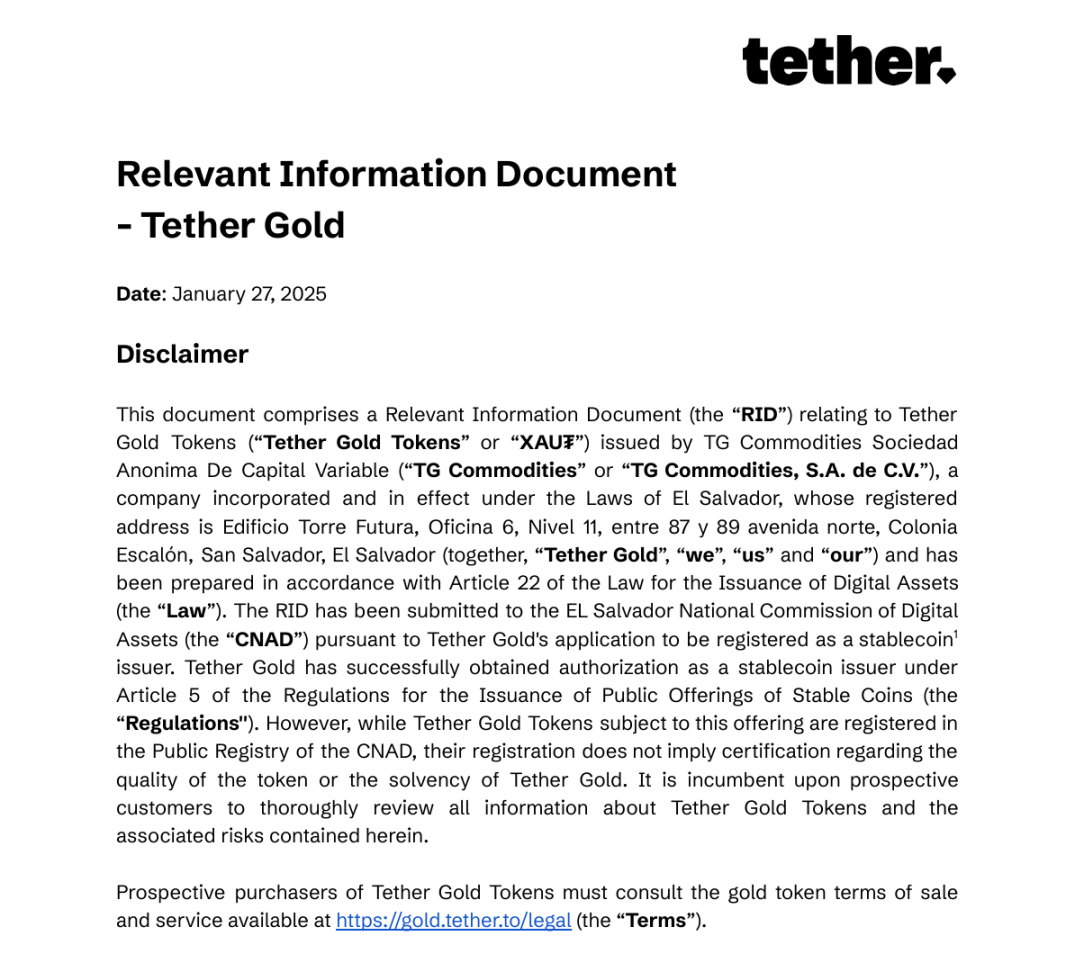
Per the latest whitepaper, “Relevant Information Document – Tether Gold (XAU₮),” released on January 27, 2025, Tether Gold (XAUt) is a gold-backed stablecoin issued by TG Commodities, S.A. de C.V., a company incorporated in El Salvador.
Each XAUt token represents ownership of one troy ounce (approximately 31.1035 grams) of physical gold stored in a high-security Swiss vault and meeting the London Bullion Market Association (LBMA) Good Delivery standard. During on-chain transactions, the system automatically reallocates allocated shares of gold in the vault to ensure that every user’s tokens correspond precisely to specific physical assets.
The physical gold is held in a highly secure Swiss vault. Although the custodian is an affiliated entity, it operates independently—with separate financial accounts and customer records. Users may also visit the official “Look-up Website” and input their on-chain address to directly verify the serial number, weight, and purity of the gold bar linked to their holdings.
Physical delivery, however, requires full LBMA-standard gold bars as the minimum unit. As described in the whitepaper, since individual bars weigh between 385 and 415 troy ounces, users are advised to hold at least 430 XAUt to ensure coverage; any excess tokens will be refunded upon redemption.
Moreover, physical delivery is only available within Switzerland. Alternatively, users may request Tether to sell their gold on the Swiss gold market and return the proceeds in USD, net of fees.
Source: Tether
Notably, the issuer TG Commodities has received authorization from El Salvador’s National Digital Assets Commission (CNAD), recognizing it as a regulated stablecoin issuer and an approved Digital Asset Service Provider (DASP). Its ultimate parent entities are Tether Holdings and Tether Operations, which fully own TG Commodities.
In fact, XAUt’s origins trace back to late 2019, when Paolo Ardoino, then Chief Technology Officer of Bitfinex and Tether, first revealed plans to launch a gold-backed stablecoin—Tether Gold. The initial whitepaper for XAUT was published on January 28, 2022.
Few could have predicted that within just four years, Tether would emerge as a “super buyer” of gold rivaling sovereign central banks.
II. Tether: A New, Unignorable Force in the Gold Market
As explicitly stated in the whitepaper, each XAUt token represents ownership of one troy ounce of physical gold. Tether guarantees that every issued XAU₮ is fully backed by an equivalent quantity of physical gold reserves, all stored in a “top-tier secure Swiss vault.”
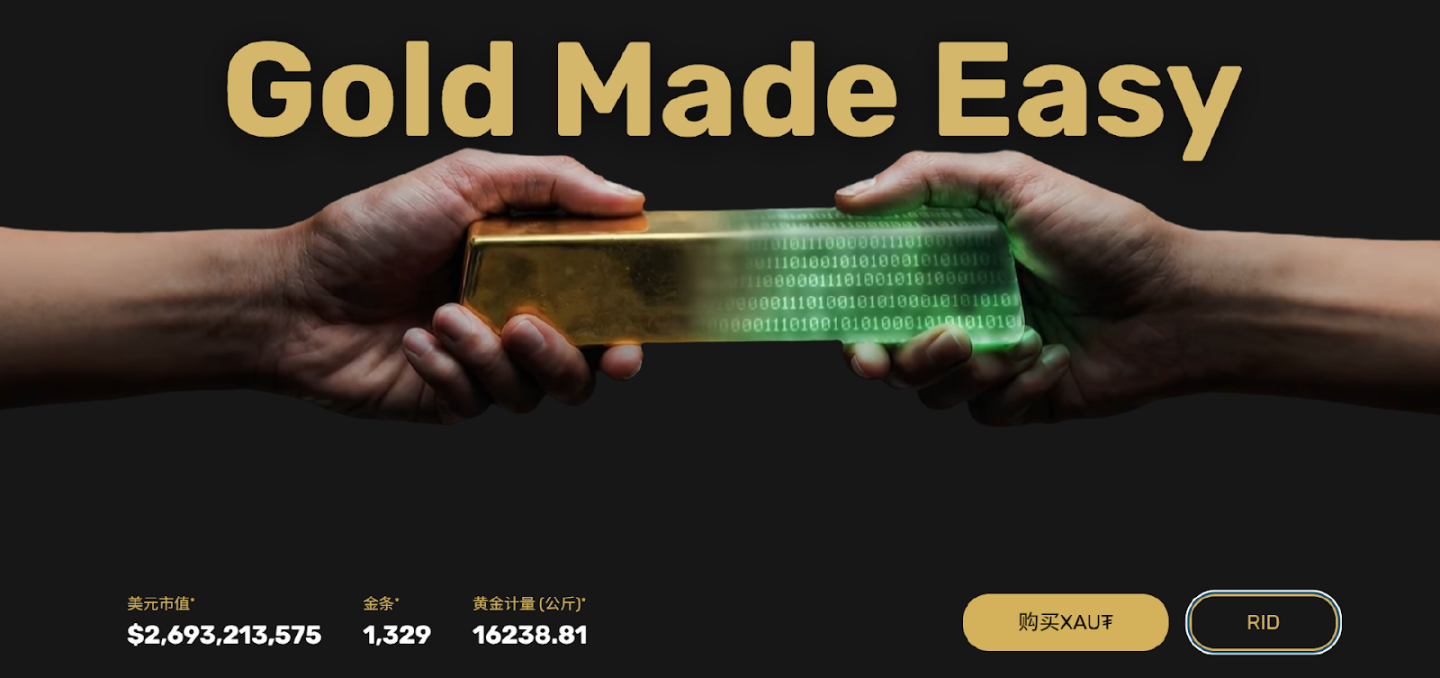
At the time of writing, the total outstanding supply of XAUt stands at approximately $2.7 billion—representing about 1,329 gold bars (16,238.4 kilograms) in physical reserves.
Source: Tether
Interestingly, Paolo Ardoino, CEO of Tether, publicly stated that Tether intends to allocate 10%–15% of its investment portfolio to physical gold, currently purchasing roughly one to two tons per week—and plans to continue doing so, aiming for long-term, stable gold procurement.
According to Bloomberg’s calculations, Tether added over 70 tons of gold last year alone to replenish reserves and support issuance of its gold-backed stablecoin. Combining this with Tether’s publicly disclosed financial results for the first three quarters of 2025:
its projected annual profit approaches $15 billion, while its current gold and Bitcoin reserves stand at approximately $12.9 billion and $9.9 billion respectively—accounting for roughly 13% of its total reserves. To reach the targeted 10%–15% allocation, Tether must still acquire an additional $2–3 billion worth of gold—effectively doubling the current scale of XAUt!
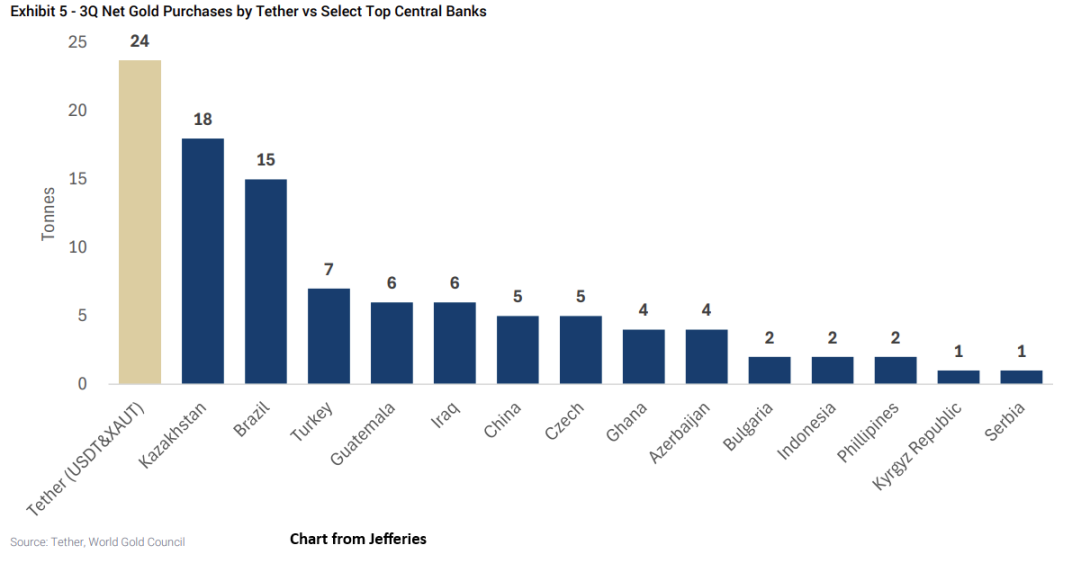
This is why some institutions have begun viewing Tether as an “incremental super-buyer” impossible to ignore in the gold market. Jefferies’ research shows that in Q2, Tether’s gold purchases accounted for ~14% of central banks’ collective gold buying; in Q3, the share remained around 12%. Notably, the timing of the second leg of the gold price rally closely coincided with Tether’s accelerated gold acquisition pace.
Given Tether’s robust profitability and the resilience demonstrated by its stablecoin business amid recent crypto market volatility, this gold-buying target appears financially prudent—not aggressive.
Source: Wall Street Insights
III. How Should We View Gold-Backed Stablecoins?
Of course, the multi-trillion-dollar investment-grade tokenized gold market is far too large for any single player—including Tether—to dominate.
Over the years, several companies have attempted to represent gold ownership on-chain. Digix pioneered DGX, a physically backed stablecoin where each DGX token is collateralized by one gram of LBMA-certified gold—99.99% pure—minted by authorized refiners and stored in The Safe House vault in Singapore.
Another widely recognized product is PAXG. In 2019, Paxos Trust Company launched PAXG—a gold token approved by the New York State Department of Financial Services (NYDFS)—built on Ethereum’s ERC-20 standard. Each PAXG token represents one troy ounce of LBMA-standard delivery gold held in professional vaults in London.
Paxos users may redeem PAXG for fiat currency, unallocated gold, or physical gold bars—and can instantly verify the serial number, brand, weight, and purity of their underlying gold bar via their on-chain address.
From a product-design perspective, these gold-backed stablecoins share a clear objective: making gold more divisible, more liquid, and better aligned with digital-native usage patterns.
Yet unlike USD-pegged stablecoins, gold-backed stablecoins operate under a more complex value proposition. The core premise of fiat-backed stablecoins rests on full collateralization and instant redeemability into digital dollars. Gold-backed stablecoins, by contrast, inevitably interact with—and are influenced by—the cyclical volatility inherent to crypto markets themselves.
Thus, when demand for stablecoins shifts sharply due to market sentiment or liquidity conditions, such pressure could theoretically propagate into their underlying balance sheets—which now include substantial, real-world gold reserves.
Especially as players like Tether accumulate increasingly large gold holdings, does this new narrative signify gold’s digital rebirth—or does it introduce an additional source of volatility to the gold market?
Perhaps this is a question every holder should contemplate deeply.
Join TechFlow official community to stay tuned
Telegram:https://t.me/TechFlowDaily
X (Twitter):https://x.com/TechFlowPost
X (Twitter) EN:https://x.com/BlockFlow_News
 @imTokenOfficial


