








Gold’s Surge: Governance Cracks and an Ongoing Order Shift
TechFlow Selected TechFlow Selected
Gold’s Surge: Governance Cracks and an Ongoing Order Shift
Gold is a defensive response, while more directional options are reflected in the RMB and Bitcoin.
 Navigating Web3 tides with focused insights
By Metrics Ventures
Over the past year, gold’s performance has been particularly striking. More importantly, its demand structure has undergone a clear shift: central banks and sovereign entities have significantly increased their allocation appetite. This can no longer be simplistically explained as inflation hedging or short-term safe-haven trading. A more plausible interpretation is that gold is responding to a deeper transformation—the repricing of sovereign currency credibility and the effectiveness of global governance.
This shift was repeatedly discussed at this year’s World Economic Forum in Davos. Whether on the formal agenda or in private conversations, phrases such as “imbalanced global governance architecture,” “the old order is breaking down,” and “we are entering a phase from which there is no return to the past” have become shared reference points. On Tuesday, Canadian Prime Minister Mark Carney articulated this pervasive unease during his Davos speech. He stated plainly that the so-called “rules-based international order” is disintegrating—humanity is moving away from a once-useful but largely fictional narrative toward a harsher reality: great-power competition is no longer constrained; economic integration has been weaponized; and rules are selectively applied before the strong.
Carney did not simply blame any single country, but instead highlighted a broader shift in circumstances. When tariffs, financial infrastructure, supply chains, and even security commitments can all be used as bargaining chips, multilateral institutions—be it the WTO, the United Nations, or other rule-based frameworks—upon which middle powers and open economies depend are losing their binding power. In this environment, pretending that rules still function normally becomes self-deception. Drawing on Václav Havel’s metaphor of “living in truth,” Carney warned nations: the real risk lies not in the fact that order is changing, but in continuing to act according to the language and assumptions of the old order.
Even more noteworthy is Carney’s repeated emphasis—not on ideological confrontation—but on a pivot in governance choices. When rules no longer automatically guarantee security, states turn to another kind of rationality: enhancing strategic autonomy, diversifying dependencies, and building “resilience under pressure.” In his view, this reflects classic risk-management logic—not a betrayal of values. Yet precisely here lies where the foundation sustaining the old order begins to erode: once countries stop believing the system can reliably deliver public goods, they will instead purchase “insurance” for themselves.
If we abstract Davos discussions away from specific national contexts, a deeper common thread emerges: countries are not suddenly becoming more conservative; rather, they are increasingly taking for granted that a foundational premise is failing—that the existing global governance system can continue coordinating fiscal, monetary, and international responsibilities over the long term. Once this premise ceases to command broad belief, state behavior shifts from “specialization within rules” to “preparation for uncertainty.” And this shift inevitably manifests at the most fundamental levels: debt, fiscal policy, and money.
It is precisely here that cracks in global governance begin penetrating financial pricing. National debt is no longer merely a macroeconomic policy tool, but is being re-evaluated as a discounted reflection of governance capacity and political constraints; sovereign currencies are no longer just mediums of exchange, but are expected to simultaneously fulfill intertemporal commitments, international responsibilities, and crisis-buffering functions. Once markets begin doubting whether these roles can still be fulfilled concurrently, currency credibility shocks cease to be extreme scenarios—and instead become a gradual yet irreversible process.
All this does not stem from any single country’s fiscal missteps, but is embedded within the current international monetary system. The dollar-centric system dictates that the world must have a persistent deficit center absorbing external savings—and that surpluses and deficits are not accidental, but institutionalized role divisions. The dollar serves both as the U.S. sovereign currency and as the global reserve, pricing, and safe-asset anchor. This means global demand for “risk-free dollar assets” intensifies further amid rising uncertainty. To supply such assets to the world, the U.S. can only fulfill this role by continuously running external liabilities.
In a financialized and capital-account-liberalized environment, this division is continually amplified. Surpluses are no longer primarily absorbed via commodity prices or exchange-rate adjustments, but are converted into long-term allocations to U.S. Treasuries and dollar-denominated financial assets; deficits are likewise not immediately constrained, but postponed and absorbed through financial systems and central bank interventions. As long as the world continues to believe dollar assets retain irreplaceable safety during crises, this imbalance can persist—and may even be viewed as one source of systemic stability.
Yet when governance trust declines, rule-based constraints weaken, and financial tools are frequently weaponized, this structural imbalance begins undergoing repricing. Surpluses and deficits cease to be mere macro phenomena—they become risk exposures in themselves. It is against this backdrop that Japan and China—both surplus countries—have gradually diverged onto distinct paths.

Japan plays the most typical—and most “cooperative”—surplus-country role within this system. Under external pressure and rule-based constraints, Japan chose to absorb adjustment costs through exchange-rate appreciation, financial liberalization, and prolonged monetary easing—thereby preserving overall order stability. This strategy reduced friction in the short term, yet transformed structural adjustment into domestic outcomes of low growth, high debt, and deep central bank involvement. The surplus did not disappear—it was internalized as the price of long-term stagnation, and Japan’s currency internationalization capacity was significantly curtailed in the process.
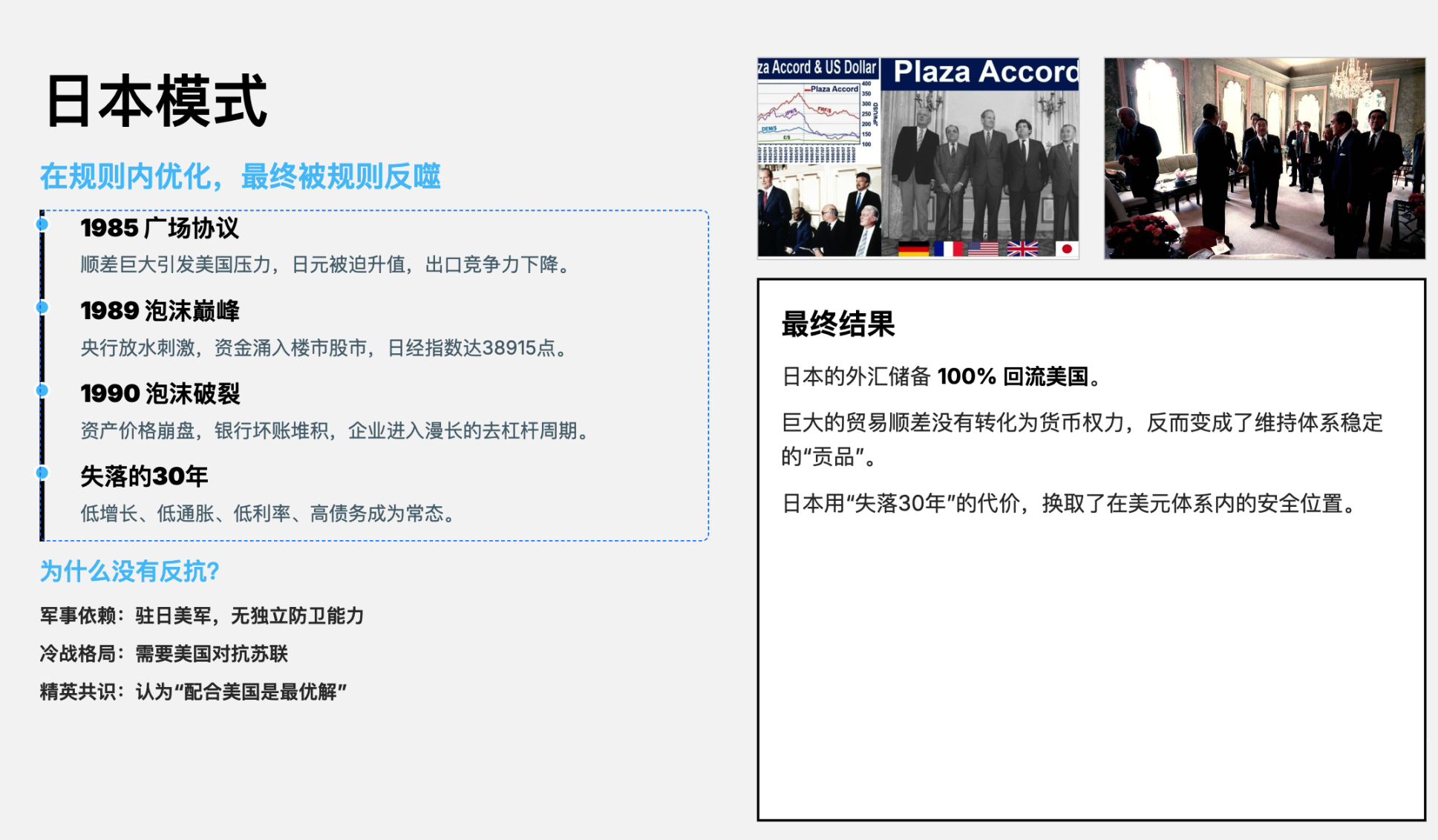
China entered this system later, and operates under markedly different development stages and domestic constraints than Japan. Faced with expanding surpluses and external pressures, China did not fully opt for rapid unwinding through price and financial channels. Instead, within frameworks of exchange-rate management, capital-account controls, and industrial upgrading, it has sought to preserve policy autonomy to the greatest extent possible. This choice has kept China under constant controversy—accused of “distorting rules” or “free-riding.” Yet from a governance perspective, it more closely resembles a strategic arrangement aimed at securing time and space for domestic transformation within the existing system—not simple institutional arbitrage.
More importantly, this path has not stopped at “maintaining surpluses,” but has quietly reshaped the structure of RMB demand. As China’s position strengthens across global trade, manufacturing, and critical supply chains, the RMB is no longer merely a settlement instrument—it is increasingly seen by more economies as a practical option for reducing external dependency and diversifying currency risk. Against the backdrop of escalating geopolitical tensions and financial sanctions weaponization, overreliance on the dollar system itself is now perceived as a risk exposure—making demand for RMB settlement, RMB financing, and RMB asset allocation strategically motivated.
Once RMB demand shifts from passive usage to active allocation, its impact extends beyond trade into finance. Higher-frequency, more stable use cases mean markets require deeper, more liquid RMB asset pools to accommodate this demand. Enhanced liquidity, in turn, influences asset pricing—gradually shifting RMB assets from “domestic-policy-driven pricing” toward “pricing logic closer to international margins.” This process does not rely on full capital account liberalization, but is instead driven by genuine demand—a gradual yet irreversible evolution.

It is precisely against this comparative backdrop that the phrase “East rises, West falls” has recently re-emerged as a proposition worthy of serious discussion. It is no longer an emotional judgment about any nation’s rise or decline, but a reflection of shifting costs associated with systemic roles. As the dollar system’s self-correcting capacity weakens, the deficit center’s room to absorb imbalances through debt expansion and financial leverage shrinks; meanwhile, surplus economies’ importance in industrial chains, security, and regional arrangements grows. In this process, China—having avoided replicating Japan’s adjustment path—retains industrial, policy, and monetary flexibility, granting it greater strategic resilience amid systemic restructuring.
Yet this evolution does not imply the imminent emergence of a new singular hegemonic currency. A more realistic scenario is a multi-polar, coexisting monetary architecture. The dollar’s centrality may weaken, but it will not vanish quickly; the RMB’s role in trade settlement, regional finance, and liquidity provision will gradually strengthen—not necessarily requiring full floating, but relying more on trade networks, industrial-chain depth, and policy credibility. Currency internationalization here is no longer a formal institutional label, but an outcome forged through actual usage.
Within such systemic evolution, the logic of reserve assets also shifts. Gold’s return to center stage is not because it delivers returns, but because it depends on no nation’s tax base, political stability, or international commitments—it is a direct response to governance uncertainty. It offers countries a de-sovereign, de-credit reserve option—particularly suited to environments marked by insufficient consensus and weakened rule-based constraints.
Bitcoin represents another tier of de-sovereign asset. Though its performance over the past year and a half has lagged behind gold and some traditional assets, its core logic remains unrefuted. As a digital, scarce asset unattached to any single governance system, it functions more like a long-dated option on future monetary forms. As monetary-system restructuring becomes increasingly explicit and liquidity reallocation proceeds, its pricing logic is more likely to catch up later—not lead early.
Pulling together these threads reveals that this unnamed, ongoing order transition is not altering short-term power balances—but fundamentally reshaping the foundational conditions under which assets exist. When rules no longer automatically guarantee security, and when currency credibility itself becomes a risk requiring hedging, the core question of asset allocation shifts—from betting on who wins, to how to remain viable in a world where uncertainty has become the norm.
Against this backdrop, gold represents a defensive response, while more directional choices appear in the RMB and Bitcoin. The RMB embodies real-world liquidity embedded in a new order—an investment in monetary restructuring anchored in trade, industry, and genuine demand traction; Bitcoin embodies the ultimate hedge against governance uncertainty—a long-dated option detached from any single sovereign system. Choosing them is not an expression of political stance, but a logically coherent asset-allocation outcome—given that fractures in global governance have already become explicit.
History rarely arrives with fanfare. Often, only in retrospect—looking back at a particular moment—do people realize that order has quietly migrated.
Join TechFlow official community to stay tuned
Telegram:https://t.me/TechFlowDaily
X (Twitter):https://x.com/TechFlowPost
X (Twitter) EN:https://x.com/BlockFlow_News
 @MetricsVentures


