Amid Geopolitical Turmoil, Tokenized Gold and 24/7 On-Chain Markets Rise
TechFlow Selected TechFlow Selected
Amid Geopolitical Turmoil, Tokenized Gold and 24/7 On-Chain Markets Rise
When the stock market is closed, on-chain activity becomes the sole channel for trading and price discovery.
 Navigating Web3 tides with focused insights
By Tanay Ved
Translated by Luffy, Foresight News
TL;DR
- Amid escalating geopolitical tensions, Bitcoin has remained resilient, rising approximately 7% since the sudden shock on February 28.
- Usage of tokenized gold products such as PAXG and XAUT has surged significantly, with investors allocating gold exposure via both on-chain and exchange channels.
- Hyperliquid’s HIP‑3 perpetual futures have emerged as a 7×24 macro-risk barometer, with perpetual contracts tied to precious metals, energy, and equities accounting for substantial shares of total trading volume and open interest.
- Crude oil perpetual futures on Hyperliquid rapidly repriced in response to supply shocks, demonstrating how on-chain channels can lead price discovery when traditional markets are closed.
On February 28, news spread globally that the U.S. and Israel jointly struck targets inside Iran. That day fell on a Saturday—traditional equity and commodity markets were fully closed, leaving investors unable to react to this major geopolitical shock. The conflict has now entered its second week.
Yet, from tokenized gold to oil perpetual futures, traditional macro assets and digital assets continued trading in real time on blockchains. At a moment when macro assets are front and center, on-chain markets are the only venues open around the clock.
In this article, we analyze on-chain activity surrounding tokenized gold products such as PAXG and XAUT, as well as commodity- and equity-linked perpetual futures built on Hyperliquid’s HIP‑3 infrastructure, to understand how 7×24 markets absorb and reflect geopolitical stress.
Market Response Under Geopolitical Stress
Following the U.S.–Iran conflict news, gold prices quickly approached all-time highs while Bitcoin declined—a classic initial shock response: gold as a safe-haven asset, Bitcoin as a risk asset.
As the conflict evolved from an unexpected event into a known risk, gold retreated slightly while Bitcoin stabilized and rebounded, retesting $70,000 amid high volatility—demonstrating relative strength.

Bitcoin and gold performance since the U.S.–Iran conflict. Data source: Coin Metrics
From March 2 to 4, Bitcoin spot ETFs recorded sustained net inflows, providing further support to Bitcoin’s price. This suggests market dynamics go beyond simple risk-aversion—Bitcoin’s strength may reflect oversold correction, technical positioning, and investor willingness to hold high-Beta assets even amid elevated geopolitical risk.
Tokenized Gold
While physical and futures gold markets were closed over the weekend, PAXG and XAUT traded continuously, serving as real-time on-chain channels for investors to gain gold exposure.
Paxos Gold (PAXG) and Tether Gold (XAUT) are tokenized gold products—each token represents one troy ounce of physical gold and is issued and settled as an ERC‑20 token on Ethereum. Together they dominate the tokenized gold market (valued at $6.1 billion), enabling investors to enter or exit gold exposure without waiting for traditional markets to reopen.
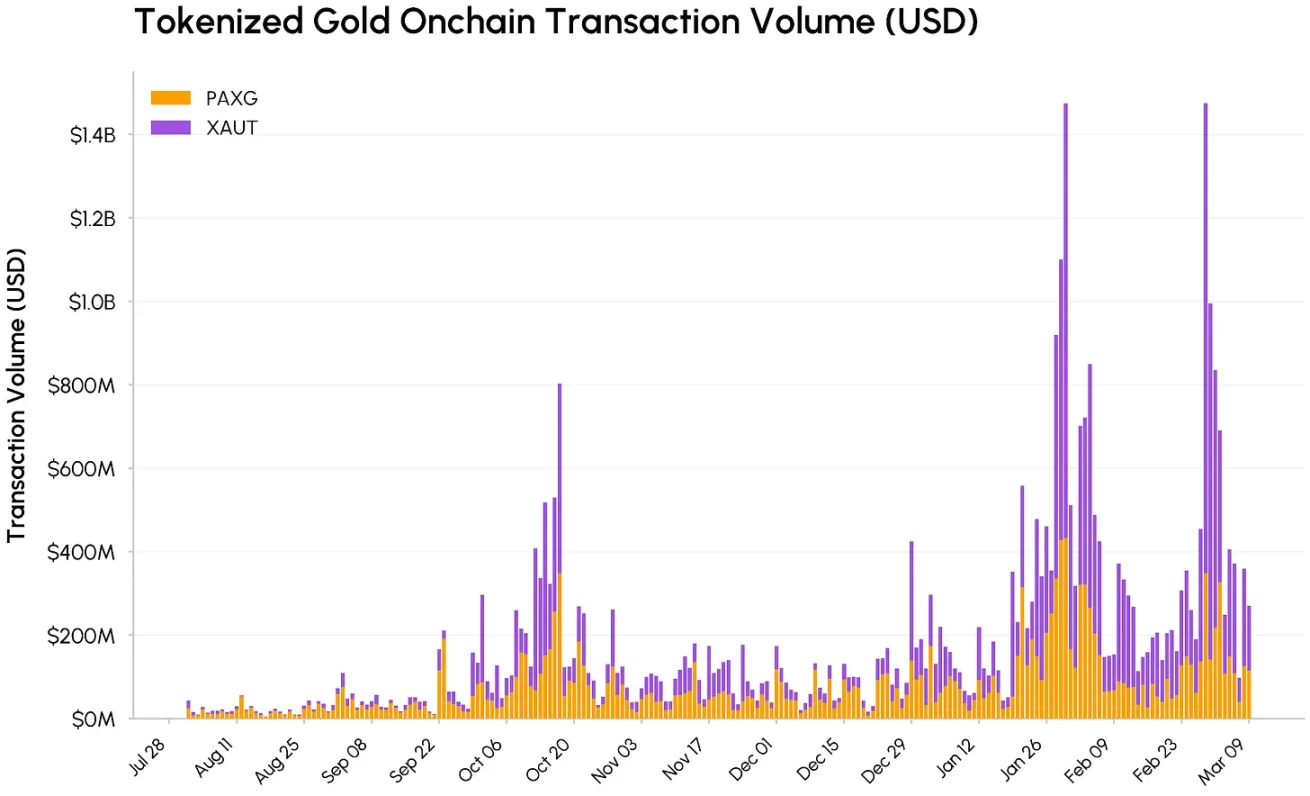
Trading volume of tokenized gold since the U.S.–Iran conflict. Data source: Coin Metrics
In 2026, geopolitical and macro risks have intensified: the arrest of Venezuela’s President Maduro, tariff uncertainty, and escalating Middle East conflict—all driving a sharp surge in gold demand.
In early February, total spot trading volume of tokenized gold across major centralized exchanges exceeded $1.8 billion; during the escalation of tensions between Iran, Israel, and the U.S., it again surpassed $1 billion. On-chain Ethereum trading volume also exceeded $1.4 billion twice, with XAUT—issued by Tether—accounting for the majority of activity.
Active addresses and transaction counts rose in tandem, indicating growing on-chain demand for gold—used for hedging, wealth preservation, DeFi collateral, and DEX liquidity pairs.
HIP‑3 Perpetual Futures on Hyperliquid
Similarly, on-chain perpetual futures on Hyperliquid have become critical trading conduits. This is enabled by Hyperliquid’s HIP‑3 market—a protocol allowing anyone, permissionlessly, to create perpetual futures on any asset (requiring only a 500,000 HYPE stake) with reliable price feeds—including crude oil, gold, silver, and stock indices—operating year-round, with no expiry dates.
Major deployers include Trade [XYZ] (offering U.S. equities and commodity perps) and Ventuals (offering unlisted equity and alternative assets such as Anthropic and SpaceX).
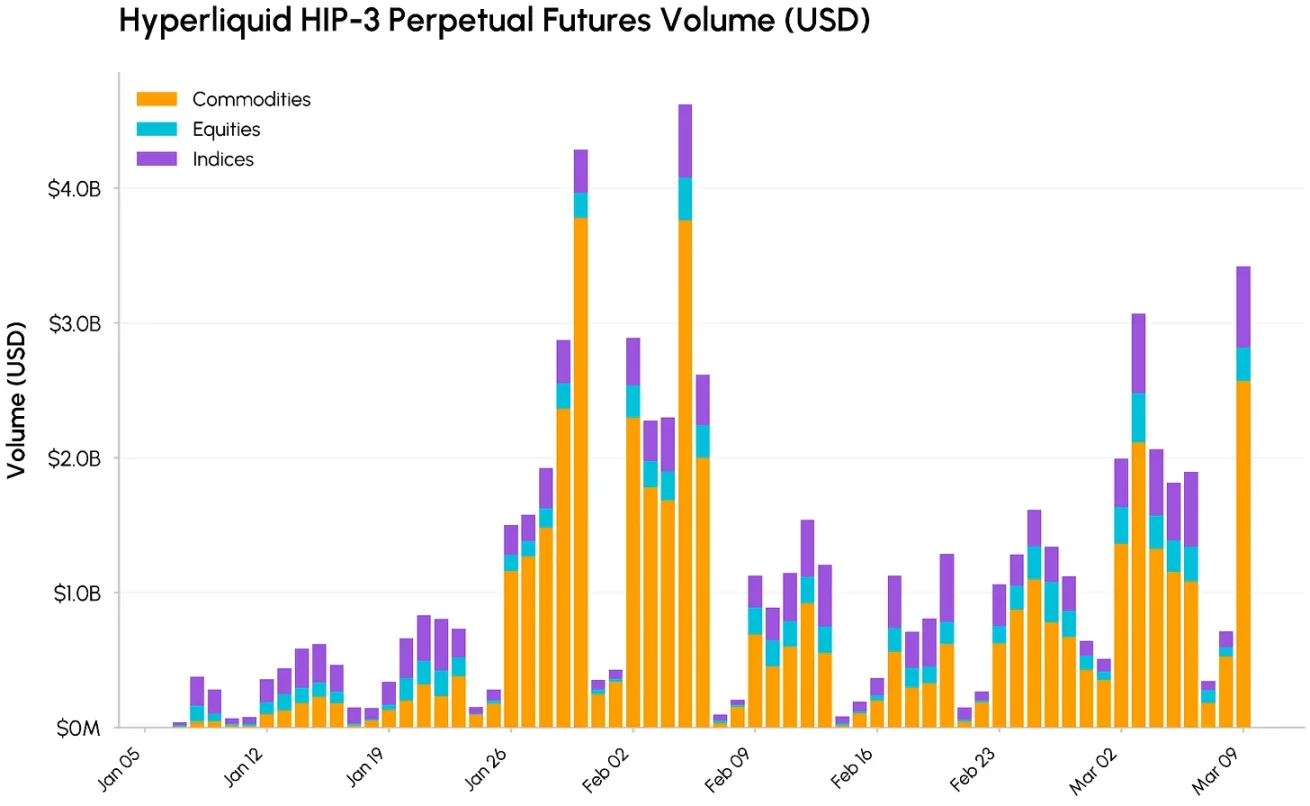
Year-to-date trading volume of Hyperliquid HIP‑3 perpetual contracts. Data source: Coin Metrics
Total HIP‑3 market trading volume has surpassed $95 billion, while open interest recently hit a record high of $1.2 billion—approximately 20% of Hyperliquid’s total open interest. Non-crypto assets—including commodities, precious metals, and equities—hold significant share, with precious metal and energy perps contributing billions in daily volume and steadily increasing open interest.
This growth signals Hyperliquid’s evolution from a niche DeFi venue into a 7×24-hour exchange mirroring traditional markets—and an increasingly important source of protocol fee revenue drawn from non-crypto markets.
Commodities Boom
Within HIP‑3, cumulative 2026 trading volume shows a clear concentration toward commodities. Silver and gold perpetuals lead decisively among all Real World Asset (RWA) contracts, followed by crude oil (CL‑USDC). As Middle East conflict stokes concerns over supply disruptions, crude oil contracts continue climbing in ranking.

Top 10 markets by 2026 trading volume on Hyperliquid HIP‑3. Data source: Coin Metrics
Average trade sizes in these markets remain smaller than institutional futures—but are already substantial for a retail-dominated on-chain platform:
- Gold perp: ~$2,700
- Silver perp: ~$3,400
- Crude oil CL: ~$2,800
- XYZ100 (Nasdaq-100): ~$1,100
How Is Crude Oil Priced When Traditional Markets Are Closed?
Hyperliquid lists multiple crude oil–linked perpetual futures—including WTI crude (CL), Brent crude (BRENTOIL), and the U.S. Crude Oil Composite Index (USOIL)—each tracking distinct benchmark oil prices. These contracts trade 7×24 on-chain order books, using stablecoins (USDC/USDH) for margin and settlement.
Each crude variant operates as a standalone market—with independent liquidity, funding rates, and index sources—so minor spreads may emerge even though all reference crude oil.
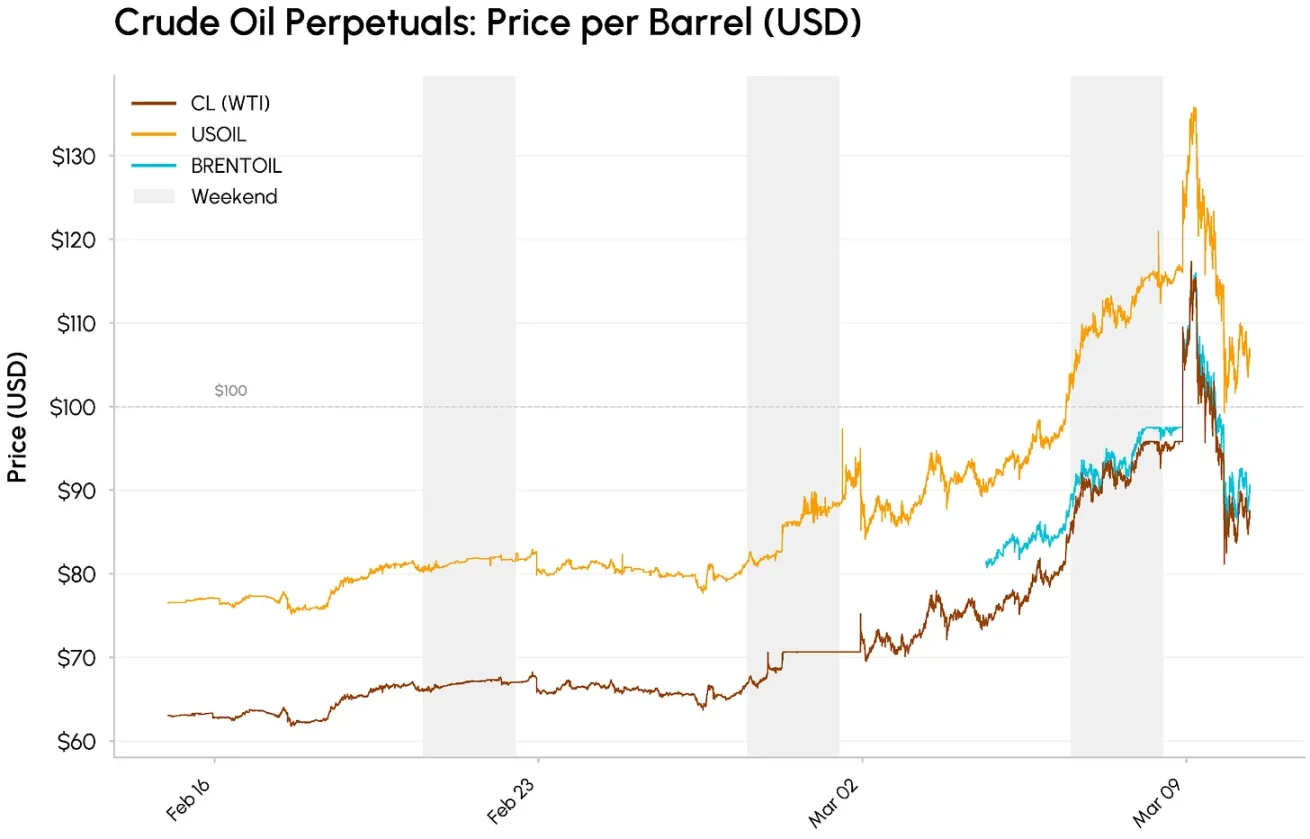
Crude oil futures pricing. Data source: Coin Metrics
When the U.S. and Israel struck Iranian facilities—disrupting supply routes and raising concerns over the Strait of Hormuz—traditional futures markets were closed, yet on-chain crude oil perps repriced within minutes.
One-minute candle charts show Hyperliquid’s CL‑USDC contract reflecting real-time oil price action over the weekend, briefly spiking to $109 before traditional markets reopened. During the same period, open interest and trading volume for this market rose to ~$175 million and ~$1.9 billion respectively—making it the second-most-traded market on the platform, surpassing Ethereum perpetuals. Traders used it to express views on supply shocks.

WTI crude oil futures trading volume and open interest on Hyperliquid. Data source: Coin Metrics
Equity Exposure
Although capital flowed predominantly into commodities during this period, HIP‑3 also offers perpetual contracts linked to stock indices and individual equities—enabling traders to take long or short positions on equities around the clock.
Trading volumes in these markets remain below those of crude oil and precious metals, but they complete HIP‑3’s positioning:
- Gold and crude oil for direct macro hedging
- Equity contracts for risk preference allocation decoupled from crypto price volatility
Multiple exchanges—including Kraken—are launching similar offerings: tokenized equities and perpetual futures based on them, delivering 24-hour equity exposure.
Conclusion
Recent geopolitical conflicts offer a limited yet highly instructive glimpse into the practical application of 7×24 on-chain finance. While traditional markets were closed, crypto infrastructure sustained trading in tokenized gold and perpetual futures—proving that blockchains, even in their early stages, with relatively modest scale and persistent liquidity and regulatory uncertainties, can function as robust 7×24 market infrastructure.
Platforms like Hyperliquid—and diverse tokenized asset products—demonstrate how this infrastructure is expanding beyond pure crypto exposure into precious metals, energy, and equities. They point toward a future where one defining feature of global markets will be 7×24 on-chain trading of macro assets.
Join TechFlow official community to stay tuned
Telegram:https://t.me/TechFlowDaily
X (Twitter):https://x.com/TechFlowPost
X (Twitter) EN:https://x.com/BlockFlow_News
 @coinmetrics