Intel surges 24% in a single day, hitting a new all-time high—but only 6 out of 34 analysts dare issue a “Buy” rating
TechFlow Selected TechFlow Selected
Intel surges 24% in a single day, hitting a new all-time high—but only 6 out of 34 analysts dare issue a “Buy” rating
From $18 to $82: Intel’s Breakneck Year-Long Rally 🏎
 Navigating Web3 tides with focused insights
Author: Claude, TechFlow
TechFlow Intro: Intel’s Q1 earnings crushed expectations—revenue of $13.6 billion and adjusted EPS of $0.29 (vs. consensus of $0.01). Its stock surged 24% in a single day to $82.57, marking its largest one-day gain since 1987 and breaching its all-time high set during the 2000 dot-com bubble.
Yet behind this euphoria lies a stark disconnect: only 6 of 34 Wall Street analysts covering Intel issued Buy ratings, while the median consensus target price stands at roughly $55—more than 30% below the current share price. Is Intel’s 250% rally over the past year a genuine turnaround in the AI era—or merely a “faith-based” trade priced far beyond fundamentals?
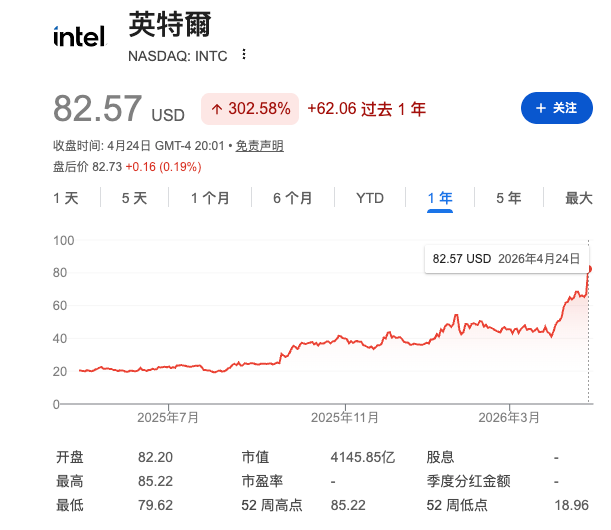
Intel delivered the most dramatic U.S. equity earnings report of 2026 so far.
On Friday, April 24, Intel closed up ~24% at $82.57—the largest single-day gain since 1987—and officially surpassed its prior all-time high from the 2000 dot-com bubble. From its 52-week low of $18.25 in September 2024, Intel has rallied over 250%. That same day, the Philadelphia Semiconductor Index posted its 18th consecutive gain; AMD surged ~14%, and NVIDIA rose 4.3%, reclaiming a market cap above $5 trillion.
However, the extreme exuberance in Intel’s stock price stands in sharp contrast to Wall Street’s consensus view.
Of the 34 analysts covering Intel, only six assigned Buy ratings, 24 maintained Hold ratings, and four retained Sell recommendations. The median consensus target price is approximately $55—meaning most analysts believe the stock should trade more than 30% below its current level.
Q1 Crushes Expectations: Revenue Beat Near 10%; EPS Forecast $0.01 vs. Actual $0.29
According to CNBC, Intel’s Q1 revenue totaled $13.58 billion, versus a Street expectation of $12.42 billion—a beat of ~9.4%. Adjusted EPS came in at $0.29, compared with consensus of just $0.01 (some sources show $0.02), representing nearly a 30-fold difference. This marks Intel’s sixth consecutive quarter of beating expectations.
By segment, the Data Center & AI group was the biggest driver, generating $5.1 billion in revenue—up 22% year-on-year and well above the $4.41 billion expected. Client Computing (PC chips) brought in $7.7 billion, ahead of the $7.1 billion forecast. Adjusted gross margin expanded to 41% from 39.2% a year earlier.
Q2 guidance also significantly exceeded expectations: revenue guidance of $13.8–$14.8 billion (midpoint $14.3 billion), versus Street estimates of $13.07 billion; adjusted EPS guidance of $0.20, versus expectations of $0.09–$0.10.
Intel CEO Lip-Bu Tan’s remark on the earnings call was widely quoted: “The CPU is reasserting itself as an indispensable foundation in the AI era.” His core argument is that AI is shifting from foundational model training toward inference and agentic applications—a transition that dramatically increases demand for CPUs and foundry capacity, not just GPUs.
Cody Acree, Senior Semiconductor Analyst at Benchmark/StoneX, posed a pointed question in an interview with Sherwood News: “If this upside is possible, why did Intel issue such conservative guidance last quarter?” He noted that Intel explicitly described wafer supply as “tight” on its Q4 earnings call—when its stock plunged 17% in a single day.
Three Major Customer Wins Land Simultaneously: Terafab, Google, and Repurchase of Ireland Fab 34
Beyond Q1 numbers, what truly ignited market sentiment were three strategic deals that materialized almost concurrently.
On April 7, Intel announced its participation in Elon Musk’s Terafab initiative, becoming the primary foundry partner for the chip manufacturing joint venture involving SpaceX, xAI, and Tesla. According to TechCrunch, Intel stated on X that its capabilities in designing, manufacturing, and packaging ultra-high-performance chips will help Terafab achieve its goal of 1 terawatt of annual compute capacity. Musk confirmed on Tesla’s Q1 earnings call that Tesla plans to use Intel’s next-generation 14A process for chip fabrication, adding, “By the time Terafab’s capacity ramps, 14A should be quite mature.”
This marks Intel Foundry’s first major external customer after years of waiting. Until now, Intel had been the sole major user of its own 18A process—despite being on par with TSMC’s 2-nanometer node, external customers remained hesitant.
Concurrently, Intel and Google announced a multi-year collaboration under which Google committed to deploying Intel’s latest Xeon 6 processors across its cloud infrastructure for AI inference and other workloads. Additionally, Intel repurchased a 49% stake in its Ireland Fab 34 facility from Apollo for $14.2 billion (having sold it for $11.2 billion in 2024), regaining full ownership. Per SEC filings, the repurchase was funded by cash reserves and a $6.5 billion bridge loan.
Analyst Community Deeply Divided: Roth Targets $100, BofA Maintains “Sell”
Post-earnings rating actions displayed rare polarization.
Among bulls, Roth Capital upgraded Intel from Neutral to Buy and doubled its target price from $50 to $100, citing “impressive execution” by CEO Lip-Bu Tan in improving manufacturing efficiency and CPU product performance. HSBC analyst Frank Lee upgraded Intel to Buy on April 21—before the earnings release—raising his target price sharply from $50 to $95, the highest on Wall Street at the time. Lee’s thesis centered not on foundry business but on the underappreciated growth opportunity in server CPUs: he forecasts ~20% year-on-year growth in Intel’s server CPU shipments for both 2026 and 2027, alongside ~20% average selling price increases. Citigroup and Evercore ISI also upgraded their ratings to Buy-equivalent following the report.
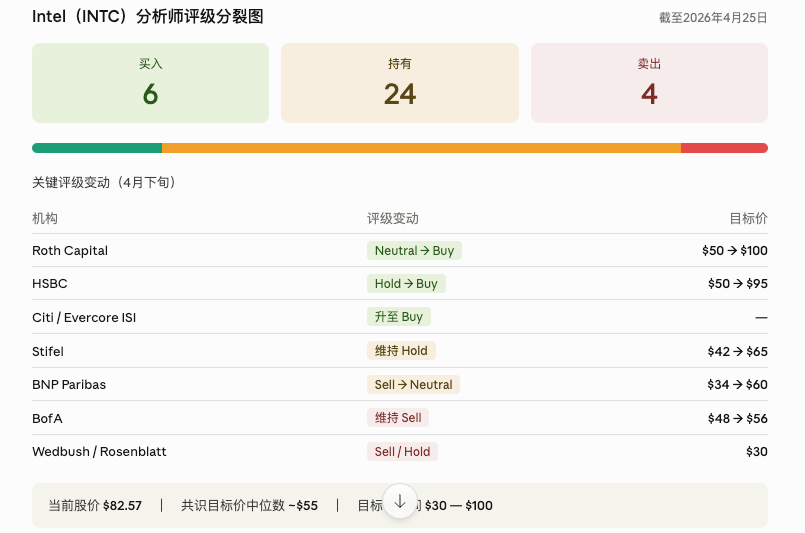
Bears remain resolute. According to TheStreet, Bank of America analyst Vivek Arya maintained his Underperform (Sell) rating—though he raised his target price from $48 to $56—arguing that Intel’s recovery is already fully priced in. He noted that Intel’s reported gross margin remains below peers’, the company continues burning cash, 18A yield remains subpar, and Intel Foundry still needs to prove itself to external customers. BofA projects Intel’s compound annual sales growth at 10%–15% for 2025–2028—far below peers’ 30%–40%. Wedbush and Rosenblatt set even lower targets of $30, implying over 60% downside from current levels.
Overall, according to Benzinga, among the 34 analysts covering Intel, only six recommend Buy, 24 Hold, and four Sell. The median consensus target price sits around $55, with a range spanning $30 to $100. At $82.57, Intel’s current share price already exceeds the majority of target price ceilings.
117x Forward P/E: The Valuation Cost of a Turnaround Story
The crux of this division lies in valuation.
Intel’s current forward P/E ratio stands at ~117x–150x (depending on data source), versus its five-year median P/E of just 12x. On a GAAP basis, Intel remains unprofitable over the trailing twelve months (TTM EPS = -$0.06), yet its ~$35.5 billion market cap represents 6.4x revenue. GuruFocus’s GF Value estimate pegs Intel’s fair value at just $27—implying over 200% overvaluation relative to today’s price.
Put another way, Intel is up over 105% year-to-date and ~284% over the past 12 months. On April 24 alone, volume hit 264 million shares—about 1.5x its three-month average. Market enthusiasm for this stock has clearly outstripped what current fundamentals can justify.
Bears’ counterarguments are equally compelling: Intel’s 18A yield issues remain unresolved; 14A is still “not fully ready” (Elon Musk’s exact words); Intel Foundry has yet to generate meaningful revenue from external customers; and free cash flow remains negative.
The semiconductor industry is inherently cyclical—and how long current AI-driven demand strength will persist remains an open question. Paying ~150x forward P/E for a money-losing company leaves virtually no margin for error.
This may explain why only six of 34 analysts dared to turn bullish: Intel’s turnaround narrative is compelling—but the price demanded for that story is already intimidating.
Join TechFlow official community to stay tuned
Telegram:https://t.me/TechFlowDaily
X (Twitter):https://x.com/TechFlowPost
X (Twitter) EN:https://x.com/BlockFlow_News
 深潮TechFlow