Q1 Market Review: Traditional Assets Enter the On-Chain Era, Crypto Market Undergoes Correction
TechFlow Selected TechFlow Selected
Q1 Market Review: Traditional Assets Enter the On-Chain Era, Crypto Market Undergoes Correction
Cryptocurrency prices are significantly influenced by macroeconomic and geopolitical factors; meanwhile, the industry’s underlying infrastructure continues to evolve.
 Navigating Web3 tides with focused insights
By Tanay Ved
Translated by Chopper, Foresight News
TL;DR
- Amid turbulent macroeconomic and geopolitical conditions, the crypto market remains under pressure. However, ETF demand has gradually improved this quarter, providing support for Bitcoin’s current price level.
- On-chain trading platforms and asset tokenization are further enabling traditional assets to enter 24/7 markets. Perpetual contracts on stocks and indices launched by platforms such as Hyperliquid, alongside new stock perpetual products introduced by major exchanges, have driven steady growth in open interest.
- Total stablecoin supply remains stable near $300 billion; adjusted transfer volume for Q1 2026 climbed to approximately $21.5 trillion. Regulatory clarity around stablecoin yield generation and issuance continues to shape industry development.
Q1 2026 has concluded—a critical juncture for reviewing developments and core themes in the crypto market. This quarter was marked by intertwined geopolitical and macroeconomic uncertainty, resulting in a risk-averse, highly volatile market overall. Although the crypto market faced headwinds—total market capitalization declined ~22%—tokenized equities and on-chain trading of traditional assets emerged as bright spots, while infrastructure made substantive progress. This article reviews Q1 2026 and analyzes the trends and key themes shaping the market this quarter.
Market Performance
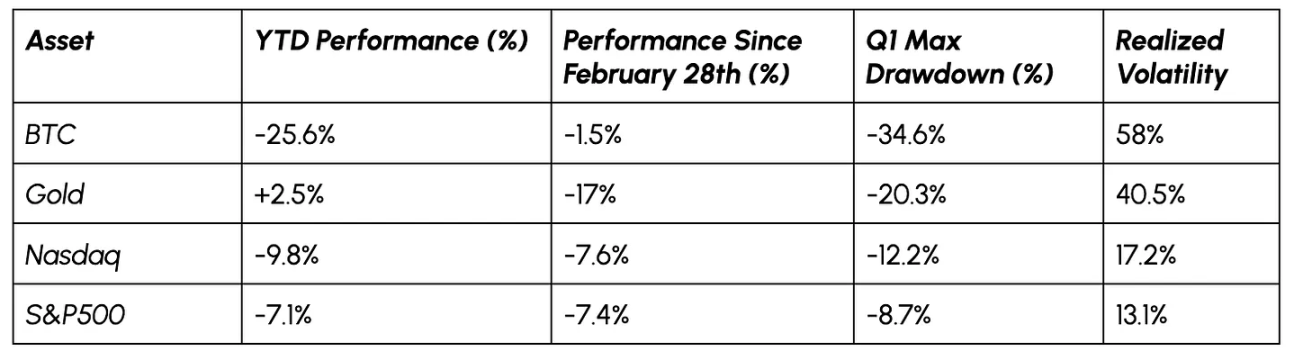
Bitcoin’s price fell over 30% from ~$95,000 in February, representing a year-to-date decline of 22%. Beyond macro pressures, broad-based risk-asset selloffs and derivative market liquidations intensified the downturn, reigniting debates about Bitcoin’s safe-haven attributes and store-of-value function.
However, since the Iran conflict erupted on February 28, Bitcoin has outperformed both equities and gold, signaling resilience and renewed demand.
Source: Coin Metrics and Google Finance
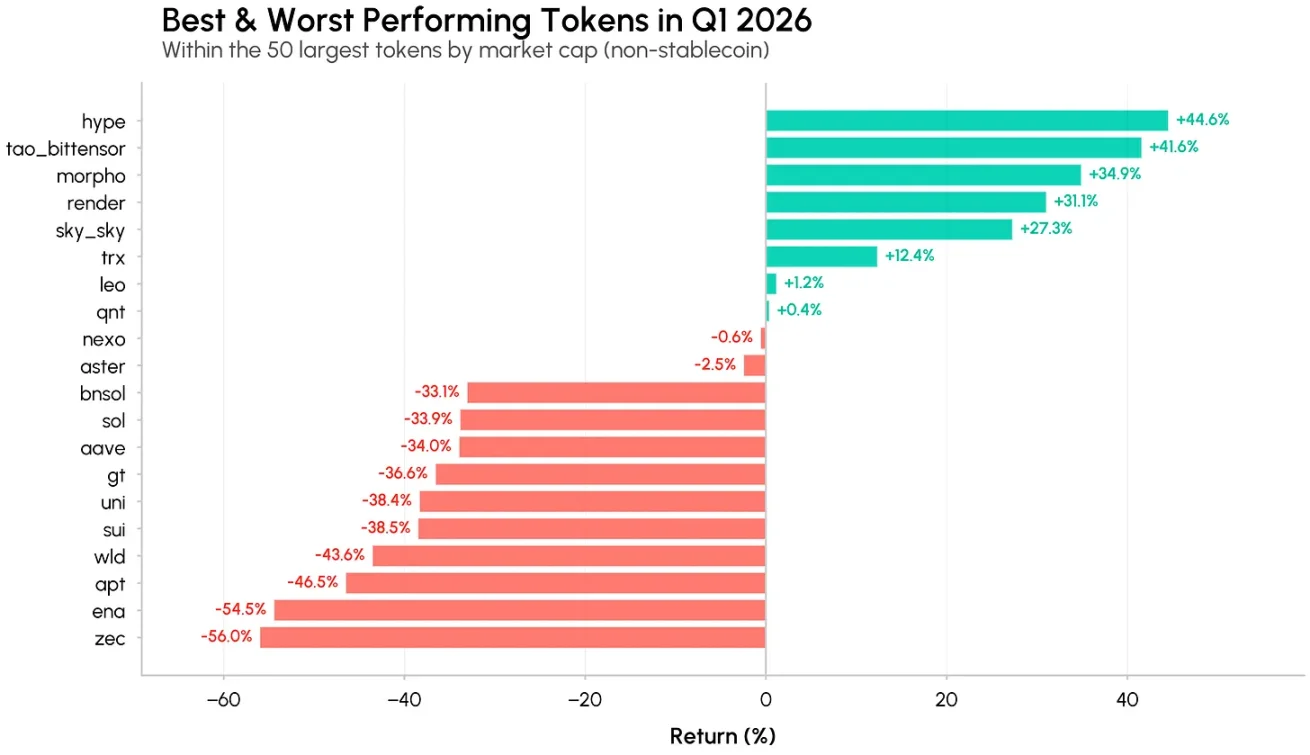
Performance across crypto assets diverged significantly, with only a handful of altcoins featuring strong narratives and genuine usage growth outperforming the broader market.
Top-performing tokens included Hyperliquid (HYPE), Bittensor (TAO), and Morpho (MORPHO), all posting quarterly gains exceeding 30%. Hyperliquid benefited from growth in its HIP-3 markets—particularly commodities and stock indices—expanding its business scope beyond crypto-native assets into broader asset classes. Bittensor and Morpho gained traction respectively through growth in AI infrastructure and decentralized finance (DeFi) credit, as institutional interest in decentralized AI and treasury management services continued rising.
Source: Coin Metrics
Bitcoin Demand Stabilizes Gradually
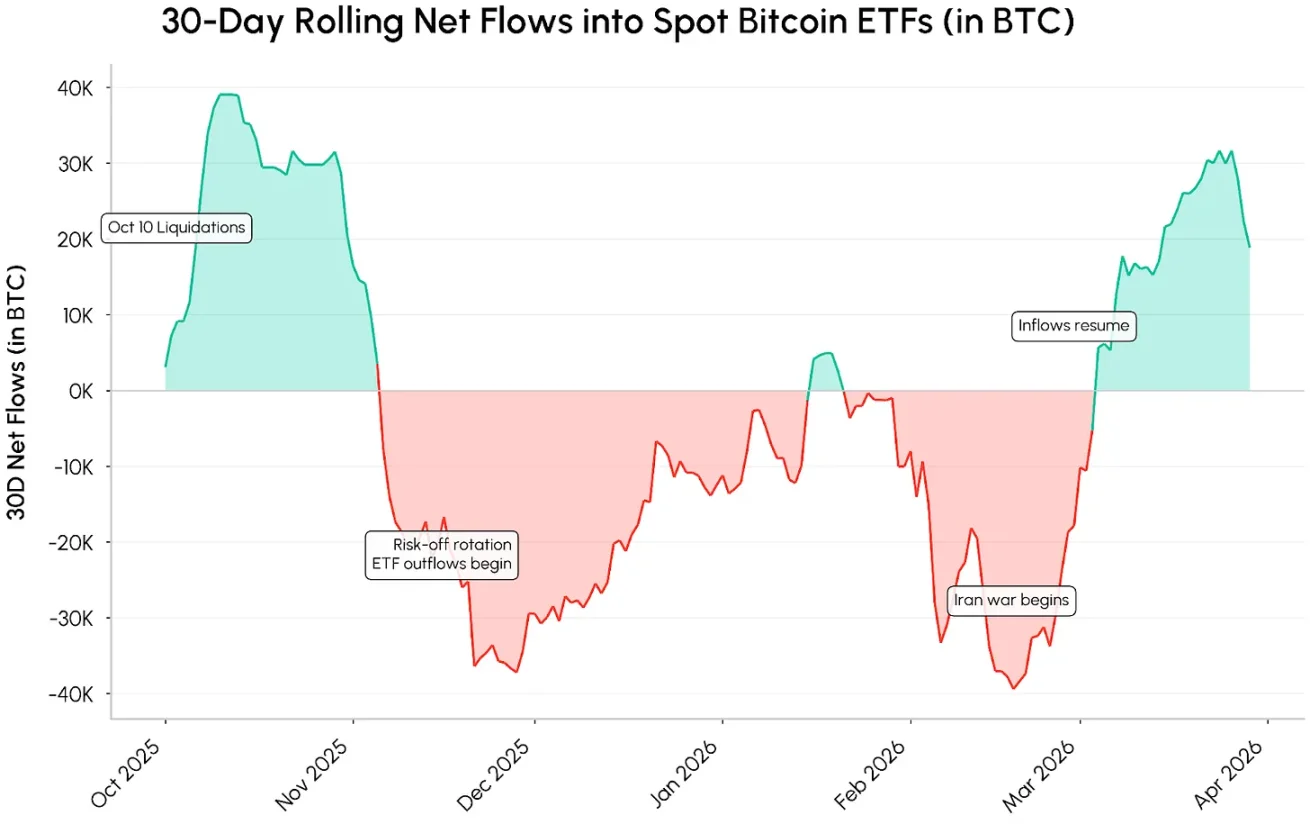
The initial risk-off sentiment at the start of the quarter reversed in March. Despite lingering market weakness, spot Bitcoin ETF demand improved markedly—reversing the sustained outflows observed since November 2025. Rolling 30-day data shows net ETF inflows exceeding 30,000 BTC, helping stabilize Bitcoin’s price near $70,000.
Source: Coin Metrics Network
Whether this demand can persist—and accelerate—depends heavily on macro conditions and policy direction. Easing geopolitical risks, moderating inflation, renewed rate-cut expectations, and growing allocation demand for ETFs and digital asset treasuries (DATs)—including Strategy’s $42 billion Bitcoin fundraising initiative—could further solidify inflows.
24/7 On-Chain Markets & Tokenized Equities
Hyperliquid and Traditional Assets
One central trend this year is the accelerated convergence of traditional financial markets and on-chain infrastructure via asset tokenization and 24/7 trading. Growth in perpetual contracts on traditional assets provides the clearest illustration of this trend.
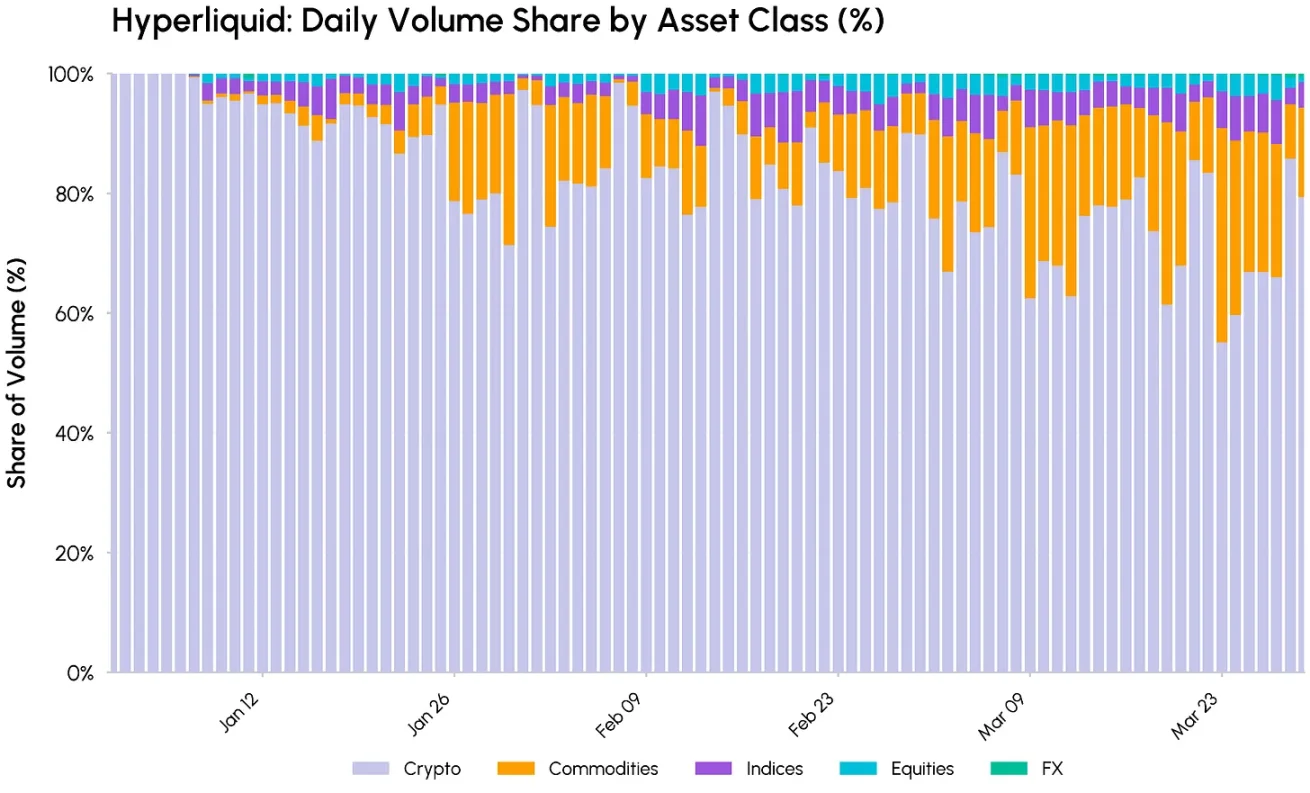
Following Hyperliquid’s launch of its HIP-3 markets covering equities, indices, and commodities, non-crypto asset trading volume surged to ~45% of total platform volume this quarter. Amid geopolitical tensions, traders sought 24/7 exposure to metals, crude oil, and other assets, driving significant growth in both overall trading volume and open interest. Notably, open interest on HIP-3 traditional assets now accounts for ~28% of Hyperliquid’s total open interest.
Source: Coin Metrics
Rise of Stock Perpetuals
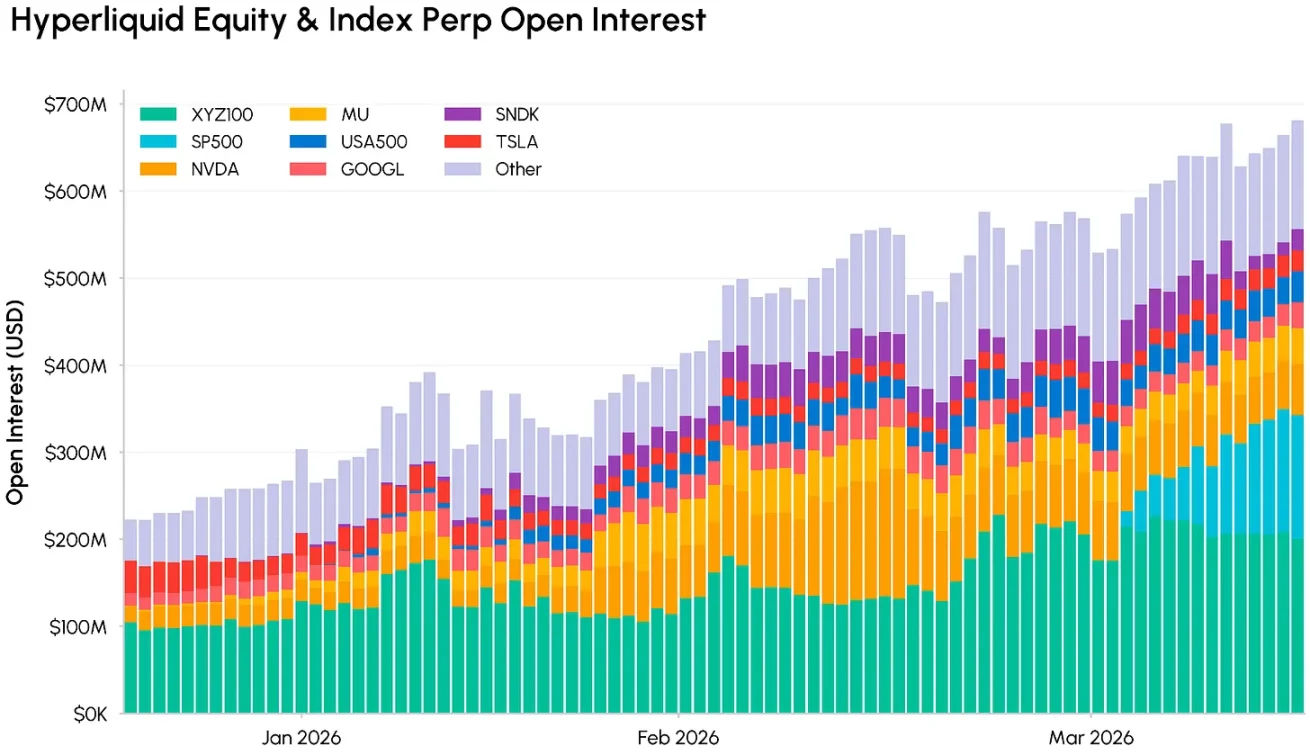
Within this niche, mainstream equities and indices have become the fastest-growing category as trading platforms expand their offerings. Kraken launched xStocks stock perpetuals in February; Coinbase International rolled out stock perpetual products, offering leveraged U.S. equity exposure. Meanwhile, [XYZ], Hyperliquid’s largest HIP-3 deployment partner, collaborated with S&P Dow Jones Indices to launch the first official S&P 500 perpetual contract—further enriching global equity exposure markets.
Source: Coin Metrics
Open interest in Hyperliquid’s stock and index perpetuals has risen steadily. Core indices—including XYZ100 (Nasdaq 100) and the S&P 500—now rank among the platform’s top-traded instruments by open interest, while individual stocks such as NVIDIA (NVDA) and Micron Technology (MU) have also achieved meaningful liquidity.
Simultaneously, issuance of tokenized equities and funds has grown, spanning frameworks like xStocks to tokenized money-market and equity funds issued by institutions such as Ondo on Ethereum and Solana.
Growth in tokenized equities and real-world asset (RWA) perpetuals underscores an emerging trend: on-chain platforms are evolving into 24/7 extensions of traditional markets—not merely crypto-native trading venues.
Stablecoins: Stable Supply, Rising Utility
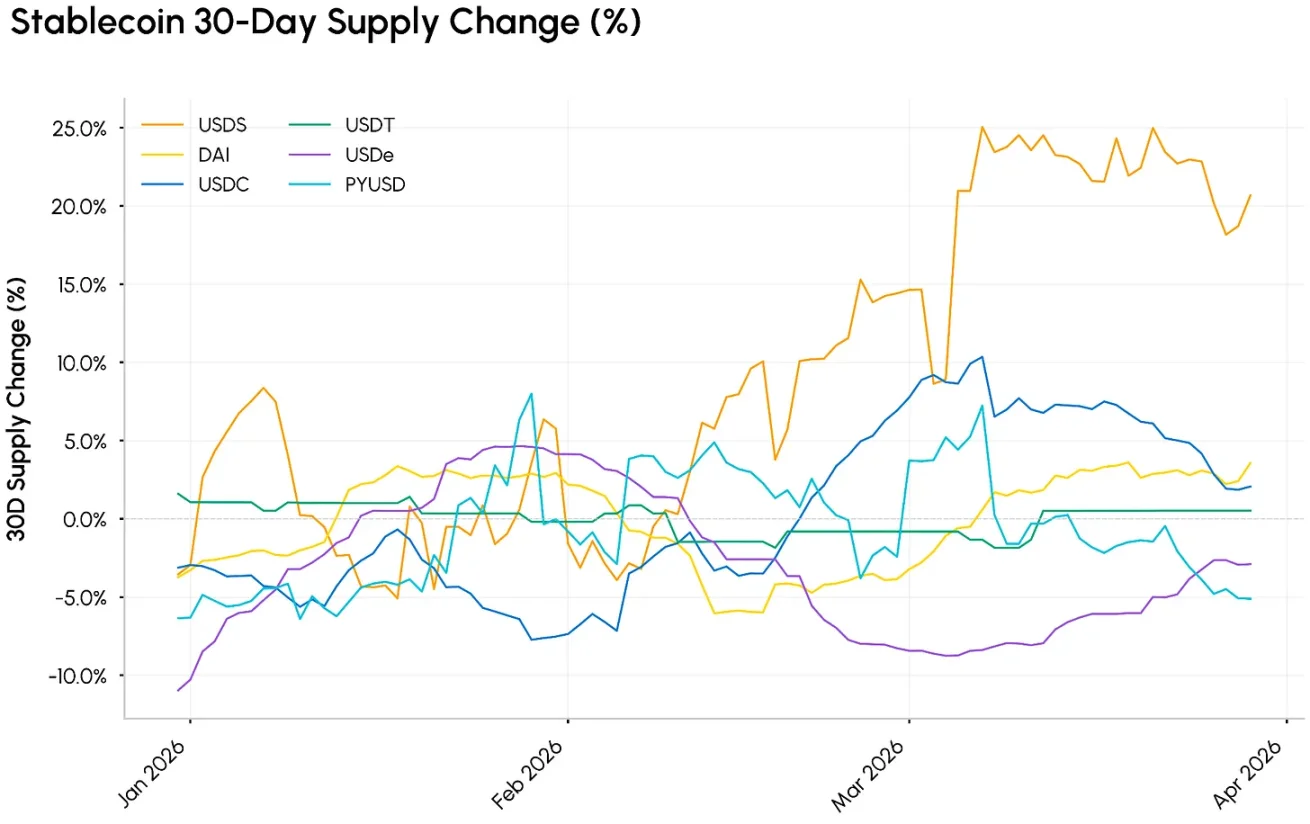
Stablecoins continue anchoring on-chain liquidity. Despite broad market declines, total stablecoin supply held steady near $300 billion in Q1 2026, with supply growth ticking up slightly on February 30.
USDS—the dollar-pegged stablecoin issued by Sky Protocol (formerly MakerDAO), backed by both crypto and real-world assets—posted the strongest growth, surging 43% to ~$8 billion. Circle’s USDC reached $77 billion in scale, while Tether’s USDT remained stable near $184 billion.
Source: Coin Metrics
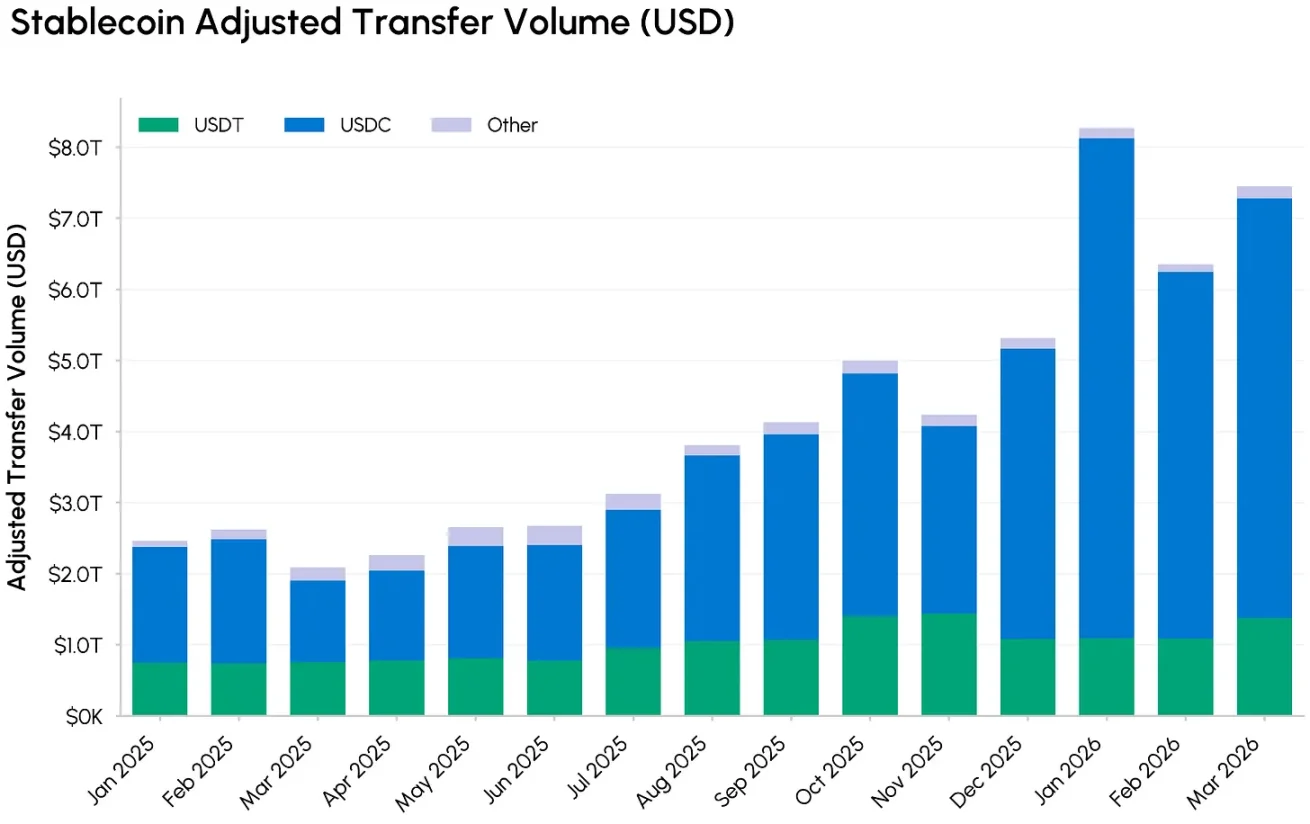
While supply remained stable, stablecoin velocity and usage surged. Adjusted stablecoin transfer volume reached $21.5 trillion in Q1—roughly triple the same period in 2025. Over 80% of transaction volume came from USDC, whose share of transactional use continues expanding relative to USDT. This activity was primarily driven by Base chain’s USDC ecosystem, where Q1 transfers alone totaled $13 trillion.
As analyzed in our recent report, much of this flow stems from DeFi infrastructure activities—such as liquidity provider rebalancing and flash loans—rather than end-user payments or settlements. That said, payment and settlement use cases are also growing in parallel.
Source: Coin Metrics
Going forward, the stablecoin industry’s trajectory may hinge on yield mechanisms and issuance rules. The latest draft of the CLARITY Act proposes banning passive yield generation on stablecoin balances but permits activity-based rewards tied to payments or platform usage. This clause could reshape core participants’ business models.
For Coinbase—where stablecoin-related revenue already accounts for over 25% of total revenue—restrictions on USDC yield could weaken its ability to attract and retain capital. Circle, by contrast, would be less affected; if high-interest-rate environments persist and regulatory rules clarify, its payment- and trading-related revenues stand to benefit. As the bill advances, its implications for DeFi lending, yield-bearing stablecoins, and tokenized Treasuries warrant close monitoring.
U.S. SEC Releases Digital Asset Classification Framework
This quarter brought a major regulatory clarification. The U.S. Securities and Exchange Commission (SEC) and the Commodity Futures Trading Commission (CFTC) jointly published guidance introducing a five-category digital asset classification framework, clarifying how each category fits within existing securities and commodities regulations:
- Digital Commodities: Native network tokens whose value derives primarily from the functionality of the underlying crypto system and market supply-demand dynamics (e.g., leading public-chain tokens). These are classified as commodities—not securities.
- Digital Collectibles & Utility Tokens: NFTs, in-game assets, gas tokens, and access tokens generally fall outside securities regulation—unless fractionalized or marketed primarily as investment vehicles.
- Payment Stablecoins: Fiat- and real-world-asset-backed stablecoins used for payments are treated as quasi-monetary instruments. However, those offering yield or employing non-compliant designs remain subject to securities classification review.
- Digital Securities: Tokenized equities, bonds, and credit-based RWAs—regardless of whether they’re on-chain—are fully classified as securities.
- Staking, Mining, and Wrapping: Native staking, mining, airdrops, and wrapping do not constitute securities transactions. However, pooled staking, yield-wrapped/structured tokens, or any instrument promising returns to investors may be deemed investment contracts.
For deeper analysis of the new token classification framework, CLARITY Act negotiation progress, and global regulatory developments, see Talos’s latest Regulatory Roundup.
Conclusion
Although crypto asset prices remain significantly influenced by macro and geopolitical factors, foundational infrastructure continues advancing. Bitcoin is finding increasing support at current price levels, while on-chain platforms deepen their integration into 24/7 trading markets for equities, commodities, and RWAs. Simultaneously, traditional giants like NYSE and Nasdaq are actively pursuing tokenization initiatives to modernize equity trading systems. Progress on the CLARITY Act and regulatory policies governing stablecoin yields will serve as critical industry variables. Should macro conditions improve, risk appetite for crypto assets could gradually rebound.
Join TechFlow official community to stay tuned
Telegram:https://t.me/TechFlowDaily
X (Twitter):https://x.com/TechFlowPost
X (Twitter) EN:https://x.com/BlockFlow_News
 @coinmetrics