








Huobi Growth Academy | Hyperliquid In-Depth Research Report: The Rise of the New Generation On-Chain Derivatives "Liquidity Foundation"
TechFlow Selected TechFlow Selected
Huobi Growth Academy | Hyperliquid In-Depth Research Report: The Rise of the New Generation On-Chain Derivatives "Liquidity Foundation"
Hyperliquid's story is an important footnote in the evolution of decentralized finance into a new stage.
 Navigating Web3 tides with focused insights
Abstract
Over the past two years, the decentralized derivatives sector has experienced explosive growth. As regulatory and trust crises in CeFi continue to emerge, demand for "high-performance, transparent, and verifiable" on-chain derivatives platforms has rapidly increased. Against this backdrop, Hyperliquid has emerged as a leader, leveraging its proprietary high-performance chain and fully on-chain order book to fulfill its vision of being “as fast as a centralized exchange, but without requiring centralized trust,” gradually becoming the dominant player in the DeFi perpetual contract market.
By mid-2025, Hyperliquid had captured 70–80% of the decentralized derivatives market share, with daily trading volume reaching hundreds of billions of dollars and TVL exceeding $2 billion. Its token HYPE briefly ranked among the top ten by market cap, and the community even dubbed it the “on-chain version of Binance.” However, Hyperliquid’s ambitions extend beyond transaction scale—it aims to build a cross-chain liquidity infrastructure enabling users to seamlessly deposit across chains, execute leveraged trades, and withdraw settlements directly from their wallets. This report comprehensively analyzes Hyperliquid across multiple dimensions: team background and organizational structure, product features and trading models, governance and institutional design, foundations of user trust, market performance and competitive landscape, implications for DEX marketing, and risks and challenges.
1. Team Background and Organizational Structure
Hyperliquid's rise stems largely from its unique team composition and organizational culture. Unlike many crypto projects reliant on large teams and massive funding rounds, Hyperliquid adopted a path of “lean efficiency and technology-driven development” from inception. Its core strengths lie in the high execution capability of a small team, strong engineering DNA, and commitment to community ownership.

Hyperliquid’s founder, Jeff Yan, has a distinct background in quantitative finance and systems engineering. A Harvard graduate in Mathematics and Computer Science, he previously worked as a quant trader at Hudson River Trading (HRT), one of Wall Street’s leading high-frequency trading firms known for extreme demands on latency and system performance. There, Jeff developed deep expertise in ultra-low-latency matching systems, quantitative modeling, and market microstructure. In 2018, he entered the crypto space, initially exploring how traditional high-frequency trading strategies could be adapted to decentralized environments. By 2022, he formally launched Hyperliquid with a clear mission: to create a high-performance trading platform that integrates high-frequency trading principles with on-chain mechanisms. Unlike typical crypto entrepreneurs focused on business development or fundraising, Jeff prioritizes product R&D and system iteration, believing that only through concentrated technical advancement can true differentiation be achieved in a competitive market. This tech-first philosophy shaped Hyperliquid’s foundational trajectory and established the team’s core identity—quantitative thinking, systems engineering focus, and relentless pursuit of peak performance.
The Hyperliquid team is exceptionally lean. Public reports and community estimates suggest the core team consists of approximately 11 members, yet supports a platform routinely handling daily trading volumes in the tens of billions of dollars. Compared to traditional fintech companies with hundreds of engineers and operators, this scale is nearly inconceivable. The “small-team, high-output” model is also reflected financially. According to community statistics and third-party research from August 2025, Hyperliquid achieves over $100 million in annual revenue per employee, with total revenue reaching the billion-dollar scale, earning it recognition as “one of the most efficient companies globally.” This extraordinary efficiency not only demonstrates team execution power but also reflects the high degree of automation and stability in its underlying systems. Order matching, risk management, and settlement operate almost entirely autonomously, allowing team members to focus on protocol upgrades and feature expansion rather than routine maintenance or manual intervention. This reduces marginal labor costs and enables maximum market coverage with minimal headcount. Crucially, this efficiency does not come at the expense of security. Hyperliquid’s matching engine and on-chain mechanisms have proven resilient during multiple extreme market conditions, maintaining stable operations and safeguarding user assets without major incidents. This reinforces market confidence that even small teams, through superior engineering and mechanism design, can deliver trading infrastructure rivaling traditional giants.
Beyond the founder’s background and team size, Hyperliquid’s organizational culture is another key advantage. First, the team adheres strictly to a “quality over quantity” hiring principle. Members typically come from elite institutions such as MIT, Caltech, and Citadel, possessing exceptional professional qualifications. Rather than rapid manpower scaling, Hyperliquid emphasizes deep engagement from core individuals to maintain high execution velocity. Second, the team demonstrates strong values in capital selection. It explicitly rejects external VC investment, maintaining a firm stance of “no VC funding.” In the crypto industry, this position is highly symbolic. Many projects raise large sums early on, often resulting in governance and value capture skewed toward investors. Hyperliquid instead funds development through self-financing and organic protocol growth, ensuring value accrues to the community rather than capital providers. This strengthens user sense of ownership and establishes a differentiated narrative positioning.
In governance, Hyperliquid follows a consistent logic. Platform fees and revenues are returned to the HLP protocol treasury and ecosystem fund; the team takes no profit share. This arrangement fosters perceptions of transparency and fairness, reducing concerns about “centralized profiteering.” As community influence in governance and ecosystem building grows, Hyperliquid has cultivated a culture where “users are owners.” This cultural foundation significantly contributes to rapid user trust acquisition and builds a durable community moat for long-term sustainability.
In summary, Hyperliquid’s team and organizational structure exhibit three defining characteristics: Founder background shapes DNA—quantitative and high-frequency trading experience grants inherent engineering and performance advantages; Small team achieves high efficiency—just over ten people support tens of billions in daily volume, achieving exceptional capital and labor efficiency; Organizational culture emphasizes community ownership—rejecting VC funding and advocating transparent distribution continuously strengthens user trust and engagement. This model challenges the conventional belief that “scale equals success,” proving in the DeFi space, small, user-centric teams can become dominant players. Hyperliquid’s team story is not just a footnote to its success, but offers a paradigm worth studying: in open finance, what’s most scarce isn’t capital or manpower, but extreme engineering capability, clear values, and consistently aligned institutional design.
2. Product Features and Trading Models
Hyperliquid’s rapid ascent stems not only from engineering prowess and organizational culture, but also from its product architecture and trading models, which form critical market barriers. In the DeFi derivatives space, most protocols face a dilemma between “performance limitations and trust requirements.” Hyperliquid resolves this tension through its proprietary dual-engine architecture, fully on-chain order book, innovative HLP treasury protocol, and strict leverage risk controls—successfully balancing performance with decentralization. The result is a platform delivering CEX-like trading experiences while preserving DeFi’s transparency and openness, making it currently one of the few platforms to genuinely combine CEX speed with DeFi security.
Hyperliquid’s technical foundation comprises two engines: HyperCore and HyperEVM, serving performance and composability respectively. HyperCore is the core matching and trading system responsible for spot and perpetual contract execution. Its performance rivals traditional CEXs, with median matching latency around 200 milliseconds and throughput reaching hundreds of thousands of TPS. This allows high-frequency traders and institutional investors to execute complex strategies on-chain without losing edge due to latency or slippage. HyperEVM is an Ethereum Virtual Machine-compatible environment supporting smart contracts and ecosystem expansion. It ensures Hyperliquid maintains compatibility with Ethereum and broader DeFi protocols despite its high performance. Through HyperEVM, Hyperliquid can expand into lending, liquid staking, asset issuance, and other financial applications, forming a complete on-chain financial loop. This “dual-engine” design balances speed with verifiability: HyperCore focuses on peak performance and stability, while HyperEVM ensures openness and ecosystem diversity. This architectural innovation enables Hyperliquid to achieve its goal of “CEX experience + DeFi security” ahead of peers.
In terms of trading model, Hyperliquid diverges sharply from mainstream AMM designs by adopting a fully on-chain order book (CLOB). Most decentralized exchanges rely on AMMs (Automated Market Makers), which enable permissionless liquidity but suffer inherent limitations in depth, slippage, and suitability for high-frequency strategies. Hyperliquid moves the entire order book and matching logic on-chain, making order placement, cancellation, matching, and settlement fully verifiable. This design brings two key benefits: First, it greatly enhances fairness and transparency—all orders and match results are recorded on-chain, eliminating opacity or market maker manipulation. Second, it opens access to institutional and high-frequency traders who are familiar with order-book-based trading and depend on sophisticated limit and cancel strategies for risk management and arbitrage. Hyperliquid’s on-chain CLOB environment meets their dual needs for depth, speed, and programmability, enabling complex strategy execution comparable to CEXs, without custody risks.
In DeFi derivatives, providing stable liquidity and liquidation capacity remains challenging. Hyperliquid addresses this via the innovative HLP (treasury) mechanism. HLP serves three roles: Liquidity Provider—HLP performs primary market-making functions, ensuring stable bid-ask depth; Risk Buffer—during user losses or extreme market volatility, HLP acts as a systemic risk pool absorbing liquidation losses, avoiding the use of ADL (Auto-Deleveraging) common in traditional exchanges. Thus, profitable users avoid forced closures due to system risk; Revenue Sharing Mechanism—users depositing funds into HLP share platform fee income and funding rate earnings.
The greatest significance of this design is democratization. In CEXs, market making and clearing are typically controlled by privileged few, excluding ordinary users. On Hyperliquid, every depositor becomes a partial market maker, sharing in market growth. Over time, this increases user stickiness and strengthens platform resilience.
Leverage and risk control are central to derivatives markets. While offering high leverage, Hyperliquid implements a dynamic risk framework. It supports up to 40–50x leverage, meeting professional trader demands. However, for low-cap assets or large positions, the system automatically reduces leverage caps to prevent systemic risks from isolated extreme exposures. Funding rate calculations further reflect platform prudence. Unlike some platforms using internal prices or pool states, Hyperliquid bases funding rates on external oracle prices, anchoring them to real markets and preventing manipulation. Frequent rate settlements (typically every 8 hours) ensure ongoing market equilibrium. These mechanisms allow Hyperliquid to maintain attractiveness for high-leverage trading while keeping system risks manageable and user experience predictable—building a relatively stable trust bridge between whales and retail users.
Overall, Hyperliquid’s product and trading model reflect strong systems engineering thinking: The HyperCore + HyperEVM dual engine balances performance and openness; The fully on-chain order book delivers institutional-grade fairness and depth; The HLP protocol treasury democratizes market-making and clearing; The leverage and risk control system attracts professional users while preserving platform safety. This comprehensive product suite not only solves longstanding pain points in decentralized derivatives but also establishes Hyperliquid’s unique competitive edge. It enables near-seamless switching between CEX and DeFi experiences, while building long-term trust and stickiness through transparent rules and revenue distribution. For these reasons, Hyperliquid has rapidly risen in a crowded field to become today’s most representative “liquidity base layer.”
3. Governance and Institutional Design: The Foundation of User Trust
Another core strength of Hyperliquid lies in its governance and institutional innovations, which enable openness, scalability, and rapid iteration. Since launch, the project has adopted a mechanism similar to Ethereum’s EIP process—Hyper Improvement Proposal (HIP)—as the foundation for community consensus and product evolution. Through HIPs, Hyperliquid not only solved liquidity bootstrapping and asset listing challenges but also created institutional pathways for derivatives market expansion, greatly enhancing ecosystem diversity.
The introduction of HIP-1 marked Hyperliquid’s first major step in governance and institutional design. Under this mechanism, any project can pay a fee in HYPE tokens to create its own token and quickly launch a spot market on the platform. This breaks the CEX model where “listing rights are monopolized by exchanges,” and avoids the bottleneck in traditional DEXs that rely on external liquidity seeding. In essence, HIP-1 standardizes and codifies the “token listing” process, allowing projects to enter markets in a fully permissionless manner while drastically lowering cold-start costs. If HIP-1 solved the question of “how to list,” HIP-2 addressed the next challenge: “how to maintain initial market depth.” In traditional markets, new assets often lack active buy/sell liquidity, causing high slippage and unstable trading. Hyperliquid tackles this via HIP-2’s Automated Market Making service (Hyperliquidity), providing foundational bid-ask depth for new projects. This improves user experience and accelerates market recognition. Notably, this automation is not mere liquidity incentives, but based on systematic algorithms and rational capital allocation, ensuring sustainable market making.
HIP-3 represents a landmark innovation in Hyperliquid’s governance framework. Per this proposal, any Builder who stakes 1 million HYPE and participates in a Dutch auction gains the right to deploy a perpetual contract market. More importantly, Builders can earn up to 50% of trading fees in their new market and customize trading parameters and fee structures. This mechanism unleashes community creativity, shifting perpetual market creation from the core team to ecosystem participants. The implications of HIP-3 are profound: It enables Hyperliquid to rapidly expand into long-tail assets such as RWA (real-world assets), indices, commodities, forex, and even pre-IPO stocks, creating product differentiation vs. CEXs; It uses high staking thresholds and auction mechanisms to filter for builders with genuine long-term commitment and financial capacity, preventing low-quality market proliferation; It ties fee-sharing to governance, giving the community clear economic incentives to expand new markets.
Collectively, the HIP series reflects Hyperliquid’s institutional logic: First lower entry barriers via open listing and automated market making, then achieve supply-side decentralization and scalable growth through the Builder mechanism. This governance framework not only overcomes traditional DEX growth bottlenecks but also establishes the institutional foundation for Hyperliquid’s long-term evolution.
In decentralized finance, user trust is fundamental to sustained growth. Although Hyperliquid’s core matching logic and fund flows may appear somewhat “centrally processed” to outsiders, it has nonetheless built strong user trust in a short time. This trust arises from the interplay of performance, institutional design, and narrative. First, performance and user experience are direct attractions. Hyperliquid delivers CEX-like speed and depth, with matching latency as low as 200ms, sufficient for high-frequency and institutional users. Users enjoy a seamless on-chain experience comparable to CEXs, without custody risks. Second, transparency and non-custodial design enhance security. The platform has no profit extraction; all fees flow back to the HLP protocol treasury and ecosystem fund. User assets remain self-custodied, and all transactions are on-chain and auditable—contrasting sharply with the “black box” nature of traditional exchanges. Third, community ownership forms a values-based trust foundation. Hyperliquid consistently rejects VC funding, avoids benefiting outside capital, and upholds “users as owners.” This narrative dispels concerns about “capital vs. user conflict” and psychologically positions users as co-builders and long-term beneficiaries.
Additionally, whale effects amplify trust transmission. Prominent大户 James Wynn executed multi-hundred-million-dollar positions with high leverage on the platform, generating exceptional returns. Such visible success stories significantly boost retail user confidence and attract more capital inflows. Finally, deflationary and incentive mechanisms reinforce expectations of token value. HYPE serves not only as a governance and staking tool but also offers fee discounts, with portions of platform revenue used for buybacks and burns. This leads users to believe there’s a direct link between platform growth and token value, encouraging long-term holding and participation.
In sum, Hyperliquid’s trust flywheel is driven by technical performance, transparent institutions, community ownership, demonstration effects, and deflationary mechanics. This composite trust structure allowed it to quickly overcome skepticism around needing to “trust like a CEX,” ultimately forming a unique competitive advantage.
4. Market Performance and Competitive Landscape
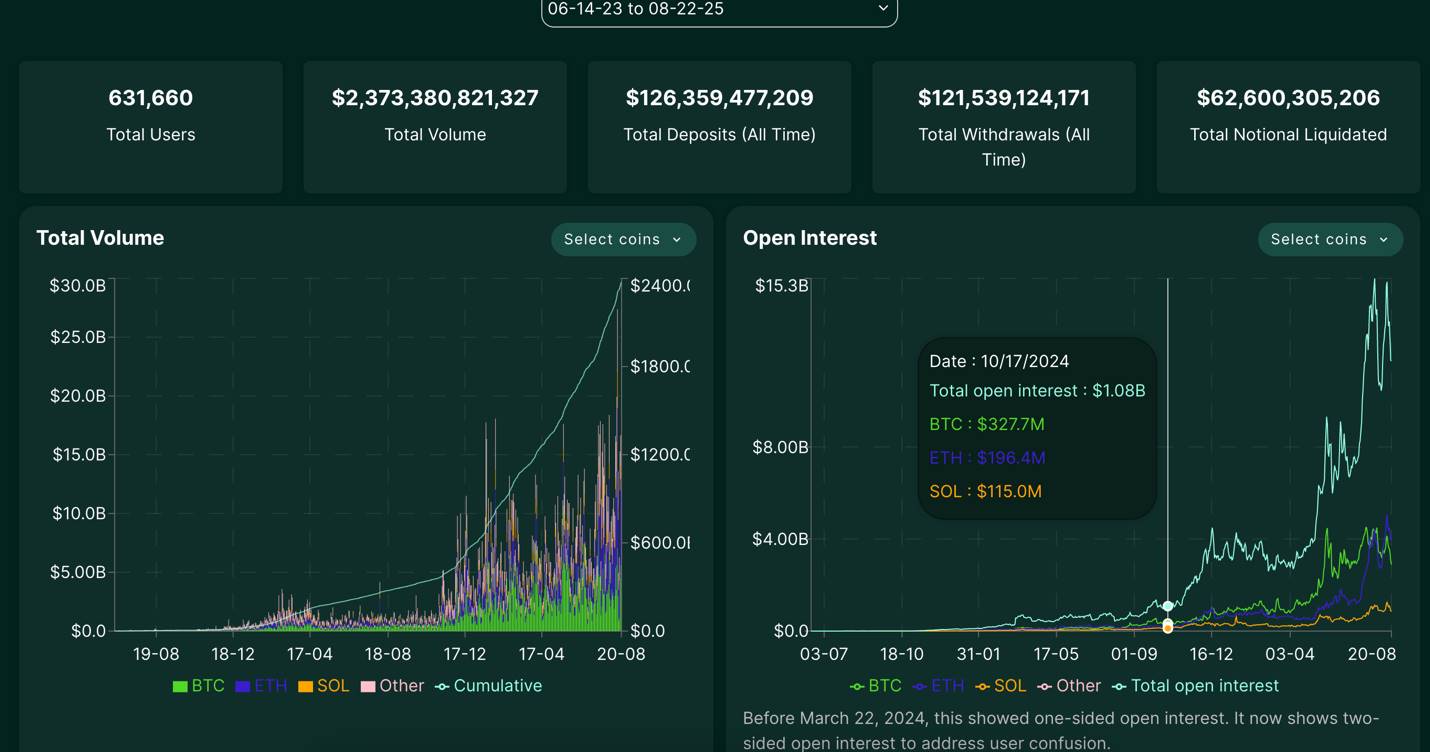
By 2025, Hyperliquid had become the undisputed leader in the DeFi perpetual contract market, maintaining a stable 70–80% market share. Its average daily trading volume reached hundreds of billions of dollars—far surpassing other decentralized derivatives platforms and rivaling mid-sized centralized exchanges. According to DefiLlama data, Hyperliquid’s annualized protocol fees reached $1.345 billion, with $110.26 million in fees over the past 30 days and cumulative fees totaling $660.98 million. Annualized revenue stood at $1.251 billion, with $102.55 million in the last 30 days and cumulative revenue of $636.46 million. This scale solidifies Hyperliquid’s status as a true “on-chain liquidity base layer.” In terms of capital, Hyperliquid’s TVL exceeds $2 billion, reflecting substantial user asset deposits and confidence in protocol security. Its token HYPE once reached a $16 billion market cap, with a fully diluted valuation (FDV) exceeding $46 billion. Such valuations reflect market recognition of its business model and widespread investor optimism about its long-term potential. Hyperliquid already matches Binance-level speed and UX, while avoiding the trust and regulatory pitfalls of CeFi through non-custodial design and community ownership. Amid declining global trust in CEXs, this differentiation serves as a strategic advantage. However, as regulations tighten, Hyperliquid will face increasing pressure balancing “no KYC, free cross-chain movement” against compliance requirements—a key challenge for future expansion.
In the DEX space, Hyperliquid’s advantages are clear: Compared to AMM-based DEXs like Uniswap, it offers more professional order-book trading tools and deeper liquidity, attracting institutional and high-frequency users. Compared to order-book DEXs like dYdX V4, its proprietary high-performance L1 and HLP model demonstrate superior performance and resilience, avoiding performance bottlenecks from reliance on external chains. Overall, Hyperliquid has established de facto monopoly status in the DeFi perpetual market. It is both a challenger to CEXs and an outperformer among DEXs. Its governance and institutional design, via the HIP series, has opened up full-process access to listing, market making, and derivatives expansion; its user trust emerges from a compounding flywheel of performance, transparency, and values; its market performance validates the model’s success. By 2025, it is not only the dominant DeFi perpetual platform but also an emerging prototype of a “cross-chain liquidity infrastructure.” Yet, regulation and governance remain key future hurdles. For other DEXs, Hyperliquid’s example shows that only the integration of technical performance, institutional innovation, and value narrative can create lasting moats in fierce competition.
5. Risks and Challenges
Although Hyperliquid has rapidly evolved from a small team to market leader, any fast-growing financial infrastructure inevitably faces risks and challenges. For Hyperliquid, these issues will determine not only its ability to maintain leadership but also shape the broader DeFi derivatives landscape.
The primary challenge comes from global regulatory uncertainty. Hyperliquid’s model emphasizes no KYC and free cross-chain capital movement—an advantage for user experience and market expansion, but a potential liability in compliance. Regulators worldwide are increasingly scrutinizing crypto derivatives’ leverage risks, anti-money laundering (AML) compliance, and cross-border capital flows, potentially introducing mandatory registration or identity verification. If Hyperliquid faces regional restrictions, it could hinder user growth and liquidity. Unlike CeFi platforms, DeFi protocols cannot easily resolve compliance via traditional licensing. Balancing regulatory compliance with decentralization ideals will remain a long-term challenge.
While Hyperliquid advocates “users as owners” and promotes governance democratization via HIP proposals and the HLP treasury, practical risks of governance centralization persist. For instance, during the JELLYJELLY manipulation incident, the Hyper Foundation had to intervene in governance and market operations, revealing continued reliance on core team decisions. This highlights a paradox: decentralized systems often require centralized fallbacks when facing complex governance issues or malicious attacks. Future efforts must refine validator governance to better balance interests between Builders and users, directly impacting Hyperliquid’s long-term sustainability. Hyperliquid’s high-performance matching engine and cross-chain bridge design are competitive advantages but carry systemic risks. During extreme market volatility or mass liquidations, cross-chain deposits, liquidations, and fund settlements may face severe stress. Any delays or failures could damage user trust. Additionally, while the HLP treasury absorbs most risks, its capacity to withstand extreme losses has limits. Enhancing system resilience without compromising user experience remains a critical area for continuous investment.
Hyperliquid’s revenue is highly dependent on market activity, especially leveraged trading demand. In bull markets, trading volume and fee income surge rapidly, but in bear markets, reduced activity could cause significant revenue contraction. If the platform fails to sustain adequate yield distribution during downturns, HLP depositors may lose motivation, weakening market depth and overall ecosystem stability. This cyclical business risk requires mitigation through diversified products (e.g., RWA, lending). Moreover, Hyperliquid’s brand narrative is built on “no VC, community ownership”—a key differentiator. However, if the team is accused of hidden profits or governance becomes opaque, user trust in the narrative could quickly erode. Additionally, as whale dominance grows, some users worry Hyperliquid relies too heavily on large accounts, potentially causing market volatility and unequal benefit distribution. If unmanaged, such perception risks could fracture the community.
Summary: Regulation, governance, system stability, market cycles, and brand perception constitute Hyperliquid’s five major future risk sources. These challenges do not undermine its current leadership but will determine whether it can evolve into a true “cross-chain liquidity infrastructure.”
6. Implications for DEX Marketing
Hyperliquid’s success extends beyond product excellence, establishing a highly instructive model in narrative and institutional design. For aspiring DEXs seeking breakthroughs, Hyperliquid’s approach offers clear lessons:
1. Narrative-driven:
User ownership and value return. Hyperliquid consistently emphasizes “no VC, users are owners,” implementing this through fee sharing and HLP yield distribution. This narrative enhances user belonging and builds strong community stickiness. For any DEX, narrative is not mere promotion but the unity of institution and practice:
Only when users tangibly benefit from platform growth does the narrative endure.
2. Product-driven:
Performance and experience go hand-in-hand. Hyperliquid’s core strength lies in its “dual-engine architecture + fully on-chain order book.”
This shows that in DEXs, users won’t sacrifice experience for decentralization.
Rather, they commit long-term only when performance approaches CEX levels. Therefore, newcomers must move beyond marketing “decentralization” alone and integrate “high performance, low latency, transparent and verifiable” attributes to convey a “fast and secure” product proposition.
3. Community-driven: Whale effect and retail diffusion. Hyperliquid’s growth began with whales driving volume and liquidity, then expanded retail adoption via integrations with wallets like Phantom. This “top-down + bottom-up” dual-engine model provides a replicable framework. For DEXs, early stages can build market trust by showcasing whale success stories, while mid-to-long term growth requires deep integration with gateway apps (wallets, aggregators) to onboard retail users.
4. Mechanism-driven: Open growth and revenue-sharing logic. The success of HIP-3 shows that opening builder ecosystems is an effective way to scale markets. By setting high staking thresholds and offering fee shares, Hyperliquid delegates market creation to the community, enabling supply-side scalability. For marketing, this suggests DEXs should treat “institutional design” as part of their growth narrative, emphasizing the platform belongs to everyone, not just a select few.
5. Brand-driven: From DEX to “liquidity base layer.” Hyperliquid no longer positions itself as a single exchange but as a “cross-chain liquidity infrastructure.” This elevates its strategic vision. For any DEX, brand marketing must transcend the “single app” mindset and craft broader narratives—such as “on-chain settlement layer” or “cross-chain asset gateway”—to gain strategic premium beyond individual products.
Hyperliquid’s lesson is clear: narrative, product, community, mechanism, and brand must work in concert. Marketing is not a standalone tactic but the unified output of institution, product, and strategy.
7. Conclusion
Hyperliquid’s journey marks a pivotal moment in the evolution of decentralized finance. From a team of fewer than twenty, to capturing 70–80% of the decentralized perpetual market, its rise can be attributed to three forces: engineering culture, institutional design, and narrative values.
Technically, Hyperliquid leveraged a lean team to build a proprietary high-performance chain and fully on-chain order book, proving small teams can out-engineer traditional giants in systems design; Institutionally, through HIP proposals and the HLP protocol treasury, it unified market expansion, risk management, and revenue sharing; Narratively, by rejecting VC funding and championing community ownership, it fostered user belonging and value alignment. Together, these elements formed Hyperliquid’s “trust flywheel,” making it not only the dominant DeFi derivatives platform but also an emerging blueprint for next-generation on-chain financial infrastructure. Looking ahead, Hyperliquid faces clear challenges: tightening regulations, governance centralization risks, system resilience under extreme conditions, and cyclical pressures on revenue. Yet, the paradigm it has pioneered offers valuable lessons. For others entering the space, Hyperliquid proves that in the fiercely competitive world of decentralized trading, only the integration of performance advantage, institutional innovation, and value narrative can build enduring moats.
In a sense, Hyperliquid is more than a DEX—it has already taken critical steps toward becoming a “cross-chain liquidity base layer.” Its emergence signals that the future of DeFi will no longer be a collection of isolated apps, but an evolving global financial network combining CEX-level performance, transparent institutions, and community governance.
Join TechFlow official community to stay tuned
Telegram:https://t.me/TechFlowDaily
X (Twitter):https://x.com/TechFlowPost
X (Twitter) EN:https://x.com/BlockFlow_News
 @HTXAcademy


