








Sequoia Capital: The Next Trillion-Dollar Company Won’t Sell Software—It’ll Sell Outcomes
TechFlow Selected TechFlow Selected
Sequoia Capital: The Next Trillion-Dollar Company Won’t Sell Software—It’ll Sell Outcomes
The next trillion-dollar company will be a software company disguised as a service company.
 Navigating Web3 tides with focused insights
Author: Julien Bek
Translated and edited by: TechFlow
TechFlow Intro: Julien Bek, Partner at Sequoia Capital, has written a clear, framework-driven article whose core thesis is: The next trillion-dollar company will not sell software tools—it will sell outcomes. For every $1 businesses spend on software, they spend $6 on services. As AI drives the cost of “getting work done” toward zero, the real opportunity lies not in Copilots (assistive tools) but in Autopilots (systems that autonomously deliver work).
He systematically unpacks automation opportunities across service industries—including insurance, accounting, healthcare, law, IT, procurement, recruiting, and consulting—and includes an opportunity matrix charted along two axes: “intelligence vs. judgment” and “outsourced vs. internal.” This analysis holds valuable insights for both AI founders and investors.
Full text below:
The next trillion-dollar company will be a software company disguised as a services firm.
Every founder building AI tools asks the same question: What happens when the next version of Claude renders my product a mere feature? That concern is valid. If you sell tools, you’re racing against the models. But if you sell the work itself, every model advancement makes your service faster, cheaper, and harder to compete with. A company might spend $10,000 annually on QuickBooks—and another $120,000 hiring an accountant to close its books. The next legendary company will simply close those books for you.
Intelligence vs. Judgment
Writing code is primarily an exercise in intelligence. Knowing what to do next is judgment.
Translating a requirements document into code, testing it, debugging it—these involve complex rules, but rules nonetheless. Judgment is different. It requires experience and taste, intuition honed over years of practice. Deciding which feature to build next, whether to accrue technical debt, or when to ship before you’re fully ready—these are judgments.
A year ago, most Cursor users treated AI as autocomplete. Today, agent-initiated tasks outnumber human-initiated ones. Software engineering accounts for over half of all AI tool usage across professions; every other category remains in the single digits. Why? Because software engineering is predominantly intellectual work. AI has already crossed the threshold: it can autonomously handle most intelligence-driven tasks, leaving judgment to humans. Software engineering arrived here first—but this shift will spread across every profession.
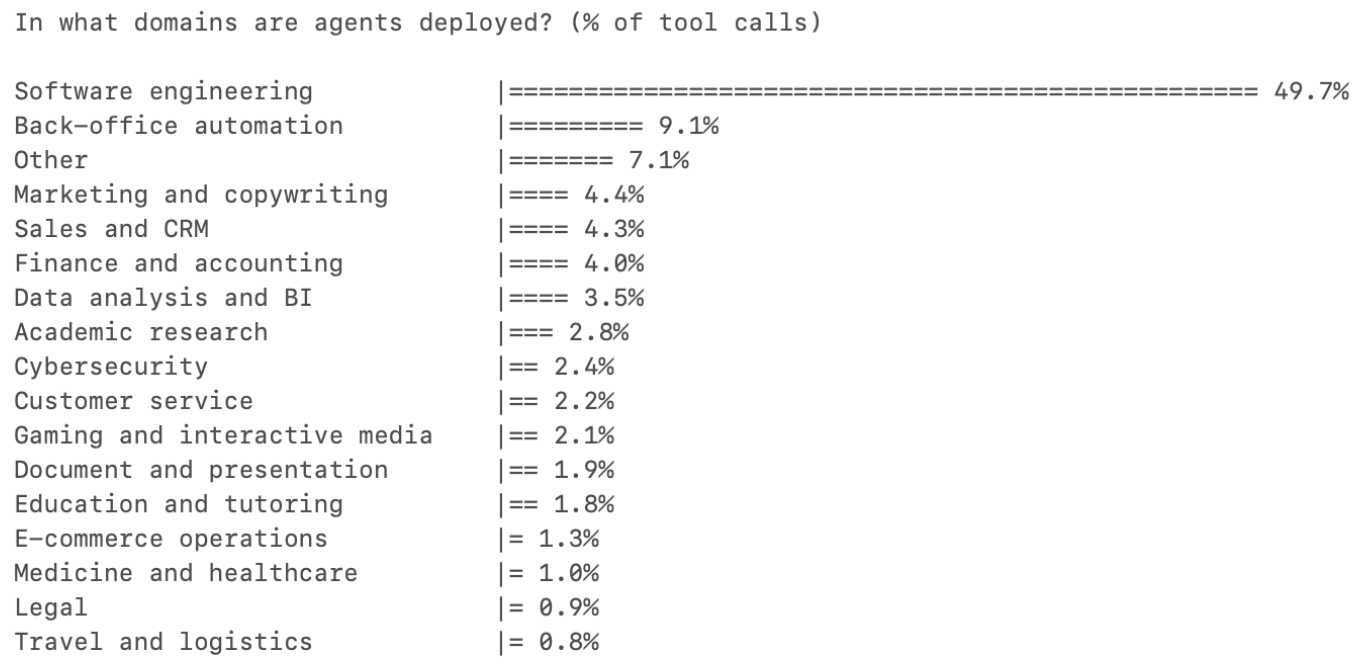
Caption: AI tool usage share across professions—software engineering far exceeds all others
Copilot vs. Autopilot
Copilot sells tools. Autopilot sells work.
Until recently, AI models were still developing in both intelligence and judgment—so the right path was to start with Copilot: putting AI into professionals’ hands and letting them decide how to use it. Harvey sells to law firms; Rogo sells to investment banks. Professionals are the customers; the tools make them more efficient, and they remain accountable for outcomes.
Today, models have become sufficiently capable that, in certain categories, the optimal starting point is Autopilot from day one. Crosby sells directly to companies needing NDAs—not to outside counsel. WithCoverage sells directly to CFOs needing insurance—not to insurance brokers. Customers buy outcomes outright. In any profession, budgets allocated to work vastly exceed budgets allocated to tools—and Autopilot captures the work budget from Day One.
The higher the intelligence component in a domain, the faster Autopilot wins.
Convergence
Today’s judgment becomes tomorrow’s intelligence. As AI systems accumulate proprietary data about “what good judgment looks like” within their domains, the frontier shifts. Copilot and Autopilot converge. The Copilot-to-Autopilot transition has already begun across multiple categories. Yet the starting position matters profoundly—it determines where Autopilot can win customers today and begin accumulating the data that will ultimately enable it to handle judgment-intensive work.
Autopilot Playbook: Outsourcing as the Entry Point
For every $1 spent on software, $6 is spent on services.
An Autopilot’s TAM is the total labor spend in a category—both internal and outsourced. But the correct entry point is where outsourcing already exists.
If a task is already outsourced, it signals three things. First, the company has already accepted that the work can be performed externally. Second, there’s an existing, cleanly defined budget line that can be replaced. Third, the buyer is already purchasing outcomes. Replacing an outsourced contract with an AI-native service provider is a vendor switch. Replacing internal staff is organizational restructuring.
The playbook: Start with outsourced, intelligence-intensive tasks. Nail distribution. As AI accumulates data, expand into internal, judgment-intensive work. Outsourced tasks are the wedge; internal work is the long-term TAM.
Crosby started with NDAs: a well-defined task, overwhelmingly intellectual, and already commonly outsourced to external counsel. Budget is pre-allocated, scope is clear, ROI is immediate, and replacement is frictionless.
Opportunity Map
Plotting each service vertical along a spectrum from “intelligence to judgment” and another from “outsourced to insourced” yields a prioritization map—with labor TAM shown in parentheses. The list below is illustrative, not exhaustive.
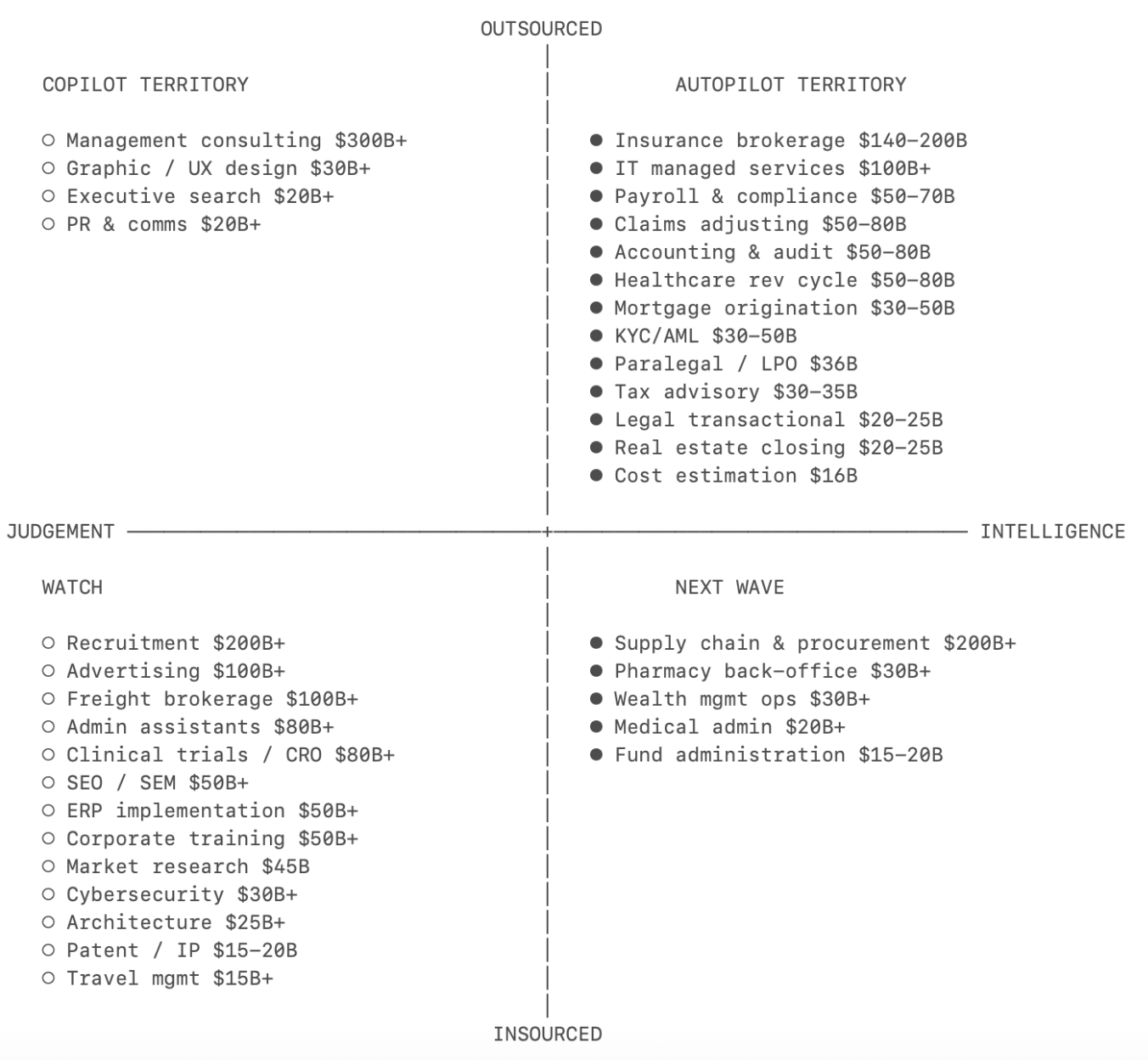
Caption: Autopilot opportunity matrix across service verticals (plotted by intelligence/judgment ratio and outsourced/insourced ratio)
Insurance brokerage ($140–200B).
The largest market on this list. Standard commercial insurance is highly standardized: the broker’s value-add is essentially price comparison across carriers and form-filling—purely intellectual work. Distribution is extremely fragmented, with thousands of small brokers running identical processes, none owning the customer relationship. WithCoverage and Harper are intriguing new entrants.
Accounting and auditing ($50–80B outsourced in the U.S. alone).
The U.S. has lost ~340,000 accountants over the past five years—even as demand grows. 75% of CPAs are nearing retirement; the licensure path is long, and starting salaries lag behind tech and finance. This structural shortage is driving accounting firms to adopt AI faster than almost any other profession. Rillet is building an AI-native ERP to close books directly. Basis began as an accounting Copilot.
Healthcare revenue cycle management ($50–80B outsourced in the U.S.).
“Healthcare” evokes judgment intensity—but billing is almost purely intellectual. Medical coding translates clinical notes into roughly 70,000 standardized ICD-10 codes. The rules are complex, yet still rules-based. Outsourcing is mature and outcome-based. Autopilot need only deliver the same result at lower cost. Anterior is furthest along.
Claims adjusting ($50–80B, including TPAs).
On the other side of insurance policies, claims adjusting presents another distinct Autopilot use case. Claims for standard policies are adjudicated by matching damage lists against policy language and setting reserves using actuarial tables. The adjuster workforce is aging, with no replacements entering the pipeline. The market is heavily outsourced to independent adjusters and TPAs like Crawford and Sedgwick. One industry—two distinct Autopilot opportunities. Pace is building an Autopilot for claims processing; Strala is building an AI-native TPA.
Tax advisory ($30–35B).
The CPA licensure regime creates regulatory moats—but 80–90% of the underlying work is intellectual. Each additional jurisdiction covered by a tax Autopilot deepens its data moat. Jurisdictional complexity is precisely why SMEs outsource tax work—no internal accountant can cover them all. TaxGPT is an early entrant; Skalar and Ravical operate in Europe.
Legal transactional work ($20–25B).
Contract drafting, NDAs, regulatory filings: high intelligence share, routinely outsourced. Outputs are sufficiently standardized and quality-verifiable, enabling buyers to trust AI outputs without deep legal expertise. Harvey, an emerging leader, is rapidly shifting toward Autopilot; Crosby and Lawhive are native Autopilot entrants.
IT managed services ($100B+).
Every SMB outsources IT. Patching, monitoring, user provisioning, alert triage—intellectual work repeated across thousands of identical environments. Existing software layers (e.g., ConnectWise, Datto) sell tools to MSPs. No one yet sells “your IT is up and running” as an outcome directly to companies. Edra automates IT workflows; Serval automates IT support.
Supply chain and procurement ($200B+).
Most enterprises negotiate seriously only with their top 20% of suppliers. The long tail is neglected because manual oversight isn’t cost-effective. Contract leakage accounts for 2–5% of total procurement spend. The entry point is abandoned work: no budget line to justify, no incumbents to displace—just free money. Magentic focuses on direct procurement AI; AskLio handles indirect procurement. Tacto is building both a record system and a Copilot for the mid-market.
Recruiting and staffing ($200B+).
The largest service market on this list. Top-of-funnel recruiting (screening, matching, outreach) is pure intelligence work—but closing deals and assessing cultural fit rely on judgment honed through years of pattern recognition. Autopilot’s entry point is high-volume, low-judgment roles, where matching is standardized. Juicebox, Mercor, and Jack & Jill are emerging leaders building across the full spectrum.
Management consulting ($300–400B).
A massive market—but work is predominantly judgment-driven. An interesting question is whether AI can decompose consulting into intelligence components (data collection, benchmarking) and judgment components (strategic recommendations), automating the former while preserving the latter for humans. The best candidate remains TBD.
The fastest-growing AI companies in 2025 are Copilots. In 2026, many will attempt to become Autopilots—they have products and customer awareness. But they also face the innovator’s dilemma: selling work means displacing your own customers from their jobs. That is the window of opportunity for pure Autopilot companies.
Join TechFlow official community to stay tuned
Telegram:https://t.me/TechFlowDaily
X (Twitter):https://x.com/TechFlowPost
X (Twitter) EN:https://x.com/BlockFlow_News


