From Robinhood to Polymarket: Is the Era of Single-Platform Integration of All Assets Approaching?
TechFlow Selected TechFlow Selected
From Robinhood to Polymarket: Is the Era of Single-Platform Integration of All Assets Approaching?
As the regulatory environment gradually opens up, major financial institutions will directly support cryptocurrency spot trading and progressively incorporate new asset classes, including prediction markets.
 Navigating Web3 tides with focused insights
By: Tiger Research
Translated by: AididiaoJP, Foresight News
Key Takeaways
Asset classes are converging at an accelerating pace: Stocks, cryptocurrencies, and prediction markets were once siloed. Today, the trend toward integrating all asset classes onto a single platform is gaining momentum. Robinhood has empirically validated this model; Polymarket and Kalshi are moving in the same direction.
In prediction markets, collateral utilization will become a core competitive advantage: In prediction markets, collateral remains locked until outcomes are finalized. Polymarket’s launch of perpetual futures is likely aimed at converting idle assets into yield-generating ones.
Traditional finance is also converging along the same trajectory: A new generation of users grew up simultaneously engaging with multiple asset classes. As generational shifts continue, demand for integrated platforms will only grow—and large financial institutions will gradually incorporate spot crypto trading and prediction markets as regulatory frameworks open up.
On April 21, 2026, the two leading prediction market platforms—@Polymarket and @Kalshi—announced the launch of perpetual futures trading on the same day. Expected underlying assets include cryptocurrencies such as Bitcoin, commodities such as gold, and equities such as NVIDIA. Both platforms stated they will officially go live upon receiving regulatory approval.

Why Now?
This can be understood through the “Robinhood Model.” The trend of consolidating formerly siloed asset classes onto a single platform began long ago; Polymarket’s and Kalshi’s announcements are simply the latest manifestation of this broader movement.
Robinhood launched initially as a stock-trading app, added cryptocurrency trading in 2018, and incorporated prediction markets in 2025—pioneering the consolidation of fragmented trading venues onto one unified platform.
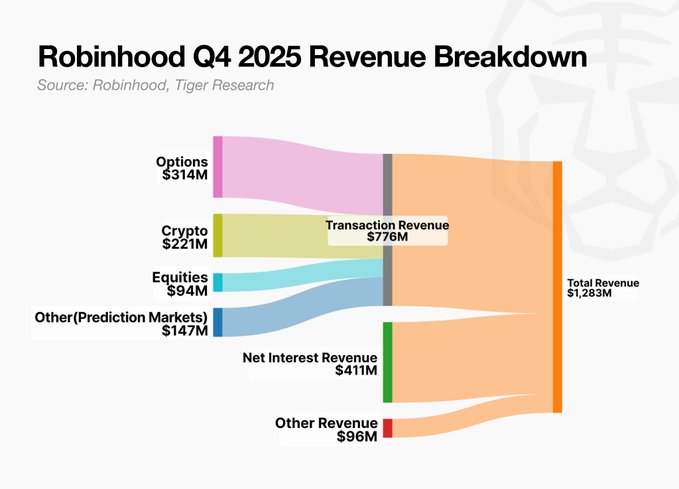
This model has been empirically validated. After expanding its crypto business, crypto trading revenue became Robinhood’s largest single revenue stream in Q4 2024. Although crypto revenue declined 38% year-on-year in Q4 2025, total revenue remained stable—options, equities, and prediction markets collectively filled the gap. A resilient, diversified revenue structure has thus taken shape.
Polymarket and Kalshi, meanwhile, are approaching the same destination from the opposite direction. They originated in prediction markets and are now adding futures trading. Their starting points differ—but their end goals align. With the Robinhood Model proven, traditional finance is likely evaluating the same path.
A Simple Analogy
Smartphones consolidated cameras, MP3 players, and navigation systems into a single device—ending the era of carrying separate gadgets for each function. Finance is undergoing the same transformation.
Brokerage accounts, crypto exchanges, and prediction markets are converging into a single platform. Robinhood began as a stock-trading app and progressively added crypto and prediction markets; Polymarket began in prediction markets and is now adding crypto perpetual contracts. Different origins—but identical trajectories.
Generalizing the Robinhood Model
As generational shifts accelerate, this trend will intensify further. A new generation of users grew up interacting with stocks, cryptocurrencies, and prediction markets simultaneously. Just as smartphone users reject the idea of carrying separate devices for cameras, music, and maps, this generation finds it alien to use distinct apps for each asset class from the outset. Demand for integrated platforms—capable of handling all asset types within a familiar interface—will naturally rise with each successive cohort.
This is the generalization of the Robinhood Model.
Polymarket and Kalshi hold a distinct advantage in this model. Because prediction-market collateral remains locked until outcomes are resolved, efficiently utilizing these idle assets will become a key differentiator.
On December 3, 2025, a developer proposed PolyAave—a concept to deposit Polymarket outcome tokens into Aave liquidity pools to earn interest. This was an early attempt to generate DeFi yield from prediction-market collateral. Polymarket’s introduction of perpetual futures likely extends this logic. It makes strategic sense to avoid letting locked capital sit idle.
While Polymarket and Kalshi are acting first, traditional finance faces similar pressures. As the regulatory environment gradually opens, major financial institutions will directly support spot crypto trading and progressively integrate new asset classes—including prediction markets.
Join TechFlow official community to stay tuned
Telegram:https://t.me/TechFlowDaily
X (Twitter):https://x.com/TechFlowPost
X (Twitter) EN:https://x.com/BlockFlow_News
 @tiger_research