OpenClaw Gold Rush: Who’s Getting Rich?
TechFlow Selected TechFlow Selected
OpenClaw Gold Rush: Who’s Getting Rich?
A complete industrial chain is progressively monetizing this collective anxiety, layer by layer.
 Navigating Web3 tides with focused insights
By: Black Shrimp Cage, TechFlow
OpenClaw has gone viral across China—how many people around you are anxious, and how many are already counting their money?
Some professionals are traveling nationwide—to Shenzhen, Chengdu, Hangzhou—specifically to configure this “lobster” for small business owners, charging over ten thousand RMB per order.
Others preinstall OpenClaw onto Apple devices and ship them directly to clients—plug-and-play, with cumulative earnings reaching $1.8 million.
Once-struggling cryptocurrency mining hardware manufacturers have pivoted overnight to selling OpenClaw hardware.
Token API resellers—middlemen operating quietly—are raking in over one million RMB monthly.
This is the unvarnished reality of the OpenClaw wave: On stage, millions tinker with deployments, buy hardware, enroll in courses; behind the scenes, an entire industrial chain is monetizing collective anxiety layer by layer.
From hardware and cloud servers to tokens and skills—the open-source code is free; anxiety is the real product.
Turning OpenClaw into Hardware
A photo circulating online left many viewers both laughing and baffled.

In the 1990s, qigong masters drew circles on aluminum pots in front of crowds, claiming to connect them to cosmic energy; in 2026, people wear lobster hats in conference rooms, undergoing ideological “re-education”—as if failing to raise a lobster means falling behind the times.
After the laughter fades, pay attention to the speaker on stage: Kong Jianping, a crypto OG and founder of iPollo.
Well-known KOL “Crypto Fearless” commented on social media: “In the crypto world, whoever consistently stands at the absolute epicenter of hype is always Boss Kong Jianping… He never misses big money—and never skimps on small money.”
When Bitcoin mining boomed, he launched Nano Labs, a mining hardware company. When the metaverse surged, he announced a strategic pivot from mining hardware to metaverse infrastructure, declaring it would usher humanity into a new era. As Hong Kong’s regulatory framework gained prominence, he established operations there and joined the board of directors at Cyberport. When DAT (Decentralized Autonomous Token) gained traction, he founded a DAT-focused company…
Now that OpenClaw has taken off, Kong Jianping is hosting offline events across Chinese cities, proclaiming humanity’s entry into the “Web 4.0” era—dominated by AI agents—and launching the iPollo Claw PC: “Engineered exclusively for OpenClaw applications.” It features an AMD 5600H processor, up to 64GB RAM, and ships preinstalled with ClawOS—the official native OS. Priced at $439 on its website.

Kong Jianping is no outlier—he’s simply the most visible name in this burgeoning hardware supply chain.
In Dongguan, a hardware manufacturer floods its sales team’s WeChat Moments with lobster logos: “OpenClaw Lobster Hardware Solutions—OEM & ODM supported. B2B and enterprise customers: call now!”

A typical white-label factory—anyone wanting to enter the market need only make one phone call to launch a rebranded “AI desktop optimized for OpenClaw.”
Like this Dongguan firm, many upstream players in this hardware chain were previously Filecoin or other crypto-mining hardware manufacturers. They know this playbook inside out: concept explosion → hardware demand surge → branding markup → limited-time harvesting window.
The supply-chain responsiveness honed during the mining era translates seamlessly to new domains.
The core logic of this business isn’t mysterious at all: The Mac Mini is the most widely recommended local hardware for running OpenClaw—but for most ordinary users, a $3,000+ Mac Mini plus command-line configuration (with no GUI) presents too steep a barrier. Demand emerges—and someone steps in to sell a “barrier-lowering” service—or better yet, a ready-to-run machine—monetizing that friction.
The deeper the anxiety, the higher the premium.
Token Reselling Is Big Business
OpenClaw itself is free—but running it requires continuous feeding of large language model (LLM) tokens.
Domestic LLM companies like MINIMAX and KIMI are among the biggest beneficiaries. Yet many still prefer overseas models—Claude, ChatGPT—for complex tasks.
The trouble? Account registration and payment are difficult—and Claude frequently bans Chinese-language users. Official APIs are expensive: A heavy OpenClaw user fully leveraging Claude could easily exceed $800/month.
This has spawned a massive token-reselling ecosystem.
You can readily purchase “50%–70% discounted Claude APIs”—but their origins remain shrouded in mystery.
On the surface, this appears to be a simple arbitrage play: acquire low-cost APIs, mark them up, and pocket the spread. But the waters run far deeper.
At the foundation, some actors use stolen credit cards to mass-register OpenAI and Anthropic accounts. Once acquired, the most common tactic is reverse-engineering ChatGPT’s and Claude’s web interfaces, repackaging them as standardized APIs for resale.
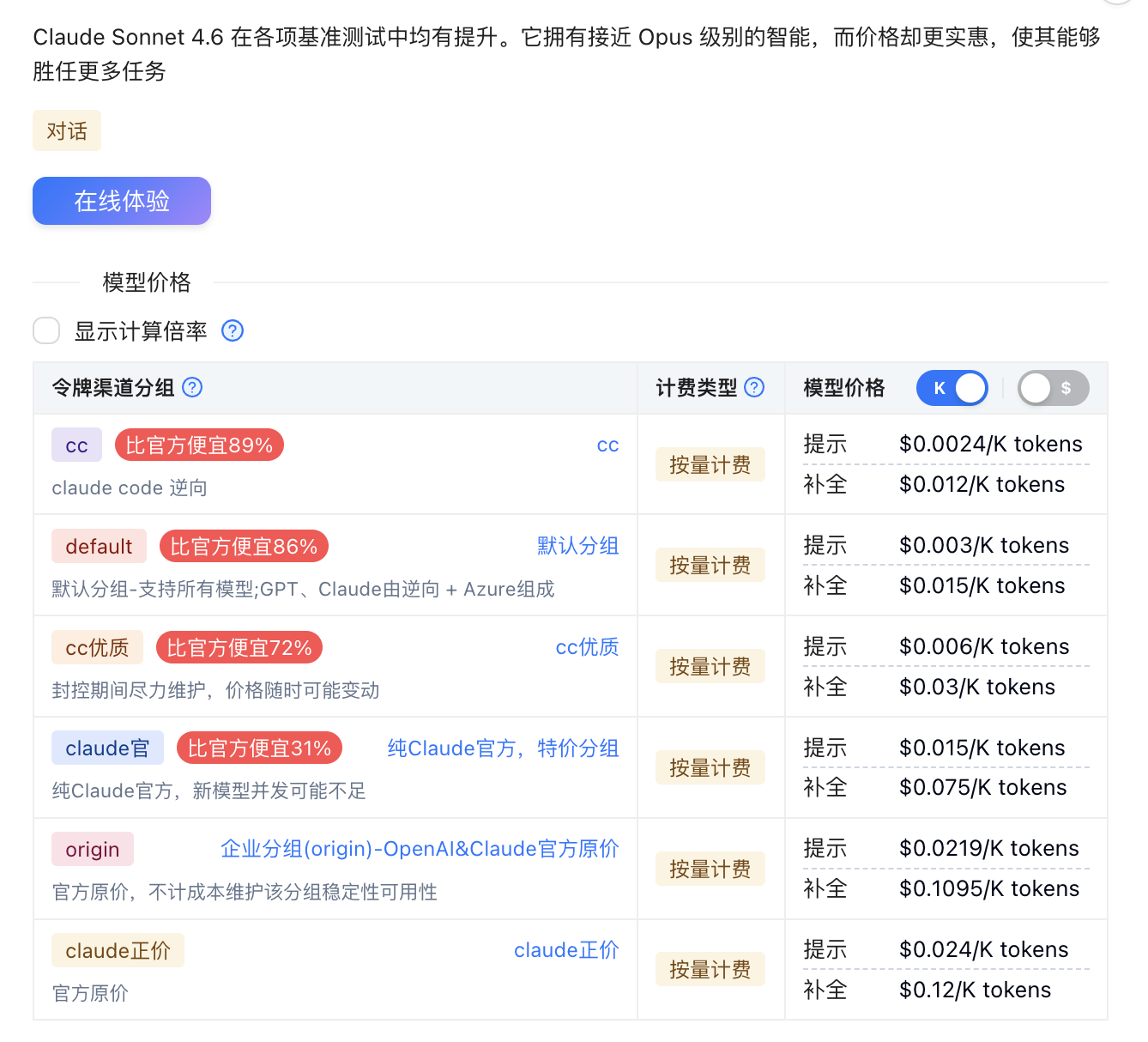
One API reseller’s pricing page shows its reverse-engineered Claude Code API priced 89% below official rates: $0.024 per K tokens officially versus just $0.0024 per K tokens on their platform.
Even more lucrative is outright fraud.
In early March, CISPA (the Helmholtz Center for Information Security) released a report titled Real Money, Fake Models: Deceptive Model Claims in Shadow APIs.

They found that nearly half of third-party API endpoints engage in bait-and-switch tactics.
You pay for API access, thrilled to believe you’re invoking GPT-5—only for the vendor to silently route your request to a low-cost domestic model, or even a free, locally run open-source model (e.g., GLM-4-9B).
Of the 17 top independent shadow API providers audited by CISPA, 15 were operated solely by individuals—and over 88.2% lacked even basic ICP (Internet Content Provider) registration.

A practitioner in the API reselling space told TechFlow that top-tier resellers now achieve monthly profits exceeding one million RMB—demand remains extremely strong.
But these are merely cost-side narratives. Yan, formerly of Manus, publicly revealed a deeper logic: For many token resellers, selling APIs isn’t the primary goal—it’s about harvesting high-quality distilled training data from specific use cases.
“Every request routed through a reseller—including full prompt + response—is ready-made distillation data. Especially in OpenClaw’s programming context, users generate complex reasoning chains and real-world engineering decisions—the exact kind of training material model vendors dream of. So the true business model of certain resellers may well be: Charging you for API routing is just the front; packaging and selling your request data to major AI firms for model distillation is where the real profit lies. You’re a paying customer—and simultaneously an unpaid data producer. One fish, two meals.”
Above this entire chain sits another, seemingly cleaner layer: Token aggregation and routing services. These platforms connect you to APIs from a dozen different models, automatically routing requests based on task complexity—cheap domestic models for simple jobs, Claude or GPT only for demanding ones—claiming to cut API costs by 65%–80%. The service itself holds real value. And those who control this traffic gateway accumulate authentic user behavior maps earlier—and more granularly—than any individual model provider.
Data is, and always will be, the real asset.
Information Arbitrage: The Oldest Business of All
If the first two lobster goldmines rely on hardware and data, the third depends on something far more fundamental: You know—and others don’t.
Li Huan’s recent business involves nonstop travel across China. Laptop in hand, he flies to Shenzhen, Chengdu, Hangzhou—installing OpenClaw for small business owners, integrating Feishu and DingTalk, fine-tuning automated workflows and custom Skills. Each job nets several thousand to over ten thousand RMB—out-earning many software engineers’ monthly salaries.
Here’s a counterintuitive twist: Li Huan isn’t a programmer—he studied liberal arts. He candidly admits he doesn’t sell technology; he sells information asymmetry—converting a trending concept directly into a plug-and-play product for business owners, while delivering emotional reassurance to soothe their anxiety.
Taking this logic to its extreme is an American named Adam Sand.
Adam isn’t an engineer either. He and his wife Allison run a consulting firm serving the roofing industry. After OpenClaw blew up, he did something technically trivial—yet commercially potent: Preinstalled OpenClaw onto MacBooks, bundled with roofing-specific Skills packages, HubSpot CRM integration, work-order systems, and hardened security configurations—then shipped them directly to clients. Plug in the power cord, and your AI employee starts work immediately. Add one-on-one training and weekly ongoing support—and price it at $5,000 per unit.
This project, RoofClaw, has generated over $1.8 million in total revenue and delivered solutions to more than 360 roofing contractors.
Many people’s first reaction: “Isn’t this just loading a free open-source project onto hardware—and charging $5,000?”
Yes. But Adam isn’t selling software—or hardware. He’s selling certainty: the guarantee that a roofing contractor—zero technical knowledge required—can deploy an AI employee tomorrow. Most buyers pay that $5,000 without hesitation, because Adam understands their pain points better than anyone—he’s spent over a decade embedded in this industry.
This is the essence of information arbitrage: truly understanding your customer’s needs.
Back in China, this business has evolved into an entirely different spectacle.
On Taobao, multiple installation service stores have surpassed 1,000 orders—some deploying teams of dozens of engineers, earning RMB 300,000–450,000 last month alone installing OpenClaw. One installer even promises “on-site deployment plus one home-cooked meal—anything from everyday dishes.”
The sector has heated up so much that Meituan and JD.com have entered the fray, partnering with Lenovo IT Services to offer remote deployment. From individual freelancers to internet giants, every tier is profiting—proof that the demand is both genuine and substantial.

Selling Skills is the flip side of this logic.
ClawHub—the OpenClaw plugin ecosystem—already hosts over 5,700 community-contributed Skills. Some sell ready-made Skills bundles; others sell SOUL.md role templates (e.g., “AI CEO,” “Marketing Director,” “Legal Reviewer”) priced from $19 to $99; some offer custom development; others peddle “Complete OpenClaw Practical Tutorials.”
The higher the technical barrier, the more people willingly pay to lower it—a rule that has held true across every tech cycle.
Shovel-Sellers Never Panic
On a startup aggregation platform verified by Stripe for official revenue, 126 startups built around OpenClaw are now tracked—with real-time rankings based on verifiable income over the past 30 days.
The data is stark: Of the top 30 highest-earning projects, over 17 offer the same service—one-click cloud hosting.
Claw Mart earned $54,000 in the past 30 days; Donely’s lifetime revenue stands at $747,000; RoofClaw’s exceeds $1.8 million.
Yet the flip side tells another story: The half-life of information arbitrage is measured in weeks—not months.
The first wave of shovel-sellers has already begun exiting. QuickClaw—a project touting “30-second OpenClaw deployment on mobile”—surged massively during one week of traffic, then listed itself for sale at $300,000.
This is the true rhythm of the wave: Technology concept explodes → information gap opens → first-movers rush in →红利 rapidly dissipates → shovel-sellers sell their shovels and walk away.
Kong Jianping has internalized this rhythm. He rode Bitcoin mining hardware into the OpenClaw hardware era—spanning an entire crypto generation. Every time he hits the crest, it’s not because he foresaw the tech sooner—but because he understood human nature better: That primal fear of being left behind—and exactly how much people will pay to silence it.
The comparison image of the qigong craze makes us laugh—yet structurally, the two eras are identical: Aluminum pots and lobster hats are both rituals, both visualizations of anxiety, both symbols signaling “I’m already on the right side.”
The sole difference? The 2026 lobster hat connects to a real, sophisticated, human-centric monetization chain.
In California’s 1849 Gold Rush, the miners didn’t get rich—the one who sold Levi Strauss jeans did.
This story has been retold for 175 years—and each time a new tech wave arrives, it’s told again.
Because every time, it’s true.
Shovel-sellers don’t bet on whether the technology wins or loses—they bet on the stability of human nature.
That’s why they never panic.
Join TechFlow official community to stay tuned
Telegram:https://t.me/TechFlowDaily
X (Twitter):https://x.com/TechFlowPost
X (Twitter) EN:https://x.com/BlockFlow_News
 深潮TechFlow