The Battle of Platform Tokens Among the Top Five Exchanges: Who Is the Dark Horse This Round?
TechFlow Selected TechFlow Selected
The Battle of Platform Tokens Among the Top Five Exchanges: Who Is the Dark Horse This Round?
Why have exchanges recently been making moves on their platform tokens?
 Navigating Web3 tides with focused insights
Author: Yue Xiaoyu
Recently, major exchanges have been making frequent moves—first OKX's strong surge in $OKB, followed by Bitget designating $BGB as the native token of the Morph public chain.
Why are exchanges suddenly focusing on their platform tokens?
On one hand, it's due to loosened regulations from U.S. authorities, prompting players to seize this window of opportunity to enhance platform token utility and lay groundwork for the future.
On the other hand, it reflects the growing convergence between crypto and traditional finance. Exchange platform tokens are among the few truly valuable assets in the crypto space backed by real business operations, leading the market to reprice their value.
Let’s take a closer look at the top five key players in this exchange platform token battle to gain a comprehensive understanding of the overall landscape.
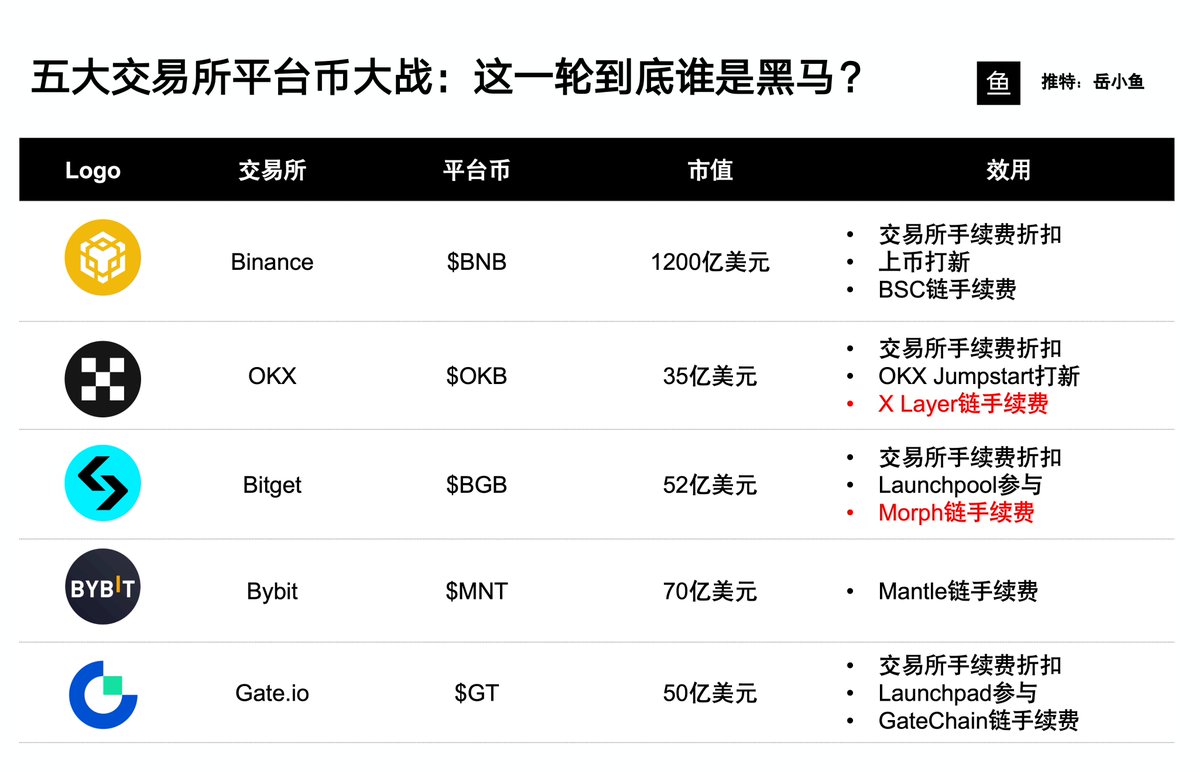
Binance's $BNB
Binance began enhancing BNB early on, and BNB has the broadest range of use cases across all exchanges.
From participating in new token launches via Launchpad/Launchpool, to Alpha offerings in the wallet, to paying gas fees on the BSC chain, BNB serves as a critical vessel for value accumulation and circulation across multiple Binance ecosystem businesses.
This is precisely why BNB has long surpassed a billion-dollar market cap, ranking among the top three cryptocurrencies by market capitalization in the entire blockchain industry.
Binance will continue advancing into the forefront of on-chain innovation and asset issuance, with BNB serving as a crucial vanguard and value-connecting tool.
OKX's $OKB
OKX’s exchange and wallet operations should be evaluated separately.
Exchange operations remain its foundation, but it has consistently been overshadowed by Binance. It hasn’t managed to break through and has faced criticism over its listing strategy.
However, OKX took an alternative path by entering the on-chain space early. Its Web3 wallet is far ahead of competitors and has captured a major entry point into the Web3 world.
The downside, however, is that OKX has lacked a robust public chain ecosystem, falling far behind BSC.
This gap has limited $OKB’s utility compared to $BNB, reducing its wealth effect.
Recognizing this issue, OKX has recently pushed $OKB aggressively, using price momentum to stimulate the X Layer public chain ecosystem.
As a result, numerous projects on the X Layer ecosystem have gained traction amid the rising attention.
In the long term, $OKB remains strategically vital for OKX and won't be abandoned easily—there is still significant potential.
Bitget's $BGB
Bitget has been integrating its ecosystem—first merging the Bitget Wallet token $BWB into $BGB, and now designating $BGB as the native token of the Morph public chain.
Bitget shares similarities with OKX: it has a strong wallet offering, having leapfrogged competitors through the acquisition of Bitkeep; however, it previously lagged in public chain development.
Although Bitget initially supported the Morph chain within its ecosystem, ongoing issues persisted. Now, it has stepped in directly, using $BGB to connect its exchange, wallet, and public chain operations.
Overall, Bitget remains a powerful exchange. $BGB has already experienced a sharp rally recently, and the platform continues to announce positive developments, making it a strong contender in the exchange platform token race.
Bybit's $MNT
Bybit does not officially have a platform token. $MNT is the native token of Mantle Network, a public chain supported by Bybit.
However, Bybit has deep ties with Mantle:
In 2021, riding the DAO wave, Bybit established its own DAO called BitDAO, aimed at building a crypto treasury, into which Bybit injected hundreds of millions of dollars.
BitDAO’s native token was BIT, and Bybit held a large amount of BIT.
Why launch a DAO?
Mainly for compliance reasons—to involve the community through a decentralized structure and avoid potential legal issues associated with centralized platform tokens.
But while solving compliance concerns, this approach created new problems: Bybit couldn't directly integrate or empower its services through the BIT token, losing a competitive edge against other exchanges.
Hence, in 2023, BitDAO transformed into Mantle Network, converting BIT tokens to MNT at a 1:1 ratio.
Today, the Mantle chain is relatively quiet, and the MNT token price has been disappointing.
In summary, among top-tier exchanges, Bybit currently has the weakest platform token presence. However, future moves are possible, making it a potential value opportunity.
Gate's $GT
First, is Gate even among the top five exchanges?
This is debatable—everyone claims to be in the top five, though there are practically ten.
Nevertheless, Gate has shown strong performance this cycle, maintaining high visibility in the community and ranking among the top five in derivatives trading volume.
Compared to OKX and Bitget, Gate’s on-chain initiatives aren’t as prominent, but its capabilities are solid: it operates its own public chain, GateChain, and Gate Wallet continues to grow steadily.
Summary
In terms of platform token utility, leading exchanges share the same direction: integrating multiple business lines, enhancing platform token utility, and implementing mechanisms like token burns to create artificial scarcity—driving up prices and further activating their public chain ecosystems.
Aside from Binance, the public chain ecosystems of other major exchanges are underdeveloped—but all are pushing forward:
OKX leads the pack, actively empowering X Layer;
Bitget follows, undergoing leadership changes and integrating Morph;
Bybit comes next—despite having Mantle, progress has been lukewarm;
Gate trails behind, with no standout achievements in public chain or wallet services.
In terms of market capitalization, Binance’s BNB is the only one exceeding a billion-dollar valuation. Other exchange platform tokens hover around the $5 billion mark, indicating substantial room for growth.
Which one will become the next billion-dollar platform token in this cycle?
Join TechFlow official community to stay tuned
Telegram:https://t.me/TechFlowDaily
X (Twitter):https://x.com/TechFlowPost
X (Twitter) EN:https://x.com/BlockFlow_News