Internet giants set their sights on cryptocurrency exchanges
TechFlow Selected TechFlow Selected
Internet giants set their sights on cryptocurrency exchanges
and sparked a war without smoke.
 Navigating Web3 tides with focused insights
By Leek, Foresight News
On August 25, Web X, one of Asia's largest crypto summits, was held at the Prince Park Tower Tokyo in Japan, marking the biggest domestic crypto event in the country. Japanese Prime Minister Shigeru Ishiba, who had recently taken office, attended the conference and emphasized Japan's desire for cryptocurrency to help transform its society.

Over 10,000 attendees participated, mostly Japanese nationals. Among the small number of foreigners present, an unnoticed group appeared at the venue—employees from major Chinese internet companies.
Cryptocurrency emerged in 2009 at the peak of the PC internet era, when Tencent and Alibaba were still experiencing explosive growth in their core businesses. This new financial paradigm did not attract attention from then-dominant unicorns. As cryptocurrency trading and mining were repeatedly banned by Chinese regulators, such a high-uncertainty, risky venture naturally drew little interest from internet giants, with very few allocating resources to compete in this space.
But in the summer of 2025, these tech giants turned their eyes overseas toward cryptocurrency, sparking a war without gunfire.
A senior executive from one of China’s top three internet firms told Foresight News in Tokyo that their purpose at this crypto summit was to find high-quality clients—large cryptocurrency exchanges—and sell them the company’s proprietary cloud services and large AI models.
It is not new for internet cloud giants to absorb crypto clients. As early as 2022, a PingWest article revealed this hidden business: AWS China’s real revenue backbone came from the crypto industry. According to sources cited by PingWest, 70% of AWS China’s income originated overseas, with 50% of that coming from crypto. In other words, crypto companies contributed over one-third of AWS China’s total revenue.
Such substantial revenue is hard for local Chinese cloud service giants to ignore. On April 30, 2025, IDC released its “China Public Cloud Services Market (2H 2024)” report, showing that China’s public cloud IaaS market reached RMB 94.82 billion in the second half of 2024, up 13.8% year-on-year. Alibaba Cloud ranked first, with its market share rising for three consecutive quarters. Huawei ranked second, followed by China Telecom, China Mobile, and Tencent.
Foresight News learned that amid increasingly fierce competition in cloud services, non-state-owned cloud giants including Alibaba, Tencent, and even Huawei have established dedicated Web3 sales teams to compete for this lucrative segment. Users can directly browse related products on their front-end pages. Notably, this setup is not unique to Chinese firms—global giants including AWS, Google, and Microsoft also offer similar products through their cloud divisions.
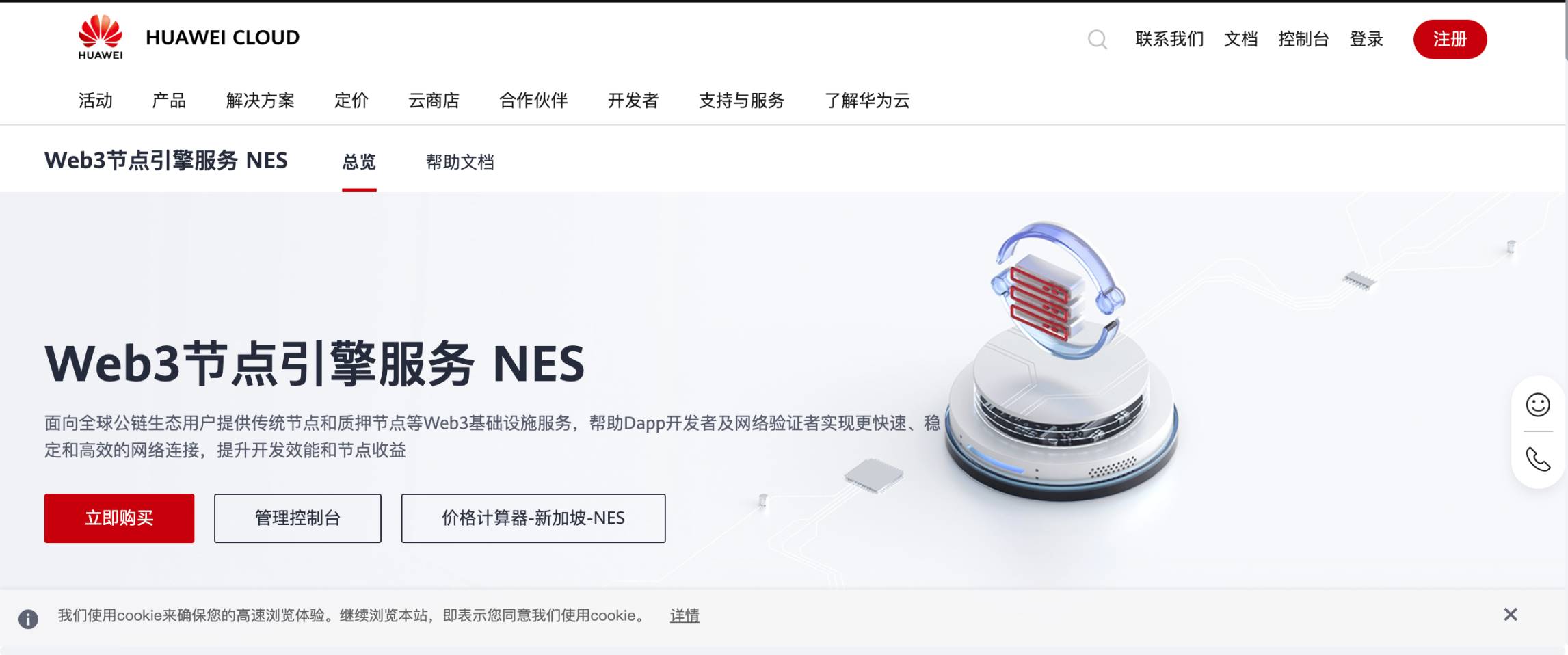
Foresight News also learned that these business units were previously based in Singapore, possibly linked to the exodus of many cryptocurrency exchanges from mainland China to Singapore starting in 2021. However, with Singapore tightening its crypto regulations after June 30, 2025, this trend is no longer sustainable.
Yet demand for cloud services from offshore cryptocurrency exchanges will not decrease, meaning competition for cloud market share will continue.
At Web X in Tokyo, two representatives from domestic social media giants told Foresight News that although they started late, their target is also compliant cryptocurrency exchanges. As latecomers, the game-changer in this competition lies in advancements in AI technology: "We are more than willing to provide our large models to crypto institutions. If there’s demand for cloud services or large models, we warmly welcome it." Other major firms have adopted the same strategy and also mentioned offering access to their large model APIs.
They have thoroughly studied their competitors and directly pointed out that OKX Exchange uses Alibaba Cloud. Previously, a massive outage at Alibaba Cloud disrupted cryptocurrency trading on OKX, indirectly leading to a leadership change at Alibaba Cloud. A representative from one of these tech giants told Foresight News that they have already secured 60% of the cloud service capacity for a mid-sized exchange.
This silent war continues relentlessly, now extending from cloud services into the domain of large AI models. Even though cryptocurrency operations are not recognized domestically, global giants do not want to miss out on this revenue stream fueled by overseas growth.
Among Chinese tech firms, AntChain has taken a relatively forward-looking approach to cryptocurrency. Its representative in Tokyo told Foresight News that the blockchain developed by Ant will launch in September, and they are actively seeking target clients. Like Ant, JD.com, which is attempting to issue a stablecoin in Hong Kong, had its founder Richard Liu reveal during this year’s food delivery battle that JD’s ambition is to apply for stablecoin licenses in dozens of countries globally. Eventually, users will be able to purchase any product using JD’s stablecoin—a payment experience current internet giants cannot offer.
Undoubtedly, these internet giants all want cryptocurrency to become a new piece in their commercial puzzle. Recently, Google announced its own “public chain,” but everyone knows it is merely a heavily restricted consortium chain far from Ethereum. This raises an interesting question: Do these world-leading internet giants truly understand blockchain technology and the spirit of crypto punk?
As for whether Chinese internet giants will deeply enter the Web3 space, an employee from one of these firms told Foresight News: "We will absolutely not enter this field unless domestic regulatory policies loosen—at least not openly."
Join TechFlow official community to stay tuned
Telegram:https://t.me/TechFlowDaily
X (Twitter):https://x.com/TechFlowPost
X (Twitter) EN:https://x.com/BlockFlow_News
 Foresight News