








Interview with Xiao Feng: Behind Hong Kong's Stablecoin Frenzy, Compliance Will Be Key to Industry Development
TechFlow Selected TechFlow Selected
Interview with Xiao Feng: Behind Hong Kong's Stablecoin Frenzy, Compliance Will Be Key to Industry Development
Although Hong Kong stablecoins are gaining popularity, regulators remain extremely cautious about this topic, creating a significant gap.
 Navigating Web3 tides with focused insights
Compiled & Translated: TechFlow
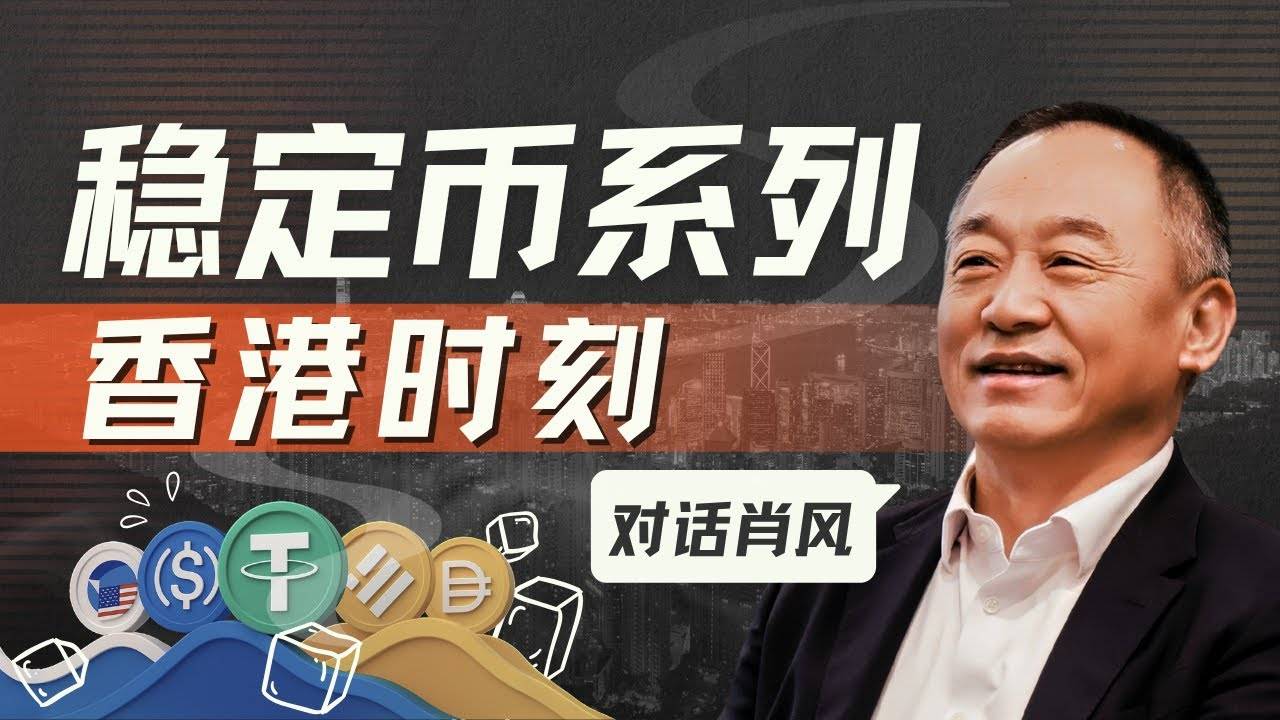
Guest:
Xiao Feng, Chairman and CEO of HashKey Group
Hosts:
Liu Feng, Host of @Web3101cast, Partner at BODL Ventures, Former Editor-in-Chief of ChainNews
Jane Hongjun, Founder of Silicon Valley 101, Podcast Host
Podcast Source: Silicon Valley 101 Podcast
Original Title: E202 | Conversation with Xiao Feng: Amid Hong Kong's Stablecoin Moment, Some Cold Thoughts Returning to Common Sense
Release Date: July 31, 2025
Key Takeaways
At the moment of Hong Kong’s stablecoin licensing, stablecoins and RWA have become extremely hot topics in the Chinese-speaking world. Dr. Xiao Feng, Chairman and CEO of HashKey Group, known as the "father of blockchain in China," shares his cold, common-sense reflections on this wave of enthusiasm.
Highlights of Key Insights
-
Hong Kong’s regulation of stablecoins is unexpectedly strict.
-
Stablecoins were not originally created for payments.
-
Mainland China will begin accepting crypto through stablecoins. Mainland discussions focus on great-power currency competition; Hong Kong is more concerned about anti-money laundering (AML) loopholes.
-
Crypto performs better than traditional finance in AML.
-
Consortium blockchains don’t work—stablecoins on consortium chains won't succeed.
-
Most successful applications emerge under permissionless conditions.
-
Hong Kong has the potential to become a global hub for digital asset trading once again.
-
Singapore positions itself as Asia's Switzerland, while Hong Kong aims to be Asia's Wall Street.
-
Next year will be a period of rapid growth for traditional financial markets embracing crypto.
-
The underlying protocols of blockchain are decentralized, but the application layer must inevitably be centralized.
-
Despite the hype around Hong Kong stablecoins, regulators remain highly cautious—a significant gap exists.
-
In Beijing, two points of consensus are gradually forming. First, facing the U.S. wave of legislation and compliance regarding crypto, stablecoins, and blockchain globally, China cannot continue to ignore it. Second, how should China respond? As one Beijing insider put it: “Will we fight the Huaihai Campaign?” The decision has been made—it must be fought. But how? Small-scale or large-scale? Which unit to eliminate first? That's what’s being discussed now. I sense that the mainland will start accepting these technologies here because if China continues to ignore them, it risks falling behind in national currency competition.
-
This time next year, we might already be discussing RWA, with the mainland beginning to accept asset tokenization. After RWA, the third step could be accepting Bitcoin.
-
If you start accepting stablecoins, you must inevitably accept public blockchains—otherwise your stablecoin will lack global competitiveness, rendering issuance meaningless.
-
RWA has three stages: easiest is fiat currency tokenization; second is financial assets; last is physical asset tokenization.
-
Currently, the market interprets stablecoins purely from a monetary perspective, lacking deeper thinking about fundamental structural changes.
-
No tokens can exist without technology, accounting methods, and financial infrastructure.
-
The core focus of Hong Kong’s stablecoin legislation for licensed issuers is AML-related requirements.
-
Stablecoins will eventually serve as a unit of value in virtual and digital worlds and become the medium of exchange for all virtual and crypto assets.
-
Exchanges strive to build strong liquidity for every trading pair. Building any liquidity pool incurs costs that must be amortized.
-
Two reasons explain why Hong Kong is becoming a favorite in capital markets again. First, the emergence of DeepSeek. Second, due to Trump-era policies, America’s traditional alliances have weakened, turning everything into business.
Cold Reflections Amid the Stablecoin and RWA Hype
Liu Feng:
Right now, across the Chinese-speaking world—whether in Hong Kong or mainland China—stablecoins have become a trending topic. Could you first briefly explain to our listeners why everyone is so focused on Hong Kong’s stablecoin regulations? Also, if possible, highlight key aspects of Hong Kong’s regulatory framework for crypto and digital assets?
Dr. Xiao Feng:
I personally feel the hype has gone too far. A few days ago, I was having coffee with a friend at a hotel café and realized people at nearby tables were all talking about stablecoins. Recently, we had an exchange with officials from Hong Kong’s Monetary Authority (HKMA) on stablecoins, and they repeatedly warned us that the sector is overheating and that Hong Kong won’t issue many licenses.
Hong Kong’s initial phase of stablecoin issuance will be extremely strict—not only in licensing but also in regulation, especially concerning the use of stablecoins in crypto for AML purposes. August 1st marks only the effective date of Hong Kong’s stablecoin bill, not the day when applications for stablecoin licenses can begin. Although rumors suggest dozens or even hundreds of companies are applying, I believe very few applications will actually be accepted by the HKMA. Authorities are paying close attention to each applicant’s background, particularly their experience and capabilities in financial risk control and AML.
Hong Kong, with decades of experience as an international financial center, makes its regulators—whether SFC or HKMA—highly sensitive to global financial trends, a stark contrast to the mainland. Mainland perspectives on stablecoins, especially offshore RMB stablecoins, tend to emphasize currency dynamics, great-power currency competition, and dollar hegemony. But Hong Kong is different. Initially, I assumed that if so many institutions, people, and capital from the mainland were eager to come to Hong Kong—to build, issue, or use stablecoins—it would greatly benefit Hong Kong as an international financial hub. Yet my impression from Hong Kong regulators is that their primary concern—or core focus—is whether stablecoin issuance, by moving outside the banking system, could lead to regulatory gaps. In fact, current financial regulators lack tools to monitor stablecoins after minting.
Thus, Hong Kong’s main concern lies precisely in potential AML loopholes. As an international financial center, if Hong Kong faces criticism from other major global financial centers over AML issues, its reputation would suffer significantly. Conversely, this creates a huge disconnect: even though there's excitement in Hong Kong, regulators remain highly cautious—an enormous gap between sentiment and policy.
Looking Back: Being Cold-Shouldered by Hong Kong Regulators
Liu Feng:
You’ve long advocated and pushed for transparent, standardized legislation on digital assets in Hong Kong. Can you share your thoughts on how today’s perception—that Hong Kong, as a global financial center, is fully embracing digital assets and crypto—coexists with deep concerns and caution? How do you view this contradiction, and the shift from past criticism and rejection to what seems like open arms now?
Dr. Xiao Feng:
I can share a personal story that perfectly illustrates your point. HashKey was established in Hong Kong at the end of 2018. We moved operations there in 2018 because stricter regulations in mainland China in 2017 forced us out, and Hong Kong remained legally compliant. In early 2019, I visited the Hong Kong Securities and Futures Commission (SFC) to apply for a crypto exchange license. The official told me, “Mr. Xiao, operating a virtual currency exchange in Hong Kong doesn’t require a license and isn’t illegal—you can just turn left after leaving and set one up.”
I heard the same thing in 2022 when I met with senior officials from Hong Kong’s Financial Services and the Treasury Bureau. I said we wanted to apply for a stablecoin license. The deputy director replied, “Mr. Xiao, issuing stablecoins in Hong Kong isn’t illegal, and we have no authority to regulate you.” I explained that we’d already invested in a stablecoin company in Hong Kong but couldn’t proceed because no bank dared offer us services related to stablecoins—our customers couldn’t deposit or withdraw fiat normally.
Why did both officials say the same thing? Because Hong Kong follows the Anglo-American legal system, where the first principle of common law is “everything is permitted unless prohibited by law.” So in 2019, with no crypto laws in Hong Kong, you could do anything—including setting up an exchange—with no legal ban. At the same time, both agencies said they had no power to issue licenses or regulate you, based on the second principle of common law: “nothing may be done without legal authorization.” If you opened an exchange on the street, they had no authority to shut it down.
I joked, “So does that mean no one oversees me in Hong Kong?” He replied, “Not exactly—police commercial crime units still oversee you. Even if your product isn’t securities, it’s at least a commodity, so consumer protection applies.”
Indeed, industry players often say Hong Kong’s compliance costs are high and unprofitable. Compliance does cost money, but those costs are justified. After all, we’re in a new financial industry—fintech-driven finance with strong externalities. Over centuries, rules protecting investors and consumers have accumulated, inevitably adding operational costs.
If our industry refuses to bear these costs, it may never mature. If you envision a $10 trillion, $100 trillion, or even $1 million billion market, spillover effects will demand constraints you must accept.
New Hope: “Mainland Will Accept Crypto Starting with Stablecoins”
Dr. Xiao Feng:
Up until now, since mainland China began restricting, regulating, or even banning certain crypto-related activities in 2017, I’ve always wondered: When and where will the mainland start reaccepting these technologies? For years, I had no answer. But recently, within the past month and a half, I think I’ve found it—because of the impact of Hong Kong’s and America’s stablecoin bills.
Most mainland discussions started after Hong Kong passed its stablecoin ordinance on May 21st, followed closely by the U.S. advancing similar legislation, sparking extensive debate in Beijing. During these discussions, it suddenly dawned on me: the mainland will begin accepting crypto by first accepting stablecoins.
Over the past six weeks, I’ve participated in numerous internal discussions. While differing views persist in Beijing as of Sunday, two points of consensus are emerging. The first is that, facing the U.S.-led global wave of legislation and compliance around crypto, stablecoins, and blockchain, China cannot afford to ignore it or fail to respond. The second is how to respond. In Beijing’s words: “Will we fight the Huaihai Campaign?” That question is settled—it must be fought. But how? With small skirmishes or full-scale war? Which army to defeat first? That’s what’s being debated now. Sitting there, I sensed that acceptance will begin here because if China keeps ignoring these innovations, it risks falling behind in national currency competition. I believe China’s leadership recognizes this, which explains former central bank governor Zhou Xiaochuan’s recent speech at the Lujiazui Forum, warning of the impact of dollar-based stablecoins on dollar dominance in the global monetary system.
This clearly reflects a national currency competition lens on dollar stablecoins—China clearly cannot stay passive. Personally, I predict, as the saying goes, “If there’s a first day, there’ll be a fifteenth.” Once you start accepting stablecoins, you must inevitably accept public blockchains—otherwise your stablecoin lacks global competitiveness, making issuance pointless.
After accepting RWA, what comes next? I believe this time next year, we’ll be discussing RWA, and the mainland may begin accepting asset tokenization. After all, RWA shares a key trait with stablecoins: supporting the real economy. Things that support the real economy are easier for mainland officials, regulators, and governments to accept. Once you accept RWA next year, you’ll inevitably face the third step—possibly accepting Bitcoin.
Challenges to China Embracing Digital Assets: Rise in Scams
Liu Feng:
You’ve painted a vision of how, possibly in the future, China might truly embrace blockchain and digital assets. It sounds like starting with stablecoins—not because of technological appeal, but due to great-power currency competition forcing acceptance of this seemingly non-crypto product. Then slowly embracing RWA, using blockchain for tokenizing assets that support the real economy. Eventually, broader adoption of blockchain-centric technologies, products, business models, and financial innovations may follow.
I wonder, what challenges do you foresee along this path—challenges that might undermine this optimistic outlook?
Dr. Xiao Feng:
I see two main challenges.
First, bodies like the EU, the U.S., developed economies, international AML organizations, and the Bank for International Settlements’ Financial Stability Board have expressed concerns to Hong Kong about its aggressive promotion of stablecoins—especially RMB stablecoins. Stablecoins could facilitate trade between China and sanctioned countries like Russia, Iran, and Venezuela—for example, oil trade.
Previously, using fiat channels was more cumbersome and monitorable. But if stablecoins operate outside banks and SWIFT, they completely decouple from the Western-established financial rulebook. This pressure is already visible, and I believe it will keep growing. Still, there’s clear demand for issuing offshore RMB and stablecoins.
Second, troubling signs are already emerging. Recently, as stablecoin fever spread from Hong Kong to Beijing—and sometimes hotter in Beijing than Hong Kong—it’s triggered a rise in fraud and scams. Actually, the trend of using stablecoins for pyramid schemes and fraud is no longer isolated to one province but spreading across many developed regions. We’re seeing warnings from financial regulators in various provinces. This is a worrying trend. I often remind myself: let’s not pour oil on the fire. We vividly remember the prolonged rectification of internet finance. We must avoid sliding back into that era, or it will severely delay mainland acceptance of stablecoins or RWA. The current trend is indeed severe—this adds pressure on the mainland because if regulators haven’t seen benefits yet, but first encounter rampant fraud, they’ll naturally slow down.
Reunderstanding RWA (Real-World Assets): Three Stages—Fiat Tokenization, Financial Asset Tokenization, Physical Asset Tokenization
Liu Feng:
Regarding innovative developments like RWA driven by new blockchain technologies, you mentioned risks of fraud. Could you share your views on what correct, promising, and genuinely valuable applications of blockchain for RWA look like?
Dr. Xiao Feng:
I refer to RWA as asset tokenization, which I divide into three stages. The first stage began around 2014—USDT representing tokenized fiat currencies. The second stage started in 2024, marked by U.S. firms like BlackRock, Fidelity, and Franklin Templeton tokenizing their dollar bond funds and money market funds.
But most market interest focuses on physical asset tokenization. I believe a core unresolved issue remains: oracles. How can you ensure a perfect, persistent link between a real-world physical asset and its digital twin on-chain—guaranteeing the off-chain asset’s existence?
Currently, no solid technical solution exists. DePIN is one attempt, but it’s been a premature concept for 20 years without finding an independent business model. DePIN may eventually solve physical asset tokenization, but the tech isn’t mature yet. Thus, physical asset tokenization still has a long way to go. For widespread adoption, the oracle problem must be solved first.
These three stages flow like water—from easy to hard. The easiest is tokenizing fiat currencies like the dollar, euro, or RMB, whose trust backing is straightforward and widely accepted.
Second, from a trust-backing standpoint, financial assets are easier to tokenize. Their issuers and custodians are licensed financial institutions under strict regulation, making digitization and tokenization smoother.
Physical asset tokenization is extremely difficult. I don’t believe we’ve found good solutions yet—it simply needs more time.
Therefore, I recommend that anyone interested in RWA first convert physical assets into financial products, then tokenize those. For example, gold: if a miner tells me he produces 8 tons annually, I wouldn’t believe him. But if that gold meets financial standards—specific purity and form required to serve as collateral or anchor for currency—then it’s credible.
Once processed, a licensed financial institution issues a gold fund or ETF. Reputable banks inspect and store the gold in vaults, serving as custodians. Upon confirmation from the custodian bank that standard-compliant gold has been received, a corresponding token is minted for on-chain circulation. This is likely the best current solution.
Liu Feng:
This makes delivering and understanding token issuance much easier. Your point suggests that although RWA refers to real-world assets, not all such assets can be simply mapped onto the blockchain. Instead, they need a rigorous upfront process: first, verifiable and auditable; second, as structured as possible. Only then will they circulate easily in transactions, enabling efficient deal-making—the essence of effective RWA implementation.
But I feel that RWA isn’t really creating new assets, but rather transforming physical assets into traditional financial records, then onto the blockchain. This sounds more like using blockchain merely as a settlement and transaction mechanism—one leveraging blockchain or crypto’s real-time settlement and consensus—but not fundamentally reinventing finance.
Back to Basics: What Problems Does Blockchain Actually Solve?
Three Evolutions in Human Accounting Methods
Liu Feng:
So the core of RWA isn’t issuing tokens or assets—returning to what you advocated a decade ago: Why do you believe blockchain and its associated crypto digital assets represent true financial innovation?
Could you revisit and explain, for audiences over the past ten or even fifteen years, the foundational reasons we need blockchain?
Dr. Xiao Feng:
Even today, when people discuss stablecoins, they analyze them macroscopically, interpreting stablecoins purely from a monetary angle, lacking understanding of underlying logic or technical foundations. Stablecoins, like all tokens, stem from a new technological foundation—primarily blockchain’s distributed ledger, which represents an evolution in human accounting methods.
Human accounting has evolved three times. The earliest counting method dates back to 3500 BC in Sumer, modern-day Iraq. Archaeologists unearthed a 3500-year-old clay tablet later identified as an accounting record tracking income and expenses. This was primitive single-entry bookkeeping—recording only inflows and outflows, nothing else.
Then around 1300 AD, new accounting methods emerged in northern Italian city-states, particularly Florence and Venice—recording not just income and expenses, but also assets and liabilities. Why did this innovation occur around 1300 AD? It was tied to technological progress—papermaking and, crucially, mathematics. Around 1200 AD, an Italian mathematician wrote a book called *Liber Abaci* (Book of Calculation), which was pivotal. Without mathematical breakthroughs, new accounting methods wouldn’t have emerged.
The third key change was replacing Roman numerals with Arabic numerals during the medieval period. The adoption of Arabic numerals coincided with the Renaissance, when ancient Greek and Roman knowledge preserved in Arabic was translated back. Technological advances enabled new accounting methods—especially Arabic numerals. Meanwhile, increasing economic complexity created new demands. Shakespeare’s *The Merchant of Venice* depicts the intricate maritime trade of that era—requiring partnerships, loans, ship rentals, and taxation—all demanding complex accounting.
These needs gave birth to double-entry bookkeeping, separating cash flows—operating, investing, and financing—each tracked independently. The growing complexity of human economic and commercial activity drove accounting evolution. Over 730 years later, in 2009, Bitcoin’s blockchain mainnet launched, introducing a new accounting method: distributed ledger technology.
Technologically, this relates to asymmetric encryption algorithms from the 1970s, the internet, and distributed databases. Advances in programming languages and smart contracts as computer programs were also critical. On the demand side, society is increasingly virtualized and digitized, with more activity occurring in digital realms. A defining feature of the digital world is crossing time, space, organizations, entities, and jurisdictions.
When such cross-boundary interactions happen, accounting must adapt—you can’t rely solely on Chinese or U.S. accounting standards. Humanity has created a parallel universe—what accounting method applies there? What currency? Which country’s accounting rules or laws? If disputes arise, which legal system governs? These become impractical or prohibitively costly, making the parallel universe unworkable. Hence, a new accounting method—distributed ledgers—emerged. The biggest difference: pre-distributed-ledger accounting relied on private ledgers—individuals recording their own books and asking others to trust them. To ensure authenticity, societies built massive systems to deter and punish fraud.
To enforce these systems, you need lawyers, accountants, police, prosecutors, courts, and even prisons. Otherwise, how can you trust someone’s books? In reality, this entire system is extremely costly. Even with these safeguards, almost no corporate books are 100% truthful.
Distributed Ledgers Restructuring Financial Market Infrastructure
Liu Feng:
This is the foundation of today’s entire credit and financial system. It’s also why early crypto natives—original crypto believers—challenged this system’s core when Bitcoin emerged.
Dr. Xiao Feng:
Yes, that challenge had overly idealistic elements—like anarchism. I believe human society can’t become anarchist; a few may live in utopia, but 99% cannot survive there. Distributed ledgers emerged from the convergence of need and technology, hence their birth in 2009. This ledger implies a complete restructuring of financial market infrastructure atop distributed ledgers.
Financial market infrastructure, classically defined, can be summarized in one sentence: the institutional arrangements governing trading, clearing, and settlement. Whether trading stocks, funds, bonds, or other instruments, the structure is largely the same. Traditional financial market infrastructure relies on central registration, central custody, central counterparty clearing, and central settlement. Without at least three intermediaries, most transactions can’t be completed. For instance, stock trades involving brokers, exchanges, fund settlements, and share clearings typically require four intermediaries.
The new record-keeping method on distributed ledgers eliminates all these intermediaries, enabling peer-to-peer transactions. This becomes possible because of a different accounting method. On a shared public ledger, both Zhang San and Li Si record transactions, and data is consensus-based. Blockchain’s distributed ledger is a transparent, global public ledger—everyone records on the same book, and everyone sees all entries. Thus, intermediaries become unnecessary. Transactions become peer-to-peer instead of centrally registered, custodied, traded, and settled. This enables instant settlement and near-zero fees.
From a business perspective, if a new financial market infrastructure offers higher efficiency, lower costs, and fewer steps, it inherently possesses vitality. Given time, it will inevitably replace the old system—if it doesn’t, it defies commercial logic.
Traditional financial market infrastructure uses net settlement—financial institutions, like banks, typically stop processing around 5 PM. After that, transactions aren’t handled. “Stopping” means settling accounts—once done, the day ends. New financial market infrastructure uses gross settlement—delivery versus payment, final upon transaction confirmation. That’s why crypto exchanges operate 7×24 hours—they don’t need to pause for settlement.
Why can’t stock trading be 7×24? Because it uses net settlement, requiring a cutoff time to finalize accounts before ending the day. That’s why NYSE plans “5 + 23-hour” trading. Why 23 hours, not 24? Because it must pause—otherwise, accounts can’t be reconciled. Thus, distributed ledgers transform financial market infrastructure. Stablecoins and other tokens are built on this new infrastructure—blockchain technology, distributed ledgers, and the new financial market infrastructure they enable. We must view stablecoins from this perspective, not just as currency.
Liu Feng:
This is exactly what I wanted you to elaborate on—because when I see people discussing stablecoins, they only talk about payment convenience. Many say it’s inferior to mobile payment systems like WeChat Pay or Alipay. However, only by truly understanding the distributed, decentralized ledger behind stablecoins can one grasp their real significance.
Although we Chinese find WeChat and Alipay extremely convenient, when engaging in cross-border, multi-counterparty transactions within vast global financial systems—even in securities markets—we discover fundamental differences between today’s systems and the new financial architecture driven by blockchain, public chains, or crypto. Therefore, understanding the meaning of stablecoins reveals why they represent a profound financial innovation.
Dr. Xiao Feng:
Clarifying the three layers—technology, accounting methods, and financial infrastructure—shows that no tokens could exist without these foundations. Not just stablecoins, but all tokens and RWA depend on them.
Core Aspects of Hong Kong’s Crypto Asset Regulation
Evolution and Core Framework of Hong Kong’s Anti-Money Laundering Policies for Crypto Assets
Jane Hongjun:
Here are a few questions about stablecoins.
First, what do Hong Kong’s policies, regulations, and legislation require for building stablecoins to establish a comprehensive AML mechanism?
Second, creating a compliant stablecoin is already extremely difficult. But another big challenge is liquidity—how do you ensure your stablecoin has liquidity and scale the market?
Dr. Xiao Feng:
Hong Kong’s stablecoin legislation, for licensed issuers, focuses primarily on AML—the other technical issues are solvable. Global AML standards for financial markets are uniform—there’s no separate AML standard for crypto. Hong Kong strives to meet or exceed global AML benchmarks. Around 2021, the Financial Action Task Force (FATF) revised its AML standards for the first time to include crypto, prompting Hong Kong’s legislature to swiftly revise its own AML laws. Early on—around 2022 and 2023—Hong Kong updated its AML ordinances, adding two key components.
The first incorporated FATF’s crypto AML guidelines into Hong Kong’s AML laws. It also added AML provisions for gold. This revision directly caused crypto asset exchanges like HashKey—which initially applied for Type 7 ATS (Automated Trading Service) licenses—to seek additional licensing.
After Hong Kong’s AML law took effect on June 1st last year, we had to apply for a Virtual Asset Service Provider (VASP) license under the new AML framework. Thus, exchanges operating in Hong Kong now generally hold two licenses: one Type 7 license under Hong Kong’s Securities Ordinance for alternative asset trading, and another VASP license under Hong Kong’s AML law. Because Hong Kong’s AML law added crypto-specific AML rules, enforcement responsibility was assigned to the SFC. The SFC thus became Hong Kong’s authority for crypto AML oversight and needed regulatory tools. Hence, the VASP license was established, officially taking effect on July 1st last year. This caused many exchanges to announce shutdowns of their Hong Kong operations on June 1st last year.
The Type 7 license has long existed under securities law. Before the SFC revised the AML law and assumed crypto AML responsibilities, it issued only Type 7 licenses under securities law. This unique situation defines Hong Kong’s landscape.
Besides introducing a second license, the law also transformed Hong Kong’s regulation of money service operators (MSOs) over the past 18 months. MSOs in Hong Kong are licensed by Customs, and naturally began including crypto-fiat exchange in their services. Business grew rapidly—so fast that Customs suspected potential money laundering. Consequently, Customs drafted its own AML requirements for MSOs and revised MSO licensing criteria.
After revisions, new legislation clarified that the SFC is Hong Kong’s primary authority for crypto AML. Customs’ prior stance became invalid since the law didn’t grant them crypto AML jurisdiction. Last year’s proposal—joint review and issuance of MSO licenses by Customs and SFC—remained just a proposal.
In May this year, new legislation on MSO licenses was enacted—the VA OTC license. Following public consultation, Customs no longer participates. The VA OTC license is now fully reviewed and issued by the SFC. FATF’s crypto AML guidelines triggered Hong Kong’s AML law revisions, profoundly impacting Hong Kong’s entire crypto industry.
Why Are Crypto AML Measures More Effective Than Traditional Finance?
Jane Hongjun:
So what does AML mean concretely in practice? Does it refer to fiat on/off-ramps for stablecoins or crypto, or to real-name requirements on-chain if stablecoins become fully on-chain? Is there a specific focus?
Dr. Xiao Feng:
Due to differing technical logics, traditional finance and crypto have developed two distinct AML models—an important discussion topic. Traditional finance assumes crypto is inherently untraceable due to anonymity. Their AML relies on identity verification, and since on-chain identities are anonymous or pseudonymous, they see a major obstacle.
After I explained it, many traditional financiers acknowledged that crypto’s AML mechanisms perform better than traditional finance. Crypto AML tracks wallet addresses, enabling tracing of fund flows—where money went or didn’t go. Within a single country, AML is relatively easier—judicial authorities can access all bank records. But in Hong Kong, accessing other banks’ data involves complex procedures, making identity-based detection far harder than in mainland China.
For cross-border cases involving multiple countries, AML is nearly impossible—other nations won’t cooperate unless through lengthy judicial assistance requests. Moreover, domestic laws restrict disclosure of customer data. Traditional finance’s AML is thus inefficient, costly, and hard to enforce. But crypto bypasses these limitations. For example, at HashKey Exchange, whether stablecoins or tokens, we technically track each token’s creation and movement path. Global crypto AML agencies spend daily tagging wallet addresses as blacklisted or whitelisted. Once an address appears on a blacklist, we treat it as suspicious and reject it.
This forms a more effective AML mechanism. Gradually, traditional finance understands and accepts this approach as currently the best solution.
Real Use Cases of Stablecoins
Liu Feng:
Why do financial institutions in Hong Kong interested in stablecoins choose them? We understand the high-level narrative of currency wars and sovereign power struggles, but why should participants, consumers, users engage?
Dr. Xiao Feng:
I once argued that stablecoins solve the last mile of financial inclusion. Stablecoins are easier to access than dollars—no bank account or banking system needed. Imagine a dollar-scarce country: even with a bank account, you might not get USD from banks due to supply shortages. Today, Nigeria has the largest population owning dollar stablecoins—30–40% of its 200+ million people, most without bank accounts. They can’t open accounts or receive banking services.
Now, with just a phone, Nigerians can exchange local currency for USDT at local exchange kiosks. Once they have USDT, individuals gain global payment capability—sending money worldwide instantly.
For example, a Filipina domestic worker in Hong Kong sends HK$1,000–2,000 monthly to her parents in rural Philippines. Current systems take 15 days, charging 7–10% fees. With stablecoins—whether HKD, USD, or offshore RMB stablecoins—her parents, who likely have phones (80–90% ownership), receive funds instantly with zero fees in seconds. That’s true financial inclusion. Thus, new technology and financial infrastructure advance financial inclusion.
Liu Feng:
Why are institutions so eager to apply for licenses? What do they see?
Dr. Xiao Feng:
If an institution started preparing three or four years ago, I believe they see massive potential. But if they just announced plans this month, most are speculators who don’t understand how to run a stablecoin system properly.
Liu Feng:
Even with long-term planning, looking ahead—today, if Hong Kong launches stablecoins, who would want to use them? Specifically, for the anticipated RMB stablecoin, given China’s capital account remains closed, where are the actual use cases?
Dr. Xiao Feng:
People narrowly define stablecoins—I think that definition is wrong. Stablecoins aren’t just payment tools. U.S. legislation treats dollar stablecoins as payment tools but leaves room—authorizing regulators to submit a report within one year on non-payment uses of dollar stablecoins.
In reality, 99% of today’s dollar stablecoins aren’t used for payments but for trading—often stemming from payments, but mainly for trading crypto assets against stablecoins. Stablecoin payment volume in 2024 is projected at $73.2 billion—not a huge number—while most usage is in crypto trading.
Stablecoins are already evolving toward becoming mediums of exchange and units of value. They will become the unit of account in virtual and digital worlds and the primary medium of exchange for all virtual and crypto assets. Future HKD and offshore RMB stablecoins will largely serve as transaction media for RWA and similar assets. I see this as their primary role—payments are possible, but unlikely to dominate within three years.
Tracing the Development of the Crypto World
Liu Feng:
Current obsession with payment applications will take longer to materialize.
Dr. Xiao Feng:
Yes, payments do come with auxiliary functions. Stablecoins weren’t created for payments. They emerged because crypto assets are too volatile—we needed a relatively stable unit to price and trade these volatile assets. “Stability” here is relative to Bitcoin’s volatility, not necessarily pegged 1:1 to the dollar. Some claim stablecoins must maintain a perfect 1:1 dollar peg, but that’s not their original purpose.
When stablecoins emerged in 2014, the market cried that volatility was too high—Bitcoin or other cryptos couldn’t function as transaction media. Traders needed a stable unit to price volatile assets—e.g., “One Bitcoin equals 120,000 USDT”—and use that for trading.
Stablecoins on Consortium Chains Won’t Succeed
Liu Feng:
When USDT or dollar stablecoins first appeared, they saw little use for years. All crypto assets were priced in fiat—dollars or yuan. For a long time, RMB was actually the dominant pricing currency for crypto assets.
Today, RMB’s role in pricing crypto assets could be seen as a key use case for RMB internationalization—but domestic regulatory policies halted this trend, paving the way for stablecoins. Now we’re discussing stablecoins again. Ten years ago, we debated this—there was a wave saying “we want blockchain, not Bitcoin.” Today, it seems we want blockchain, Bitcoin, and even more—stablecoins.
Dr. Xiao Feng:
I recall in late 2014 or early 2015, the UK Chief Scientific Adviser’s office published a policy report titled “Distributed Ledger Technology: Beyond Blockchain.” Its tone was: blockchain is great, distributed ledgers are fine—but that token thing is bad. Thus, the concept of consortium chains emerged. Up to now, where have these consortium chains gone? The market and technology have answered: consortium chains don’t work. The essence of a chain is native tokens. Without tokens, it’s just the internet. In fact, places most opposed to tokenized blockchains may gradually accept them. If you accept stablecoins, you’re accepting on-chain tokens.
Liu Feng:
Is it possible that stablecoins discussed today—especially in Chinese contexts—could be issued on consortium chains?
Dr. Xiao Feng:
Some try, but I believe it won’t succeed. Who would use a consortium chain? If usage requires application, permission, and approval, imagine how hard adoption would be. First, you must apply; then, enormous effort is needed to vet each user—one by one. It’s identical to KYC in traditional finance. Blockchain succeeded because permissionlessness is a core feature—it’s a permissionless network where anyone can freely join or exit with just a personal decision. Bitcoin miners exemplify this: buy hardware, find electricity and internet, join anytime, quit anytime by powering off. That’s how Bitcoin mining began.
Most applications—especially successful ones—emerge under permissionless conditions. As discussed earlier, digital economies involve cross-time, cross-space, cross-jurisdictional, cross-entity organizations. Who grants permission? Based on what criteria? To achieve real adoption and success, you must follow a fundamental blockchain principle—just like the necessity of tokens. If a bank builds a public or open consortium chain, won’t customer acquisition be harder than offline? Without customers, what’s the point of the chain? Ultimately, inefficiency and high costs prevent real traction.
Competition and Collaboration Between Traditional Brokers and Crypto Exchanges
Liu Feng:
Beyond stablecoins, could Dr. Xiao comment on the recently issued trading licenses? It’s a market hotspot—many traditional brokers are enthusiastically entering crypto trading. How are these licenses issued? What’s their value? And how should traditional brokers handle crypto trading now and in the future?
Dr. Xiao Feng:
From a broker’s perspective, they’re upgrading existing securities brokerage licenses. Originally handling stock trades, they now want their licenses to cover crypto asset trading—essentially doing the same job. Very few apply separately for Type 7 exchange licenses or VASP licenses.
In Hong Kong, our HashKey Exchange is considered an independent third party. Almost all brokers, after upgrading their brokerage licenses, route orders to us—we function as a trading system. But if a broker sets up its own exchange, other brokers won’t route orders there. This creates a liquidity problem: you’d need to build your own liquidity pool—a very costly endeavor. But without orders, how can you build liquidity? Under these conditions, profitability is nearly impossible—unless you’re the sole player, forcing others to trade with you and send orders your way.
Exchanges work hard to build strong liquidity for every trading pair. Creating any liquidity pool incurs costs that must be amortized. Hence, if 40 brokers collectively handle 10 trades, everyone benefits.
What’s the Value of a Compliant Digital Asset Exchange?
Liu Feng:
With ongoing license issuance, have you observed improvements in trading volume and liquidity at Hong Kong-based crypto exchanges?
Dr. Xiao Feng:
Based on our exchange data, not only is trading volume growing, but customer growth is also rapid—including asset deposits on our platform. This growth is significant. When anyone registers as our customer, we conduct rigorous KYC (Know Your Customer). Customers passing strict KYC are high-value. We also operate an offshore exchange, categorizing exchanges as offshore and onshore. Hong Kong’s exchange is onshore. Offshore exchanges grow faster in customer numbers due to looser KYC, but ultimately, the onshore exchange’s value is tenfold that of offshore—measured by trading volume and commission revenue.
We chose the compliant path. Reflecting on developments since Bitcoin in 2009—or roughly since trading began in 2011—I have three observations.
First, from 2009 onward, Bitcoin and ETH are termed “digital-native.” Thanks to distributed ledgers, many things emerged from nothing. With USDT’s arrival and the rise of digital twins, the digital-native phase fueled offshore exchanges, which were highly profitable. But now, the digital-twin phase is emerging, creating new exchanges—onshore exchanges. Because anything digital-twin-like is treated as a security issuance, requiring licensing, compliance, and regulation. Any RWA issuance without SFC approval may face serious trouble. This isn’t the ICO era—Hong Kong couldn’t regulate you then. Now, with laws in place, failing to adapt your exchange model brings big problems. Simultaneously, digital twins present huge opportunities—potentially expanding the tokenized asset market from $3 trillion to $30 trillion. Otherwise, such growth is impossible. If a $300 trillion market exists without regulation, would any country tolerate it? No. Thus, my first observation: the shift from digital-native to digital-twin brings
Second observation: exchange evolution. From offshore to onshore—offshore exchanges succeeded in Phase One. As HashKey, we don’t believe mimicking them is viable—it’s a dead end. So we adopt the onshore exchange model to serve the booming era of digital-twin tokenized assets.
Third observation: fusion between on-chain and off-chain. Since last year, Bitcoin and ETH will continue generating digital-native tokens, moving from on-chain to off-chain—becoming ETFs on exchanges, which then have no direct chain connection. Meanwhile, BlackRock and others move off-chain assets on-chain—tokenizing funds, even sparking heated debates on tokenizing stocks. These summarize three trends since 2009.
Hong Kong vs. Singapore
Hong Kong Poised to Become a Digital Asset Trading Hub
Liu Feng:
Given this trend, do you think Hong Kong could truly become the world’s center for digital asset trading again?
Dr. Xiao Feng:
I believe Hong Kong has a strong chance—thanks to unique advantages. The core factor is actually China. From internet, AI, to crypto, global competition is primarily between the U.S. and China. Among the world’s top 20 internet platforms, half are American, half Chinese—Europe and others have almost none. Same in AI—besides the U.S. and China, few countries develop large models.
Reportedly, 40–50% of members in any major U.S. AI model team are ethnic Chinese, especially first-generation overseas students. Python development is similar—Europe contributes almost nothing to core tech globally. By the application layer—digital twin applications—Europe does almost nothing. Real work happens either in the U.S., China, or Chinese communities.
That’s the most critical factor enabling Hong Kong to potentially become a global crypto hub. Additionally, Hong Kong’s common law system under “One Country, Two Systems,” aligned with Anglo-American legal traditions, distinguishes it from mainland China and provides unique advantages. Mainland China follows civil law—everything requires permission. Hong Kong’s common law allows more flexibility. Thus, under “One Country, Two Systems,” Hong Kong is better positioned to act on behalf of China in this domain.
Two Reasons Hong Kong Regains Favor in Capital Markets
Liu Feng:
Your words make sense today, but last year or the year before, many might have dismissed them. Back then, Hong Kong wasn’t doing well. Now, it seems to regain favor in capital markets. Can you share the key changes and drivers you’ve observed?
Dr. Xiao Feng:
I see two main factors. First, I sometimes joke: DeepSeek saved China. DeepSeek’s emergence dramatically changed global valuation of Chinese assets. When disliked, Chinese assets got 8x P/E; when liked, 80x P/E. Suddenly optimistic about Chinese assets, valuations rebounded sharply—previously too pessimistic, so the rebound was huge. Before DeepSeek, many believed China couldn’t succeed in AI, dragging down overall Chinese asset valuations.
Second, due to Trump-era policies, traditional U.S. alliances weakened—everything turned into business. This caused capital previously concentrated in the U.S. to rebalance. Many investors no longer keep all funds in the U.S. due to high uncertainty. During rebalancing, some capital naturally flows into China.
Many ethnic Chinese who moved money to the U.S. now, amid tense U.S.-China relations, fear U.S. freezes on their assets—so they begin relocating funds, with Hong Kong as a destination.
Another factor: the Ukraine war led Switzerland to abandon neutrality, siding with Ukraine. Once neutral, Swiss banks lose appeal. Funds previously held in Switzerland now rebalance. With Switzerland no longer neutral, money doesn’t have to stay there.
Thus, two destinations attract inflows: Hong Kong and Dubai. Dubai also draws capital—Middle Eastern money withdrawing from Europe. Previously managed via London, but post-Brexit, much Middle Eastern capital returns to Hong Kong and Dubai. Now, Dubai is awash with capital.
Singapore Is Asia’s Switzerland; Hong Kong Is Asia’s Wall Street
Liu Feng:
For years, in Chinese-speaking regions, many favored Singapore, viewing it as a key challenger and alternative to Hong Kong’s financial hub status. We’ve seen major financial institutions relocate regional HQs from Hong Kong to Singapore, financial media move, and even core crypto institutions follow.
Dr. Xiao Feng:
Both are international financial centers but with entirely different positioning. Singapore aims to be Asia’s Switzerland; Hong Kong, Asia’s Wall Street. In Singapore, there’s little active trading—the most vibrant asset markets are in Hong Kong. If you position as Asia’s Switzerland, you desire stability and calm—avoiding volatility and criticism. That’s why Singapore forces unlicensed institutions serving non-Singaporeans to leave—they bring reputational damage without tax benefits. But if you aim to be Asia’s Wall Street, it’s different. You must keep markets active, offering abundant investment and trading opportunities—otherwise, you’re not Wall Street. These are two distinct choices.
Liu Feng:
Sitting in our Central office today—once part of the world’s financial heart—how many bankers and wealth managers around you have truly embraced crypto and digital assets?
Dr. Xiao Feng:
Currently, the proportion of traditional finance embracing crypto isn’t high. Like a half-full bottle—some see half-empty, others half-full. My observation: despite low penetration, the ratio is rising. I believe next year will be a period of exceptionally rapid growth. The fundamental reason is U.S. legislation providing legitimacy and compliance validation for the entire crypto industry.
Previously, low adoption in traditional finance stemmed mainly from compliance concerns—they wouldn’t risk reputation for gains. Despite high asset-class returns, most institutions—especially fiduciaries—won’t take risks, as compliance failures would be their liability. But once laws provide backing—especially with Trump administration momentum—traditional institutions and investors can enter en masse. Thus, after U.S. laws pass this year, next year should see explosive growth.
Whether the entire crypto industry enters a second growth curve hinges on this year’s U.S. legislation. U.S. laws will influence globally, prompting others to follow—and may even force China to reform. As an international financial center, Hong Kong is highly sensitive to global financial shifts. Its regulators and builders, with decades of experience, will closely follow these changes.
Jane Hongjun:
You mentioned what bankers are doing. I wonder—has Hong Kong’s latest round of regulatory and licensing policies become too strict? Blockchain enables borderless trading—could this反而benefit overseas projects, making compliance and licensing harder for local ones?
Dr. Xiao Feng:
Licensing and regulation in a jurisdiction are inevitable. Offshore spaces will gradually shrink, pressured by two forces: laws/regulation and operational resources. Tokenized assets won’t likely trade in fully unregulated zones—securities regulators won’t allow it.
Additionally, digital-native assets are contracting. The world doesn’t need hundreds of chains. Ideally, it consolidates into Bitcoin and Ethereum—one each—already sufficient. Internet’s underlying protocols are globally unified. Multiple protocols create complexity and cross-chain issues.
Blockchain’s underlying protocols should be open-source, decentralized—globally uniform. But the application layer must be centralized, due to specific use cases, needs, and consumer protection. In the coming eras of RWA, stablecoins, and digital twins, unchecked speculation can’t continue.
Liu Feng:
Dr. Xiao, you consistently emphasize decentralization and permissionlessness, yet advocate embracing regulation and compliant operations. Doesn’t this contradict crypto’s native spirit?
Dr. Xiao Feng:
Viewed layer by layer, there’s no contradiction. The base layer must be decentralized; the application layer inevitably involves centralization to some degree. Centralization vs. decentralization can be framed as fairness vs. efficiency in economics. Fairness demands decentralization—more participants voting. Efficiency demands centralization—highest efficiency often means one decisive voice. Most commercial applications must balance fairness and efficiency.
100% decentralization at the application level is unrealistic. This is an ongoing reflection for me—a unity of opposites. Recently, I read a book by Professor Tian Tao from Renmin University about Huawei, titled *Moving Forward in Paradox*, exploring the importance of paradox.
HashKey’s IPO Goals and Choices
Liu Feng:
Have you considered listing in Hong Kong?
Dr. Xiao Feng:
We’ve had this goal since establishing in Hong Kong in 2018—so we’ve maintained strict compliance standards. We’re among the few global groups able to provide consecutive audit reports from Big Four accounting firms for over three years. Naturally, we hope to realize our IPO dream—we should become a public company, operating more transparently.
Unforgettable Moments in Navigating the Crypto World
Liu Feng:
Also, I’d love to hear about your past experiences. You’re a veteran in finance, transitioning from traditional finance, advocating blockchain’s importance for over a decade. Soon, it’ll be Ethereum’s 10th anniversary—July 30th.
Specifically, you and your背后万象区块链 were among the earliest and most crucial supporters of Ethereum before its launch. Could you briefly reflect on the most impactful moments you’ve witnessed in this industry’s development over the past decade?
Dr. Xiao Feng:
That takes us back to 2014. I began studying blockchain in 2013. In 2014, we traveled overseas. That year, I visited San Francisco and met Ripple. Sun Yuchen had just been appointed chief representative.
After that trip, my understanding shifted from indirect to firsthand. Traveling from New York to Silicon Valley and back, I became convinced this new technology could truly reshape finance. So after returning in 2014, we acted in 2015. Late that year, I discussed Ethereum at a financial magazine forum, live-streamed by Sina Finance. Afterward, Shen Bo introduced me to Vitalik. We met in 2015, leading to investment. At the time, I found Vitalik’s vision compelling—first, logically sound; second, worth supporting despite challenges. Back then
Join TechFlow official community to stay tuned
Telegram:https://t.me/TechFlowDaily
X (Twitter):https://x.com/TechFlowPost
X (Twitter) EN:https://x.com/BlockFlow_News
 深潮TechFlow


