








Mainland Stablecoin Regulation "Landed" and Digital RMB 2.0 "Sets Sail"
TechFlow Selected TechFlow Selected
Mainland Stablecoin Regulation "Landed" and Digital RMB 2.0 "Sets Sail"
Law has never been static rules, but the outcome of博弈.
 Navigating Web3 tides with focused insights
By Manqin
Introduction
Lately, many friends have been asking: What exactly has been upgraded in Digital RMB 2.0? Will it affect our existing crypto assets?
But if you only focus on the Digital RMB, you might miss another far more critical thread—the clear regulatory stance on stablecoins announced on November 28 is simultaneously reshaping the legal boundaries of the entire digital currency landscape.
These two developments are not unrelated. When viewed under a unified regulatory logic, one reveals what’s no longer allowed, while the other signals what direction is now permissible for the market.
This article doesn’t aim to simply judge whether these changes are “bullish or bearish.” Instead, by analyzing the simultaneous emergence of the November 28 meeting and Digital RMB 2.0, it seeks to clarify three key points:
- How far has mainland China's stablecoin regulation actually "landed"?
- What financial logic is truly transformed by Digital RMB 2.0?
- After the red lines around illegal financial activities have been redrawn, what strategic paths remain available for Web3 practitioners?
The "Cold and Hot" at the End of 2025
At the close of 2025, China’s Web3 industry stands at an extremely pivotal juncture. If Hong Kong, moving southward, is steadily advancing institutional experiments with stablecoins within a rule-of-law framework, then what’s happening on the mainland isn't exploration—it’s a reconfirmation of boundaries. Within just one month, practitioners have clearly felt that a more defined and rigid regulatory paradigm is being implemented.
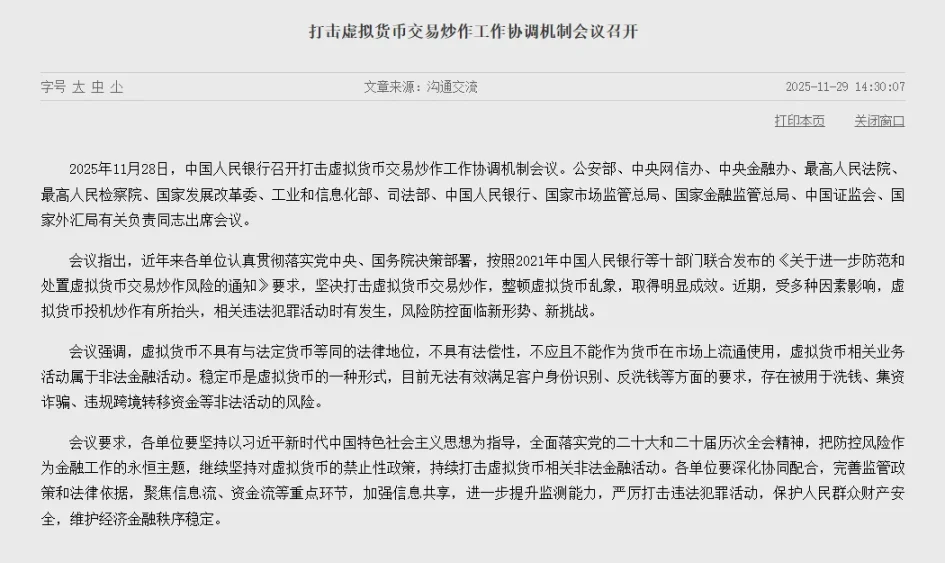
On one hand, industry expectations have rapidly cooled: On November 28, central bank and other authorities, during a coordination meeting on anti-money laundering risks and beneficial ownership management, issued a definitive regulatory classification of "stablecoins." Market hopes that "Hong Kong legislation might pressure slight policy adjustments on the mainland" were quickly dispelled after the reaffirmation of the "illegal financial activity" red line—regulatory attitudes haven’t softened; they’ve become even clearer.
On the other hand, policy signals are heating up: By the end of December, Digital RMB 2.0 was officially unveiled. Based on current disclosures, the new phase of Digital RMB has evolved beyond a simple "digital cash" form into a "digital deposit currency" capable of earning interest, supporting complex smart contracts, and carrying commercial bank liability attributes—significantly expanding its institutional positioning and application scope.

Amid this coexistence of cold and heat, regulatory intent has shifted from implicit to explicit. This is no accidental policy combination, but a carefully orchestrated "replacing the old with the new"—clearing out non-state-backed stablecoins to make room for a state-led digital currency system with clearly defined and controllable market space.
Regulatory Logic: The "Old Wine" in a "New Bottle"
Many analysts interpreting the November 28, 2025 regulations try to identify new rules. But we believe this is merely a restatement of the September 24, 2021 "Notice."
1. The Missing Ripple: The Market Has Already Built Immunity
A telling indicator: When the "September 24 Notice" was released in 2021, BTC immediately crashed, sending shockwaves through the industry. Yet after the 2025 meeting, markets didn’t even flinch. This market indifference stems from logical repetition.
As early as four years ago, regulators had already classified "Tether (USDT)" as an illegal virtual currency. Even though this meeting highlighted the so-called key point that "stablecoins fall under virtual currencies," there is no new legal ground being broken.
2. The Judicial "Backstab": From Warm Understanding Back to Cold Enforcement
The real punch of this meeting lies not in "classification," but in the forced reversal of judicial trends. We must recognize a subtle shift in jurisprudence:
- 2021–2022: All blockchain-related contracts were deemed void, users bore all risks, and courts offered virtually no relief.
- 2023–early 2025: Judges began showing understanding toward Web3, no longer automatically rejecting everything under "public order and good customs." In civil disputes involving real money used to purchase crypto, some courts started ruling partial refunds in fiat currency.
- Post-late 2025 (after Nov. 28): Winter returns. The meeting sent a clear signal requiring judicial rulings to align strictly with administrative regulation—Web3 civil disputes mean contracts are void, period, and risks are entirely self-borne.
3. The Real Regulatory Anchor: Blocking Foreign Exchange "Underground Pipelines"
Why is the administrative apparatus reiterating "old rules" now? Because stablecoins have touched the most sensitive nerve—foreign exchange controls. Today, USDT and USDC have morphed from Web3 trading tools into "parallel highways" for large-scale capital outflows. From tuition payments for overseas education to sophisticated money laundering chains, stablecoins have effectively dismantled the $50,000 annual foreign exchange quota per individual.
The November 28 meeting wasn’t about technology—it was about foreign exchange. Regulators reiterated their stance because they realized that despite strict defenses, the instant settlement nature of stablecoins still leaves gaps in the foreign exchange control dam.
4. Prudent Risks and Outlook
It must be acknowledged that under the current regulatory mindset, security is placed in absolute priority. While this helps rapidly contain risks, it may also create a real consequence: a short-term decoupling between the domestic financial system and the globally advancing programmable finance ecosystem, thereby reducing room for institutional experimentation on public blockchains.
Digital RMB: From 1.0 Exploration to 2.0 "Logical Reconstruction"
Why must stablecoins be definitively classified now?
Because Digital RMB 2.0 carries the mission of bringing "technological logic under sovereign frameworks."
In the Digital RMB 1.0 era: From the user side, its M0 (cash) status meant zero interest, making it hard to compete against highly mature third-party payment tools. From the banking side, commercial banks acted only as "distribution windows," bearing heavy AML and system maintenance costs without being able to generate loans or earn interest spreads from Digital RMB—lacking intrinsic business incentives.
In the Digital RMB 2.0 era: According to current announcements, key changes include: shifting in nature from "digital cash" to "digital deposit currency," with interest paid on balances in verified wallets; technologically, 2.0 emphasizes compatibility with distributed ledgers and smart contracts—an apparent absorption of certain Web3 technologies, though without adopting their decentralized core.
The launch of Digital RMB 2.0 confirms that programmability, instant settlement, and on-chain logic are indeed inevitable forms of future money. However, within China, this form is required to operate within a centralized, traceable, sovereignty-backed closed loop. This centralized experiment represents an intermediate product born from the negotiation between technological evolution and governance logic.
Legal Red Lines: Defining the Boundary of "Illegal Financial Activities"
As a lawyer practicing on the front lines of Web3, I must warn all practitioners: The risk baseline post-2025 has shifted from "compliance flaws" to "criminal底线." This judgment encompasses, but is not limited to, the following aspects:
Accelerated Behavioral Classification: Large-scale buying and selling of USDT and other virtual currencies is rapidly transitioning from administrative violations to criminal charges such as illegal business operations. Especially after the clear classification of stablecoins, any business activities involving bidirectional conversion between mainland fiat and stablecoins, use as a payment medium, or redemption services face drastically reduced technical defense space in judicial practice.
Regulatory Escalation: This boundary-setting further restricts the possibility for non-state entities to innovate in financial infrastructure. Within the mainland, any attempt by non-public actors to build a non-official value transfer network—regardless of the technology used—will likely be classified as "illegal clearing" upon substantive review by regulators. That is, "technological neutrality" is no longer an invincible shield. When operations touch fund aggregation, redemption, or cross-border transfers, regulatory reach will pierce through complex protocol layers to trace back to the operating entity.
Survival Strategies and Breakthrough Recommendations for Web3 Practitioners
The walls are indeed getting higher—but logic hasn’t been severed.
The fact that Digital RMB 2.0 incorporates smart contracts shows that technology itself hasn’t been rejected, only reintegrated into a controllable institutional framework. This leaves realistic adjustment space for Web3 practitioners who truly understand both technology and business logic.
Under current regulatory conditions, a more prudent choice is adopting a "strategic分流" approach.
First, offshore expansion and compliance. For those aiming to build permissionless, decentralized financial applications, full physical and legal relocation offshore is necessary. In jurisdictions like Hong Kong, leveraging licensed frameworks such as the Stablecoin Ordinance to conduct global operations is not a temporary workaround but a principled necessity under the rules.
Second, conscious "decoupling" of technology and finance. Within the mainland, strictly avoid any modules involving fund custody, clearing, or redemption. Since official efforts are advancing a permissioned, smart-contract-enabled Digital RMB 2.0 ecosystem, focusing instead on underlying architecture, security audits, and compliant tech development—and becoming a technical service provider for official financial infrastructure—is currently the most stable and sustainable path for tech teams.
Third, identifying new opportunities within official channels. Cross-border payment systems like the mBridge (Multi-CBDC Bridge) are emerging as one of the few areas with remaining expansion potential within compliant frameworks. Finding innovation entry points atop existing institutional infrastructure may represent the truly viable window of opportunity amid this regulatory reshaping.
Law has never been static—it is always the result of博弈.
Rules may seem harsh, but understanding them is precisely how better choices are made. In this environment of "replacing the old with the new," blind resistance only amplifies risk. What matters most is helping the most valuable technological forces find anchors where they can survive—and thrive—after the red lines have been redrawn.
Join TechFlow official community to stay tuned
Telegram:https://t.me/TechFlowDaily
X (Twitter):https://x.com/TechFlowPost
X (Twitter) EN:https://x.com/BlockFlow_News


