








Crypto Morning Brief: MARA Holdings permitted to sell Bitcoin; Hash Global secures $100M follow-on investment from YZi Labs
TechFlow Selected TechFlow Selected
Crypto Morning Brief: MARA Holdings permitted to sell Bitcoin; Hash Global secures $100M follow-on investment from YZi Labs
Visa will collaborate with Stripe’s Bridge to expand stablecoin cards to more than 100 countries worldwide.
 Navigating Web3 tides with focused insights
Author: TechFlow
Yesterday’s Market Highlights
Trump Calls for Protection of U.S. Crypto Industry, Criticizes Banks for Blocking Key Legislation
Today, Trump posted on Truth Social strongly criticizing banking institutions for attempting to undermine the GENIUS Act and obstruct passage of the Clarity Act. He stated that these bills are critical to ensuring the U.S. becomes the “Crypto Capital of the World,” warning that failure to act could drive the industry overseas—to countries like China. Trump urged banks to reach agreements with the crypto industry, emphasizing that doing so serves the best interests of the American people, and called for swift market structure reforms to let “Americans earn more from their money.”
CFTC Chair: U.S. to Clear Path for Crypto Perpetual Contracts Within Weeks
According to CoinDesk, U.S. Commodity Futures Trading Commission (CFTC) Chair Mike Selig said the agency is “working to bring professional futures—real professional futures—to the U.S. within about a month,” adding that “we expect to announce several policies very soon.” Selig noted that the U.S.’s prior regulatory stance has driven substantial perpetual futures business overseas.
Speaking alongside Securities and Exchange Commission (SEC) Chair Paul Atkins at the Milken Institute event in Washington, D.C., Selig revealed that both agencies are advancing “Project Crypto,” including introducing “innovation exemptions” for crypto innovation and clarifying the regulatory treatment of decentralized finance (DeFi) developers. Additionally, the CFTC will establish clear standards and guidance for prediction markets.
Lido: Security Vulnerability Detected in ZKsync wstETH Bridge Endpoint; Deposits Suspended
According to Lido, a potential security vulnerability was identified in the ZKsync wstETH bridge endpoint contract. There is currently no evidence the vulnerability has been exploited, holders of wstETH on ZKsync remain unaffected, and other cross-chain bridges are not impacted.
As a precautionary measure, Lido has suspended new deposits to the ZKsync bridge. Withdrawals and token transfers from ZKsync remain fully functional.
Lido has prepared a fix and plans to audit and deploy it following its next scheduled on-chain governance vote (expected late March/early April), after which deposit functionality will resume. Lido stated it will share further updates at an appropriate time.
Aave Chan Initiative to End Collaboration with Aave DAO in July, Governance Tensions Escalate Further
According to The Block, the Aave Chan Initiative (ACI), founded by Marc Zeller and serving as Aave DAO’s primary delegate and service provider, announced it will not renew its collaboration agreement with the DAO and intends to phase out services over the next four months. This decision follows the earlier exit announcement by another core contributor, BGD Labs, marking yet another key contributor departing amid escalating governance tensions within Aave. ACI’s move further highlights the governance challenges confronting Aave’s decentralized autonomous organization.
Visa to Partner with Stripe’s Bridge to Expand Stablecoin Cards to Over 100 Countries Worldwide
According to Fortune, Visa and Bridge—a crypto startup acquired by Stripe in 2025—plan to expand their stablecoin-backed card business to 100 countries across Europe, Asia, and Africa. This partnership has already launched in 18 countries, enabling users to pay at merchants accepting Visa using stablecoin balances held in their crypto wallets.
Zach Abrams, Co-Founder and CEO of Bridge, stated that Visa’s robust merchant network and widespread acceptance—built over the past 40 years—remain highly valuable in the stablecoin ecosystem. Additionally, Bridge will participate in Visa’s ongoing pilot program exploring the feasibility of settling payments using stablecoins on blockchain instead of traditional bank transfers.
Cuy Sheffield, Visa’s Head of Cryptocurrency, said: “If we can move billions of dollars on-chain, we can move trillions.”
American Bitcoin Adds 11,298 ASIC Miners, Expected Hashrate Increase of 12%
According to PRNewswire, American Bitcoin plans to expand its Bitcoin mining capacity by adding 11,298 ASIC miners. This expansion is expected to increase the company’s hash rate by approximately 12%.
Empery Digital Responds to Shareholder Demand: Will Not Liquidate Bitcoin Holdings
Empery Digital Inc. (Nasdaq: EMPD) confirmed today receipt of a director nomination notice from ATG Capital Management and Tice P. Brown. The company explicitly stated it has evaluated and rejected Mr. Brown’s proposal to immediately liquidate its entire Bitcoin portfolio, concluding it does not serve the best interests of all shareholders. Empery Digital emphasized that adherence to its current strategy has increased Bitcoin per share by approximately 39%, and adopting the liquidation proposal would deprive shareholders of future Bitcoin value appreciation.
The company will continue executing its low-cost, high-efficiency Bitcoin financial strategy—repurchasing shares trading below net asset value (NAV) to increase Bitcoin per share and narrow the NAV discount. The Board will submit formal recommendations at the upcoming 2026 Annual Shareholders Meeting.
Earlier reports indicated that Empery Digital’s shareholders publicly demanded the CEO’s resignation and full liquidation of all BTC holdings.
MARA Amends Asset Management Policy to Allow Sale of Bitcoin Held on Balance Sheet
According to The Block, Bitcoin mining firm MARA Holdings announced in its 10-K filing submitted Monday to the U.S. Securities and Exchange Commission an expansion of its fiscal policy for 2026, permitting the sale of its accumulated Bitcoin reserves.
As of December 31, 2025, MARA holds 53,822 BTC—valued at approximately $4.7 billion—including 9,377 BTC lent out and 5,938 BTC pledged as collateral for a $350 million credit facility. MARA stated in the filing: “In the second half of 2025, we modified our digital asset management strategy to allow sales of Bitcoin generated from operations; in 2026, we expanded the strategy to permit sales of Bitcoin held on the balance sheet.”
Antalpha Discloses Purchase of $134 Million in Tether Gold
According to GlobeNewswire, Nasdaq-listed crypto fintech firm Antalpha released its 2025 financial results, reporting annual revenue of $79.7 million—a 68% year-on-year increase. Additionally, Antalpha disclosed it has strategically allocated capital into tokenized gold, purchasing $134 million worth of Tether Gold (XAUT). As of year-end 2025, its XAUT holdings totaled 39,371 tokens, with an unrealized gain of $13.4 million. Antalpha also noted that XAUT can be redeemed for physical gold via its Antalpha RWA Hub.
Hash Global Secures $100 Million Strategic Top-Up from YZi Labs
According to official announcements, Hash Global—the leading Asian digital asset investment management firm—announced its newly launched institutional version of the BNB Yield Fund, the BNB Holdings Fund, has received a $100 million strategic top-up from YZi Labs.
This marks a further strategic commitment following YZi Labs’ prior support for Hash Global’s launch of the BNB Yield Fund targeting traditional distribution channels and retail investors.
This additional investment reflects the deepening of the partnership between the two parties and signals the formal entry of BNB into a structurally advanced stage of institutional adoption.
SoftBank-Backed PayPay Plans U.S. IPO to Raise $1.1 Billion, Holds 40% Stake in Binance Japan
According to CoinDesk, Japan’s largest cashless payment provider, PayPay, plans to list on the Nasdaq, offering 55 million American Depositary Shares (ADSs) at a price range of $17–$20 per share—potentially raising up to $1.1 billion, valuing the company above $10 billion. With over 70 million registered users, PayPay acquired a 40% stake in Binance Japan last October.
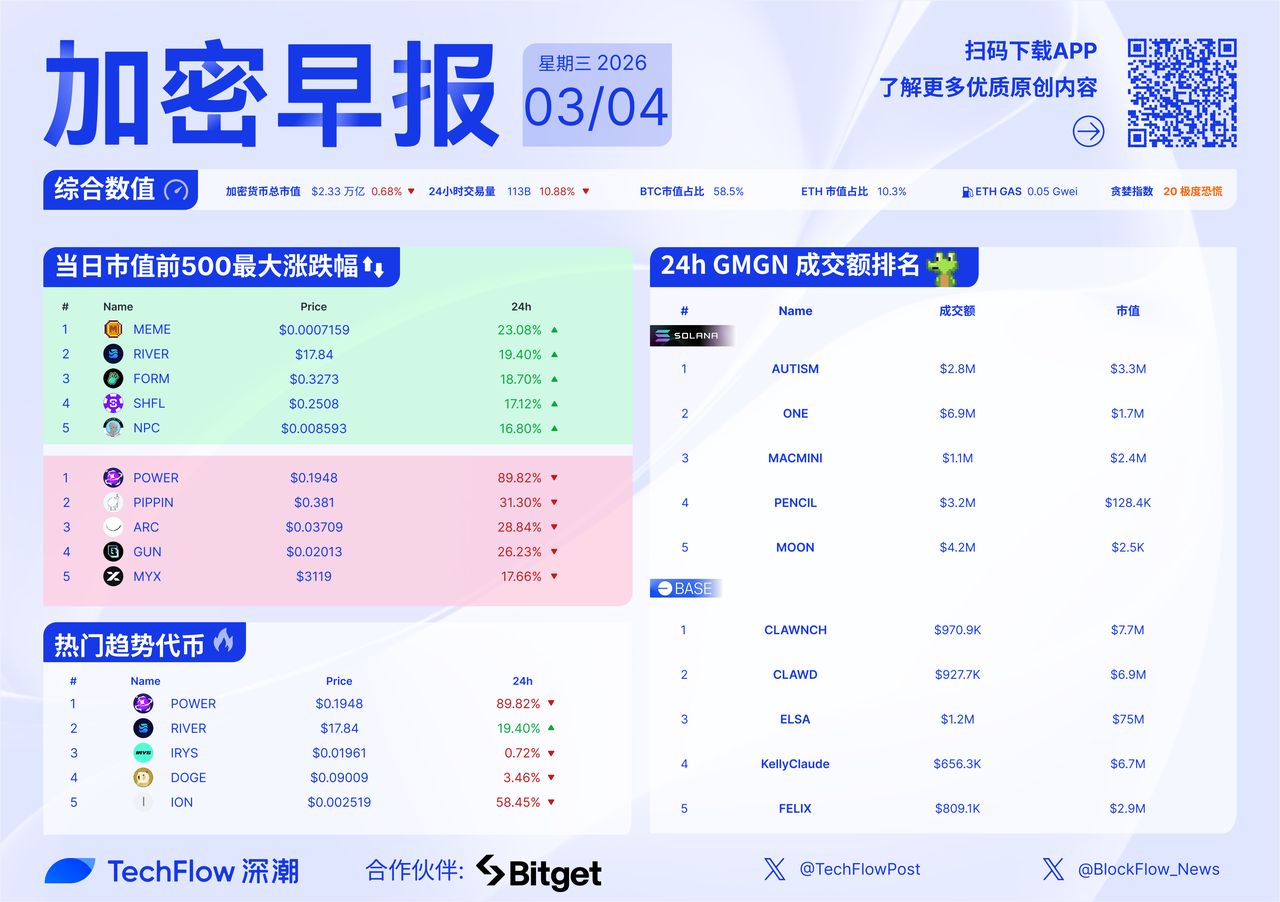
Market Data
Recommended Reading
This article explores the vulnerability of AI and data centers amid geopolitical conflicts and the security challenges they face as modern infrastructure. Using the example of Amazon’s UAE data center—which suffered a Claude AI service outage due to Iranian missile strikes—the article analyzes the complex relationship between AI technology and geopolitics, noting that current international law and security frameworks are inadequate in addressing threats data centers may face during wartime.
Ethereum Is Getting a New Engine
This article details Ethereum’s planned deep technical overhaul—including state trie optimization and virtual machine replacement—to improve efficiency and scalability. These changes aim to resolve existing system bottlenecks while addressing challenges posed by quantum computing and rapid technological evolution. However, these proposals have yet to achieve broad consensus among developers—especially the virtual machine replacement—and Layer-2 scaling solutions are increasingly diverging from Ethereum’s core identity in pursuit of independent development paths. Such technical adjustments may mark Ethereum’s entry into a new developmental phase.
March 3 Market Recap: Third Day of U.S.-Iran War, Crypto Market Mounts Dramatic Counterattack
This article summarizes global market performance on the third day of the U.S.-Iran war—including equities, cryptocurrency markets, and gold and silver prices—and analyzes markets’ contrarian behavior amid war-related panic, examining how geopolitics impacts financial markets.
CoinGecko Data Review: 2025 DEX Perps Volume Surged 346%; Hyperliquid Ranks Seventh Globally
This article analyzes the migration trend from centralized exchanges (CEXs) to decentralized exchanges (DEXs), particularly the explosive growth of perpetual contract exchanges and its profound impact on market structure. Decentralized platforms such as Hyperliquid—through technological innovation and infrastructure optimization—have become integral components of global financial markets.
This article analyzes the relationship between U.S. Middle East wars and Federal Reserve monetary policy. Author Arthur Hayes presents a distinctive investment thesis: history shows the Fed consistently cuts rates after each U.S.-led Middle East war to support the economy—making it potentially the optimal time to accumulate high-quality assets like Bitcoin. Drawing on historical precedents—including the 1990 Gulf War, the 2001 War on Terror, and the anticipated 2026 Iran conflict—the article explores war’s impact on the economy and monetary policy and outlines related investment strategies.
Join TechFlow official community to stay tuned
Telegram:https://t.me/TechFlowDaily
X (Twitter):https://x.com/TechFlowPost
X (Twitter) EN:https://x.com/BlockFlow_News
 深潮TechFlow









