After the U.S.-Israeli airstrikes, Iran’s largest exchange saw a 700% surge in cryptocurrency withdrawals—but internet shutdowns blocked capital flight.
TechFlow Selected TechFlow Selected
After the U.S.-Israeli airstrikes, Iran’s largest exchange saw a 700% surge in cryptocurrency withdrawals—but internet shutdowns blocked capital flight.
Nobitex is Iran’s largest cryptocurrency exchange, handling approximately 87% of the country’s cryptocurrency trading volume.
 Navigating Web3 tides with focused insights
Authors: Brayden Lindrea, Felix Ng
Translated by TechFlow
TechFlow Intro: This report uses on-chain data to quantify the real scale of cryptocurrency as a capital flight channel amid geopolitical crisis—nearly $3 million in withdrawals occurred within one hour after the airstrikes. Yet the other half of the story is equally noteworthy: the Iranian government promptly cut off internet access, effectively sealing this escape route. Conclusions from Elliptic and TRM Labs contradict each other; readers may draw their own judgments.
Full Text Below:
Minutes after the U.S. and Israel launched airstrikes on Tehran on Saturday, Iran’s largest cryptocurrency exchange experienced a massive wave of crypto withdrawals. However, widespread internet outages that followed curbed further capital outflows.
Blockchain analytics firm Elliptic stated in a Monday post that withdrawal volumes on the Nobitex exchange surged over 700% within minutes of the first airstrike, exceeding $500,000. Charts show that hourly withdrawal volumes later approached $3 million.
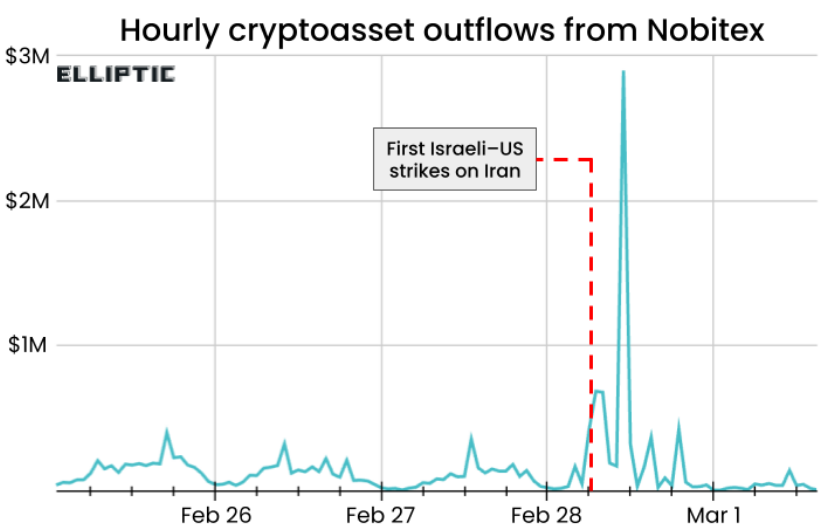
Elliptic noted that the sharp spike in withdrawals “likely represents capital flight from Iran,” with preliminary tracking indicating that large sums were transferred to overseas cryptocurrency exchanges.
“This enables funds to be moved out of Iran while circumventing parts of the global banking system’s scrutiny,” Elliptic stated.
However, Nobitex’s withdrawal volume dropped sharply after Saturday. Another crypto forensics platform, TRM Labs, attributed this decline to strict internet shutdowns imposed by Iranian authorities.
TRM noted that internet connectivity in Iran dropped by approximately 99% shortly after the outbreak of hostilities.
TRM also challenged Elliptic’s conclusion that “funds are fleeing Iran”:
“At present, the country’s crypto ecosystem shows no signs of acceleration or capital flight; instead, transaction counts and volumes are shrinking as authorities enforce stringent internet blackouts.”
This episode of crypto capital outflow unfolded against the backdrop of U.S. and Israeli efforts to topple Iran’s current regime and dismantle its nuclear weapons and missile programs. Iran subsequently launched retaliatory airstrikes against neighboring countries, further escalating regional instability.
Nobitex is Iran’s largest cryptocurrency exchange, handling roughly 87% of the country’s crypto trading volume. In 2025, its trading volume totaled approximately $7.2 billion, with over 11 million users.
Millions of Iranians Affected by Recent Banking Collapse
Due to the fragility of Iran’s banking system and extensive international sanctions, Iranians have long relied on cryptocurrencies to store and transfer funds.
In October last year, Ayandeh Bank—one of Iran’s largest private banks—declared bankruptcy after accumulating $5.1 billion in losses and nearly $3 billion in liabilities, affecting over 42 million customers.
Last year, the Central Bank of Iran warned that eight additional domestic banks face dissolution unless reforms are implemented.
Iranian crypto exchanges themselves have faced recurring problems—Nobitex suffered an $81 million hack in June.
Join TechFlow official community to stay tuned
Telegram:https://t.me/TechFlowDaily
X (Twitter):https://x.com/TechFlowPost
X (Twitter) EN:https://x.com/BlockFlow_News
 @Cointelegraph