








Interpretation of Hong Kong’s New Virtual Asset Licensing Regulations: Joint Announcement by the Financial Services and the Treasury Bureau and the Securities and Futures Commission Signals the Dawn of the “Full Licensing” Era
TechFlow Selected TechFlow Selected
Interpretation of Hong Kong’s New Virtual Asset Licensing Regulations: Joint Announcement by the Financial Services and the Treasury Bureau and the Securities and Futures Commission Signals the Dawn of the “Full Licensing” Era
This article will interpret the new regulatory requirements, analyze their core impact on the market, and propose response recommendations accordingly.
 Navigating Web3 tides with focused insights
By FinTax
1 Introduction
On December 24, 2025, Hong Kong’s Financial Services and the Treasury Bureau (FSTB) and the Securities and Futures Commission (SFC) jointly published the consultation conclusions on legislative proposals to regulate virtual asset trading and custody services. Simultaneously, they launched a one-month public consultation on establishing licensing regimes for two additional categories of service providers: those offering advice on virtual assets and those providing virtual asset management services.
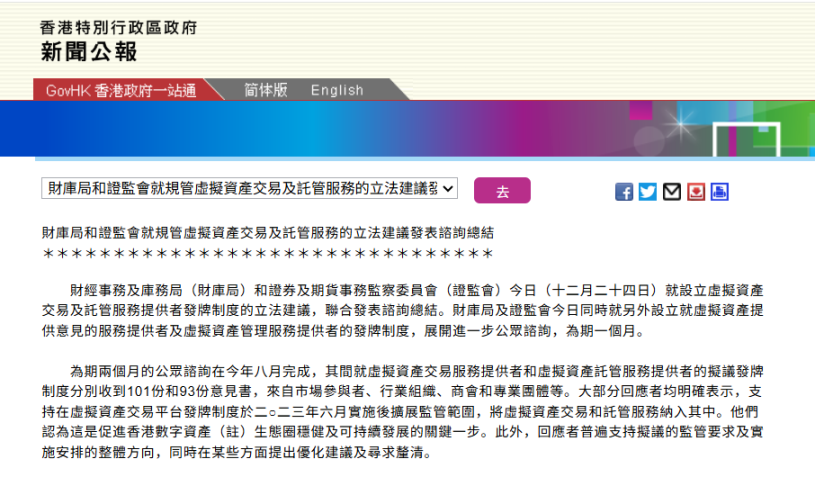
In 2023, Hong Kong amended the Anti-Money Laundering and Counter-Terrorist Financing Ordinance (AMLO), introducing a statutory licensing regime for virtual asset trading platforms. To fill regulatory gaps, the FSTB and SFC jointly initiated a consultation in June 2025 on legislative proposals to regulate virtual asset trading and custody services under the AMLO framework. The two policy documents released herein represent the conclusions and responses to that June 2025 consultation. They explicitly bring virtual asset trading and custody services under the licensing regime, outline preliminary regulatory approaches, and innovatively extend the licensing framework to cover “advice on virtual assets” and “virtual asset management services.” This means Hong Kong’s virtual asset market will achieve a comprehensive, end-to-end licensing regime covering trading, custody, advisory, and asset management activities.
This article analyzes the new regulatory requirements set forth in the two policy documents—“Consultation Conclusions on Legislative Proposals for Regulating Virtual Asset Trading and Further Public Consultation” and “Consultation Conclusions on Legislative Proposals for Regulating Virtual Asset Custody Services”—assesses their core market implications, and proposes corresponding response strategies.
2 Policy Content Interpretation
The two policy documents not only systematically summarize feedback received during last year’s June consultation on regulating virtual asset trading and custody services but also propose expanding the licensing scope to include investment advisory and asset management activities. These proposed regulatory systems remain at the legislative stage and will only take effect upon formal enactment of the relevant legal amendments.
2.1 “Consultation Conclusions on Legislative Proposals for Regulating Virtual Asset Trading and Further Public Consultation”
This document summarizes feedback from the consultation on virtual asset trading services and concurrently introduces two new regulatory proposals. First, it finalizes key regulatory details for virtual asset trading services, specifying the scope of covered activities, financial requirements, and transitional arrangements.
- Scope Definition: The definition of virtual asset trading services aligns with “Type 1 regulated activity (dealing in securities)” under the Securities and Futures Ordinance. Any person carrying on, as a business, activities involving buying or selling virtual assets for clients—or inducing others to do so—must obtain a license. Examples include operating virtual asset matching platforms, providing over-the-counter (OTC) brokerage services, acting as virtual asset brokers executing client trades, and offering virtual asset market-making services.
- Capital Requirements: Capital resource requirements for licensed virtual asset traders mirror those applicable to Type 1 licensed corporations: a minimum paid-up share capital of HK$5 million and a minimum liquid capital of HK$3 million. This requirement effectively filters out undercapitalized small-scale service providers, enhancing overall industry safety and stability.
- Mandatory Custody: Licensed traders must appoint an SFC-regulated virtual asset custodian to safeguard client virtual assets, ensuring separation between trading and custody functions and prohibiting self-custody of client assets. Initially, this excludes foreign custodians, aiming to build a closed-loop, controllable local custody ecosystem.
Second, under the AMLO framework, the scope of regulated entities is further expanded to include licensing requirements for “providing advice on virtual assets” and “virtual asset management services.”
“Providing advice on virtual assets” refers to giving investment advice regarding whether, which, or how to acquire or dispose of virtual assets—or publishing decision-oriented analytical reports—akin to investment advisory services. Specific examples include recommending optimal timing for purchasing or selling specific virtual assets or advising on virtual asset portfolio allocation. For such entities, regulators propose detailed requirements across dimensions including financial resources, professional staffing, compliance obligations, and business restrictions. Exemptions modeled on traditional finance will apply to internal corporate services, trading activities, or ancillary professional services.
“Virtual asset management” refers to providing portfolio management services for virtual assets, requiring both delegated investment decision-making authority from clients and professional portfolio management delivery. Regulators state that no minimum investment threshold exemption will apply: any entity offering virtual asset portfolio management services—regardless of the amount invested in virtual assets—must obtain a license or register. This rule aims to prevent risks from flowing into the market through unregulated advisory or asset management channels and to narrow arbitrage opportunities exploiting traditional financial product structures to evade dedicated virtual asset regulation.
2.2 “Consultation Conclusions on Legislative Proposals for Regulating Virtual Asset Custody Services”
The “Consultation Conclusions on Legislative Proposals for Regulating Virtual Asset Custody Services” establishes a regulatory framework specifically for virtual asset custody, treating custody as the final line of defense for client asset security—and imposing higher capital requirements accordingly.
- Scope Coverage: The regulated entities are operators holding private keys or similar tools enabling transfer of client virtual assets. Independent third-party custodians must apply for dedicated licenses, while custody operations affiliated with licensed trading platforms may qualify for exemptions to avoid duplicate licensing. Responsibilities along the custody chain are further clarified—for example, related entities of licensed trading platforms engaged in custody must separately apply for custody licenses; and existing financial institutions (e.g., banks) offering virtual asset custody services must also fall within this framework.
- Capital Requirements: Licensed custodians face higher capital requirements than traders: a minimum paid-up share capital of HK$10 million and a minimum liquid capital of HK$3 million. These thresholds aim to ensure licensed custodians possess operational resilience and risk-response capacity commensurate with their business scale—reflecting the distinctive nature of custody services.
- Other Provisions: Operational standards for licensed custodians will be aligned with traditional financial regulatory rules or existing custody guidance for licensed trading platforms, covering aspects such as online/offline asset storage ratios, private key management, insurance coverage, and independent audits. For instance, high cold-wallet storage ratios are mandated—with flexibility to adjust based on business needs—to balance fast withdrawal capability against security; strict multi-signature protocols and tiered permission controls are required, alongside regular penetration testing and stress testing.
3 Impact on Hong Kong’s Crypto Industry
3.1 Comprehensive Upgrade of the Licensing Framework
Hong Kong’s virtual asset licensing regime has undergone a fundamental transformation—from previously issuing a single license exclusively for centralized virtual asset trading platforms (VATPs) to now establishing an end-to-end licensing system covering four core business lines: trading, custody, advisory, and asset management. The VATP licensing regime targeted the specific institutional form of “centralized exchanges,” imposing comprehensive requirements on capital, custody, and anti-money laundering (AML), but focused regulatory attention narrowly on the “trading venue” itself. Meanwhile, widespread activities outside the exchange—such as OTC trading, independent asset custody, investment advisory, and specialized asset management—either remained ambiguously regulated or fell entirely into unlicensed regulatory voids, creating both risk vulnerabilities and regulatory arbitrage opportunities. The introduction of standalone trading and custody licenses—and the proposed new advisory and asset management licenses—constitutes a systematic response to these limitations, fostering a professional, resilient virtual asset services market ecosystem.
3.2 Building Institutional Trust in the Crypto Market
The new regulations establish institutional trust in the crypto market through a series of quantifiable, auditable hard constraints. First, capital and operational thresholds aligned with those for traditional financial institutions—such as HK$5 million for traders and HK$10 million for custodians—effectively screen out institutions with weak risk resilience, thereby building institutional credibility anchored in capital strength. Second, the complete regulatory loop covering virtual asset trading, custody, advisory, and asset management shifts asset security assurance from reliance on single-license frameworks and institutional self-regulation toward comprehensive, systemic regulation. For individual and institutional investors alike, this framework delivers legal and regulatory safeguards comparable to those in traditional finance—making them easier to understand and trust.
3.3 Challenges and Uncertainties Following Regulatory Implementation
Regulatory upgrades inevitably entail challenges. At the market level, smaller and mid-sized service providers may face particularly severe compliance transformation hurdles, while globally mobile crypto capital with higher risk appetites may migrate to jurisdictions with more flexible regulatory frameworks. At the regulatory level, this model demands high technical expertise: regulators must process a large volume of license applications in the short term, and delays in review timelines could create compliance vacuums—stifling legitimate business development. Moreover, regulators must possess sufficient technical capabilities to identify and assess risks embedded in custody solutions, blockchain analytics tools, and novel trading models.
4 Responses for Crypto Market Participants
In the short term, “proactive compliance for survival and strategic repositioning for growth” is the primary strategy for Hong Kong crypto market participants. Hong Kong’s virtual asset sector is entering an era of fully licensed operations. Market participants must immediately classify their business activities legally—as trading, custody, advisory, or asset management—and initiate preparations for corresponding license applications. Some licenses carry no transitional period; any delay could expose businesses to illegal operation risks after the regulations take effect.
Over the medium to long term, market participants can gradually shift focus from mere regulatory compliance toward leveraging compliance advantages to build core competitiveness. This requires internalizing AML monitoring, asset custody security, and financial audit transparency—not merely as regulatory checkboxes, but as operational norms exceeding baseline requirements—thereby delivering trustworthy, robust, and auditable financial-grade services.
The institutionalization driven by the new regulations may carry tax implications, necessitating forward-looking tax planning by market participants. For example, business income classification must be clarified under the regulatory framework to determine taxable income categories. New compliance-related operating costs—including license fees and audit expenses—may generate tax-deductible opportunities, requiring ongoing policy tracking and proper accounting documentation. More importantly, as institutional clients enter the market, delivering audit-compliant transaction records and tax reporting will become a foundational service capability—prompting market participants to proactively enhance their tax and finance systems to meet growing business demands.
Against the backdrop of an upgraded licensing framework, the market may evolve into a competitive landscape featuring a few comprehensive, full-license service groups alongside numerous specialized providers serving niche segments. Beyond obtaining licenses, early investment in regtech capabilities—or forging deep partnerships within specific ecosystem niches—could present valuable opportunities to establish competitive advantage in the next phase.
Join TechFlow official community to stay tuned
Telegram:https://t.me/TechFlowDaily
X (Twitter):https://x.com/TechFlowPost
X (Twitter) EN:https://x.com/BlockFlow_News
 TaxDAO


