In-depth Analysis of Hong Kong's New Virtual Asset Trading Platform Regulations: "Circular on Shared Liquidity for Virtual Asset Trading Platforms"
TechFlow Selected TechFlow Selected
In-depth Analysis of Hong Kong's New Virtual Asset Trading Platform Regulations: "Circular on Shared Liquidity for Virtual Asset Trading Platforms"
What are the new changes in regulation?
 Navigating Web3 tides with focused insights
By: Crypto Salad
Riding the momentum of the FinTech Week, the Hong Kong Securities and Futures Commission (SFC) recently issued two thunderclap announcements that have stirred significant waves. We all know that today’s biggest challenge for virtual asset trading platforms (VATPs) in Hong Kong is unprofitability—regulatory barriers are built so high and tight that while they effectively keep out “dirty money,” they also suffocate market liquidity, rendering the ecosystem nearly stagnant.
The SFC clearly recognizes this issue. As Executive Director of中介机构部 Ye Zhiheng stated, digital asset regulation should follow a “small steps, fast progress” principle—dynamic oversight through incremental experimentation. This phrase is particularly apt, and the two recent circulars perfectly embody its essence.
Today, Crypto Salad will provide an in-depth analysis from a legal professional’s perspective: What exactly has changed in the regulatory landscape? And how will these changes impact exchanges’ next moves?
About the "Circular on Shared Liquidity for Virtual Asset Trading Platforms"
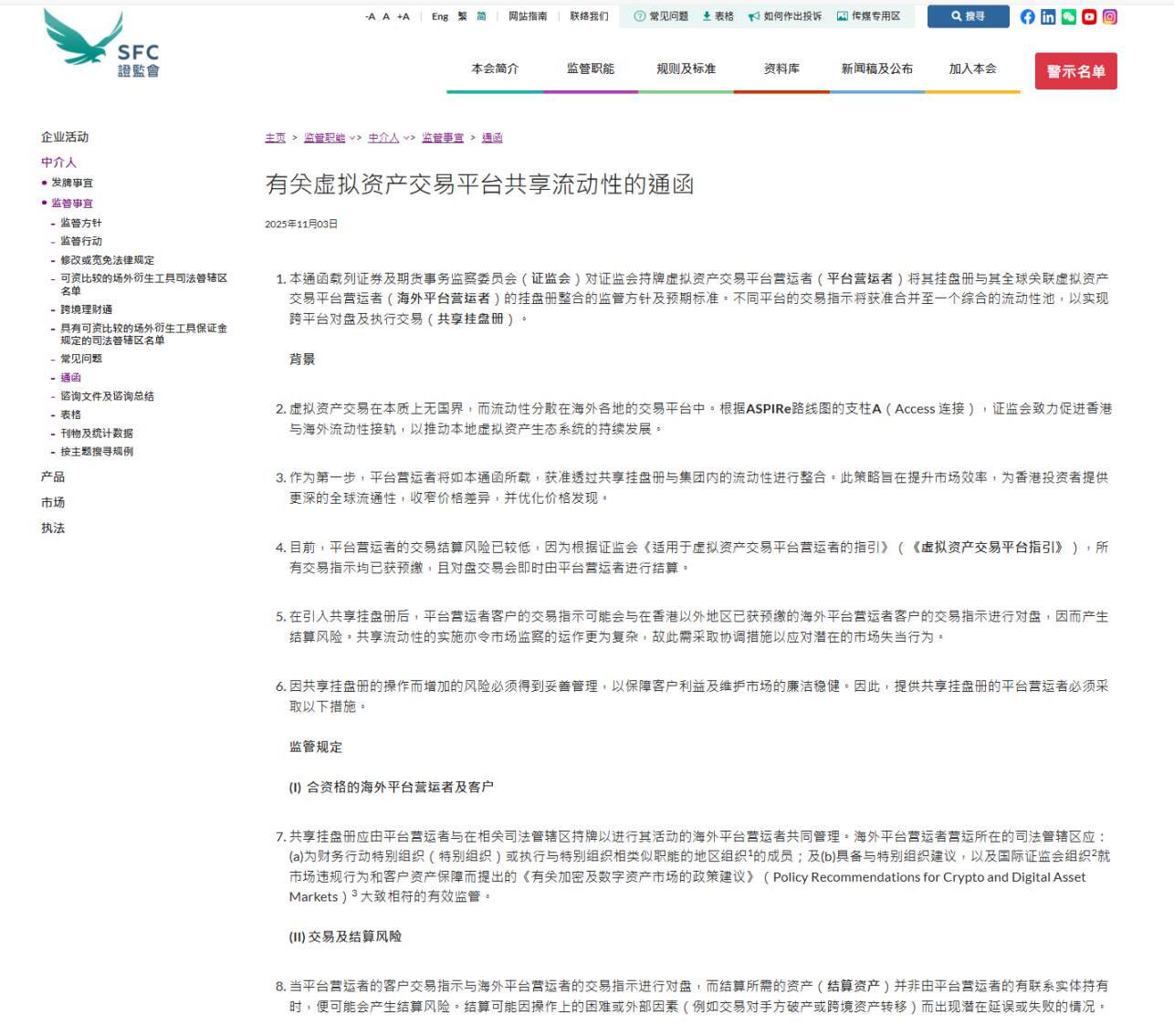
1. First-time allowance for VATPs to share order books with their overseas affiliated platforms
First, shared order book refers to a unified order book jointly managed and used by two or more virtual asset trading platforms. It consolidates trading orders from different platforms into a single matching system, forming a cross-platform liquidity pool.
In traditional models, each platform independently maintains its own order book. When users place orders, the platform records and matches them internally—a process known as "order matching." With the introduction of shared order books, affiliated platforms across jurisdictions can now merge buy and sell orders into one "trading pool" for centralized matching—the key source of enhanced liquidity.
Many people’s immediate reaction might be: Can HashKey now connect to Binance? While shared liquidity sounds promising, how far does it actually go? Crypto Salad believes, based on this circular, not yet.
First, the Circular explicitly states that the order book can only be shared between a licensed Hong Kong exchange and its "globally affiliated" virtual asset trading platforms. This means Haskey Exchange can only access liquidity from other regional trading platforms within the same group as HashKey Global—not with non-group platforms such as Binance.
Second, even within the same corporate group, not all exchanges qualify. The SFC imposes two layers of restrictions on the jurisdiction where the overseas platform operates:
1) Both the VATP and the overseas platform must hold valid licenses in their respective jurisdictions.
2) The overseas platform's country must be sufficiently "reliable"—according to Hong Kong’s definition of reliability.
The overseas platform must be located in an internationally recognized, well-regulated jurisdiction, specifically meeting these criteria:
-
Must be a member of the Financial Action Task Force (FATF) or a similar organization;
-
Must have regulatory policies broadly aligned with FATF’s anti-money laundering standards and IOSCO’s policy recommendations on crypto asset markets.
First, the country hosting the overseas platform must be recognized by Hong Kong. How is this assessed? If it is a FATF member (region), it unquestionably meets the requirement. (As of November 9, 2025, there are 40 members listed on the FATF official website at https://www.fatf-gafi.org/en/countries.html.)
Meeting hard eligibility requirements isn't enough—soft capabilities must also align: the jurisdiction must have exchange regulations conforming to international standards. For platforms already established in well-regulated regions like Japan, this condition is easily met, as they already operate under strict AML and market supervision frameworks with comparable licensing requirements. However, in countries like India, Turkey, or Mexico, where such regulatory policies are absent, even if a VATP sets up a local exchange without violating local laws (due to lack of rules), it still fails to meet the prerequisites for liquidity integration—it cannot sit at Hong Kong’s table.
Legal basis:
Paragraph 7 of the Circular states: "The shared order book should be jointly managed by the platform operator and an overseas platform operator licensed in the relevant jurisdiction to conduct its activities. The jurisdiction in which the overseas platform operator operates shall:
-
(a) be a member of the Financial Action Task Force (FATF) or a regional organization performing functions similar to FATF; and
-
(b) have effective regulation substantially consistent with FATF Recommendations and IOSCO’s Policy Recommendations for Crypto and Digital Asset Markets regarding market misconduct and client asset protection."
2. Clear risk mitigation measures for trading and settlement
Paragraph 8 of the Circular clearly points out that when a Hong Kong platform shares an order book with an overseas counterpart but the assets involved in settlement are held in separate custody systems, various settlement risks may arise—such as delays or failures in settlement.
This is a very real scenario. In traditional securities trading, user assets are typically held within a central clearing house (CCP). But in virtual asset exchanges, user funds are scattered across different custodians operating independently. It’s like everyone keeps money in separate bags—while transactions within one bag are straightforward, pulling money from someone else’s bag introduces new risks: empty withdrawals, slow transfers, incorrect amounts, etc.
Of course, this is an extreme example. Most reputable licensed exchanges have professionally sound and secure custody arrangements. Still, to ensure greater stability in cross-border liquidity sharing, Hong Kong has set forth the following requirements:
-
Unified rules to ensure fairness, orderliness, and accountability: Paragraph 9 requires that a comprehensive set of rules govern the use of the shared order book throughout the entire trading process. These rules must be binding and enforceable for all participants—including both Hong Kong and overseas platforms, custodians, and users—and should cover pre-funding, instruction issuance, trade execution, settlement procedures, default management, responsibility transitions (if applicable), and the roles, rights, obligations, and liabilities of each party.
-
Mandatory full pre-funding with automated verification to ensure deliverability: Paragraph 10 mandates that platforms establish an automated pre-trade validation mechanism to verify in real time whether a trading instruction satisfies three conditions: full pre-funding, asset custody, and sufficient quantity.
-
Establishment of a Delivery-Versus-Payment (DVP) settlement mechanism: DVP is a widely adopted financial settlement method in traditional securities markets. Under DVP, settlement occurs only when delivery of assets and payment happen simultaneously—ensuring the buyer receives the asset exactly when the seller receives payment. Otherwise, the transaction does not settle. This is the most effective way to eliminate timing risk. In simple terms, both parties prepare their assets first; the clearing system verifies both sides meet the conditions before completing the transfer—a typical centralized exchange approach. Hong Kong aims to bring DVP-level security to virtual assets, eliminating settlement failure risks.
-
Daily clearing with intraday settlements: Paragraphs 14 and 15 require that Hong Kong platforms settle trades with overseas platforms at least once per day and perform intraday settlements, setting a "maximum unsettled transaction limit" to prevent cross-border unsettled trades from snowballing.
-
Compensation arrangements: The Circular stipulates compensation mechanisms, emphasizing that cross-border settlement risks must be borne entirely by the trading platform. This means the Hong Kong platform must assume full liability—even if defaults occur due to overseas users or settlement failures at foreign platforms, the Hong Kong operator must compensate affected clients.
Legal basis:
Paragraph 16 states: "A platform operator providing a shared order book must demonstrate robust financial capacity to manage the shared order book and must bear full responsibility to its clients for transactions executed via the shared order book, as if those transactions were conducted on the platform operator’s own order book."
In addition, reserve funds must be segregated from platform assets, held in trust, strictly dedicated to customer compensation, and sized no less than the maximum unsettled transaction limit. The more cross-border trades a platform conducts, the larger its required reserves.
Legal basis:
Paragraph 17 states: "The platform operator must establish a reserve fund in Hong Kong, held in trust by the operator and designated for customer compensation to cover losses arising from settlement failures. The size of the reserve fund should not be less than the maximum unsettled transaction limit and should be adjusted according to expected settlement risk exposure."
Paragraph 18 states: "Under paragraph 10.22 of the Virtual Asset Trading Platform Guidelines, the platform operator must have compensation arrangements to protect against potential loss of custodied client virtual assets. Clients should receive equivalent protection regarding settlement assets to be delivered. Therefore, the platform operator must purchase insurance or establish compensation arrangements to safeguard against potential losses of settlement assets (e.g., due to theft, fraud, or misappropriation), with coverage amount not less than that required under paragraph 10.22 of the Guidelines."
3. Technical challenges behind the regulation
From an industry standpoint, the Hong Kong government undoubtedly wants to boost exchange liquidity, but it has also set very high entry barriers—reflecting Hong Kong’s characteristic style of dancing in shackles—and aligning with the SFC’s “small steps, fast progress” development principle. Of course, Hong Kong’s unique political and financial status plays a primary role, but Crypto Salad believes technical constraints are also a latent driver behind regulatory caution.
In practice, the biggest hurdle for VATPs implementing cross-border liquidity sharing isn’t necessarily meeting regulatory criteria or raising sufficient capital reserves—it’s the technical complexity. The Circular uses broad terms like “joint management” and “interconnection” to describe inter-platform cooperation, but omits critical technical interoperability issues involving trading pathways, matching engines, clearing processes, and risk control modules. For technical teams, the real challenge isn’t simply “whether” or “how” to connect to a shared order book, but rather “how to securely connect, stably operate, and accountably settle—all within a compliant framework.”
Moreover, from a compliance angle, cross-border data protection standards vary significantly across jurisdictions. Which data can be transferred? Who owns responsibility? Is there a clearer definition of “affiliated platforms”? For instance, if OSL and Bybit have implicit equity ties, would they qualify as affiliated platforms eligible for liquidity sharing? Even within the same corporate group, disparate IT infrastructures and risk management systems could undermine true operational alignment—raising further questions about what truly constitutes an “affiliated platform.” These are just some of the nuanced details that legal experts are beginning to scrutinize.
Cross-border liquidity sharing may appear technically simple—just connecting two systems—but in reality, it resembles a deep integration project akin to a major merger. Limiting access solely to affiliated platforms is not a long-term solution. The core challenge facing the industry is how to fully open the system while correctly executing every compliance detail.
4. Crypto Salad Commentary
This Circular reaffirms Hong Kong’s regulatory stance: openness, but only under compliance. Overseas platforms with weak regulatory frameworks or inadequate compliance capabilities will find it extremely difficult to join this ecosystem. International platforms seeking access to Hong Kong’s shared order book will need to upgrade their monitoring systems accordingly.
From a practical perspective, does Hong Kong’s market offer enough吸引力 to compel overseas platforms to restructure parts of their operations to fit into Hong Kong’s puzzle? Crypto Salad believes there is influence—but primarily on platforms already committed to global, large-scale compliant operations. For retail-focused platforms relying on regulatory arbitrage, entering Hong Kong’s market remains premature.
Join TechFlow official community to stay tuned
Telegram:https://t.me/TechFlowDaily
X (Twitter):https://x.com/TechFlowPost
X (Twitter) EN:https://x.com/BlockFlow_News