








Liquidity illusion: When monetary bubbles mask the structural collapse of civilization
TechFlow Selected TechFlow Selected
Liquidity illusion: When monetary bubbles mask the structural collapse of civilization
The current situation is not as optimistic as it seems.
 Navigating Web3 tides with focused insights
Author: arndxt, crypto KOL
Translation: Felix, PANews
We are currently at the end of an extremely financialized cycle.
A meme coin can surge tenfold in a month, then drop 20% in a single day, and CT still acts surprised. We're in a bubble market, but bubbles are just surface-level. The deeper issues lie in liquidity, distortion, and a civilization collapsing under the weight of its own contradictions.
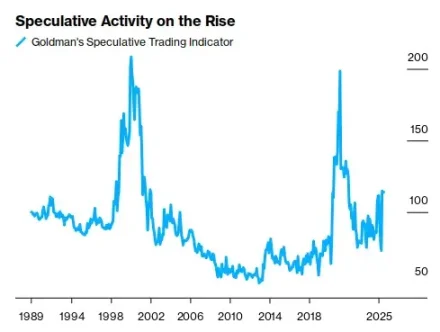
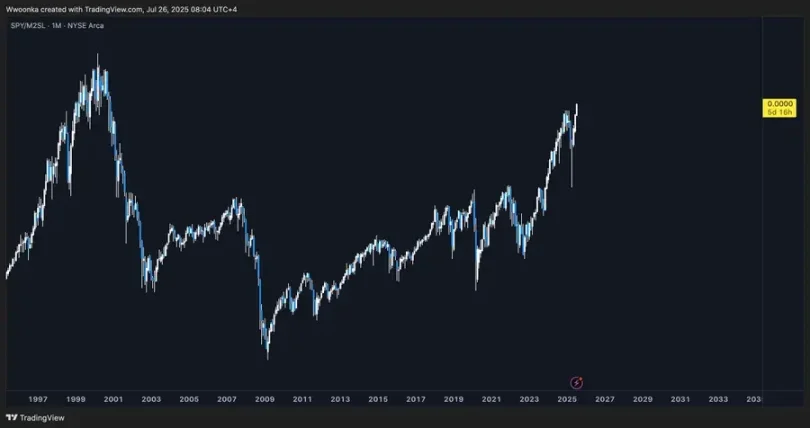
The S&P 500 hits new highs, and people cheer. But step back—those so-called all-time highs are merely illusions of liquidity, measured in a currency driven by every form of inflation with no underlying support. Adjusted for inflation, the S&P has made zero progress since the 2000s. This isn't "growth"—it's a chart of money supply.
And the Fed won’t cut rates next week. At best, September. If the economy deteriorates, maybe one more cut in December. But rate adjustments can't fix anything anymore. We’re facing structural problems now. Only three things truly matter:
1. The slow collapse of the debt system
The modern monetary order has reached its end. Built on ever-expanding debt, it now faces unsolvable internal contradictions. Old strategies—stimulus, bailouts, policy pivots—all relied on one key illusion: the more debt, the greater the prosperity.
This illusion is unraveling. Productivity growth has stagnated. Demographics work against the system. The working-age population is shrinking, dependency ratios are rising, and consumption increasingly depends on credit rather than income. The machine is aging and can no longer self-repair.
Soros’s theory of the super-bubble, often misread as market analysis, is actually an epistemological critique—the way false narratives sustain broken systems. 2008 should have burst this myth. It didn’t. COVID did—because the cost was moral. It proved governments cannot, in the most literal, biological sense, protect their citizens. Many governments have decided survival is not equal for all.
The result is decay in legitimacy. Today’s institutions resemble facades propped up by surveillance, subsidies, and psychological operations. The Epstein case is not an anomaly—it’s a brief exposure of the real architecture: a system where crime, governance, and capital intertwine. The U.S. no longer hides its corruption; it monetizes it.
2. Intelligence encapsulation
Discussions around artificial general intelligence (AGI) remain trapped in naive optimism. Most still believe AI will become as widespread as Excel or AWS—a productivity tool monetized through subscriptions.
This is unrealistic fantasy.
If machines gain self-improvement capabilities, simulate complex systems, and design new weapons—biological, chemical, or informational—they won’t be open source.
Nuclear technology wasn’t democratized. CRISPR isn’t freely available. Every powerful technology eventually becomes a tool of state governance—and superintelligence will be no different.
What Sam Altman hints at, and what Jensen Huang quietly signals through synthetic biology, isn’t about consumer productivity but control over the post-human trajectory. Moderna, the multinational pharma company, is a case in point—the next product won’t be sold at CVS.
The public will not have access to AGI. They’ll only interact with neutered fragments of AGI, wrapped in user interfaces. The real systems will be hidden, restricted, and trained to serve strategic objectives. But that won’t stop most people from believing otherwise. Belief, however, cannot compete with infrastructure.
3. Time as the new currency
Until now, money could buy comfort, security, and social status—but not time. That is changing. As AI decodes the genome and synthetic biology accelerates, we’re entering an era where longevity becomes an engineering advantage.
Don’t mistake this for a public health revolution. True life extension, cognitive enhancement, and embryo optimization will be extremely expensive, tightly regulated, and politically contentious. Governments already overwhelmed by aging populations won’t encourage immortality.
Thus, the rich won’t just be richer—they’ll be biologically distinct, literally, not metaphorically. The ability to alter the human blueprint will create a new economic class: those who escape the mortality curve via biotech patents.
This future cannot be scaled—it’s a path of privilege. Longevity will become the ultimate luxury, priced exclusively for the few. This is why most “longevity funds” underperform. The return is survival—and survival cannot be scaled.
Fork in the Road: Three Civilizations Ahead
We are diverging onto separate tracks, each with its own political economy:
-
Dumbed-down masses (digital fentanyl): dopamine loops generated by AI, social media, virtual pornography, infinite scroll. Overstimulated, malnourished, politically irrelevant. This is the experience of most people. Cheap and easily scalable anesthesia.
-
Cognitive elite (biological transcendence): a small group enhanced biologically and intellectually. They don’t seek financial returns but mastery over biology and death. Fewer, wealthier, and increasingly inaccessible.
-
New Amish (conscious rejection): the third, exit path—those who disconnect, seek meaning outside the machine, and attempt to preserve human experience in a world designed to erase it. Spiritually rich, strategically doomed.
The first group funds the second. The third resists both.
Most will “go with the flow” (blindly follow), barely staying afloat, unaware they’ve become products, not participants. But for those who see the future, opting out is no longer neutral—it’s resistance.
Clear Strategy in a Broken World
Markets are noise. Cryptocurrency, stocks, yield games—they’re optional tools, not salvation. The real game is about survival. The question is who escapes the collapse, and under what conditions.
-
The design of the monetary system is degrading continuously.
-
Superintelligence will not be your productivity assistant.
-
Biotechnology will isolate time itself.
-
Epstein proved power is isolated, not accountable.
If you understand this, the question isn’t how to “beat the market.” It’s how to prepare for asymmetry within a system that no longer serves its participants.
You won’t recognize it in price movements—you’ll recognize it in systems thinking.
Most won’t look up. Most won’t believe until it’s too late. Even if it costs them everything. Because dying numb is worse than dying broke.
Join TechFlow official community to stay tuned
Telegram:https://t.me/TechFlowDaily
X (Twitter):https://x.com/TechFlowPost
X (Twitter) EN:https://x.com/BlockFlow_News
 @arndxt_xo






