Stablecoins Breaking Boundaries: In-Depth Analysis of the Race Among 12 Countries' Stablecoin Regulatory Policies
TechFlow Selected TechFlow Selected
Stablecoins Breaking Boundaries: In-Depth Analysis of the Race Among 12 Countries' Stablecoin Regulatory Policies
Systematically梳理 the latest developments in stablecoin regulation across countries.
 Navigating Web3 tides with focused insights
Author: Fairy, ChainCatcher
Editor: TB, ChainCatcher
The breakout effect of stablecoins is continuously amplifying.
From frequent appearances of related topics on Douyin's trending charts, to traditional financial influencers collectively shifting their content focus, to relatives and neighbors proactively inquiring, stablecoins seem to have become a socially pervasive buzzword embedded in daily life.
Meanwhile, global policy developments are reaching a critical turning point. Over the past year, multiple countries have shifted from cautious observation to acceptance of stablecoins: Hong Kong’s Stablecoin Ordinance is about to take effect, the EU’s MiCA regulation has officially been implemented, and the U.S. passed the GENIUS Act. Stablecoins are quietly reshaping the foundation of the global monetary system.
This article systematically reviews the latest regulatory developments across countries, analyzing the underlying logic and strategic implications of this financial transformation.
A Global Overview of Stablecoin Regulation at a Glance
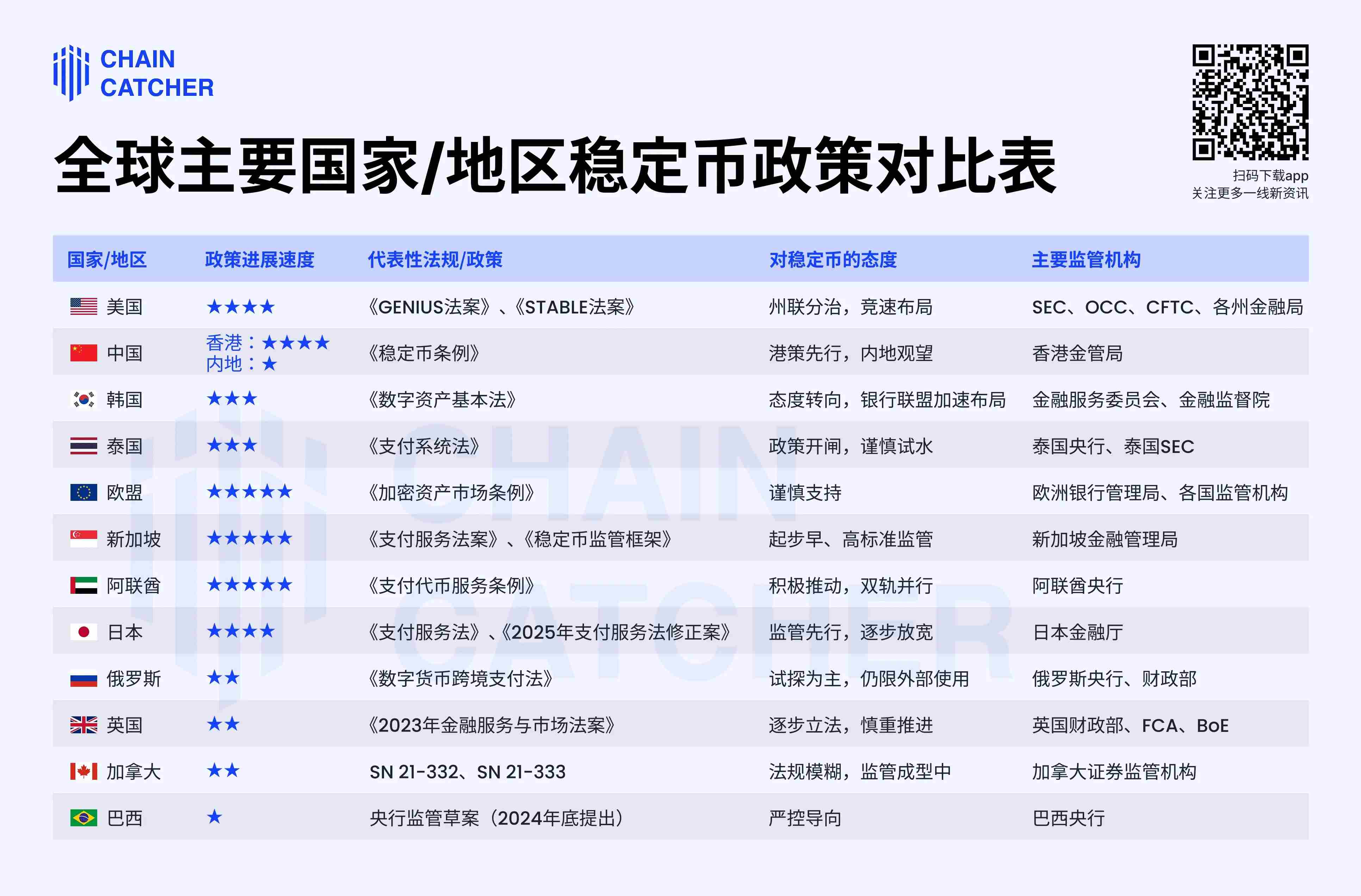
Analyzing Stablecoin Policy Evolution Across Twelve Key Global Markets
United States: Dual Federal-State Governance, Racing to Establish Frameworks
Policy Progress Speed: ★★★★
Stablecoin development in the United States follows a "federal + state-level" dual-track approach. On one hand, the federal government is accelerating efforts to establish a unified regulatory framework; on the other, individual states are pioneering specific regulations and driving early implementation.
At the state level, several jurisdictions have already enacted concrete regulations and frameworks:
-
In 2023, Wyoming passed the Wyoming Stablecoin Act, establishing the Wyoming Stablecoin Committee and planning to issue a state-supported stablecoin, WYST, by August 20, 2025.
-
The New York Department of Financial Services required stablecoin issuers to obtain a BitLicense or trust company license as early as 2018, along with compliance with strict rules.
-
California passed the Digital Financial Assets Law (DFAL) in 2023, creating a comprehensive licensing regime covering stablecoin issuers. DFAL will take full effect in July 2026.
Federal-level regulatory legislation is also advancing rapidly:
-
The GENIUS Act was signed into law by Trump on July 19, 2025.
The act mandates: prohibition of interest-bearing stablecoins, monthly disclosure of reserve composition subject to audit, and personal liability of CEOs and CFOs for data accuracy. Issuers may choose federal or state oversight, while smaller issuers (issuance under $10 billion) may opt for state-only regulation.
-
The STABLE Act was introduced in March 2025 and has passed the House, awaiting Senate vote. Its draft content largely mirrors that of the GENIUS Act.
China: Hong Kong Leads, Mainland Observes
Policy Progress Speed: Hong Kong ★★★★|Mainland ★
China's mainland and Hong Kong exhibit a "vanguard + domestic"联动 pattern in stablecoin regulation: Hong Kong establishes a mature regulatory system to attract business, while the mainland remains cautious.
Hong Kong’s Stablecoin Ordinance will officially take effect on August 1, 2025.
Currently, around 50 to 60 companies have expressed interest in applying, half being payment institutions and the other half large internet platforms, most with Chinese capital backgrounds. Companies including JD, Standard Chartered, and Ant Group have initiated preparations. The industry expects only 3 to 4 licenses to be issued initially, indicating high entry barriers.
It is reported that initial licenses may be granted via invitation rather than open application, and early stablecoins will primarily be pegged to the Hong Kong dollar and U.S. dollar.
On the mainland, long-standing "preventive suppression" is gradually giving way, with multiple provinces and cities recently signaling research and interest in stablecoins.
-
On July 7, Wuxi Municipal Reform Promotion Conference proposed exploring “stablecoin-enabled foreign trade development” to expand digital trade opportunities;
-
On July 9, the official WeChat account of Jinan Municipal Government Research Office published an Xinhua-written feature article on stablecoins;
-
On July 10, the Shanghai SASAC Party Committee held a study session on cryptocurrency and stablecoin trends and response strategies;
-
On July 18, China Academy of Industrial Internet hosted a “Stablecoin and Industrial Digital Assets Seminar.”
South Korea: Shifting Stance, Banking Consortium Accelerates Plans
Policy Progress Speed: ★★★
South Korea is transitioning from “watching” to “entering.” With President Lee Jae-myung pledging support for won-pegged stablecoins, the ruling party formally introduced the Digital Asset Basic Act on June 10, allowing local firms with capital over $368,000 to issue stablecoins—a clear policy relaxation.
Currently, eight major South Korean banks are forming a joint venture to co-issue a won-pegged stablecoin. Participants include KB Kookmin Bank, Shinhan Bank, Woori Bank, NH Bank, Korea Development Bank, Suhyup Bank, and Korean branches of Citibank and Standard Chartered. The project is jointly driven by the eight banks, the Open Blockchain & Decentralized Identity Association, and the Financial Supervisory Service. If approved, it is expected to launch by end of 2025 or early 2026.
However, regulatory clarity remains uncertain. According to 100y.eth, research head at Four Pillars, South Korea is currently experiencing a stablecoin bubble without clear regulatory guidance. Financial news reports almost daily on banks or companies filing stablecoin-related trademarks, typically followed by 15%-30% stock price increases for listed firms.
Thailand: Policy Opening, Cautious Piloting
Policy Progress Speed: ★★★
Thailand's stablecoin policy has evolved from initial caution to cautious piloting. As early as 2021, the Bank of Thailand began exploring stablecoin regulation, issuing preliminary guidelines. Thai baht-pegged stablecoins are classified as “e-money” under the Payment Systems Act, requiring prior consultation and approval from the central bank before issuance. Foreign-currency-pegged stablecoins (e.g., USDT, USDC) are not banned but require further oversight.
A true turning point came in 2024. In August, Thailand launched a regulatory sandbox allowing selected service providers to experiment with cryptocurrencies.
In 2025, pilot expansion accelerated:
-
In January, Thailand’s finance minister stated during a Securities and Exchange Commission meeting that the government is considering issuing a 10-billion-baht government bond-backed stablecoin.
-
In March, Thailand’s SEC approved USDT and USDC as tradable assets on regulated domestic exchanges.
-
In July, the SEC and BOT jointly launched a “National Crypto Sandbox,” enabling foreign tourists to exchange digital assets like USDT and USDC into Thai baht via licensed platforms for tourism spending.
European Union: Unified Regulation, Cautious Support
Policy Progress Speed: ★★★★★
The EU’s stance on stablecoins can be summarized as “cautious support”: fully recognizing their potential while remaining highly vigilant about financial stability, regulatory arbitrage, and money laundering risks.
In June 2023, the EU formally released the Markets in Crypto-Assets Regulation (MiCA), aiming to comprehensively regulate crypto markets. Partial provisions took effect on June 30, 2024, with stablecoin-specific clauses fully implemented by December 30, 2024. The regulation applies to all 27 EU member states and three EEA countries: Norway, Iceland, and Liechtenstein.
MiCA sets high barriers for stablecoin issuance and operation: issuers must obtain authorization from a national regulator (e.g., Germany’s BaFin, France’s AMF) and establish a legal entity within the EU. For “significant” stablecoins (e.g., high transaction volume), supervision shifts to the European Banking Authority (EBA).
MiCA also limits non-euro-denominated stablecoins to no more than 1 million transactions or €200 million in daily value per currency area. Exceeding these thresholds requires issuers to halt issuance and submit a remediation plan within 40 working days.
To date, the EU has issued MiCA licenses to 53 crypto firms, including 14 stablecoin issuers and 39 crypto asset service providers.
Singapore: Early Starter, High Standards
Policy Progress Speed: ★★★★★
Singapore leads in stablecoin regulation. As early as December 2019, it enacted the Payment Services Act, defining and classifying payment service providers.
Later, in December 2022, the Monetary Authority of Singapore (MAS) released a draft “Stablecoin Regulatory Framework” for public consultation, finalizing it on August 15, 2023. This framework specifically applies to single-currency stablecoins (SCS) pegged to the Singapore dollar (SGD) or G10 currencies issued in Singapore, supplementing the Payment Services Act.
MAS sets high entry barriers. Issuers must meet the following requirements:
-
Minimum capital of at least 50% of annual operating expenses or SGD 1 million, whichever is higher;
-
Stablecoin issuers cannot engage in trading, asset management, staking, lending, or directly hold shares in other legal entities;
-
Liquid assets must exceed 50% of annual operating costs to ensure normal redemption capacity;
-
Reserve assets must consist solely of low-risk, highly liquid instruments: cash, cash equivalents, or bonds with less than three months to maturity.
Currently, multiple institutions have applied to MAS for stablecoin issuance licenses. StraitsX (issuer of XSGD) and Paxos are seen as leading examples of compliant deployment.
United Arab Emirates: Proactive Push, Dual-Track System
Policy Progress Speed: ★★★★★
The UAE demonstrates supportive and open attitudes toward stablecoin policies. In June 2024, the Central Bank of the UAE (CBUAE) issued the Payment Token Services Regulation, defining “payment tokens” (stablecoins) and establishing a regulatory framework.
As a federation of seven emirates, the UAE features a distinct “dual-track” regulatory model: the central bank oversees federal-level regulation, while financial free zones such as Dubai International Financial Centre (DIFC) and Abu Dhabi Global Market (ADGM) operate under independent legal systems and regulatory authorities.
Compared to the EU’s MiCA or Hong Kong’s Stablecoin Ordinance, the UAE’s new rules define stablecoins more broadly, though still impose certain boundaries:
-
Prohibition of algorithmic stablecoins and privacy tokens
-
Stablecoins may not offer interest or rewards tied to holding duration
In practice, the UAE’s stablecoin market is already showing results. In December 2024, AE Coin received CBUAE approval, becoming the UAE’s first fully regulated dirham-pegged stablecoin.
In April 2025, Abu Dhabi’s sovereign wealth fund ADQ, conglomerate IHC, and the UAE’s largest bank First Abu Dhabi Bank jointly announced plans to launch a new dirham-pegged stablecoin.
Japan: Regulatory Leadership, Development Pending
Policy Progress Speed: ★★★★
Japan leads globally in stablecoin regulation and has completed foundational legislative architecture, primarily through amendments to the Payment Services Act (PSA).
In June 2022, Japan’s Diet passed the revised PSA, which took full effect in June 2023. The updated law provides detailed definitions of stablecoins, identifies eligible issuers, and specifies licensing requirements for stablecoin transactions. It restricts stablecoin issuance to three categories: banks, trust companies, and money transfer service providers.
In March 2025, Japan’s Financial Services Agency advanced the 2025 Payment Services Act Amendment, optimizing the stablecoin issuance mechanism: trust-type stablecoins may allocate up to 50% of reserves to specific low-risk instruments such as short-term government bonds or time deposits. The amendment also introduces a dedicated registration category for crypto intermediaries, lowering barriers for OTC participation.
Russia: Tentative Steps, External Use Only
Policy Progress Speed: ★★
Russia’s attitude toward stablecoins has significantly shifted in recent years—from initial caution or opposition to limited support—driven by geopolitical pressures and strategic needs for cross-border settlement and autonomous financial infrastructure.
In 2022, the Russian central bank pushed for a complete ban on cryptocurrencies. However, in July 2024, policy took a key turn: the State Duma passed two bills formally legalizing crypto mining and permitting approved enterprises to use crypto assets, including stablecoins, for international settlements with overseas partners. Domestically, however, cryptocurrencies remain prohibited as payment methods.
In March 2025, the central bank released a proposal to allow “particularly qualified” high-net-worth individuals and select enterprises to invest in crypto assets during a three-year pilot, aiming to explore a more transparent and controlled market environment.
Beyond formal policy, Ivan Chebeskov, head of the Ministry of Finance’s Digital Financial Assets Department, publicly stated that Russia should consider launching a sovereign stablecoin to adapt to evolving global payment systems.
United Kingdom: Regulatory Advancement Underway
Policy Progress Speed: ★★
UK policy is at a critical juncture between framework design and legislative implementation. The regulatory system is based on the Financial Services and Markets Act 2023, supplemented by secondary regulations and guidance from the Financial Conduct Authority (FCA) and the Bank of England (BoE). The Act received Royal Assent on June 29, 2023, and for the first time includes “digital settlement assets” (including stablecoins) within the scope of regulated financial activities.
In November 2023, the FCA published regulatory requirements for companies issuing or custodizing fiat-backed stablecoins. The proposed framework aims to apply existing regulatory standards—already applicable to many FCA-authorized entities—to stablecoin activities.
In April 2025, the UK government released a consultation paper on crypto legislation, proposing to add regulated activities including operating crypto asset trading platforms and issuing stablecoins.
Despite ongoing regulatory progress, the Bank of England governor maintains a more conservative stance. Governor Andrew Bailey has repeatedly warned that widespread stablecoin adoption could undermine public confidence in the national currency and pose systemic risks to the financial system.
Canada: Legal Ambiguity, Regulation Taking Shape
Policy Progress Speed: ★★
Compared to markets like the U.S. and EU, Canada’s policy is more conservative, and its domestic stablecoin market is developing slowly.
In December 2022, the FTX collapse triggered global crypto turmoil, prompting Canadian securities regulators (CSA) to tighten rules, bringing stablecoins under the regulatory umbrella of “securities and/or derivatives.”
Since 2023, CSA has issued two key documents, SN 21332 and SN 21333, outlining a regulatory framework for fiat-pegged stablecoins. Under these rules, stablecoin issuers must register as securities issuers, file prospectuses, or sign recognized undertakings with CSA.
Last month, Canada’s banking regulator stated it is ready to regulate stablecoins, with the framework currently under development.
Brazil: Strict Control Orientation
Policy Progress Speed: ★
Data from Brazil’s central bank shows that over 90% of the country’s crypto transactions involve stablecoins, mainly used for cross-border payments—sparking compliance concerns.
Central Bank President Gabriel Galipolo noted that the bank initially believed stablecoins gained popularity as a convenient way for people to hold U.S. dollars. But deeper analysis revealed most transactions relate to cross-border shopping and lack transparency, raising risks of tax evasion or money laundering.
To address this, in December 2024, the central bank proposed a new draft rule to bring stablecoins under foreign exchange regulation and prohibit transfers to wallets controlled by non-Brazilian entities.
Overall, Brazil’s regulatory direction is clear: prioritize stringent control and suppress high-risk transaction scenarios.
Despite tightening regulations, traditional banks are exploring compliant pathways. Itau Unibanco, Brazil’s largest bank (with over 55 million customers), plans to launch a real-pegged stablecoin. Itau is currently studying experiences from other banks and awaiting the release of Brazil’s stablecoin regulatory framework.
Join TechFlow official community to stay tuned
Telegram:https://t.me/TechFlowDaily
X (Twitter):https://x.com/TechFlowPost
X (Twitter) EN:https://x.com/BlockFlow_News
 ChainCatcher 链捕手