What Is Smart Money Seeing in BlackRock’s and Visa’s Stablecoin Bets?
TechFlow Selected TechFlow Selected
What Is Smart Money Seeing in BlackRock’s and Visa’s Stablecoin Bets?
The entry of traditional financial giants signifies that stablecoins are evolving from "a toy in the crypto circle" into "infrastructure for global finance."
 Navigating Web3 tides with focused insights
Author: Cathy
In January 2026, the total market capitalization of the global stablecoin market surpassed $317 billion, hitting an all-time high.
But what truly matters isn't the number itself—it's the trend behind it: Circle’s USDC surged 73% in 2025, marking the second consecutive year outpacing Tether’s USDT (36%). Then in December 2025, Visa announced the launch of USDC settlement services in the United States.
When the world’s largest payment network begins settling with stablecoins, when BlackRock—a manager of $10 trillion in assets—launches on-chain money market funds, and when JPMorgan settles $3 billion daily via blockchain, what are these traditional financial giants seeing?
01 Why Are Traditional Financial Giants Going All-in on On-Chain?
In March 2024, BlackRock launched BUIDL—a tokenized money market fund.
This wasn’t BlackRock’s first foray into blockchain, but it was its most aggressive move yet. BUIDL is issued directly on public blockchains, holds U.S. Treasuries and cash, maintains a $1 net asset value, and distributes monthly yields to holders.
BUIDL surpassed the $1 billion mark in March 2025, becoming the first on-chain fund to reach that scale. By the end of 2025, its size had exceeded $2 billion, making it the largest tokenized fund in existence.
What did BlackRock see?
The answer is simple: efficiency and cost.
Traditional money market funds require T+1 or T+2 settlement for subscriptions and redemptions; cross-border transfers rely on the SWIFT system, riddled with layered fees. In contrast, on-chain funds settle in seconds, with transaction costs under $1, operating 7×24 hours.
More importantly, BUIDL opened up an entirely new distribution channel. Previously, retail investors struggled to access money market funds (typically requiring minimum investments over $1 million). But through blockchain, anyone can now buy in.
That’s why protocols like Ondo Finance have risen to prominence.
Ondo does one thing simply: repackages institutional-grade RWA products like BlackRock’s BUIDL into smaller shares for DeFi users. Its OUSG product invests directly in BUIDL, allowing everyday users to earn 4–5% annualized returns from U.S. Treasuries.
The tokenized U.S. Treasury sector exploded in 2025, growing from less than $200 million at the beginning of 2024 to over $7.3 billion by the end of 2025 (per RWA.xyz data). BlackRock’s entry effectively provided regulatory legitimacy for the entire RWA space.
02 Why Choose USDC Over USDT?
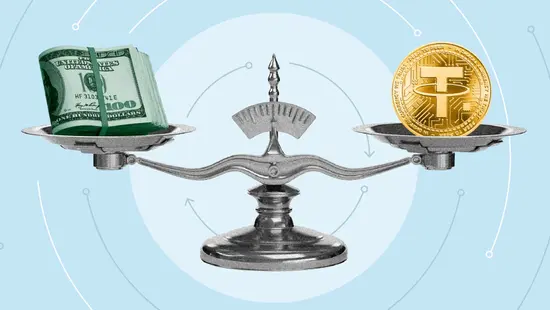
Tether (USDT) remains the king of stablecoins, with a market cap of $186.7 billion, capturing 60% of the market share.
But smart money is voting with its feet.
In 2025, USDC’s market cap grew from around $44 billion to over $75 billion—an increase of 73%. Meanwhile, USDT grew only 36%, rising from approximately $137 billion to $186.7 billion. This marks the second consecutive year that USDC has grown faster than USDT.
Why?
The answer is regulation.
On July 18, 2025, the U.S. President signed the GENIUS Act—the first federal legislation targeting stablecoins in the United States. The law mandates that “payment stablecoins” must be fully backed (100%) by reserves in cash or short-term Treasuries and cannot offer interest to users.
Circle’s USDC fully complies with this standard. Moreover, Circle became the first global issuer to achieve full compliance under the EU’s MiCA framework.
What does this mean?
It means USDC has obtained a passport into mainstream financial systems.
When Stripe chooses a stablecoin for payments, it picks USDC. When Visa launches stablecoin settlements, it uses USDC. When Shopify enables merchants to accept stablecoins, it supports USDC.
For banks, payment companies, and regulated exchanges, USDC is a “whitelisted asset,” while USDT faces delisting pressure in Europe due to transparency concerns about its reserves.
But Tether isn’t worried.
Because its main battlefield isn’t the U.S. or Europe—it’s high-inflation regions: Latin America, Africa, Southeast Asia.
In countries like Argentina, Turkey, and Nigeria, USDT has effectively replaced parts of local currencies, serving as a de facto “shadow dollar.” People’s first action upon receiving wages is often converting them into USDT for preservation.
The stablecoin market is splitting into two distinct paths:
- USDC: the compliant path, serving Western institutions and payment use cases, backed by top-tier investors including BlackRock, Fidelity, and General Catalyst
- USDT: the offshore path, serving emerging markets and trading use cases, maintaining an irreplaceable role across the Global South
03 Is This Surrender or Evolution for Payment Giants?
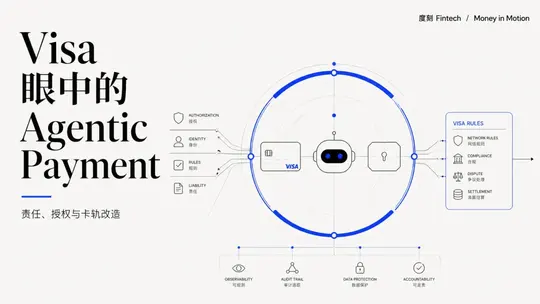
In December 2025, Visa announced the rollout of USDC settlement services in the United States.
This was a historic moment.
Previously, Visa’s business model relied on charging 1.5%-3% per transaction. Now, it allows partners to settle using USDC, drastically reducing fees.
This may look like self-disruption—but in reality, it’s defensive offense.
What threat does Visa see?
Stablecoins are steadily eroding its core business: cross-border payments.
Traditional cross-border payments require multiple intermediary banks, each taking cuts, with settlement times of 3–5 days. Stablecoin payments settle in seconds, costing less than $1.
According to an a16z report, stablecoins processed $46 trillion in transaction volume in 2025—surpassing Visa—and adjusted payment/settlement volume reached about $9 trillion, growing rapidly and encroaching on cross-border and emerging market shares.
Visa’s strategy? If you can’t beat them, join them.
By launching USDC settlement, Visa transforms itself from a “payment rail” into a “payment orchestrator.” It no longer relies on high transaction fees but instead monetizes compliance, risk control, anti-money laundering, and other value-added services.
Meanwhile, other payment giants are moving too:
- Stripe: Acquired Bridge, a stablecoin infrastructure platform, for $1.1 billion in October 2024—one of the largest acquisitions in crypto history
- PayPal: Its stablecoin PYUSD surged 600% in 2025, growing from $600 million to $3.6 billion
- Western Union: Will launch USDPT, a stablecoin on Solana, in the first half of 2026
- 10 European banks: Jointly formed Qivalis, planning to launch a euro-denominated stablecoin in late 2026
Notably, both Western Union and Visa chose Solana as their settlement chain for initial partnerships, highlighting the advantages of high-performance public blockchains—high throughput and low transaction fees—in payment applications.
04 Banks Won’t Sit Idly By
Faced with pressure from non-bank players (Circle, Tether) and payment giants (Stripe, Visa), banks aren’t standing still.
JPMorgan is the most aggressive.
In early 2026, JPMorgan expanded JPM Coin—its deposit token under the Kinexys blockchain division—onto the Canton Network to enable multi-chain interoperability. This isn’t a publicly tradable stablecoin, but rather a “deposit token.”
Kinexys already handles over $3 billion in average daily transaction volume, primarily serving multinational corporations like Siemens and BMW, enabling them to transfer funds between subsidiaries globally in seconds.
JPMorgan’s logic is clear:
We don’t need to issue tokens on public chains to compete. We’ll keep our clients within private chains, use blockchain to boost efficiency, and retain full control.
In Europe, Société Générale has gone even further. Its subsidiary SG-FORGE issued EURCV (euro stablecoin) and USDCV (dollar stablecoin)—the first stablecoins issued by a regulated bank on a public blockchain (Ethereum)—and listed them on compliant exchanges like Bitstamp.
However, note that bank-issued stablecoins like JPM Coin and USDCV primarily serve corporate clients, not retail markets. They represent the path of traditional finance embracing blockchain technology while maintaining centralized control.
05 Emerging Stablecoin Trends
To summarize, four clear trends are shaping the stablecoin market in 2026:
Acceleration of RWA Tokenization
BlackRock, Ondo, Franklin Templeton, and others are launching tokenized U.S. Treasuries and money market funds. This sector experienced explosive growth in 2025, surging from under $200 million at the start of 2024 to over $7.3 billion by the end of 2025—a more than 35x increase. Traditional financial institutions are bringing U.S. Treasury yields on-chain through tokenization.
Clearer Regulatory Pathways
USDC grew 73%, outpacing USDT for the second straight year. After the passage of the GENIUS Act, compliance has become the only viable path for mainstream institutions. Backed by elite investors like BlackRock and Fidelity, if Circle’s planned 2026 IPO succeeds, it will mark a major milestone for the stablecoin industry.
Restructuring of Payment Infrastructure
Stripe’s $1.1 billion acquisition of Bridge, Visa’s launch of USDC settlement, and PayPal’s 600% surge in PYUSD—all show traditional payment giants integrating stablecoins into their infrastructure rather than passively defending. High-performance blockchains like Solana, with their advantages in payment use cases, are becoming the preferred choice for enterprise applications.
Deepening Market Fragmentation
Stablecoins are no longer synonymous with “stability.” They are diverging into two distinct categories:
- Payment stablecoins (USDC, PYUSD): non-interest-bearing, but compliant, designed for institutions and merchants
- Yield-bearing stablecoins (Ondo USDY, Ethena USDe): offering 4–5% annualized returns, attracting DeFi capital
06 Conclusion
When BlackRock starts issuing on-chain funds, when Visa adopts USDC for settlement, when JPMorgan settles $3 billion daily—stablecoins are no longer just a “crypto story,” but the opening act of a complete financial system overhaul.
This isn’t hype or speculation. In 2025, stablecoins recorded $46 trillion in total transaction volume, with adjusted payment/settlement volume reaching $9 trillion. These are real-world, hard-dollar commercial flows.
The arrival of traditional financial giants signals that stablecoins are transitioning from “toys for crypto natives” to “infrastructure for global finance.” For those watching this space, the key isn’t predicting the next fad, but understanding the underlying logic of this transformation.
Smart money is already moving.
Join TechFlow official community to stay tuned
Telegram:https://t.me/TechFlowDaily
X (Twitter):https://x.com/TechFlowPost
X (Twitter) EN:https://x.com/BlockFlow_News
 白话区块链
白话区块链