Arthur Hayes: The U.S. has cut interest rates every time it waged wars in the Middle East over the past 40 years—and this time is no exception.
TechFlow Selected TechFlow Selected
Arthur Hayes: The U.S. has cut interest rates every time it waged wars in the Middle East over the past 40 years—and this time is no exception.
The timing to go all-in on Bitcoin and high-quality altcoins like $HYPE.
 Navigating Web3 tides with focused insights
Author: Arthur Hayes
Translated and edited by TechFlow
TechFlow Intro: The core argument of Hayes’ article is simple: Following every U.S.-led Middle Eastern war—from the 1990 Gulf War to the 2001 Global War on Terror—the Federal Reserve has cut interest rates. He believes the same historical logic will repeat itself with a 2026 Iran war—and that will be the optimal time to accumulate Bitcoin. The view is bold, the logic clear: you need not agree after reading, but it merits serious attention.
Full text below:
(All views expressed herein are solely those of the author and do not constitute investment advice, recommendations, or guidance for engaging in investment transactions.)
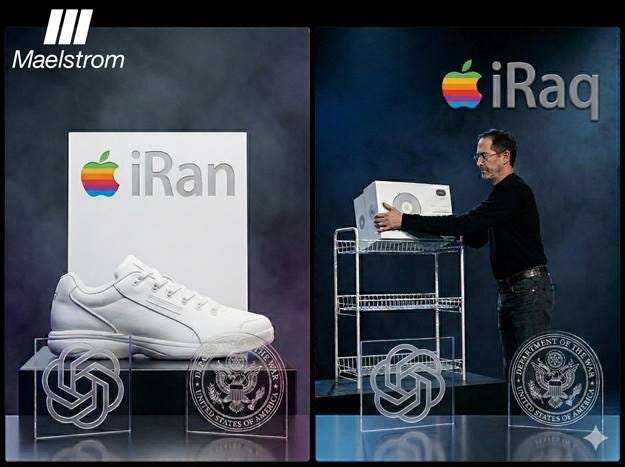
Under the directive of Donald J. Trump—the most peace-loving president in U.S. history—the U.S. Department of War and OpenAI jointly launched an offensive Agent AI weapon: a deadly new Apple iOS. Once uploaded onto a nation’s network infrastructure, this operating system triggers regime change. Regime change is typically accompanied by indiscriminate bombing of military and civilian infrastructure, inflicting massive casualties and costing anywhere from hundreds of billions to several trillion dollars. After resistance forces are eliminated, newly installed U.S.-backed political elites proceed to bleed both American taxpayers and local populations dry, depositing the proceeds into private wealth accounts at JPMorgan Chase. Public resentment against such Vichy-style, pro-U.S. regimes in the Middle East accumulates over time—eventually erupting violently to install reactionary, often oppressive and bloodthirsty, indigenous political structures. The sales cycle is thus complete, and OpenAI can begin marketing its next version. Are you already eagerly anticipating OpenAI’s IPO—priced at an infinite P/E ratio?
Since my consciousness awakened in 1985—leaving my imprint upon the quantum continuum—the Pax Americana’s righteous crusades against Middle Eastern oil-producing nations—and critical geopolitical chokepoints along oil-and-gas pipeline routes—have never ceased. Behold this elegant chart generated using Perplexity’s new Computer model:
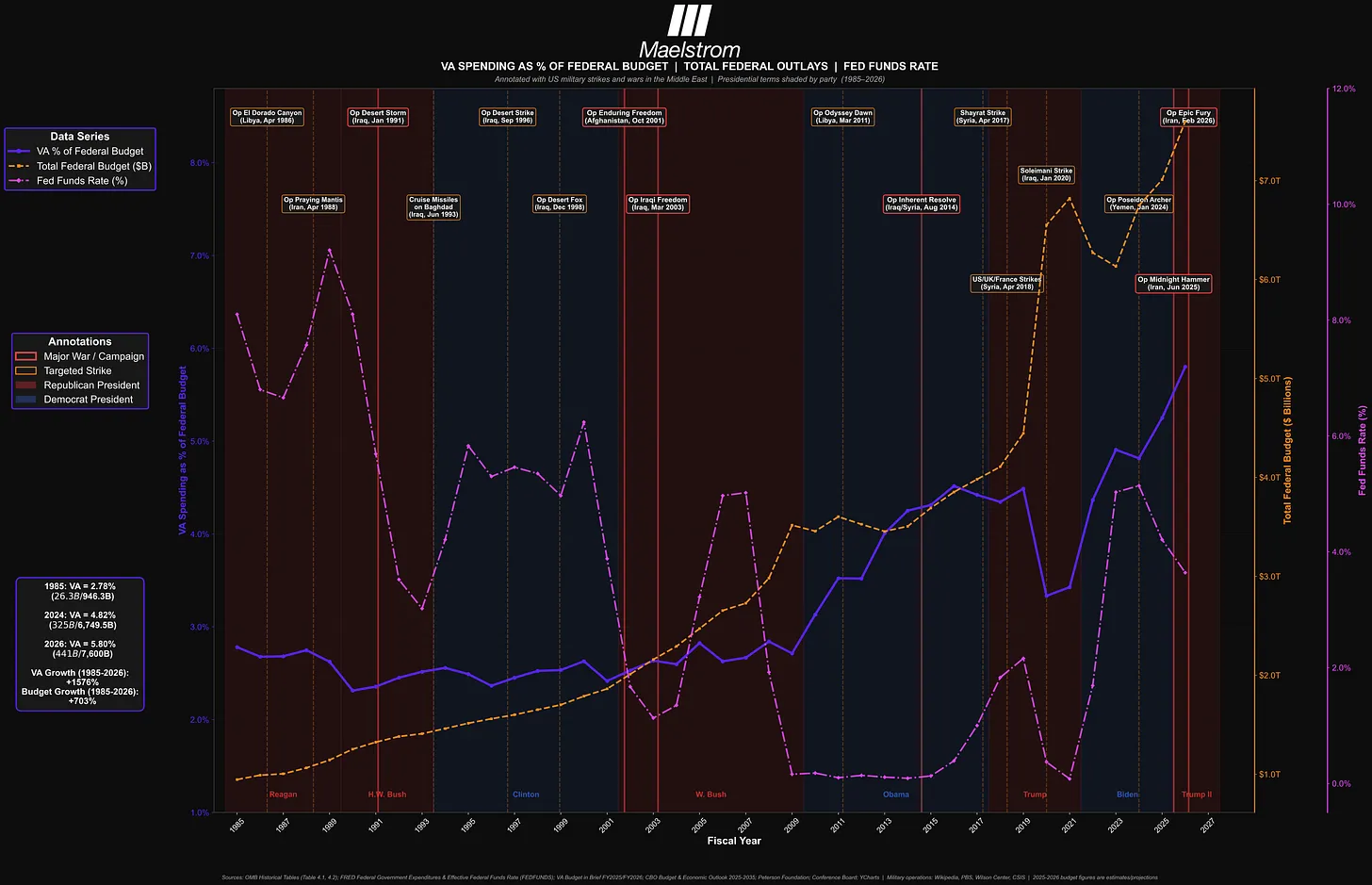
At the macro level, the chart illustrates the human cost of war: the share of federal budget allocated to Veterans Affairs (VA) spending, the total nominal size of federal expenditures, and the effective federal funds rate. Markers indicate instances where the United States launched missile strikes or full-scale wars against Middle Eastern countries—shown here for illustrative purposes only, not as an exhaustive list. As shown, VA spending growth has outpaced overall federal budget growth by a factor of two. Most importantly for this article: each time the Pax Americana initiates a Middle Eastern war, the Fed promptly lowers the cost of funds. Though every U.S. president during my lifetime has attempted to deceive the public—claiming those televised “video game wars” in the Middle East inflict no suffering on American soldiers—the data clearly reveals that this obsession with Middle Eastern military adventurism is destroying American lives at an extremely high cost.
My ovarian lottery granted me birth on this land called the United States—a territory defined by fictional, curved lines. During my forty years of existence, every Republican “Red Team” and Democratic “Blue Team” president has fired missiles at—or waged full-scale war against—at least one Middle Eastern country. It’s as if, the moment you assume the presidency, senior bureaucrats escort you into a top-secret room, clamp your testicles in a vise, and force you to swear: “At least one Middle Eastern nation shall feel the scorching heat of democracy during your term—or else.”
Whether or not you subscribe to currently fashionable conspiracy theories explaining why the U.S. bombs this or that country, the chart makes one thing unmistakably clear: since 1985, every U.S. president has used military force against one or more Middle Eastern nations. Therefore, when President Trump openly boasts about the apparent assassination of Iran’s Supreme Leader Khamenei—and endorses popular revolution to topple that theocratic state—we investors must ask: what will happen to our portfolios when Trump embarks on the same rite of passage traversed by all his predecessors?
As a crypto-bro afflicted by toxic masculinity and possessing a relatively simple mind, I rely on a very basic heuristic to gauge Bitcoin’s price direction: the longer Trump remains engaged in the extraordinarily expensive project of Iranian nation-building, the higher the likelihood that the Fed will lower funding costs and expand the money supply to support the latest round of Middle Eastern adventurism under the Pax Americana.
To test this hypothesis, let’s examine the Fed’s actions following every major Middle Eastern war since 1985.
1990 Gulf War—The Father (President George H. W. Bush)
At its first meeting following the outbreak of war, the Fed held rates steady—but signaled that monetary policy easing might become necessary if the conflict dragged on.
The following quotations are direct excerpts from FOMC statements, retrieved for me by Perplexity.
August 21, 1990:
“The heightened uncertainty arising from events in the Middle East, and the resulting deterioration in the economic outlook, have greatly complicated the formulation of appropriate monetary policy.”
“Several members judged that developments appeared likely to move toward a stance requiring easing at some point, to counteract the weakening trend in economic activity that had been evident even before oil prices rose.”
The Fed subsequently cut rates at its November and December 1990 meetings, citing the war—albeit euphemistically—as a complicating factor in decision-making. The war ended in March 1991.
“Business and consumer confidence declined sharply, reflecting not only developments in the Middle East but also uncertainty regarding the implications of those developments—and their impact on oil prices.”
The Fed eased monetary policy amid inflationary pressures triggered by soaring oil prices.
2001 Global War on Terror (GWOT)—The Son (President George W. Bush)
The GWOT began immediately after the collapse of New York’s Twin Towers at the World Trade Center. Iraq and Afghanistan were almost instantly subjected to interrogation by cruise-missile tribunals. The Fed wasted no time accelerating rate cuts to restore economic confidence.
At the emergency meeting following the attacks, Maestro Alan Greenspan himself announced:
“Clearly, the events of last week have created considerable fear and uncertainty, exerting substantial downward pressure on asset prices and increasing the probability of asset-price deflation, with obvious implications for the economy. Accordingly, I move that the target for the federal funds rate be reduced by 50 basis points.”
In essence, if eroding confidence in the Pax Americana economy causes asset prices to fall, the Fed must act immediately. The cure, as always: cheaper, more abundant money.
Another Fed statement is equally revealing—it signals that, when required, the Fed stands ready to fulfill its duty of helping finance the war machine.
November 6, 2001—FOMC Statement:
“Although the necessary reallocation of resources to enhance security may dampen productivity growth for a time, prospects for productivity growth and the long-term economic outlook remain favorable.”
2009 Troop Surge—The Holy Spirit (President Barack Obama)
Unfortunate civilians in Iraq, Syria, and Afghanistan may have believed a Nobel Peace Prize-winning president would not rain hellfire upon their lands. They were gravely mistaken; false hope truly kills. Though Obama did not launch any major new Middle Eastern wars, he did implement a troop surge in Afghanistan—a conflict he deemed just.
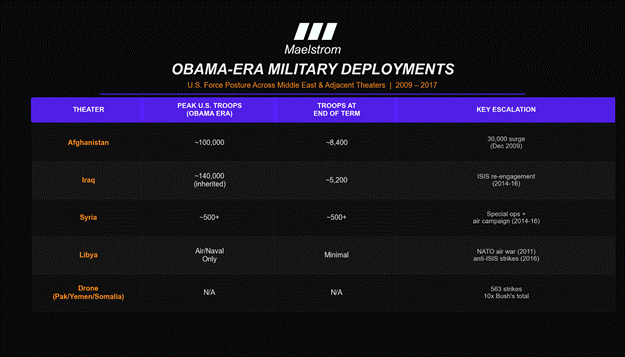
Given that the Fed had already cut rates to zero by late 2008 and begun printing money via quantitative easing, it had no further operational leeway left in response to Obama’s troop surge. Money was free—and supply unlimited. The U.S. war machine and its contractors feasted.
2026 Iran—The Messiah (President Donald Trump)
Fate is ironic: after surviving an assassination attempt during his 2024 presidential campaign, Trump nearly rose from the dead. As Kanye said, Jesus walks. I can now talk about Kanye—because he’s surrendered, right…?
Trump’s presidential tenure—and the re-election prospects of his Red Team Republican lawmakers in November—will hinge respectively on success defined by financial asset market gains and oil price declines. Given that regime change in Iran has been the shared daydream of bipartisan Pax Americana political elites since the 1979 fall of the Shah, the Fed enjoys strong political cover to ease monetary policy aggressively. To neglect its patriotic duty—to provide cheaper, more abundant funding for rebuilding Iran into a U.S. client state—would be unpatriotic.
Trading Strategy
Sitting here today, we cannot know how long Trump will sustain his interest—costing tens of billions, or even trillions, of dollars—in reshaping Iranian politics to his liking, nor how much geopolitical and financial-market pain he can politically withstand before withdrawing. A prudent approach is to wait and watch. The optimal timing to go all-in on Bitcoin and high-quality altcoins like $HYPE is immediately after the Fed cuts rates and/or prints money to support the government’s Iran objectives.
Stay safe, everyone.
Join TechFlow official community to stay tuned
Telegram:https://t.me/TechFlowDaily
X (Twitter):https://x.com/TechFlowPost
X (Twitter) EN:https://x.com/BlockFlow_News
 Arthur Hayes