Crypto Capital Favors the "Big Brother": Under Bitcoin's Dominance, How Can Altcoins Break Through and Reshape the Landscape?
TechFlow Selected TechFlow Selected
Crypto Capital Favors the "Big Brother": Under Bitcoin's Dominance, How Can Altcoins Break Through and Reshape the Landscape?
This cycle's altcoin beneficiaries will be more concentrated, and capital allocation will be more selective than in any previous cycle.
 Navigating Web3 tides with focused insights
Author: Tanay Ved
Translation: Luffy, Foresight News
TL;DR
- The crypto investment landscape continues to expand, yet capital’s selection of assets is narrowing: Bitcoin's market dominance is steadily rising, while the growth of stablecoins and on-chain derivatives is increasingly squeezing out altcoins.
- The altcoin market is shrinking, with a significantly strengthened concentration at the top: The current top 10 altcoins account for approximately 82% of the sector’s total market cap, up sharply from 70% five years ago.
- Since 2023, large-cap cryptocurrencies have significantly outperformed mid- and small-cap coins. Post-market volatility, capital flows further reinforce investor preference for high-liquidity, mature leading assets.
The map of crypto investment continues to expand. Hundreds of new tokens launch each year, more equities tied to digital asset businesses are emerging, and tokenization technology is gradually bringing traditional assets such as equities and commodities on-chain. Yet, despite increasingly diverse investment options, market capital has become ever more selective.
Bitcoin’s market dominance has rebounded to around 65%, hitting its highest level since early 2021. At the same time, stablecoins and on-chain derivatives (such as wrapped tokens, staked tokens, and cross-chain bridge tokens) now account for nearly 12.5% of the total crypto market cap. As a result, altcoins face dual pressure—despite growing token counts, their overall market share continues to shrink.
This edition of the "State of the Network Markets" report explores whether the crypto market is undergoing a structural shift toward capital centralization. We will analyze trends in market dominance and performance across different market-cap tiers and sectors to understand whether capital is increasingly concentrating in fewer, larger, and more mature tokens—or whether investment opportunities remain broadly distributed.
Trends in Market Cap Dominance
We begin by analyzing market cap dominance. Bitcoin’s market dominance—the ratio of its market cap to the total crypto market cap—rose to 65% in 2025, reaching its highest level since 2021. Notably, this growth hasn’t been a short-term spike but rather a sustained, steady climb since bottoming in 2022.
The launch of spot Bitcoin ETFs accelerated institutional adoption, attracting over $150 billion in long-term capital, further boosting Bitcoin’s market dominance. This trend solidifies Bitcoin’s role as a “safe-haven” asset within crypto and establishes it as a high-liquidity, regulated gateway for traditional institutional investors entering the space. Unlike previous bull runs where the so-called “altseason” quickly diluted Bitcoin’s share, this cycle shows a more durable dominance.
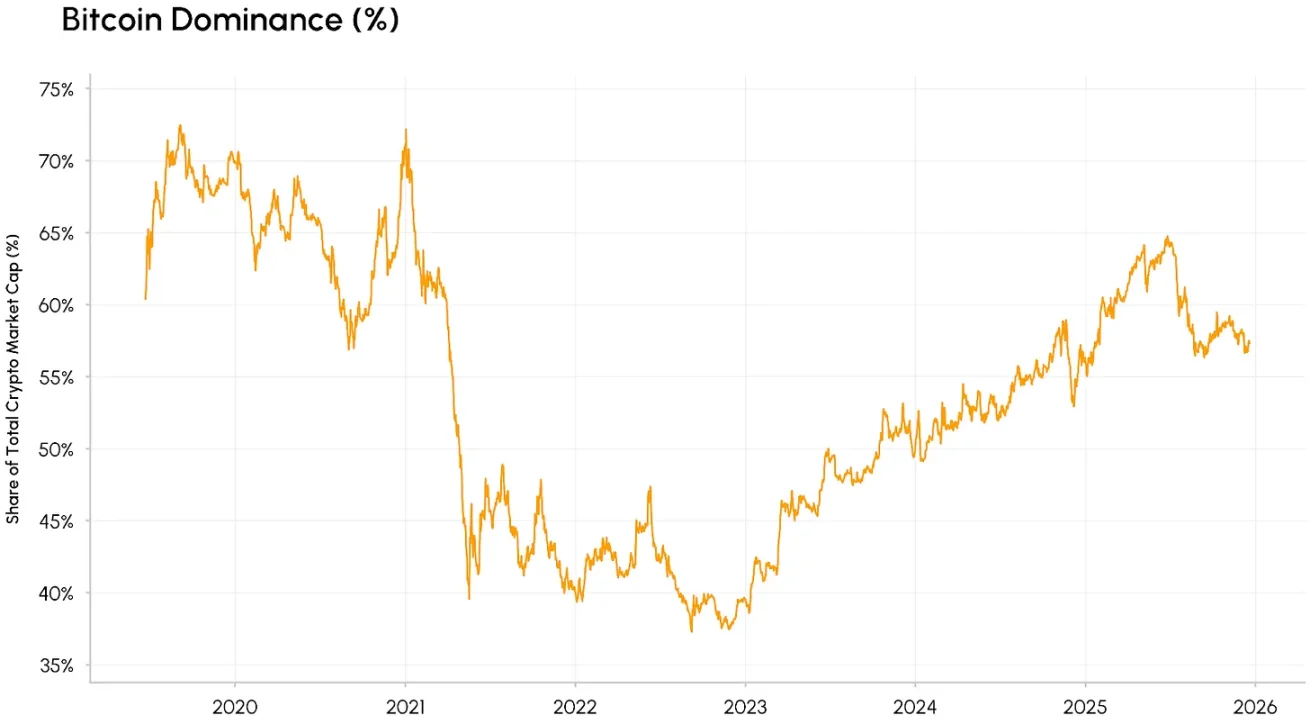
Bitcoin dominance, data source: Coin Metrics
The structure of other assets in the crypto market is also shifting. Stablecoins with a combined market cap exceeding $300 billion, along with on-chain derivatives, are capturing an increasing share of the total crypto market cap. These tokens serve distinct functions: stablecoins act as the primary medium of exchange, while on-chain derivatives provide investors with yield claims or income-generating mechanisms linked to underlying assets.
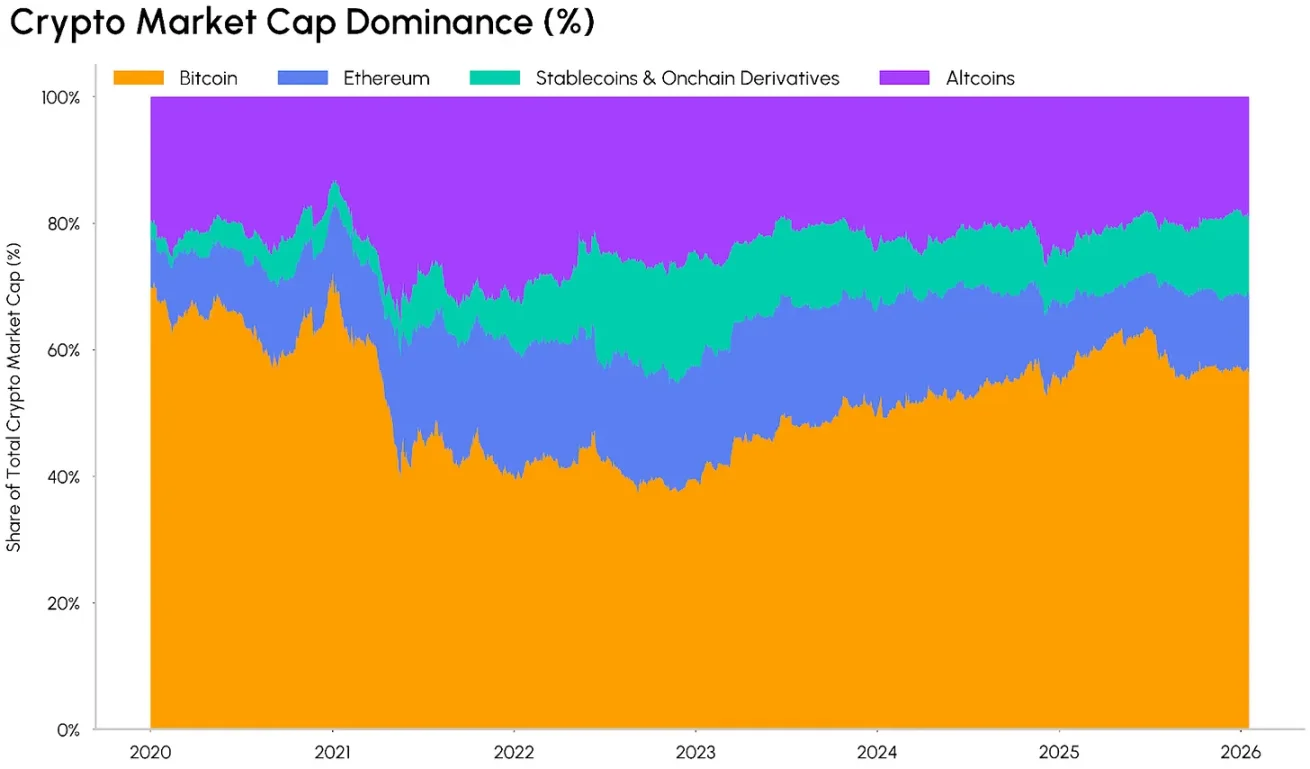
Crypto market dominance breakdown, data source: Coin Metrics
As a result, the altcoin market faces a dilemma. The pool of viable investment targets is shrinking, and top-heavy consolidation is intensifying: value continues to concentrate in assets with higher liquidity and greater maturity—those with clear use cases, defined regulatory pathways, and strong alignment with trends like stablecoins, decentralized finance (DeFi), and asset tokenization.
Unlike prior market cycles, capital rotation from major coins into altcoins has slowed considerably. ETFs and various institutional investment vehicles are locking liquidity firmly into top-tier assets. However, with the implementation of standardized listing rules, the rollout of altcoin and multi-asset ETFs broadening access to large-cap altcoins, and progress in market structure legislation, this landscape may eventually shift.
“Giant Monopoly” Trend Within the Altcoin Sector
Even within the altcoin segment, capital concentration is intensifying. Currently, the top 10 altcoins (excluding Bitcoin) account for about 82% of the sector’s total market cap—up significantly from 64% during the 2021 bull run. Many small-cap altcoins that briefly gained value in the last cycle have since faded, replaced by a market structure with stronger top-tier dominance. Meanwhile, the lifespan of short-term market narratives continues to shorten, making it harder to sustain long-term value appreciation.
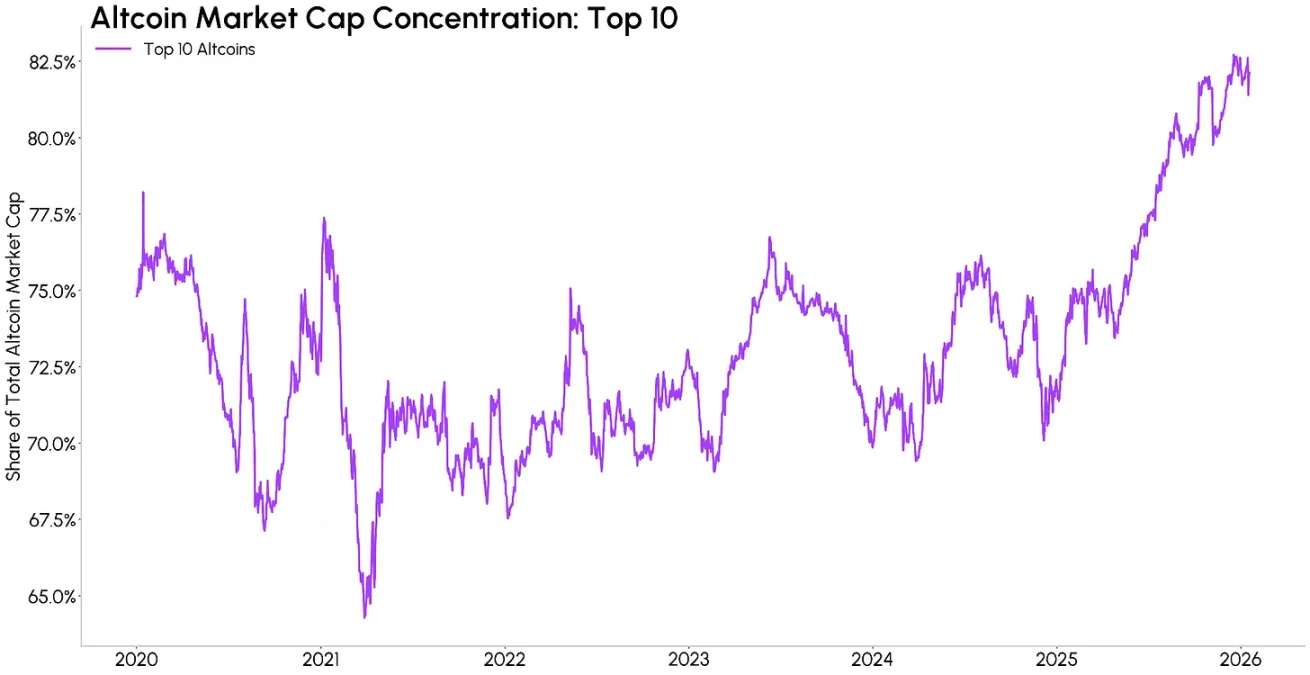
Top 10 altcoins’ market cap share, data source: Coin Metrics
We can also observe this centralization trend by tracking how many tokens exceed certain market cap thresholds. Despite repeated all-time highs in total crypto market cap, the number of altcoins surpassing $1 billion in market cap has declined from a peak of about 105 in 2021 to roughly 58 today. This means that even as the total number of assets grows, the number of truly “investable” altcoins is shrinking. While this doesn’t imply the altcoin sector is declining, it suggests investor focus will increasingly center on assets with stronger fundamentals and greater resilience.
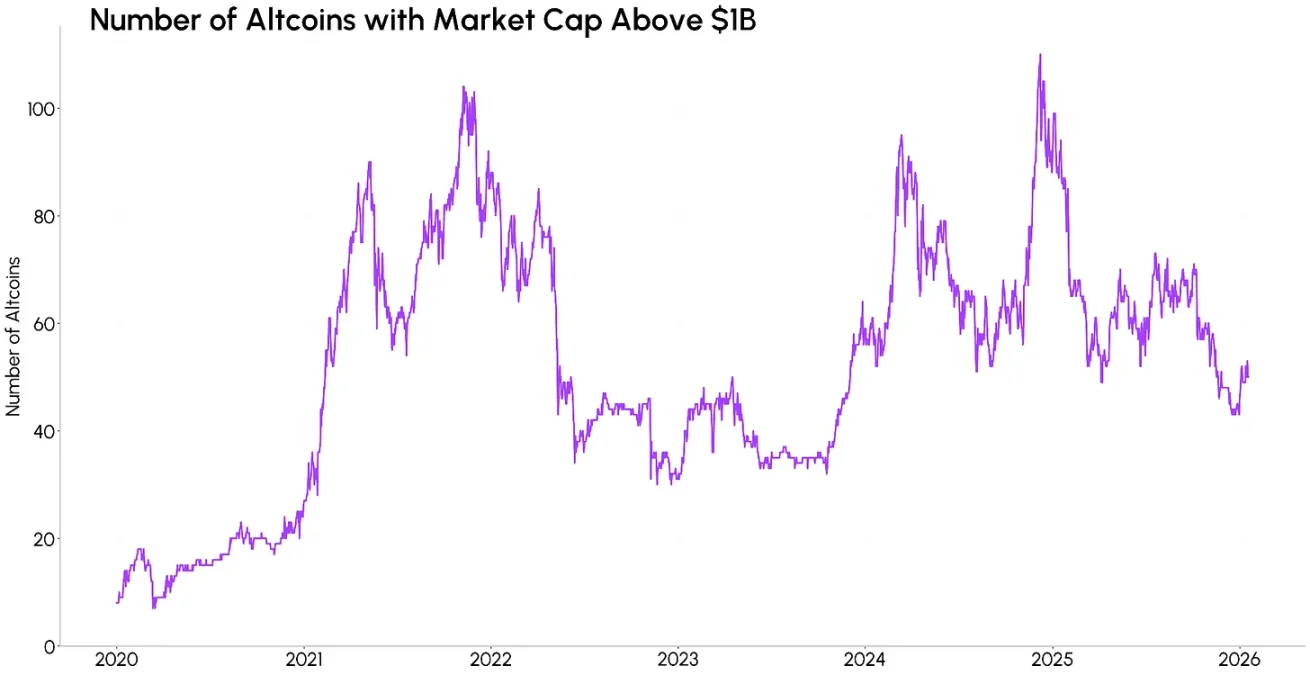
Number of altcoins with market cap above $1 billion, data source: Coin Metrics
The table below summarizes the annual evolution of these market trends. Some indicators still show cyclical patterns—for example, Bitcoin’s dominance tends to dip during bull markets and rise in bear markets—but the share of the top 10 altcoins follows a different trajectory: from 2020 to 2024, it remained stable between 69% and 73% regardless of market conditions, then surged to 82% in 2025. This shift indicates a structural realignment toward mature, leading assets—not merely a short-term chase for high-performing ones.
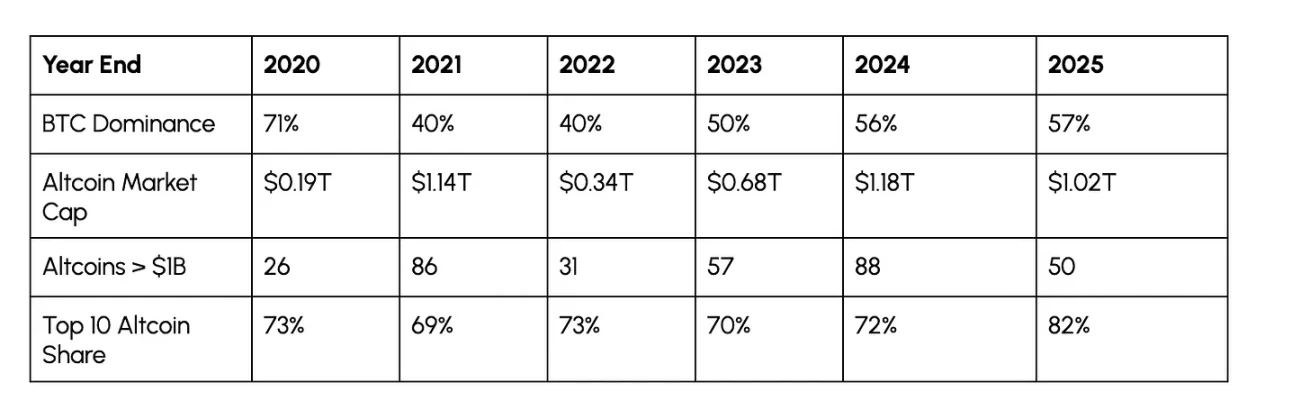
Data source: Coin Metrics
Capital Flows Toward Major Coins
This capital centralization trend is also evident in asset performance. Since 2023, mid-cap coins (market cap $1B–$10B), and especially small-cap coins (under $1B), outperformed large-cap coins (over $10B) during both early and late phases of 2024. However, this trend sharply reversed in 2025, driven by rapidly fading enthusiasm for meme coins and other short-lived narratives.
On an equal-weight basis, from January 2023 to present, large-cap cryptos have returned approximately 365%, compared to only about 70% for mid-caps and 55% for small-caps—erasing most of their earlier gains. This divergence underscores how returns are increasingly favoring mature, highly liquid assets, while small-cap tokens struggle to replicate the sustained rallies seen in past cycles.
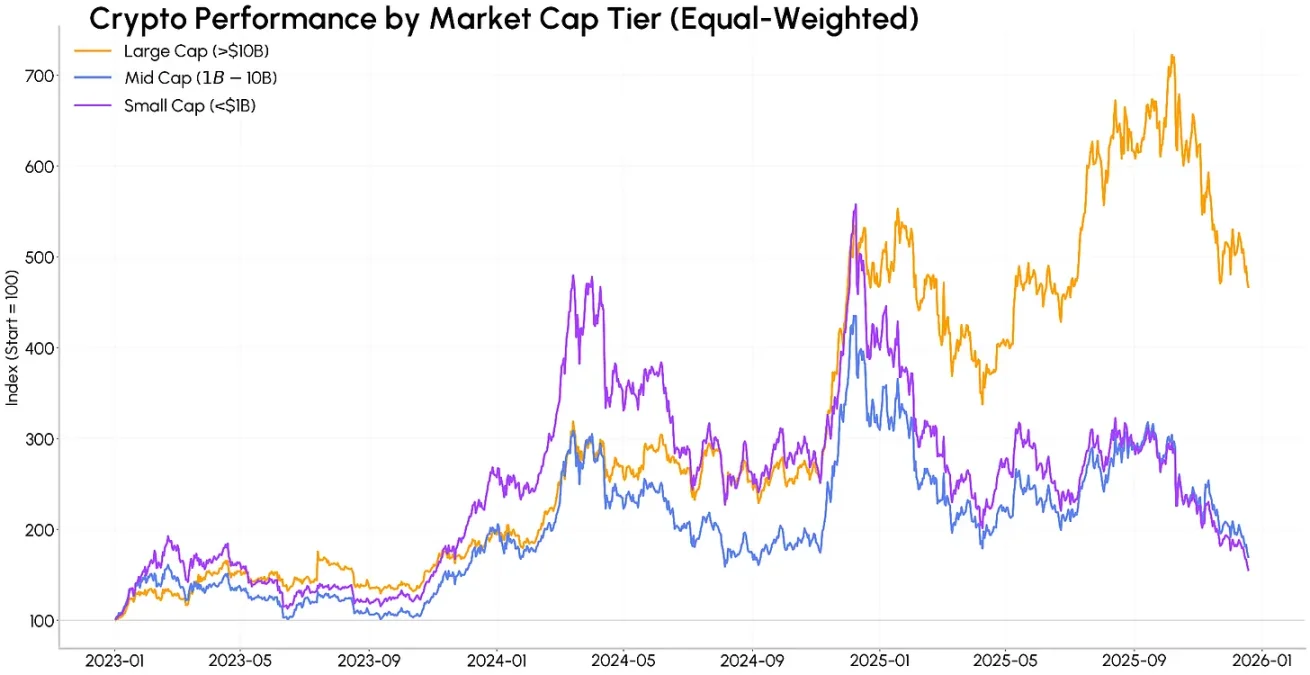
Performance of tokens by market cap size, data source: Coin Metrics
On October 10, 2025, a market event triggered by excessive leverage and liquidity shortages led to widespread liquidations. This incident may further strengthen the trend of capital flowing into defensive assets, with investors increasingly favoring high-liquidity holdings over highly volatile small-cap alternatives.
Conclusion
All data points indicate that the crypto market is undergoing structural changes, maturing, and consolidating. Although the number of crypto assets keeps growing and the range of traditional assets being supported by blockchain infrastructure is expanding, overall market liquidity remains limited. Moreover, within diversified portfolios, crypto assets must compete for allocation against equities and traditional safe-haven assets like gold.
Currently, capital is increasingly concentrating in large-cap crypto assets and infrastructure sectors enabling stablecoins, tokenized assets, and decentralized finance. Liquidity and scale have become more critical than ever, raising the bar for altcoins seeking long-term capital.
That said, if regulatory frameworks for market structure become clearer, altcoin and multi-asset ETFs gain broader adoption, and overall liquidity improves, a new “altseason” could still emerge. However, it is foreseeable that the beneficiaries of such a cycle would be far more concentrated, and capital would be more selective than in any previous market cycle.
Join TechFlow official community to stay tuned
Telegram:https://t.me/TechFlowDaily
X (Twitter):https://x.com/TechFlowPost
X (Twitter) EN:https://x.com/BlockFlow_News
 @coinmetrics