








From World Computer to World Ledger: Is Ethereum Aiming to Be the Central Bank on Chain?
TechFlow Selected TechFlow Selected
From World Computer to World Ledger: Is Ethereum Aiming to Be the Central Bank on Chain?
From "World Computer" to "World Ledger": What Narrative Evolution Has Ethereum Undergone?
 Navigating Web3 tides with focused insights
On June 20, Ethereum founder Vitalik Buterin retweeted and commented on a post by ConsenSys founder Joseph Lubin, stating, "Ethereum Layer 1 (Ethereum L1) is the world ledger."
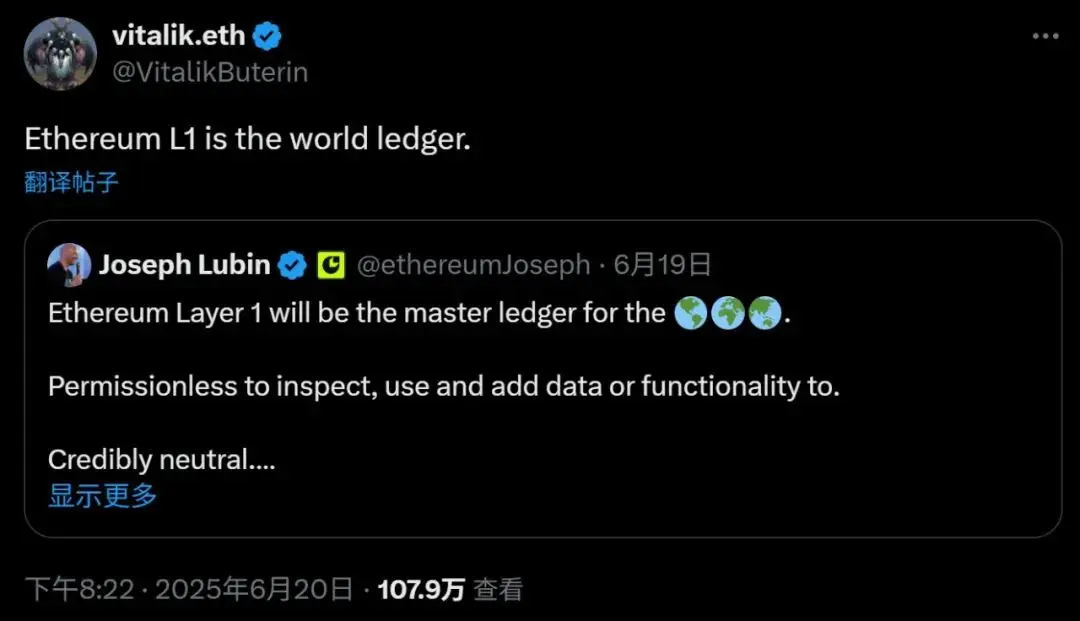
This marks a rare public stance from Vitalik amid recent discussions on Ethereum's macro narrative.
As is well known, in the blockchain world, each public chain generally has a defined design purpose, which often shapes its technical architecture and ecosystem ethos.
Ethereum, for instance, has had the ultimate vision of becoming a "world computer" since its inception—a platform capable of running any smart contract and supporting diverse Web3 application logic. Vitalik himself has clearly stated that Ethereum is not just a payment network, but rather a general-purpose decentralized computing layer.
So how exactly did we transition from the idea of a "world computer" to a "world ledger"?
01. Ethereum: The Original Vision of a World Computer
In fact, this kind of evolution isn't unique to Ethereum. Even Bitcoin, which initially proposed the vision of "electronic cash," has gradually shifted away from its payment-focused role as it grew in scale and market maturity, evolving instead into "digital gold" centered around value storage.
Objectively speaking, this transformation is a pragmatic choice. BTC, as the flagship cryptocurrency that broke into the mainstream, has already been substantially incorporated into the balance sheets of traditional financial institutions and has become one of the core assets in TradFi portfolios.
Similarly, reviewing Ethereum’s development path, while there hasn’t been a radical shift in grand narrative, its trajectory has undergone continuous dynamic evolution:
Throughout successive market cycles since 2016, Ethereum has led all smart contract platforms, spawning numerous on-chain use cases—from ERC20 tokens to DeFi, then NFTs and blockchain games—each wave demonstrating the power of "on-chain computation."
Smart contracts have remained central to Ethereum's identity, which is why Vitalik has repeatedly emphasized that Ethereum is a decentralized application platform designed to support various Web3-native logics—not merely asset transfers. Yet contradictions have emerged in practice.
The most criticized issues were high gas fees and low TPS, which limited the large-scale deployment of complex computational logic. In response, Rollup technologies began gaining prominence starting in 2020. Over the past five years, Ethereum has gradually established an "L1 + L2" layered architecture.
Under this framework, especially over the last two years, increasing evidence suggests Ethereum is emerging as a credible, stable, sovereign-grade "world ledger."
02. Narrative Restructuring Under L1+L2 Division
A concise way to summarize this division would be: "Ethereum mainnet ensures security and settlement; L2 handles high-frequency interactions."
In essence, a clear division of labor has formed within the Ethereum ecosystem—the mainnet provides foundational infrastructure for security and final settlement, while L2s (such as Base, Arbitrum, Optimism, etc.) handle the bulk of frequent transactions and user operations.
This improves scalability and further strengthens ETH’s value capture mechanism, naturally positioning the Ethereum mainnet as a "global decentralized ledger." The more successful and numerous the L2 networks are, the more vibrant the ecosystem becomes—and the greater the value of Ethereum mainnet as a unified global ledger.
After all, every L2 network relies on it as a central bank–like settlement layer.
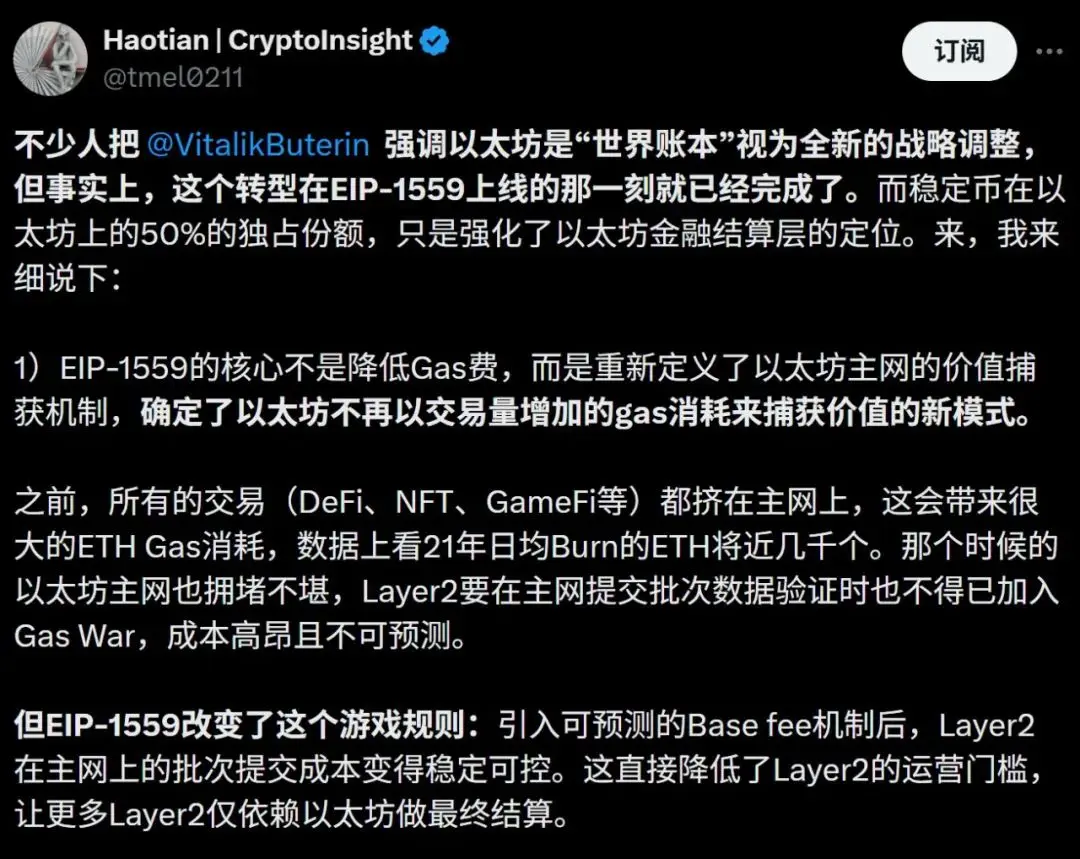
As Web3 researcher Haotian noted, EIP-1559 was undoubtedly a pivotal moment in Ethereum’s narrative shift. It introduced base fees and a fee-burning mechanism, fundamentally reshaping how Ethereum captures value. No longer dependent on gas revenue from heavy mainnet usage, Ethereum now draws sustained income via L2s that effectively “pay taxes” to the base layer.
In other words, users are no longer direct customers of the mainnet. Instead, L2s act as service providers, delivering services to users and collecting fees, then ultimately remitting payments to the mainnet in exchange for settlement rights—an arrangement reminiscent of the historical “tax farming” system:
-
The mainnet serves as the final trusted ledger for transaction clearing and settlement—akin to a central bank;
-
L2s resemble commercial banks, providing frequent services to end users;
-
Each L2 transaction, when verified back on the mainnet, burns ETH—effectively paying for the security of the ledger.
In short, Ethereum hasn't abandoned its "world computer" vision. Rather, the L1+L2 architectural and developmental path is guiding it toward first becoming a "world ledger."
03. The Pragmatic Realization of a "World Ledger"
Another interesting observation is that every major surge in ETH's value has stemmed from the mainnet being actively used in its role as a ledger.
The 2017 ERC20 token wave positioned Ethereum as a clearing and settlement layer for token issuance; the 2020 DeFi Summer turned it into a capital settlement platform powered by composable smart contracts; and if the current cycle sees another explosion driven by tokenized equities and RWA (real-world assets), Ethereum will once again serve as the trusted ledger.
For TradFi institutions, computational capability matters—but what ultimately determines whether they migrate on-chain is the ledger’s "trustworthiness, finality, and security." These are the core concerns for compliant assets.
This explains why platforms like Robinhood have chosen to launch tokenized U.S. stock trading services on L2s such as Arbitrum—not only because they trust the performance of Rollup architectures, but more importantly, because these transactions ultimately settle back on the Ethereum mainnet.
This indicates that today’s L2 solutions offer sufficient performance, security, and compliance capabilities to handle core traditional financial assets. In a sense, this wave of "tokenizing U.S. stocks" reinforces Ethereum’s role as global financial clearing and settlement infrastructure, further validating the feasibility and real-world demand for its "world ledger" function.
This is Ethereum’s pragmatic evolutionary path—from "world computer" to "world ledger." It’s no longer just promising future on-chain applications, but being chosen by real-world, mainstream assets as their final settlement destination.
From this perspective, these trends not only affirm the value of Ethereum L1, but also profoundly reshape the value capture logic of L2s, driving the entire Ethereum ecosystem toward true integration between technological and financial infrastructures.
In one sentence: the narratives that will truly drive this chain toward billion-user adoption aren’t just about what Ethereum *can* do—but what the real world is *willing* to use Ethereum for.
Join TechFlow official community to stay tuned
Telegram:https://t.me/TechFlowDaily
X (Twitter):https://x.com/TechFlowPost
X (Twitter) EN:https://x.com/BlockFlow_News
 @imTokenOfficial


