The level of division within the Federal Reserve is historically rare
TechFlow Selected TechFlow Selected
The level of division within the Federal Reserve is historically rare
Deutsche Bank stated that the June dot plot reflects the highest level of disagreement among Fed officials in ten years, as they face fundamental differences over how to balance inflation control with economic growth.
 Navigating Web3 tides with focused insights
By Li Xiaoyin, Wall Street Insights
How divided is the Fed—and what does it mean for rate cuts?
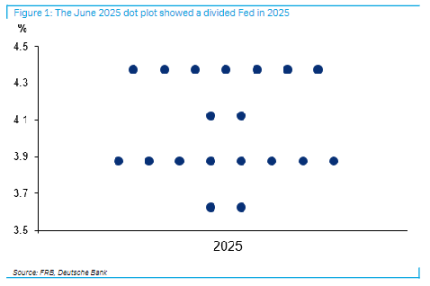
The Federal Reserve's latest Summary of Economic Projections (SEP) shows a median outlook calling for two rate cuts in 2025. However, individual officials' projections range from no cuts at all to as many as 75 basis points in reductions, highlighting significant disagreements among policymakers.
More importantly, Fed Governors Christopher Waller and Michelle Bowman have publicly signaled openness to a rate cut in July—marking an early "reversal" that has further fueled market speculation about a policy pivot.
According to Wind Trading Desk, Deutsche Bank chief U.S. economist Matthew Luzzetti and his team noted in a recent research report that the level of disagreement among Fed officials reflected in the June SEP is the highest in ten years. This stems from fundamental differences over how to balance inflation control against economic growth.
The report added that while current divisions are notable, the degree of uncertainty among Fed officials regarding the 2025 interest rate path is not unprecedented—and is actually lower than levels seen a year ago. As incoming economic data becomes clearer, officials’ views may gradually converge, though divisions are likely to persist in the near term.
Historic Split Within the Fed, But Actual Rate Uncertainty Is Declining
Through deep analysis of the Federal Reserve’s June SEP, Deutsche Bank concludes that the central bank’s main issue today is not “historic uncertainty,” but rather “historic division.”
Deutsche Bank’s research shows that the June dot plot reveals a highly polarized distribution of officials’ forecasts for the federal funds rate in 2025. The gap between the most common forecast and the second-most common stands at 50 basis points—the widest such divergence in ten years.
The report further notes that when weighted by number of officials, this bimodal distribution approaches historical extremes, indicating that the Fed is now split into two distinct camps.
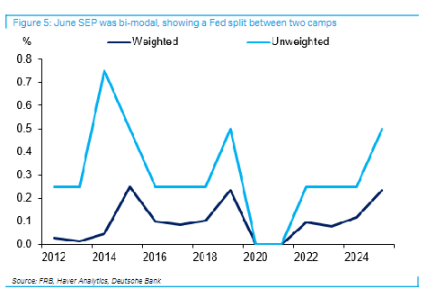
This level of division suggests the Committee could see more debate—and possibly dissents—in the months ahead.
Despite the visible rift, the report emphasizes that uncertainty around the 2025 rate path is not historically high.
Measured by the spread between the highest and lowest projections in the dot plot, the dispersion in the June SEP is comparable to mid-year forecasts over the past decade—and even lower than in June 2023.
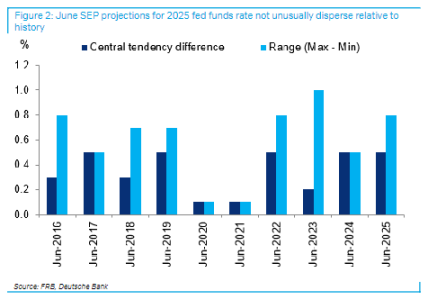
On inflation, although officials’ forecasts for core PCE inflation differ by as much as one percentage point—the largest gap in ten years—this has not translated into a historically wide divergence in interest rate expectations. This is partly because officials agree more closely on the outlook for unemployment, with only a 0.3 percentage point spread in their forecasts.
Divergent Views on Economic Outlook and Inflation Risks
The internal divide within the Fed stems from differing interpretations of the underlying economy.
The report notes that despite elevated inflation uncertainty, strong consensus on the labor market outlook may have prevented even greater dispersion in rate projections.
Nevertheless, the bimodal pattern in the June dot plot indicates a fundamental split over how to balance inflation control with supporting growth. The fact that Governors Waller and Bowman have expressed openness to a July rate cut underscores this divide—reflecting concerns among some officials about rising risks of economic slowdown, while others remain focused on persistent inflation pressures.
Looking ahead, it remains unclear whether these internal disagreements will escalate into formal policy dissent. The report expects that as economic data becomes clearer, officials’ views may gradually align—but divisions are likely to persist in the short term.
Join TechFlow official community to stay tuned
Telegram:https://t.me/TechFlowDaily
X (Twitter):https://x.com/TechFlowPost
X (Twitter) EN:https://x.com/BlockFlow_News