Huobi Growth Academy | In-depth Research Report on Web3 Parallel Computing: The Ultimate Path to Native Scaling
TechFlow Selected TechFlow Selected
Huobi Growth Academy | In-depth Research Report on Web3 Parallel Computing: The Ultimate Path to Native Scaling
The next-generation sovereign execution platform for the Web3 world will likely emerge from this in-chain parallel struggle.
 Navigating Web3 tides with focused insights
1. Introduction: Scaling is an Eternal Proposition, Parallelism is the Ultimate Battlefield
Since Bitcoin's inception, blockchain systems have faced one unavoidable core challenge: scaling. Bitcoin handles fewer than 10 transactions per second, while Ethereum struggles to break through a performance bottleneck of just dozens of TPS (transactions per second)—a stark contrast to Web2 systems that routinely achieve tens of thousands of TPS. More importantly, this isn't simply a matter of "adding more servers," but rather a systemic limitation embedded in the foundational consensus and structural design of blockchains—the so-called "impossible trinity" of decentralization, security, and scalability.
Over the past decade, we've witnessed countless scaling attempts rise and fall. From Bitcoin's scaling wars to Ethereum’s vision of sharding, from state channels and Plasma to Rollups and modular blockchains, from Layer 2 off-chain execution to structural reconfiguration of data availability, the industry has forged a path full of engineering ingenuity. Rollup, as today’s most widely accepted scaling paradigm, achieves significantly higher TPS by offloading execution burden from the main chain while preserving Ethereum’s security. Yet it does not address the true limits of a blockchain's underlying "single-chain performance"—particularly at the execution layer, where throughput remains constrained by the ancient model of serial in-chain computation.
It is precisely for this reason that in-chain parallel computing has gradually come into focus. Unlike off-chain scaling or cross-chain distribution, in-chain parallelism seeks to completely re-architect the execution engine while maintaining the atomicity and unified structure of a single chain. Guided by principles from modern operating systems and CPU design, it aims to upgrade blockchains from a single-threaded model of “executing transactions sequentially” into a high-concurrency computing system featuring “multi-threading, pipelining, and dependency scheduling.” This approach could enable hundreds-of-fold throughput improvements and may become a key prerequisite for the explosion of smart contract applications.
In fact, within Web2 computing paradigms, single-threaded computation has long been rendered obsolete by modern hardware architectures, replaced instead by continuous optimization models such as parallel programming, asynchronous scheduling, thread pools, and microservices. Blockchain, being a more primitive and conservative computational system with extremely high demands for determinism and verifiability, has yet to fully leverage these advances in parallel computing. This represents both a limitation and an opportunity. New chains like Solana, Sui, and Aptos introduced parallelism at the architectural level, pioneering this exploration; emerging projects like Monad and MegaETH go even further, advancing in-chain parallelism into breakthroughs in pipeline execution, optimistic concurrency, and asynchronous message-driven mechanisms—exhibiting characteristics increasingly similar to modern operating systems.
Parallel computing is thus not merely a "performance optimization technique," but a pivotal shift in blockchain execution models. It challenges the fundamental mode of smart contract execution and redefines basic logic around transaction packing, state access, call relationships, and storage layout. If Rollup is about “moving execution off-chain,” then in-chain parallelism is about “building a supercomputer core on-chain.” Its goal is not just higher throughput, but to provide truly sustainable infrastructure support for future Web3-native applications—high-frequency trading, game engines, AI model execution, on-chain social platforms, and more.
As the Rollup赛道 becomes increasingly homogenized, in-chain parallelism is quietly emerging as the decisive variable in the new cycle of Layer 1 competition. Performance is no longer just about being “faster,” but whether it can support an entire heterogeneous application ecosystem. This is not merely a technological race, but a battle over paradigms. The next generation of sovereign execution platforms in the Web3 world will likely emerge from this contest of in-chain parallelism.
2. Scaling Paradigm Landscape: Five Approaches, Each with Unique Focus
Scaling, one of the most important, persistent, and difficult challenges in public chain evolution, has given rise to nearly all major technical paths over the last decade. Starting with Bitcoin's block size debate, this technical race over "how to make the chain run faster" eventually diverged into five fundamental approaches, each tackling bottlenecks from different angles, carrying distinct technical philosophies, implementation difficulties, risk profiles, and use cases.
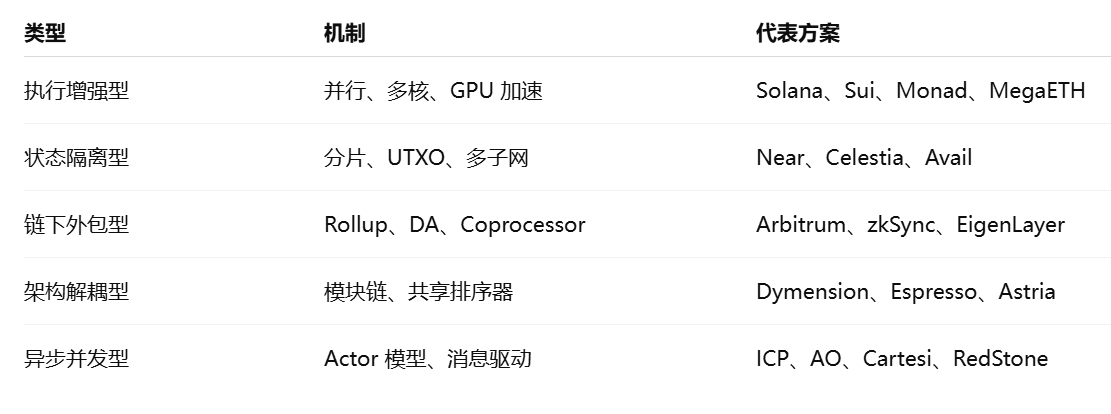
The first approach is direct on-chain scaling, exemplified by increasing block size, shortening block intervals, or optimizing data structures and consensus mechanisms to boost processing capacity. This method was central during Bitcoin’s scaling debate, giving rise to forks like BCH and BSV under the "big block" faction, and influencing early high-performance public chains such as EOS and NEO. The advantage lies in preserving the simplicity of single-chain consistency, making it easy to understand and deploy. However, it quickly hits systemic ceilings related to centralization risks, rising node operation costs, and synchronization difficulties. As a result, it is no longer a mainstream core solution today, often serving only as auxiliary enhancements to other mechanisms.
The second route is off-chain scaling, represented by State Channels and Sidechains. These approaches move most transaction activity off-chain, writing only final results back to the main chain, which acts as the ultimate settlement layer. Philosophically, this mirrors Web2's asynchronous architecture—keeping heavy processing at the periphery while the main chain performs minimal trusted validation. While theoretically capable of infinite throughput expansion, issues around trust models, fund security, and interaction complexity limit real-world adoption. For example, Lightning Network has clear financial use cases but never achieved explosive ecosystem growth. Similarly, sidechain-based designs like Polygon POS expose weaknesses in inheriting main-chain security despite high throughput.
The third path—the currently most popular and widely deployed—is Layer 2 Rollup. Instead of altering the main chain directly, it scales via off-chain execution with on-chain verification. Optimistic Rollups and ZK Rollups each have strengths: the former offers faster implementation and better compatibility but suffers from challenge period delays and fraud proof limitations; the latter provides stronger security and better data compression but faces development complexity and insufficient EVM compatibility. Regardless of type, Rollup essentially outsources execution while retaining data and verification on-chain, achieving a relative balance between decentralization and performance. Rapid growth of projects like Arbitrum, Optimism, zkSync, and StarkNet proves the feasibility of this path, though it reveals mid-term bottlenecks such as excessive reliance on data availability (DA), persistently high fees, and fragmented developer experience.
The fourth approach is the recently emerged modular blockchain architecture, represented by Celestia, Avail, and EigenLayer. Modular paradigms advocate fully decoupling core blockchain functions—execution, consensus, data availability, and settlement—assigning them to specialized chains and combining them via interoperability protocols into scalable networks. Heavily influenced by modular OS design and composable cloud computing concepts, its strength lies in flexible component replacement and significant efficiency gains in specific areas like DA. But challenges are equally apparent: post-decoupling synchronization, verification, and inter-trust costs soar; developer ecosystems become highly fragmented; requirements for long-term protocol standards and cross-chain security far exceed those of traditional chains. Rather than building a “chain,” this model builds a “network of chains,” demanding unprecedented levels of architectural understanding and operational sophistication.
The fifth and final route—also the primary focus of this article—is in-chain parallel computing optimization. Unlike the previous four, which mainly perform “horizontal splitting” at the structural level, parallel computing emphasizes “vertical upgrading”: changing the execution engine architecture within a single chain to enable concurrent processing of atomic transactions. This requires rewriting VM scheduling logic and introducing a full suite of modern computer system scheduling mechanisms—including transaction dependency analysis, state conflict prediction, parallelism control, and asynchronous calls. Solana was among the first to implement a parallel VM concept at the chain level, enabling multi-core parallel execution through account-model-based transaction conflict detection. Next-generation projects like Monad, Sei, Fuel, and MegaETH push further, experimenting with pipeline execution, optimistic concurrency, storage partitioning, and parallel decoupling to build high-performance execution cores akin to modern CPUs. The key advantage of this direction is achieving throughput breakthroughs without relying on multi-chain architectures, providing sufficient computational elasticity for complex smart contracts—an essential technical prerequisite for future applications such as AI Agents, large-scale on-chain games, and high-frequency derivatives.
Reviewing these five scaling paths reveals their divergence as systematic trade-offs between performance, composability, security, and development complexity. Rollup excels in consensus outsourcing and security inheritance; modular architectures emphasize structural flexibility and component reuse; off-chain scaling pushes beyond main-chain bottlenecks at high trust cost; while in-chain parallelism focuses on fundamental upgrades at the execution layer, aiming to reach the performance limits of modern distributed systems without breaking intra-chain consistency. No single path solves all problems, but together they form a comprehensive picture of Web3 computing paradigm evolution, offering rich strategic options for developers, architects, and investors alike.
Just as operating systems evolved from single-core to multi-core, and databases advanced from sequential indexing to concurrent transactions, Web3’s scaling journey will inevitably advance toward a highly parallelized execution era. In this era, performance will no longer be merely a race of chain speed, but a holistic manifestation of foundational design philosophy, depth of architectural understanding, hardware-software co-design, and system-level control. And in-chain parallelism may well be the ultimate battlefield in this prolonged war.
3. Parallel Computing Taxonomy: Five Paths from Account to Instruction Level
Within the ongoing evolution of blockchain scaling technologies, parallel computing has become the core path to performance breakthroughs. Unlike horizontal decoupling at structural, network, or data availability layers, parallel computing involves deep excavation at the execution layer—it governs the most fundamental logic of blockchain operational efficiency, determining how quickly and effectively a system responds to high-concurrency, multi-type, complex transactions. Tracing the development of this technical spectrum from execution models yields a clear taxonomy of parallel computing, broadly categorized into five technical paths: account-level parallelism, object-level parallelism, transaction-level parallelism, virtual machine (VM)-level parallelism, and instruction-level parallelism. These five paths progress from coarse-grained to fine-grained, representing both an increasing refinement of parallel logic and a corresponding rise in system complexity and scheduling difficulty.

The earliest form, account-level parallelism, is epitomized by Solana. Based on a decoupled account-state design, it statically analyzes sets of accounts involved in transactions to determine potential conflicts. If two transactions access non-overlapping account sets, they can be executed concurrently across multiple cores. This mechanism works well for structured, clearly defined input-output transactions—especially predictable-path programs like DeFi. However, it assumes account access is predictable and state dependencies are statically inferable, leading to conservative execution and reduced parallelism when dealing with complex smart contracts (e.g., dynamic behaviors in on-chain games or AI agents). Additionally, cross-account dependencies severely diminish parallel gains in certain high-frequency scenarios. While Solana’s runtime has achieved significant optimization, its core scheduling strategy remains limited by account-level granularity.
A step finer than account-level is object-level parallelism, which introduces semantic abstractions of resources and modules, enabling concurrent scheduling at the granular unit of “state objects.” Aptos and Sui represent key explorers here, particularly the latter, which uses Move language’s linear type system to define resource ownership and mutability at compile time, allowing precise runtime control over resource access conflicts. Compared to account-level parallelism, this approach offers greater universality and extensibility, supporting more complex state read-write logic and naturally serving high-heterogeneity scenarios like gaming, social apps, and AI. However, object-level parallelism also raises barriers in language adoption and development complexity. Since Move is not a direct replacement for Solidity, the ecosystem transition cost is high, limiting the adoption speed of its parallel paradigm.
Transaction-level parallelism takes another leap forward—a direction explored by next-generation high-performance chains like Monad, Sei, and Fuel. Here, neither state nor accounts serve as the smallest parallel units; instead, the entire transaction itself becomes the basis for dependency graph construction. Transactions are treated as atomic units, with static or dynamic analysis used to build a Transaction DAG, and a scheduler enables concurrent pipelined execution. This design allows the system to maximize parallelism without requiring full knowledge of underlying state structures. Monad stands out in particular, integrating modern database engine techniques such as optimistic concurrency control (OCC), parallel pipelining, and out-of-order execution, bringing chain execution closer to the paradigm of a “GPU scheduler.” In practice, this requires extremely sophisticated dependency managers and conflict detectors, and the scheduler itself may become a bottleneck. Nevertheless, its theoretical throughput potential surpasses both account- and object-level models, positioning it as one of the most ceiling-high forces in the current parallel computing landscape.
VM-level parallelism embeds concurrent execution capability directly into the low-level instruction scheduling logic of the virtual machine, aiming to fully overcome the inherent limitations of EVM’s sequential execution. MegaETH, acting as a “super virtual machine experiment” within the Ethereum ecosystem, attempts to redesign the EVM to support multi-threaded concurrent execution of smart contract code. Underlying mechanisms include segmented execution, state isolation, and asynchronous calls, allowing each contract to run independently in separate execution contexts, with a parallel sync layer ensuring final consistency. The greatest challenge lies in maintaining complete compatibility with existing EVM behavioral semantics while transforming the entire execution environment and Gas mechanism—enabling the Solidity ecosystem to smoothly migrate to a parallel framework. The hurdles extend beyond deep technical stacks to include political resistance within Ethereum’s L1 governance regarding major protocol changes. Yet if successful, MegaETH could spark a “multi-core processor revolution” in the EVM domain.
The final and most granular path—also the most technically demanding—is instruction-level parallelism. Inspired by modern CPU designs such as out-of-order execution and instruction pipelining, this paradigm posits that since every smart contract is ultimately compiled into bytecode instructions, each operation can be scheduled, analyzed, and reordered just like a CPU executing x86 instructions. The Fuel team has already introduced a preliminary instruction-reorderable execution model in FuelVM. In the long term, once blockchain execution engines achieve predictive execution and dynamic reordering of instruction dependencies, their degree of parallelism could reach theoretical limits. This path might even elevate blockchain-hardware co-design to new heights, transforming chains into true “decentralized computers” rather than mere “distributed ledgers.” Of course, this approach remains largely theoretical and experimental, with relevant schedulers and security verification mechanisms still immature. Nonetheless, it points to the ultimate boundary of future parallel computing.
In summary, the five paths—account, object, transaction, VM, and instruction—form a spectrum of in-chain parallel computing evolution, progressing from static data structures to dynamic scheduling mechanisms, from state access prediction to instruction-level reordering. Each advancement in parallelism brings a significant increase in system complexity and development barriers. At the same time, they mark a paradigmatic shift in blockchain computing models—from traditional fully sequential consensus ledgers toward high-performance, predictable, and schedulable distributed execution environments. This is not merely catching up with Web2 cloud computing efficiency, but a profound reimagining of the ultimate form of a “blockchain computer.” Different public chains’ choices among these parallel paths will determine the upper bounds of their future application ecosystems and their core competitiveness in AI Agents, on-chain games, and high-frequency trading scenarios.
4. Deep Dive into Two Leading Contenders: Monad vs MegaETH
Among the multiple evolutionary paths of parallel computing, the two attracting the most market attention, strongest narratives, and clearest technical visions are undoubtedly Monad’s “build-a-parallel-chain-from-scratch” approach and MegaETH’s “EVM-internal parallel revolution.” These two directions are not only the most intensively pursued by crypto primitives engineers today, but also represent the two most definitive poles in the current Web3 performance race. Their divergence extends beyond starting points and architectural styles—it reflects fundamentally different target ecosystems, migration costs, execution philosophies, and future strategic trajectories. They embody competing paradigms of “reconstructionism” versus “compatibilism” in parallel computing, profoundly shaping market expectations about the ultimate form of high-performance chains.
Monad embodies a thorough “computational purist.” Its design philosophy is not centered on EVM compatibility, but draws inspiration from modern databases and high-performance multi-core systems to redefine the foundational operation of blockchain execution engines. Its core technology stack leverages mature mechanisms from database fields—Optimistic Concurrency Control (OCC), Transaction DAG scheduling, Out-of-Order Execution, and Pipelined Batch Processing—with the ambitious goal of elevating chain transaction throughput to the million-TPS range. In Monad’s architecture, transaction execution and ordering are fully decoupled: the system first constructs a dependency graph, then passes it to a scheduler for pipelined parallel execution. All transactions are treated as atomic transaction units with explicit read-write sets and state snapshots. The scheduler performs optimistic execution based on the dependency graph, rolling back and re-executing upon conflicts. Technically, this is extremely complex, requiring a transaction management stack akin to modern databases, plus multi-level caching, prefetching, and parallel verification to minimize final state commit latency. Yet theoretically, it could push throughput limits far beyond anything currently imagined in the blockchain space.
Crucially, Monad does not abandon EVM interoperability. Through a “Solidity-Compatible Intermediate Language” layer, it allows developers to write contracts using Solidity syntax while enabling intermediate-language optimization and parallelized scheduling within the execution engine. This “surface-level compatibility, bottom-layer reconstruction” strategy preserves developer friendliness for the Ethereum ecosystem while maximizing execution potential—a classic “ingest EVM, then reconstruct it” technical strategy. This implies that once deployed, Monad could not only become a peak-performance sovereign chain but also serve as an ideal execution layer for Layer 2 Rollup networks, or even evolve into a “plug-and-play high-performance kernel” for other chains’ execution modules. In this sense, Monad is not just a technical path—it represents a new logic of system sovereignty, advocating a modular, high-performance, reusable execution layer to establish new standards for inter-chain collaborative computing.
In sharp contrast to Monad’s “new world builder” stance, MegaETH takes the opposite approach—starting from Ethereum’s existing world and achieving massive efficiency gains with minimal changes. MegaETH does not discard EVM specifications but aims to inject parallel computing capabilities directly into the current EVM execution engine, creating a future “multi-core EVM.” Its fundamental principle involves a complete overhaul of the current EVM instruction execution model, endowing it with thread-level isolation, asynchronous contract execution, and state access conflict detection—enabling multiple smart contracts to run simultaneously within the same block and merge state changes at the end. This model requires no changes to existing Solidity contracts, no adoption of new languages or toolchains. Simply deploying the same contract on a MegaETH chain delivers significant performance gains. This “conservative revolution” path is highly attractive, especially for Ethereum’s L2 ecosystem, offering a painless, syntax-preserving upgrade path.
MegaETH’s core breakthrough lies in its VM multithreading scheduling mechanism. Traditional EVM uses a stack-based single-threaded execution model where each instruction runs linearly and state updates occur synchronously. MegaETH breaks this pattern by introducing asynchronous call stacks and isolated execution contexts, enabling simultaneous execution of “concurrent EVM contexts.” Each contract can invoke its own logic in an independent thread, and all threads converge their states through a Parallel Commit Layer that performs unified conflict detection and resolution upon final submission. This mechanism closely resembles modern browser JavaScript multithreading (Web Workers + Shared Memory + Lock-Free Data), preserving main-thread determinism while introducing high-performance background asynchronous scheduling. Practically, this design is also highly favorable for block builders and searchers, who can optimize mempool ordering and MEV capture strategies based on parallel policies, forming an economically advantageous closed loop at the execution layer.
More importantly, MegaETH chooses deep integration with the Ethereum ecosystem. Its primary deployment targets are likely to be EVM-based L2 Rollup networks such as Optimism, Base, or Arbitrum Orbit chains. Once widely adopted, it could deliver nearly 100x performance improvements atop the existing Ethereum tech stack—without altering contract semantics, state models, Gas logic, or calling patterns. This makes it an extremely appealing upgrade path for EVM conservatives. The MegaETH paradigm says: as long as you’re working within Ethereum, I’ll let your computational performance skyrocket in place. From pragmatic and engineering perspectives, it is easier to deploy than Monad and better aligns with the iterative paths of mainstream DeFi and NFT projects, making it a strong candidate for near-term ecosystem adoption.
In a deeper sense, Monad and MegaETH represent not just two implementations of parallel technology, but a classic clash between “reconstructionists” and “compatibilists” in blockchain development: the former pursues paradigm-breaking innovation, rebuilding everything from VM to state management for maximum performance and architectural flexibility; the latter favors incremental optimization, pushing legacy systems to their limits while respecting existing ecosystem constraints to minimize migration costs. Neither is absolutely superior—they serve different developer communities and ecological visions. Monad suits those building entirely new systems from scratch, targeting extreme-throughput applications like on-chain games, AI agents, and modular execution chains. MegaETH better serves L2 teams, DeFi projects, and infrastructure protocols seeking performance upgrades with minimal development changes.
One is like a high-speed rail built on an entirely new track, redefining rails, power grids, and carriages solely for unprecedented speed and experience; the other is like installing turbochargers on an existing highway, improving lane scheduling and engine structure so vehicles run faster without leaving familiar road networks. Ultimately, they may converge: in the next phase of modular blockchain architecture, Monad could become a “execution-as-a-service” module for Rollups, while MegaETH could serve as a performance acceleration plugin for mainstream L2s. Together, they may form the dual wings of a high-performance distributed execution engine for the future Web3 world.
5. Future Opportunities and Challenges of Parallel Computing
As parallel computing transitions from theoretical design to on-chain implementation, its unleashed potential is becoming increasingly tangible and measurable. On one hand, we see new development paradigms and business models beginning to redefine themselves around “on-chain high performance”: more complex on-chain game logic, more realistic AI Agent lifecycles, more real-time data exchange protocols, more immersive interactive experiences, and even collaborative on-chain Super App operating systems—all shifting from questions of “whether it can be done” to “how well it can be done.” On the other hand, what truly drives the leap in parallel computing is not just linear performance gains, but structural shifts in developer cognition and ecosystem migration costs. Just as Ethereum’s introduction of Turing-complete contracts catalyzed multidimensional explosions in DeFi, NFTs, and DAOs, the “asynchronous restructuring between state and instructions” enabled by parallel computing is incubating a new model of the on-chain world—one that is both a revolution in execution efficiency and a fertile ground for fissile product innovation.

First, in terms of opportunities, the most immediate benefit is the removal of “application ceilings.” Current DeFi, gaming, and social applications are mostly constrained by state bottlenecks, Gas costs, and latency, preventing true scalability of on-chain high-frequency interactions. Take GameFi: genuinely responsive action feedback, synchronized high-frequency behavior, and real-time combat mechanics almost don’t exist because traditional EVM’s linear execution cannot support broadcast confirmation of dozens of state changes per second. With parallel computing, however, mechanisms like Transaction DAGs and asynchronous contract contexts can build high-concurrency behavior chains, ensuring deterministic outcomes through snapshot consistency—enabling a structural breakthrough toward a true “on-chain game engine.” Likewise, the deployment and operation of AI Agents will gain essential improvements. Previously, AI Agents typically ran off-chain, uploading only behavioral results to on-chain contracts. But in the future, parallel transaction scheduling could support asynchronous collaboration and shared state among multiple AI entities, enabling truly autonomous, real-time Agent-on-chain logic. Parallel computing will become the infrastructure for these “behavior-driven contracts,” propelling Web3 from a world of “transactions as assets” to one of “interactions as agents.”
Second, developer toolchains and VM abstraction layers are undergoing structural transformation due to parallelization. Traditional Solidity development follows a sequential mental model—developers are accustomed to designing logic as single-threaded state changes. But in parallel computing architectures, developers must confront read-write set conflicts, state isolation strategies, and transaction atomicity, potentially adopting architectural patterns based on message queues or state pipelines. This cognitive shift fuels rapid emergence of next-generation toolchains. Examples include parallel smart contract frameworks supporting dependency declarations, IR-based optimizing compilers, and concurrent debuggers with transaction snapshot simulation—all fertile ground for infrastructure innovation in the new cycle. Moreover, the ongoing evolution of modular blockchains provides excellent deployment pathways: Monad can plug in as an execution module for L2 Rollups, MegaETH can replace EVM in mainstream chains, Celestia supports data availability, and EigenLayer supplies decentralized validator networks—forming a high-performance, integrated architecture spanning from底层 data to execution logic.
However, the path forward for parallel computing is far from smooth—its challenges are even more structural and harder to solve than its opportunities. One core technical hurdle lies in “ensuring consistency under state concurrency” and “managing transaction conflict resolution strategies.” Unlike off-chain databases, blockchains cannot tolerate arbitrary levels of transaction rollback or state reversal—every execution conflict must be modeled beforehand or strictly controlled in real time. This means parallel schedulers must possess powerful dependency graph construction and conflict prediction capabilities, along with efficient fault-tolerant mechanisms for optimistic execution. Otherwise, under high load, the system risks falling into a “retry storm of concurrency failures,” where throughput drops instead of rising, potentially destabilizing the chain. Furthermore, security models for multi-threaded execution environments remain incomplete—issues like precision of inter-thread state isolation, novel exploitation methods for reentrancy attacks in asynchronous contexts, and gas explosions in cross-thread contract calls—are unresolved problems awaiting solutions.
Even more insidious challenges arise at the ecosystem and psychological levels. Will developers willingly migrate to new paradigms? Can they master parallel model design? Are they prepared to sacrifice some code readability and auditability for performance gains? These soft factors are ultimately what determine whether parallel computing can generate real ecosystem momentum. Over recent years, we’ve seen multiple high-performance chains fade into obscurity due to lack of developer support—NEAR, Avalanche, and even some Cosmos SDK chains vastly outperforming EVM—all reminding us: without developers, there is no ecosystem; without an ecosystem, even the best performance is just castles in the air. Therefore, parallel computing projects must not only build the strongest engines but also the gentlest onboarding paths—making “performance plug-and-play,” not “performance equals cognitive barrier.”
In the end, the future of parallel computing will be both a triumph of systems engineering and a test of ecosystem design. It forces us to reconsider what a “chain really is”: Is it a decentralized settlement machine, or a globally distributed real-time state coordinator? If the latter, then capabilities once considered mere “technical details”—state throughput, transaction concurrency, contract responsiveness—will become the primary metrics defining a chain’s value. The parallel computing paradigm that successfully completes this transition will become the most core, compounding-effect infrastructure primitive of this new cycle—its impact extending far beyond a single technical module to potentially reshape the entire Web3 computing paradigm.
6. Conclusion: Is Parallel Computing the Best Native Scaling Path for Web3?
Among all paths exploring the performance frontier of Web3, parallel computing may not be the easiest to implement, but it is likely the one closest to the essence of blockchain. It doesn’t scale by moving computation off-chain, nor by sacrificing decentralization for throughput. Instead, it seeks to re-architect the execution model itself—within the atomicity and determinism of the chain—going straight to the root of performance bottlenecks at the transaction, contract, and virtual machine layers. This “native-to-chain” scaling method not only preserves blockchain’s core trust model but also lays sustainable performance foundations for future complex on-chain applications. Its difficulty lies in structure; its appeal lies in structure. If modular architectures restructure the “architecture of the chain,” then parallel computing restructures the “soul of the chain.” This may not be a shortcut to quick victory, but it could well be the only sustainable correct path in Web3’s long-term evolution. We are witnessing an architectural leap akin to the transition from single-core CPUs to multi-core/threaded operating systems—and the shape of a native Web3 operating system may well be hidden within these in-chain parallel experiments.
Join TechFlow official community to stay tuned
Telegram:https://t.me/TechFlowDaily
X (Twitter):https://x.com/TechFlowPost
X (Twitter) EN:https://x.com/BlockFlow_News
 @HTXAcademy