From Airdrops to Identity: Web3's Five Years, How Have Points and Alpha Been Winning Users?
TechFlow Selected TechFlow Selected
From Airdrops to Identity: Web3's Five Years, How Have Points and Alpha Been Winning Users?
Incentives become filters, points are no longer rewards, and alpha is more than just bait.
 Navigating Web3 tides with focused insights
Author: Nomos Labs
Introduction: Why Are We So Obsessed with "Points" and "Alpha"?
Sometime ago, we became unusually sensitive to "points" and "Alpha."
The first thing we do upon opening an exchange or DEX is no longer searching for the next coin to double, but checking whether our position on the points leaderboard has changed or if there are updates to new Alpha airdrop rules.
We've started carefully maintaining our on-chain behavior records—even without knowing exactly what points can eventually be redeemed for or how Alpha airdrops are truly distributed. Still, we tirelessly "grind points" and "interact," because we believe they might one day bring unexpected rewards.
Gradually, we realize that so-called "points" are no longer just trading incentives, but strategic levers platforms use to direct assets and control user attention; while "Alpha" is no longer just vague eligibility for airdrops—it's becoming the strongest emotional driver within ecosystem governance mechanisms.
Over the past five years, from CEXs like Binance, OKX, and Bybit, to DEXs like Uniswap, Curve, and zkSync, the mechanics of points and Alpha have continuously evolved—from initial trading rebates toward today’s ecosystem mechanisms centered on community governance, resource allocation, and traffic filtering.
This seemingly user-growth game built around Alpha and points is actually reshaping relationships between users, platforms, and ecosystems—each of us already deeply immersed in this game.
I. The Evolution of Points Mechanisms—From Rebate Tools to Ecosystem Orchestration Systems
In early crypto ecosystems, whether CEX or DEX, points played a very simple role: increasing user trading volume.
Initial trading points were straightforward: exchanges represented by Bitstamp and Bitfinex offered varying levels of rebates or fee discounts based solely on trading volume. This “points-like” design was intuitive and effective—users could clearly see the direct economic benefit from each trade, similar in form to “points,” where every transaction brought measurable financial gain. But its flaws were also evident: it failed to retain long-term users or build genuine community stickiness. Users acted more like profit-driven traffic than co-builders.
At this stage, Alpha barely existed—or was merely a vague “early investment opportunity”—and failed to become a real driver of user growth.
1. From "Trading Rebates" to "Early Access Tickets"
After 2017, with the emergence of Binance Launchpad, CEXs first linked points to “opportunity”: users earned points through staking or holding assets to qualify for participation in high-potential project IDOs.
This design changed the rules: points were no longer just for reducing fees, but became the key to accessing Alpha projects—you had to lock up assets and stay active to earn tickets to the next potential breakout.
Platforms such as OKX Jumpstart and Bybit Launchpad quickly followed suit. The points model thus entered an “opportunity-binding phase”: no longer about “giving rewards,” but about “filtering participants.”
2. From "Filtering Participants" to "Empowering Governance"
In parallel, DEX ecosystems took a more radical approach to redefining the meaning of points. Uniswap’s 2020 UNI airdrop marked a true breakthrough in the concepts of points and Alpha. It wasn’t a simple rebate, but an active “incentive + governance” mechanism based on users’ past on-chain behaviors. Users didn’t just receive short-term rewards—they directly became protocol governance participants, with points representing on-chain community voting rights and decision-making power.
This shift clarified the strategic significance of points: moving from mere transaction drivers to core tools for ecosystem governance and community engagement.
After 2021, this trend deepened further. Curve’s veToken points model explicitly tied points directly to governance rights and distribution of ecosystem rewards;新一代 DEXs like Raydium embedded points into the core processes of project launches and ecosystem initiation. At this point, points were no longer a platform’s “add-on,” but foundational tools for project launches, community governance, and resource allocation in Web3 ecosystems.
Looking back at the development history of points mechanisms, we can clearly see their core evolution path:
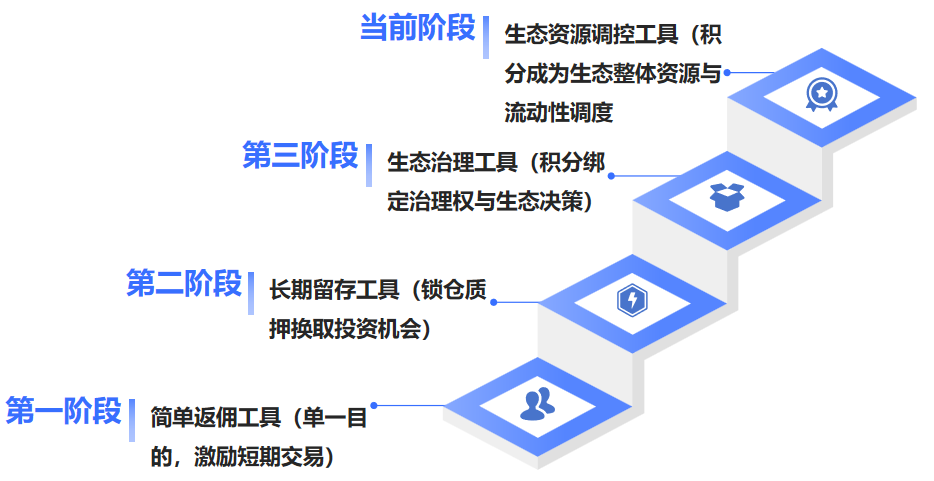
Image Source: Nomos Lab, compiled from public data
Today, both CEX and DEX strategically design points rules to regulate user attention, asset flow directions, and even overall ecosystem trends. Competition over points mechanisms is no longer just a battle of discounts, but a full-scale ecosystem war.
From simple "transaction incentives" to deep "ecosystem strategic weapons," the evolution of points reflects profound changes in Web3 user growth strategies—a transformation driven both by user demand and escalating platform competition.
II. The Mutation and Co-evolution of Alpha Mechanisms—From Vague Expectations to Ecosystem Drivers
If points represent the “structured order” set by platforms, then Alpha is the “emotional fuel” provided by user participation.
Points usually have clear acquisition methods and redemption paths, whereas Alpha drives sustained user activity through a vague yet powerful sense of anticipation—even when no specific “reward” is defined.
It doesn't always bind to points systems and sometimes operates entirely outside formal incentive structures, yet often generates the strongest desire to participate, becoming the most critical “non-institutional force” behind platform growth.
1. The Psychological Essence of Alpha: Ambiguity Fuels Engagement
The allure of Alpha lies in “uncertainty.”
Precisely because users don’t know whether an Alpha airdrop will happen, when it will come, or how it will be distributed, they’re more likely to actively participate, grind interactions, and keep assets active under the expectation that “maybe something will come.” This is a classic psychological game: vague hope exerts stronger pull than explicit rules.
Blur is the most typical example. Despite having a leaderboard, its early airdrop points system lacked clear redemption rules—yet users still frenziedly listed orders, interacted, and generated trading volume, believing: “As long as I’m active, I might get rewarded.”
This emotional drive forms the foundational strength of Alpha.
2. Three Mainstream Alpha Models and Their Evolutionary Logic
(1) Narrative-Driven Alpha: Participation Driven by Emotional Consensus
-
Representative Projects: zkSync, StarkNet, Scroll
-
Mechanism Features: No points system; user on-chain interactions are sparked purely by rumors of potential airdrops
-
User Behavior: Interactions span the entire ecosystem; users register across all projects; behavior is highly scattered but consistently active
(2) Points-Linked Alpha: Binding Expectations Through Rules
-
Representative Projects: Binance Alpha Points, Curve veCRV
-
Mechanism Features: Alpha is explicitly tied to points, which can be spent to obtain TGE allocations or airdrop eligibility
-
User Behavior: Actions revolve around points tasks; assets and behaviors are highly concentrated, leading to intense competition
(3) Behavior-Capturing Alpha: Ruleless Yet Highly Effective
-
Representative Projects: LayerZero, Blur
-
Mechanism Features: No formal points system, but user behavior data is secretly recorded and influences airdrop eligibility
-
User Behavior: Users self-design interaction trajectories, but cannot determine input-output ratios
3. The Risks of Alpha Gaming: Over-Stimulation and Behavioral Distortion
While Alpha’s ambiguity can spark enthusiasm, it can also encourage short-term arbitrage and meaningless volume-grinding.
Issues like Blur’s initial wash-trading, zkSync’s flood of low-quality interactions, and accusations that LayerZero excessively incentivized “interaction farms” reveal a core problem:
When Alpha ceases to be scarce and becomes a common outcome of mere interaction, it loses its filtering value and pollutes the ecosystem.
Hence, platforms began experimenting with combined “points + Alpha” mechanisms for finer control.
4. Alpha and Points: Co-Evolving Hybrid Mechanisms
Single mechanisms are no longer sufficient for ecosystem management. Platforms now explore “dual-track driving”:
Mechanism Advantages Risks Optimal Use Points Clear rules enable tiered incentives Prone to farming and internal competition Serve as basic structure and screening threshold Alpha Sparks passion and strengthens user engagement Unstable expectations lead to excessive interaction Act as supplementary reward and emotional driver
The goal of hybrid mechanisms is:
-
Use points to “standardize behavior paths” and prevent systemic abuse;
-
Use Alpha to “create ambiguous expectations” and stimulate long-term engagement.
Binance’s Alpha Points model employs this strategy:
-
Define points earning rules and spending thresholds (institutional control);
-
Introduce lucky draws and special conditions (emotional selection);
And control release pace and difficulty for each Alpha event to achieve dual goals of traffic management and user filtering.
5. Alpha’s New Role: Becoming the “Proof of Commitment” for On-Chain Narratives and Ecosystem Identity
Alpha’s evolutionary path is gradually shifting from “reward” to “identity symbol.”
In ecosystems like zkSync and LayerZero, users interact not merely for short-term airdrops, but to be recognized as “ecosystem co-builders” or “long-term participants.” Alpha is becoming an indirect credential for on-chain reputation and governance rights.
-
After its airdrop, Blur introduced a points consumption mechanism: encouraging long-term activity rather than one-time leaderboard rushes
-
Binance Alpha sets points retention thresholds and random conditions: filtering loyal users instead of arbitrageurs
-
LayerZero begins identifying “authentic interaction paths” and implements anti-cheat behavior systems
These changes collectively point to one trend:
Alpha is becoming the most differentiated and symbolic “value distribution logic” in on-chain ecosystems.
III. Points × Alpha—The Dual-Track User Control System
Growth mechanisms in the Web3 world are entering a “dual-track driving” phase: institutional points systems and ambiguous Alpha rewards are now being consciously combined into a strategic tool spanning user acquisition, behavior guidance, asset retention, and rhythm management.
Previously, points and Alpha were two separate realms: one a transparent, quantifiable participation structure; the other mobilizing users’ subjective imagination through vague, uncertain expectations. Today, they are no longer split—they reinforce each other, forming a new operating system for user behavior.
Binance was among the first to grasp this. In its Alpha Points mechanism, points acquisition rules are designed with extreme precision: users earn points via trading, holding, and participating in activities. Different tiers of qualification thresholds grant priority access to specific TGE projects or airdrop eligibility. But what truly drives users to obsessively “grind points” isn’t the direct utility of those points—it’s the suspenseful Alpha behind them: you might get an airdrop if you accumulate enough points, or you might just miss out.
This design of blurred boundaries greatly boosts user engagement. For example, in the DOOD airdrop, users with 168+ points received automatic eligibility, while those scoring 129–167 relied on UID tail-number lotteries. This subtle “gray zone” motivated many users to increase interactions and boost their scores to avoid falling into the “marginalized risk area.”
The core of this mechanism lies here: points provide structure, Alpha provides suspense; points reflect “what I’ve done,” Alpha embodies “what might happen”; points bind to rules, Alpha appeals to psychology. When fused, platforms gain multifaceted control over users’ attention, time, behavior, and asset flows.
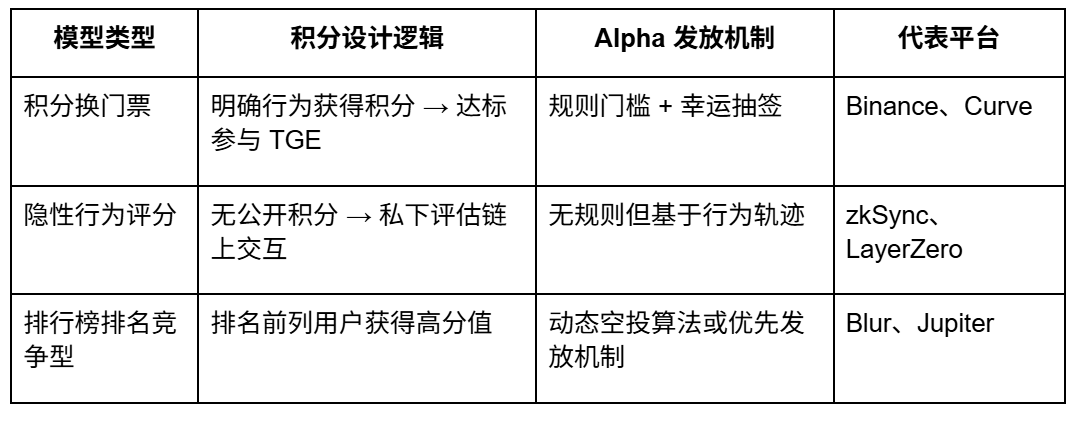
Image Source: Nomos Lab, compiled from public data
This structure not only optimizes user segmentation and filtering logic but also significantly enhances the platform’s ability to control ecosystem rhythms. Take Blur as an example: initially offering no points redemption rules, it successfully created an emotional narrative of “your efforts will be seen” through a points leaderboard and behavior-linked scoring system, prompting users to engage continuously, frequently, and at high cost.
This practice of using “ambiguous Alpha” as the core incentive is essentially a deep exploitation of user psychology: when reward rules are opaque, users invest more, believing “maybe I’ll be the one chosen.” Meanwhile, the existence of points provides a positive feedback loop of “I’m doing the right things”:
-
Points control behavior paths: clear incentive rules guide asset locking and long-term participation;
-
Alpha provides emotional drive: uncertainty motivates grinding and increases stickiness;
-
Fusion Point: combining “points snapshots + Alpha airdrops + consumption mechanisms” to regulate pace and ecosystem load.
Ultimately, user behavior transforms. They no longer act merely to “redeem rewards,” but to “leave traces” and be recognized by the system. They build a “points identity” on the platform while betting on future Alpha payouts. This “participation equals candidacy” mechanism turns users from short-term actors into long-term asset co-builders.
This silent binding is exactly what platforms desire.
IV. The Blurring Boundary—CEX and DEX Mechanism Convergence and Competitive Restructuring
As the dual-track Alpha × Points mechanism matures, another fundamental trend emerges: the boundary between CEX and DEX is rapidly blurring. They borrow from each other, learn, and gradually converge. Previously seen as opposing paradigms of “centralization vs decentralization,” both are now moving toward the same goal: building more stable user participation systems and collaborative ecosystem mechanisms.
First, CEXs are adopting DEX-style governance concepts. Platforms like Binance, OKX, and Gate are no longer satisfied with traditional task centers and rebate points. They’re introducing on-chain behavior snapshots, wallet linking, and tiered task structures, using on-chain interaction traces to shape user levels and points progression. For instance, Binance’s Alpha Points incorporates “Web3 wallet linking + on-chain task participation,” effectively identifying “trusted users” through on-chain behavior and creating DEX-style “reputation distribution.”
Meanwhile, these platforms are gradually adding lightweight governance features—such as user voting for token listings (e.g., Gate Startup) or activity polls (e.g., OKX voting boards)—building pathways from “user consensus → behavior valorization,” effectively borrowing DEX governance participation models.
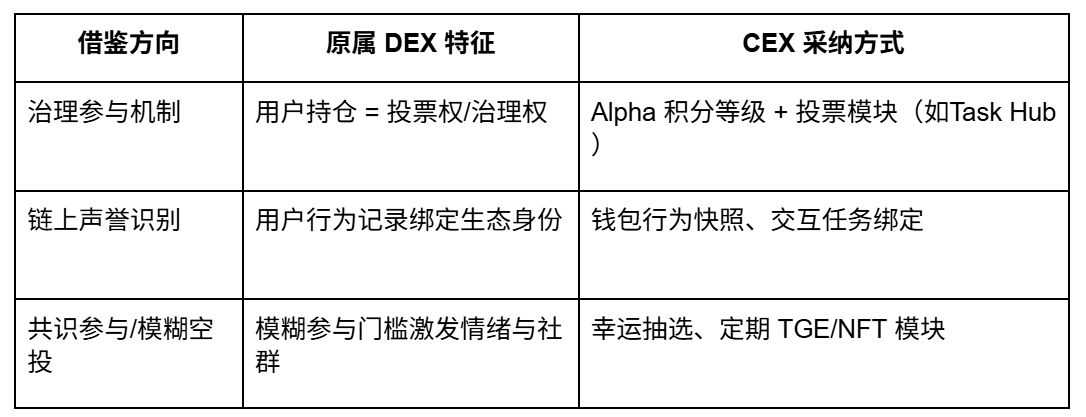
Image Source: Nomos Lab, compiled from public data
At the same time, DEXs are quietly converging toward CEX models. New-generation DEXs like Uniswap, PancakeSwap, Jupiter, and Velodrome are introducing points systems, task frameworks, phased airdrops, ranking mechanisms, and periodic resets—adopting institutionalized operational modules.
Jupiter’s LFG system exemplifies a CEX-style “leaderboard + points reset + cycle repetition” operation model. Velodrome combines veNFT and bribe mechanisms to orchestrate governance voting and incentive distribution, creating programmable “user behavior + governance incentives” points pathways. Uniswap is advancing a cross-protocol structure of “on-chain identity + multi-chain points,” constantly refining operational precision.
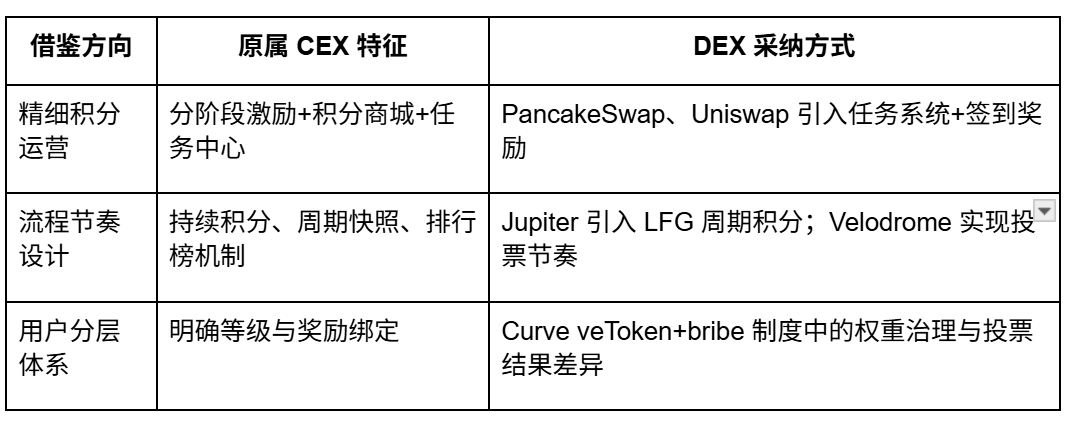
Image Source: Nomos Lab, compiled from public data
More importantly, user behavior itself is changing amid this platform convergence.
Users no longer simply “choose platforms,” but “choose mechanisms”: Do they offer fair points rules? Do they provide ambiguous yet credible Alpha rewards? Is there a trackable identity trail? The unit of platform competition is no longer “number of users,” but “mechanism design capability”—whoever builds smoother incentive structures and captures higher-quality user journeys will have greater chances of winning future ecosystem dominance.
Points and Alpha are becoming the “mechanism language” of this competition.
The old battle for traffic is transforming into a battle for mechanism design, and platform governance, community control, and user stickiness are evolving through this fusion into a deeper, more structured phase.
V. Beyond Points: The Mechanism War Has Just Begun
We once thought points were just promotional tools—hand out some perks, attract new users, stabilize trading volume, mission accomplished. Looking back now, that understanding was too shallow.
In today’s Web3 world, the games of points and Alpha are no longer superficial incentive structures, but interfaces for cognitive and power negotiations between platforms and users.
On one hand, platforms meticulously define user behavior tracks via points systems—what’s worth doing, when to do it, how much qualifies as “good enough.” On the other hand, they use ambiguous Alpha mechanisms to create “maybe something will happen” expectations, continually stimulating emotional engagement.
This system is highly sophisticated—not requiring users to know exactly what they’ll get, only that it’s “worth staying.”
And just as this narrative logic solidifies, new shifts begin brewing.
We stand at the threshold of “mechanism convergence → mechanism leap.” The coming game won’t just be about “what you did,” but about what traces you left in whose system.
Future points will likely go far beyond simple “trading volume × weight,” incorporating multiple variables:
-
Which chains have you interacted with?
-
How many ecosystem governance processes have you participated in?
-
Do you have a complete and coherent on-chain behavior trajectory?
-
Are your actions just leaderboard grinding, or actual participation?
In other words, points won’t just be “evidence of behavior,” but the way ecosystems understand your value.
And this understanding will no longer be confined to individual platforms.
We’re already seeing early signs:
zkSync includes “average asset retention duration” in its interaction calculations; LayerZero’s points system has long silently tracked which chains you’ve engaged with and your depth of interaction; “on-chain identity protocols” like Sismo and Gitcoin Passport are being adopted across platforms as IDs verifying whether you’re a “real user.”
In the near future, points across different platforms may stop competing and instead form a cross-ecosystem, mutually recognized “trust network”: if you’ve interacted with LayerZero, zkSync might lower your entry threshold; if you’ve participated in a certain DAO’s governance, Blur might grant you whitelist access directly.
Then, what we face won’t be “how many points I have,” but “how the entire Web3 sees me.”
Meanwhile, platforms are growing nervous.
As ambiguity drives high engagement, regulatory uncertainty looms closer:
Are points considered assets? Does Alpha constitute disguised fundraising? If a points system aims to ultimately airdrop tokens to users, must it publicly disclose its distribution logic? Does it pose compliance risks?
Hence, more and more platforms are becoming “vague yet restrained”: not giving clear formulas, not stating directly “how many points get what,” everything is just “for reference,” subject to “official announcements.”
It appears to be “maintaining mystery,” but in reality, it’s “avoiding liability.”
The endgame of this ambiguity battle may well be: users grow smarter, platforms grow more cautious.
Thus, truly effective mechanisms will no longer be about “stimulating interaction grinding,” but designing participation structures that make users want to stay and be recognized—not to farm points, but to co-build.
Such mechanisms aren’t just operational tactics—they are the ecosystem order itself.
Final Thoughts: You're Not Just Grinding Points—You're Defining Who You Are
Points seem like rewards, but they’re actually records of “you showed up.”
Alpha seems like an airdrop, but it’s really a signal saying “you were seen.”
Looking back at the entire evolution—from Bitfinex’s rebate system, to Binance’s Launchpad, from Uniswap’s UNI airdrop, to Curve’s veToken governance rights, to LayerZero, Jupiter, and zkSync’s user identification algorithms—we now clearly see:
Users don’t stay because of incentives—they stay because they认同 the mechanism.
We’ve evolved from “airdrop farmers” to “candidates.”
We participate not for short-term gains, but to build an identity—an image visible to the ecosystem.
We’re not just grinding points—we’re shaping who we want to become. We’re not just betting on Alpha—we’re betting that a certain mechanism is worth joining and co-building.
The battlefield between platforms has shifted from “who gives more airdrops” to “whose system can retain people.”
From traffic competition to structural competition.
From incentive gaming to identity construction.
From points games to order design.
We’ll eventually forget how many points we had or what Alpha we received.
But we’ll remember: which platform truly saw me.
Join TechFlow official community to stay tuned
Telegram:https://t.me/TechFlowDaily
X (Twitter):https://x.com/TechFlowPost
X (Twitter) EN:https://x.com/BlockFlow_News
 @NomosLabs