When on-chain exposure becomes the norm, how does Aleo rebuild Web3 sovereignty through privacy infrastructure?
TechFlow Selected TechFlow Selected
When on-chain exposure becomes the norm, how does Aleo rebuild Web3 sovereignty through privacy infrastructure?
Reconstructing privacy boundaries with zero-knowledge proofs, empowering users to regain control over their data sovereignty.
 Navigating Web3 tides with focused insights
Author: Frank, PANews
On February 23, a routine test by Binance founder CZ on the BSC chain sparked widespread chaos—when he attempted to purchase a MEME coin, his on-chain activity was tracked in real time. The community mistakenly interpreted it as an official endorsement, triggering a frenzy of copycat investments from tens of thousands of users. CZ was forced to clarify: "This was just a personal test."
Behind this incident lies the so-called "privacy paradox" triggered by blockchain transparency: on-chain behavior is effectively naked, leaving users vulnerable to sandwich attacks, targeted phishing by hackers, and meme traders chasing "smart money"—only to be exploited themselves. Howard Wu, founder of Aleo, put it bluntly: "CZ’s first AMM experience is exactly why I built Aleo. I just want my account to be visible only to me. I don’t understand why the entire world needs to see it." Blockchain’s once-revolutionary advantage—transparency and traceability—has become a critical weakness in complex environments like DeFi and GameFi: privacy leaks serve as entry points for attacks, and transparent ledgers turn into breeding grounds for exploitation.
According to a Certik report, losses from phishing attacks due to exposed on-chain activity reached $1 billion in 2024. As transparency shifts from a foundation of trust to a constraint on growth, is blockchain due for a privacy revolution? Aleo’s answer is clear: rebuild privacy boundaries with zero-knowledge proofs (ZKP), empowering users to reclaim sovereignty over their data.
Building a Bridge Through the Depths of Cryptography
While other privacy projects waver between “full anonymity” and “regulatory compliance,” Aleo has chosen a more fundamental path: using ZKP technology to enable “selective transparency”—users can hide sensitive data while still proving its validity to authorized parties. This vision rests on three core technological pillars:
Aleo’s key innovations span three layers: zkCloud (privacy computation layer), Leo language (developer tools layer), and AleoBFT consensus (network layer).
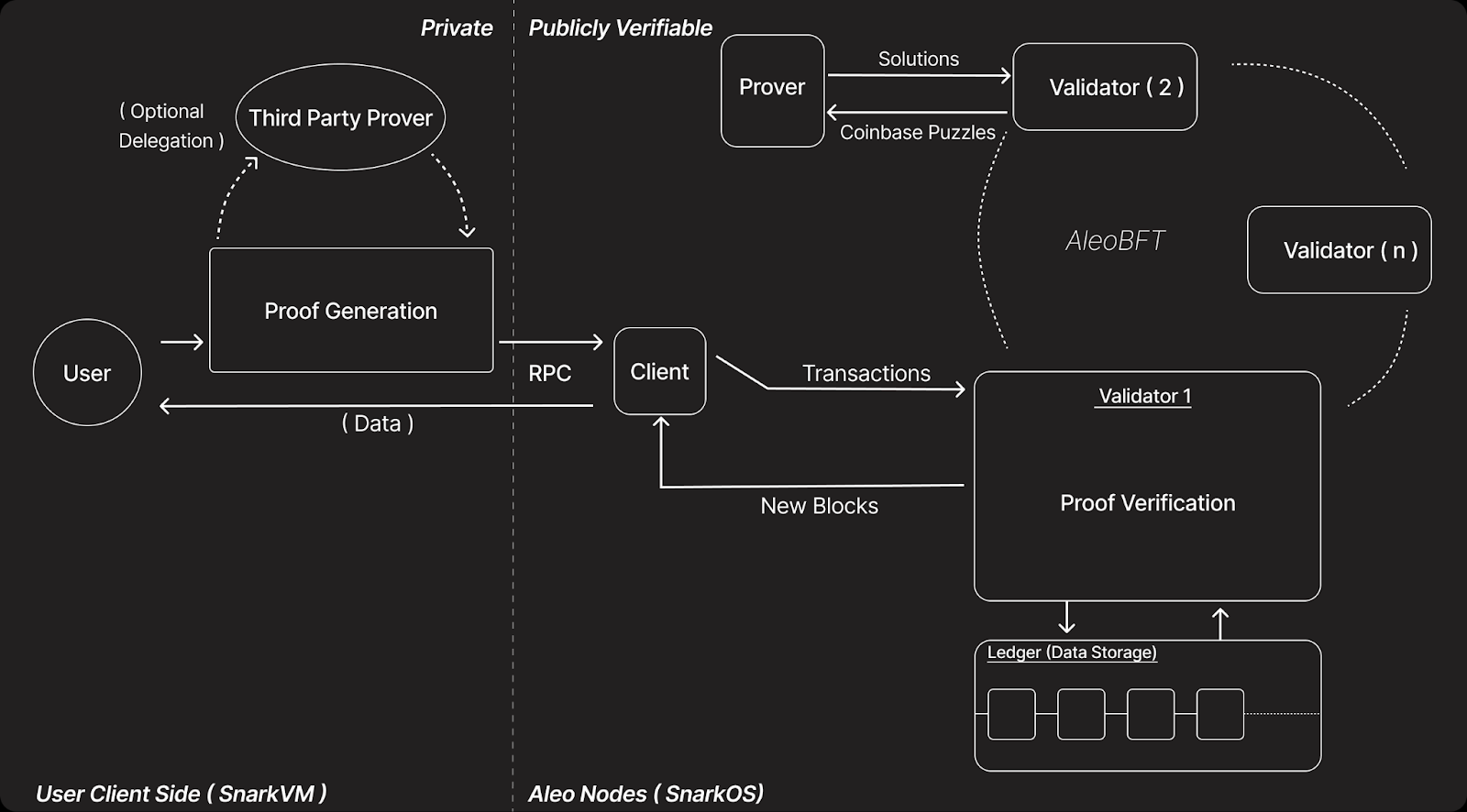
zkCloud is a core technology of Aleo that offloads complex computations from the blockchain to users’ own devices, then uses zero-knowledge proofs to verify the correctness of these computations. This approach protects user privacy while significantly improving blockchain performance.
The key innovation is off-chain execution. A blockchain functions like a shared ledger where all transactions and computations are publicly recorded. But if everyone writes directly onto this ledger, it becomes slow and exposes private details. zkCloud acts like giving each user a “private notebook.” You perform calculations privately in your notebook, then submit only the verified result to the public ledger. This method is both faster and privacy-preserving. According to Messari, zkCloud reduces processing time for private transactions from seconds to milliseconds and cuts computational costs by over 90%.
To support this, Aleo developed a specialized programming language called Leo, designed for building privacy-preserving decentralized applications. Leo simplifies the complex zero-knowledge proof (ZKP) technology, enabling developers to create privacy apps without needing to be cryptography experts. Since ZKP itself is highly complex and inaccessible to most programmers, Leo serves as a “translator,” converting advanced cryptographic concepts into simple programming syntax. Developers can write code as they normally would—the underlying ZKP complexity is automatically handled by Leo. Thanks to this low barrier to entry, official Aleo data shows a 150% increase in dApps built with Leo in 2024.
AleoBFT is Aleo’s consensus mechanism, combining the strengths of PoW and Proof-of-Stake (PoS). It uses a dynamic committee to quickly confirm transactions while maintaining decentralization and security. AleoBFT first selects a committee via PoW, which then uses PoS to rapidly finalize transactions. This ensures both decentralization and high efficiency. Testnet data shows AleoBFT achieves an average transaction confirmation time of 2 seconds—significantly faster than Ethereum’s 15 seconds—making it ideal for applications requiring speed. Together, zkCloud safeguards privacy and boosts efficiency, Leo lowers development barriers to drive innovation, and AleoBFT enables fast, decentralized transactions.
Strategic Alliances: Google Cloud and Coinbase as Trust Anchors
Although zero-knowledge proofs and privacy computing may seem esoteric to ordinary users, major players have already recognized the potential of this space. Prior to mainnet launch, Aleo raised over $200 million—setting a record for the largest funding round in the zero-knowledge sector. Investors include renowned institutions such as a16z, SoftBank, Coinbase, and Samsung.
These cutting-edge technologies and endorsements from industry giants have bolstered Aleo’s credibility and accelerated the development of its ecosystem governance.
On February 27, 2025, Aleo announced a strategic partnership with Google Cloud, becoming the first zero-knowledge Layer 1 network in Google Cloud’s ecosystem. As part of the collaboration, Google Cloud runs validator nodes on the Aleo mainnet, enhancing the network’s decentralization and stability. For developers, this integration enables access to Google Cloud’s BigQuery tool for analyzing Aleo network data—including transaction volume and on-chain records—improving development efficiency. Additionally, Coinbase joined as one of the first validators at mainnet launch.
In Q4 2024, Aleo’s ecosystem continued growing, with daily active addresses increasing by 10.6% and new addresses rising by 34.4%. By March, the number of Aleo validator nodes had reached 25.
Meanwhile, Aleo’s governance roadmap is advancing steadily. In May 2024—before mainnet launch—the Aleo Foundation launched a governance platform allowing token holders to vote on protocol upgrades and improvement proposals. After mainnet launch, the Ambassador Program was structured into three tiers: Apprentice, Voyager, and Maestro. Participants earn AleoPoints by submitting content and contributing to community governance. The platform leverages ZKP technology to enable private voting, preventing external manipulation. As of March 2025, the governance platform has processed multiple proposals, including ARC-0042 in December 2024 (dynamic reward adjustment, supported by 93% of the community).
From On-Chain Privacy to a Real-World “Data Passport”
With strong financial backing and strategic partnerships paving the way, Aleo’s technological breakthroughs now require thriving ecosystems to realize their full impact. Its technical advantages are beginning to materialize into real-world use cases, with Aleo’s zPass protocol gradually moving toward adoption.
“Without built-in privacy, cryptocurrency will never truly enter the real world,” declared Howard Wu on X—a statement that reveals Aleo’s ultimate ambition: leveraging privacy computing to unlock blockchain adoption across industries.
zPass is a protocol developed by Aleo based on zero-knowledge proof technology. It allows users to securely verify specific attributes of their identity—such as age or nationality—without revealing their full personal information. Think of it as a “privacy passport”: you can prove “I am an adult” or “I am a U.S. citizen” without disclosing your name or address.
In February 2025, Aleo announced that five projects had begun implementing zPass in production environments: Playside, World3, Humine, GeniiDAO, and ThreeofCups (3oC), spanning gaming, finance, healthcare, education, and social sectors.
For example, Playside uses zPass for age verification, ensuring younger users receive safe, age-appropriate experiences when interacting with AI agents—such as confirming eligibility to access certain game content.
Humine, a decentralized clinical trial platform, leverages zPass to let patients prove eligibility (e.g., having a specific condition or being within an age range) without exposing their complete medical history.
Clearly, the real-world application of zero-knowledge proofs extends far beyond crypto and finance into traditional industries. This expansion embodies Aleo’s core vision: returning data sovereignty to users and building a new Web3 ecosystem centered around “privacy as a service.”
From $1 billion in on-chain attack losses to CZ’s MEME coin mishap, Aleo’s narrative reflects the evolution of blockchain value: as technology shifts from pursuing “absolute transparency” to enabling “controlled anonymity,” a new social contract emerges—true freedom in the digital world isn’t about total disclosure, but the right to control the boundaries of one’s own data.
Join TechFlow official community to stay tuned
Telegram:https://t.me/TechFlowDaily
X (Twitter):https://x.com/TechFlowPost
X (Twitter) EN:https://x.com/BlockFlow_News
 PANews