








No Trading Required: A Step-by-Step Guide to Generating Passive Income with Pendle
TechFlow Selected TechFlow Selected
No Trading Required: A Step-by-Step Guide to Generating Passive Income with Pendle
Those who did not sell their tokens typically keep them stored on centralized exchanges, thus missing out on opportunities to earn passive income.
 Navigating Web3 tides with focused insights
Author: Igor Jerkovic
Translation: TechFlow
I'm a software engineer with over 15 years of experience, actively involved in the crypto space since 2017. Currently, I'm going through my third crypto cycle (and currently developing the DeFi Koala project). Throughout these cycles, I've observed a common pattern: many of my friends consistently buy cryptocurrencies at the peak of each four-year cycle—usually near price tops—and subsequently endure massive unrealized losses (or realized losses if they sell).
Those who don't sell often keep their tokens sitting on centralized exchanges, missing out on opportunities to earn passive income. Even those who do take profits frequently leave their stablecoins idle, waiting for prices to drop before buying back in. I share this because trading is genuinely difficult, but there's actually a better way to accumulate more crypto assets without constant trading.
A Common Mistake: Ignoring Passive Income
Through conversations with numerous crypto holders, I've found that most people aren't aware they can earn yield on their holdings. In this article, I'll share a simple strategy to help you generate passive income from your crypto assets.
Simple Strategy: Lend Out Your Stablecoins
One of the easiest ways to earn passive income is lending your stablecoins (e.g., USDC) to borrowers in exchange for interest. Decentralized finance (DeFi) lending platforms typically require over-collateralization, meaning borrowers must deposit collateral exceeding the loan amount. If the value of their collateral approaches the sum of the borrowed amount and accrued interest, they face liquidation, and lenders are automatically repaid.
A potential downside? Interest rate volatility.
For example, over the past year, the average annual percentage rate (APR) for USDC on Aave was 6.28%. This means $10,000 invested would earn $628 in interest—compared to 0% if left idle on an exchange.
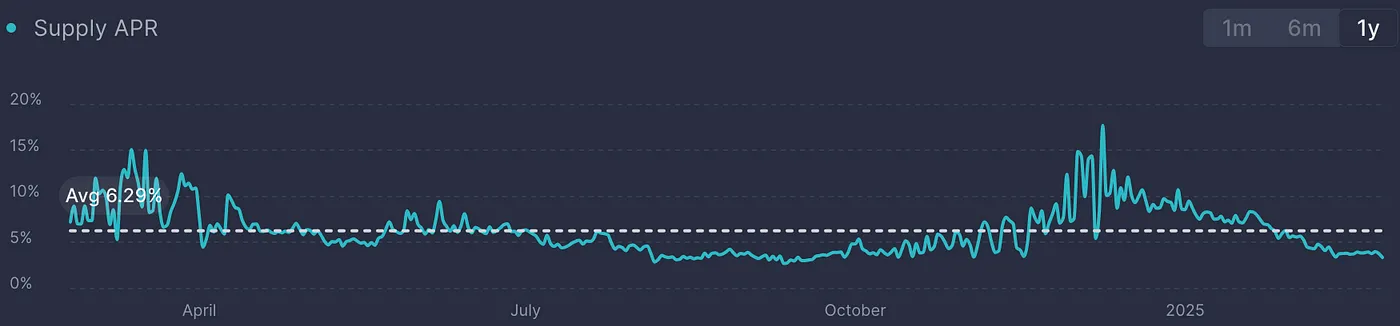
Average supply rate on Aave over one year
But the problem lies in rate fluctuations.
Better Strategy: Locking in Fixed Yields
This is where Pendle comes in. Pendle allows you to lock in fixed yields for a predetermined period, eliminating uncertainty caused by fluctuating rates.
For instance, in December 2024, Ethena’s floating APR reached as high as 27%. While tempting, such rates are unstable—at the time of writing, it has dropped to 9%. To address this, I used Pendle to lock in a fixed APR of 20.5% for six months.
How Pendle Works
Pendle splits yield-bearing tokens into two types:
-
Principal Tokens (PT): Their value grows steadily over time.
-
Yield Tokens (YT): Provide variable yield, which decays as the maturity date approaches.
In December 2024, I first swapped USDC for sUSDe via CowSwap (a decentralized exchange aggregator offering better rates than Uniswap), then purchased sUSDe PT tokens maturing on May 29, 2025.
On May 29, 2025, I will realize a 20.5% APR. This means a $10,000 investment will grow to $10,951. Additionally, I can withdraw part of my funds early while still capturing partial gains.
Note: Since I only locked funds for six months, my actual annualized return is approximately 9.5%. Had I locked for a full year, I would have earned the full 20.5%.
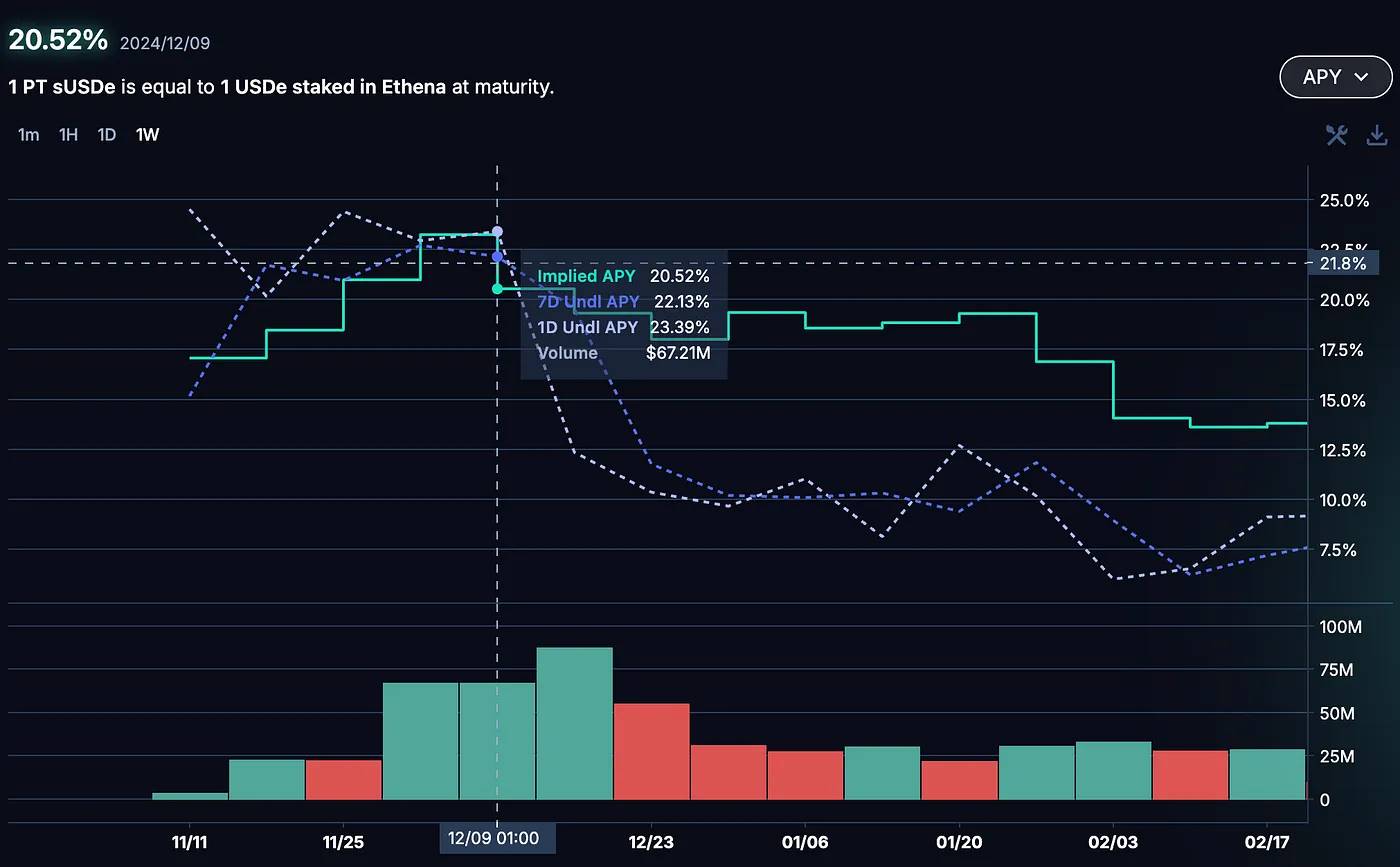
Yield locked on Pendle on December 12, 2024
After maturity, I may reinvest using Pendle again or explore other DeFi opportunities depending on market conditions.
Essentially, Pendle tokenizes fixed-yield DeFi strategies, similar to zero-coupon bonds, giving investors a tool to secure predictable returns.
Step-by-Step Guide: How to Lock Fixed Yields Using Pendle
Before getting started, assume you’ve already:
✅ Understood what a crypto wallet is.
✅ Learned how to transfer tokens from a centralized exchange to an external self-custody wallet.
Tip: To interact with DeFi, you’ll need a self-custody wallet (like MetaMask) or a hardware wallet (e.g., Ledger connected via MetaMask).
Step 1: Connect to Pendle
-
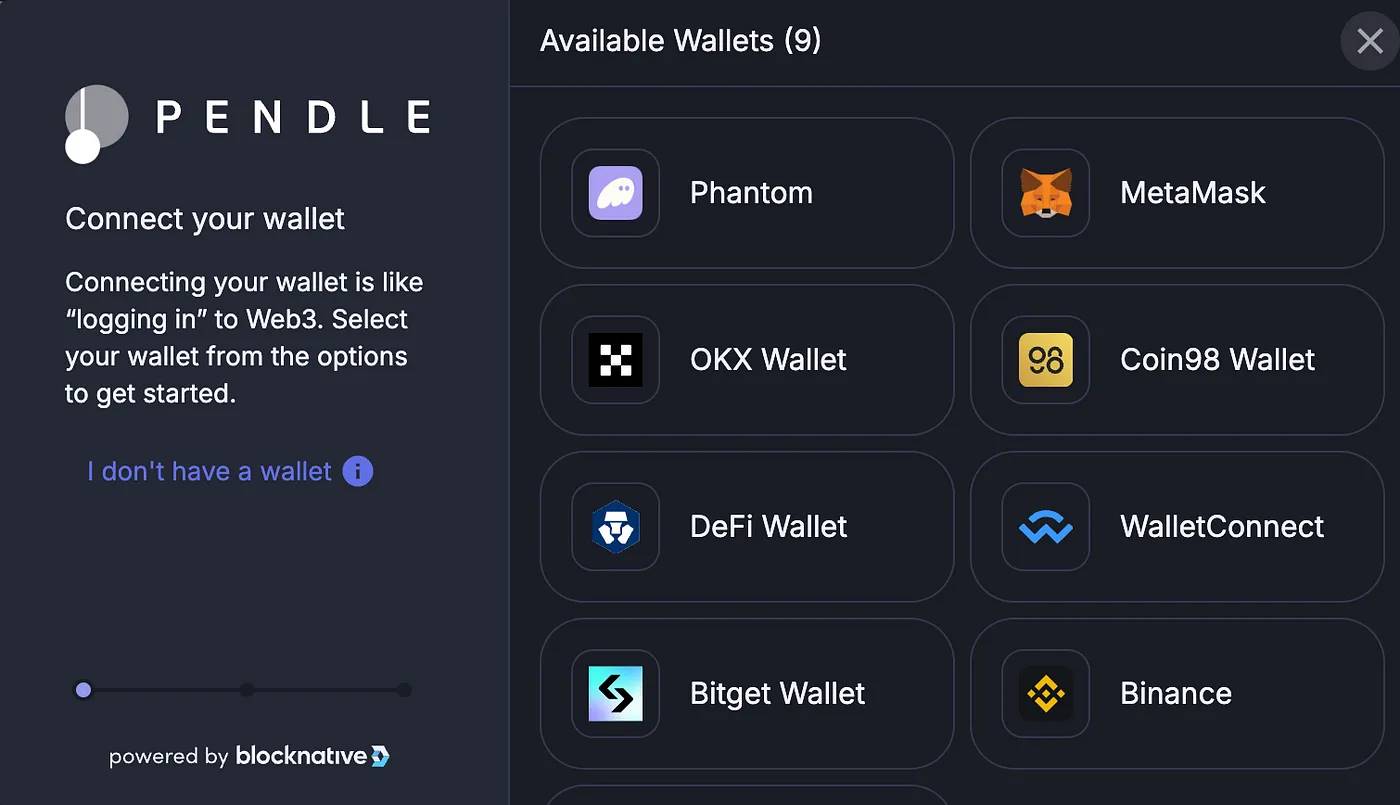
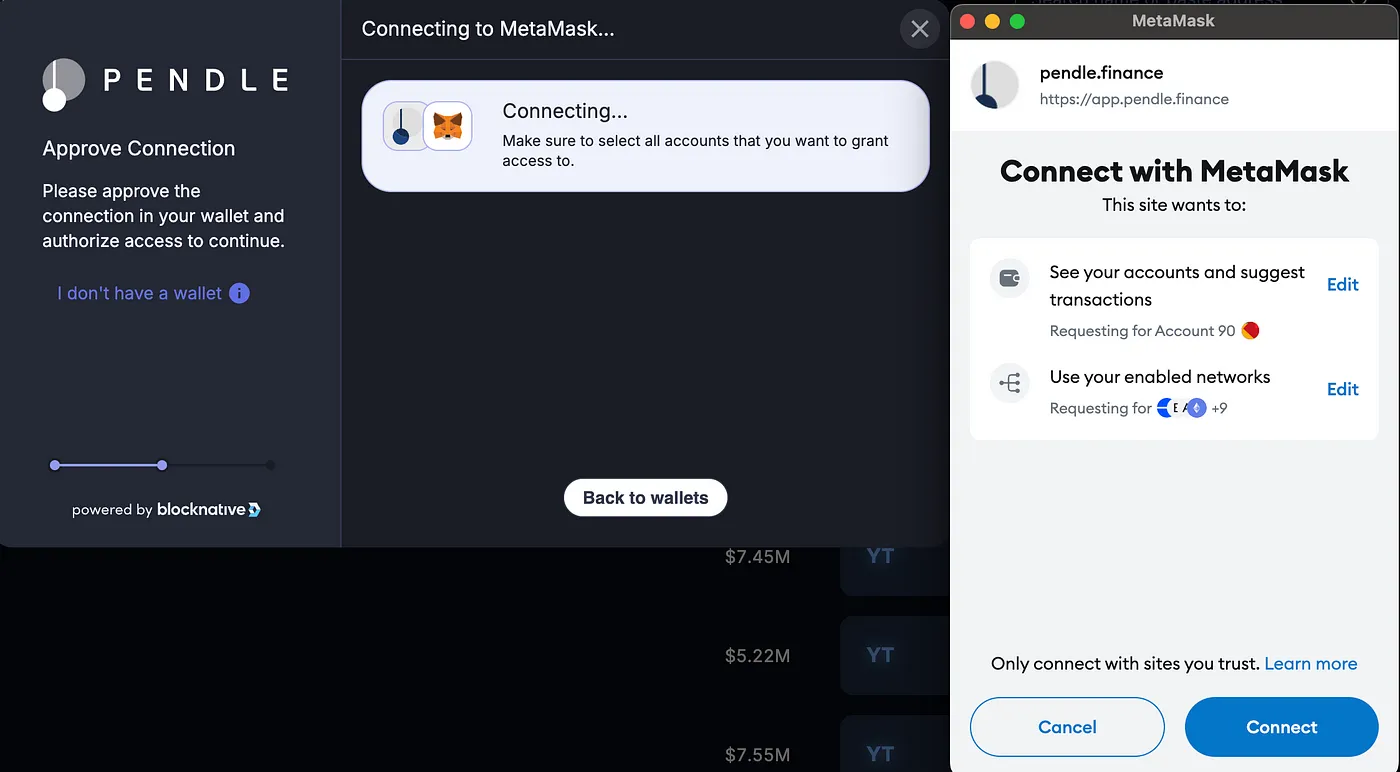
Go to the Pendle website and click “Connect Wallet.”

-
Select MetaMask (if that’s where your private keys are stored).
-
A pop-up window will appear asking you to connect to the site (this allows Pendle to see your public address and request transaction signatures)—click “Connect.”
Step 2: Choose a Fixed Yield
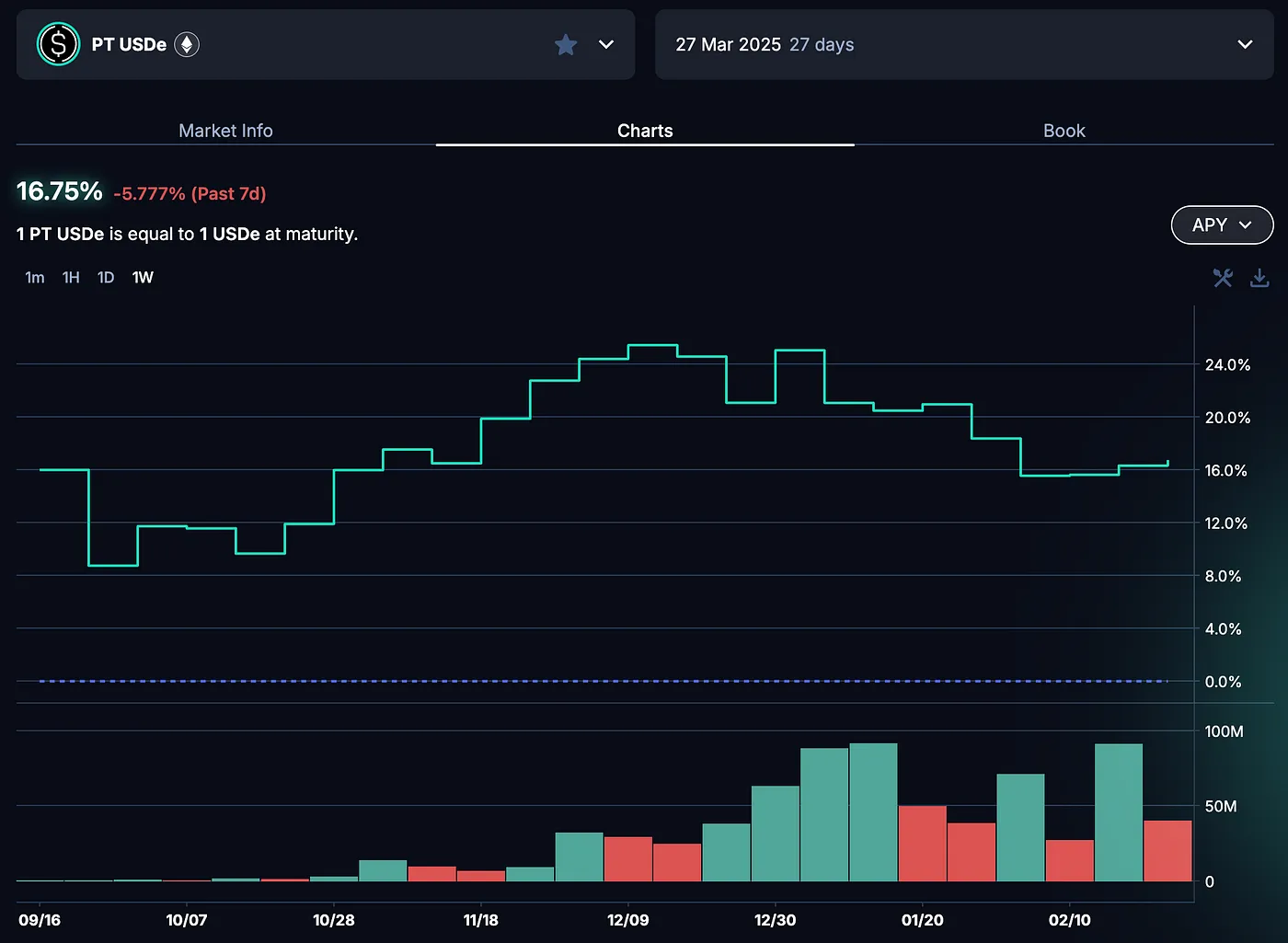
At the time of writing, Ethena’s stablecoin (USDe), when staked as sUSDe, offers a floating yield of 9%. However, using Pendle, you can lock in a 16.75% APR until March 27, 2025.
Click the “PT 16.75%” button.

-
You’ll see historical rate volatility—the rate depends on market conditions.
-
Select the “PT” option (not “YT”) and click “Buy PT.”
-
Enter the amount—for example, I set it to 10,000 USDe.
-
The interface will display the expected return:
-
By March 27, 2025, I can redeem 10,115.4 USDe.
-
This equates to a 16.51% annual percentage yield (APY), or 1.154% gain over 27 days.
-
-
On the same screen, you can view how the rate has fluctuated over time. Typically, borrowing rates rise during bullish markets when demand for stablecoin loans increases, benefiting lenders. But once you lock in a rate via Pendle, it remains fixed regardless of future market shifts.
Approve USDe Usage
Since USDe is an ERC-20 token, you must first authorize Pendle to use it before proceeding.
-
Click “Approve USDe.”
-
A MetaMask pop-up will appear—sign the transaction.
-
This step allows Pendle’s smart contract to convert your USDe into PT-USDe-27Mar2025 tokens.
Why is approval needed? The ERC-20 standard separates ownership from usage rights, ensuring only authorized smart contracts can access your funds. This mechanism prevents unauthorized contracts from moving your tokens.
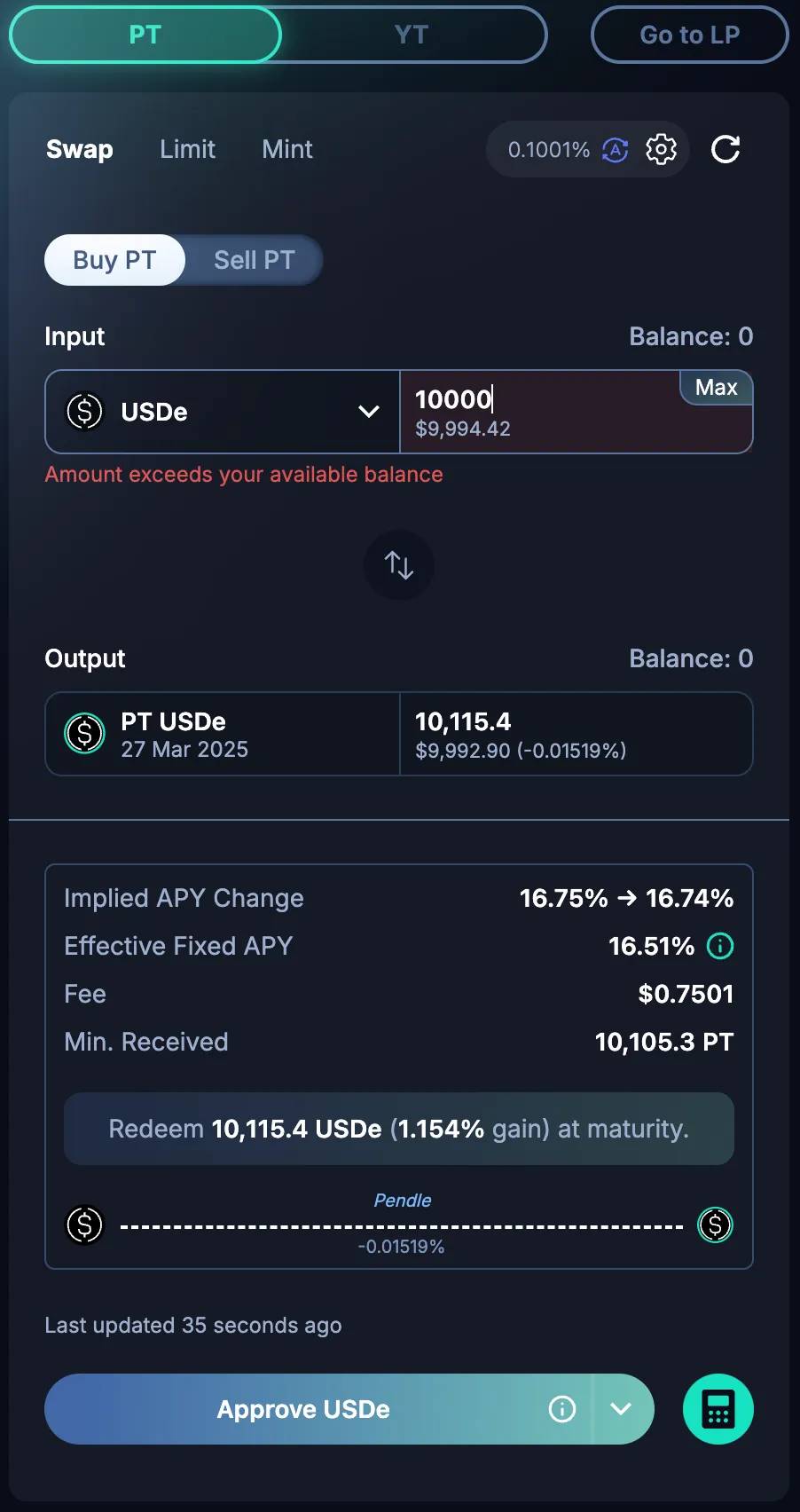
After authorization and completing the steps, you’ll be able to redeem 10,115.4 USDe on March 27, 2025—a 16.51% APY or 1.154% total return over 27 days. If the market offered a full 365-day lock-up, you’d earn the full 16.51%.
Important Notes:
-
The approval step is required because USDe is an ERC-20 token on Ethereum. The ERC-20 approval mechanism mandates explicit user consent before any smart contract (like Pendle) can use your tokens, preventing unauthorized access.
-
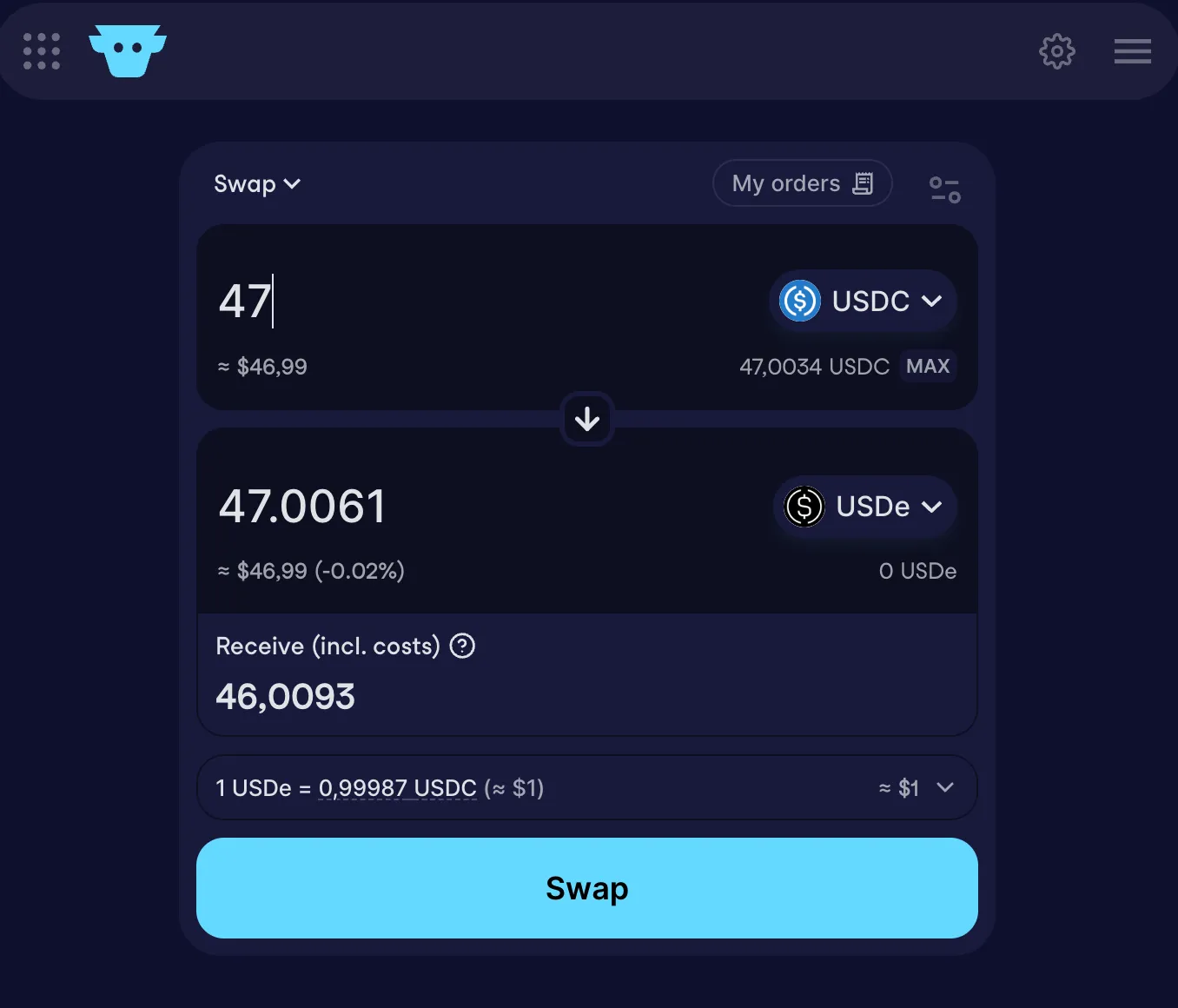
Ensure your wallet already holds USDe before starting. Directly swapping into USDe PT tokens usually incurs lower fees than converting from another token. If you don’t yet hold USDe, consider using CowSwap, which currently offers the best exchange rates across all decentralized exchanges (DEXs).
Step 4: Execute the Swap
-
Click “Swap,” which triggers a MetaMask pop-up prompting you to sign the transaction.
-
You’re now exchanging USDe for PT tokens.
-
Congratulations! 🎉 You’ve successfully locked in a fixed-yield position.
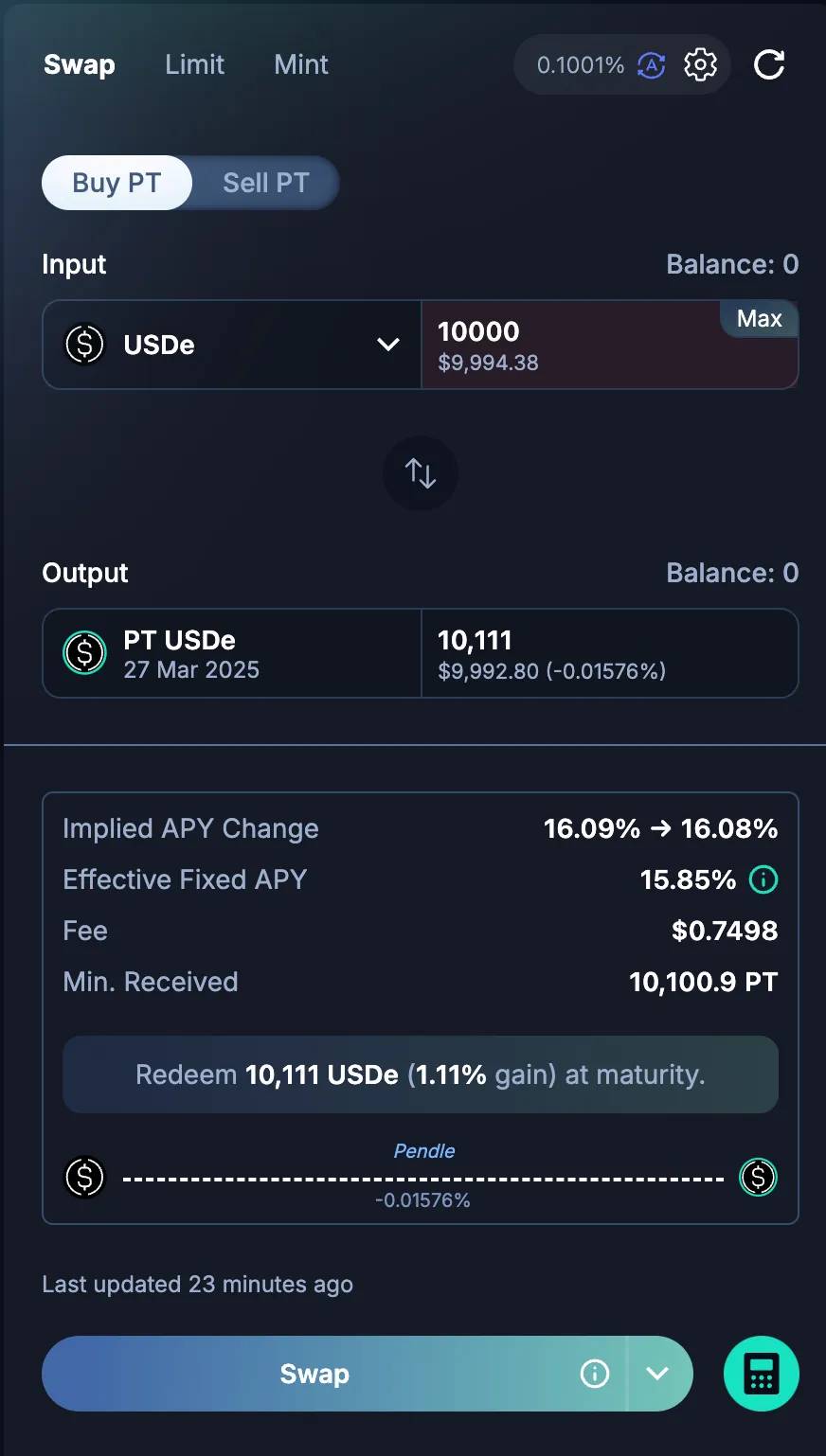
In this transaction, you interact with Pendle’s smart contract to swap USDe for PT-USDe-27Mar2025 tokens. Upon maturity, you can redeem them and receive your principal plus yield, paid in USDe.
Step 5: Monitor Your Position
-
Click “My Dashboard” to view your holdings.
-
Over time, your position’s profit and loss (P&L) will gradually increase.
-
On the maturity date, you’ll receive your full return.
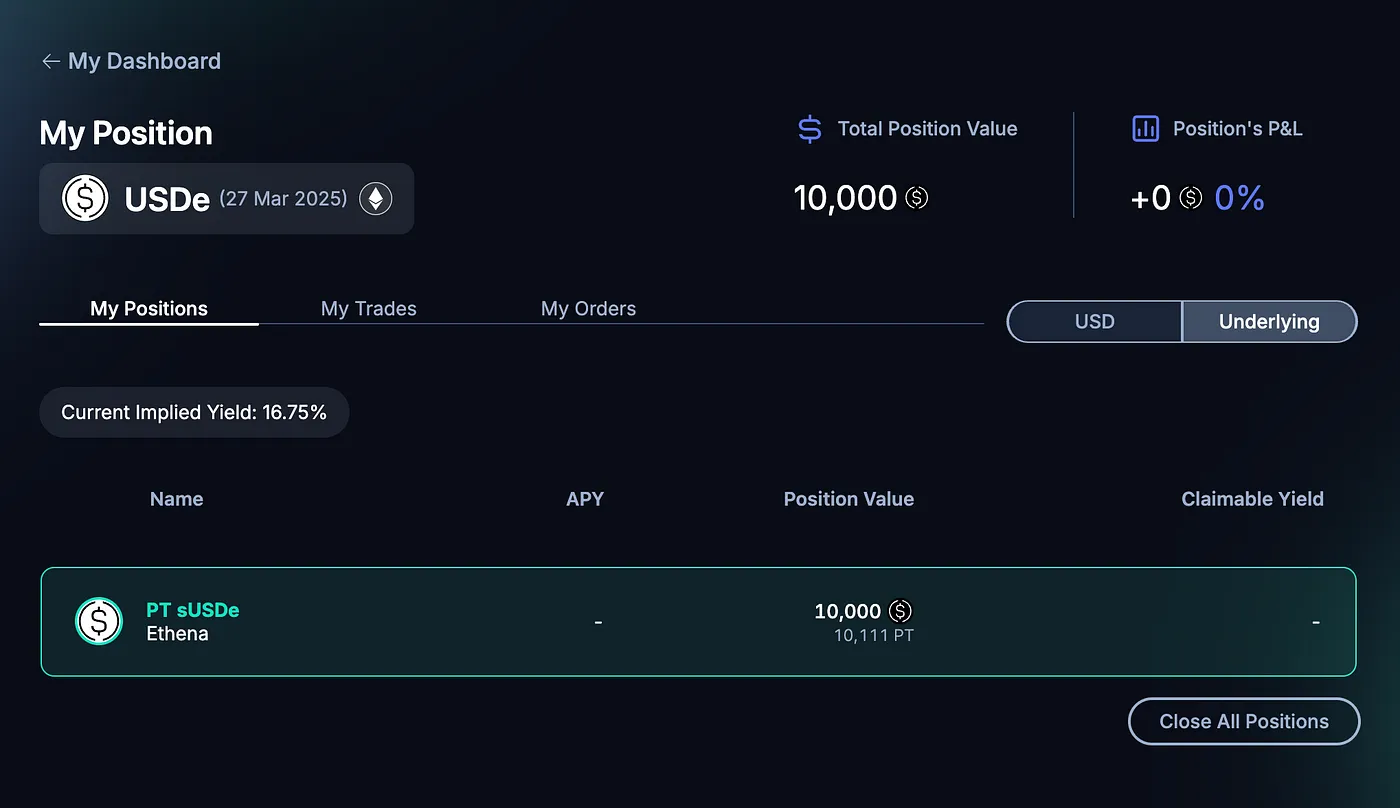
In the portfolio section, you can track your open positions. As time passes, your P&L will grow, and by maturity, your total gain is projected to reach 111 USDe.
Congratulations! You’ve earned solid returns. Now, simply swap your USDe back to USDC or another preferred cryptocurrency. I’ll publish a detailed guide soon on how to do this efficiently using CowSwap, which offers the best available rates.
Simplifying the Process: Making Fixed-Yield Investing Easier
Although this strategy is highly effective, when I shared it with friends, most expressed hesitation about doing it themselves. The process involves several complex steps:
-
Understanding the difference between floating and fixed yields.
-
Learning how Pendle works.
-
Navigating multiple DeFi platforms (such as CowSwap, Pendle, Ethena).
To simplify everything, I’ve built a product that consolidates these steps into a seamless “one-click fixed-yield locking” experience.
If you're interested, check outDeFi Koala and sign up for the Closed Alpha.
Join TechFlow official community to stay tuned
Telegram:https://t.me/TechFlowDaily
X (Twitter):https://x.com/TechFlowPost
X (Twitter) EN:https://x.com/BlockFlow_News


