








Funding becomes increasingly difficult, and crypto venture capital enters the final stage of frenzy
TechFlow Selected TechFlow Selected
Funding becomes increasingly difficult, and crypto venture capital enters the final stage of frenzy
In 2022, the amount invested in crypto venture capital reached $23 billion; by 2024, this figure had dropped to $6 billion.
 Navigating Web3 tides with focused insights
Author: Decentralised
Translation: Odaily Planet Daily Golem
This article examines the current state of venture capital in the crypto industry and expectations for the future. All data comes from Funding Tracker.
Current State of Crypto Venture Capital
Rational market participants might expect capital markets to have highs and lows, much like other cyclical phenomena in nature. However, venture investment in cryptocurrency appears more like a one-way waterfall—a continuous gravitational descent. We may be witnessing the final phase of a funding frenzy that began with smart contracts and ICOs in 2017, accelerated during the low-interest-rate era of the pandemic, and is now returning to more stable levels.
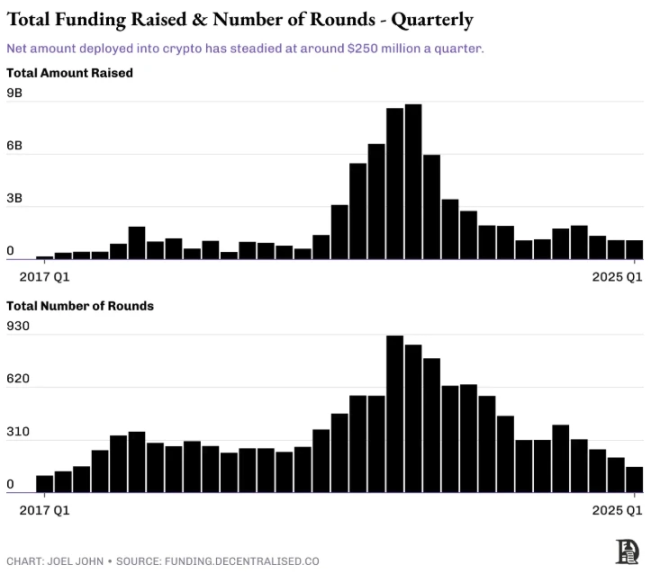
Total Funding and Total Number of Funding Rounds
In the peak year of 2022, venture investment in cryptocurrency reached $23 billion, declining to $6 billion by 2024. There are three main reasons for this:
-
The 2022 boom led VCs to allocate excessive capital to cyclical projects with inflated valuations. For example, many DeFi and NFT projects failed to deliver returns. OpenSea reached a peak valuation of $13 billion.
-
Funds found it difficult to raise new capital between 2023 and 2024, while projects listing on exchanges struggled to achieve the valuation premiums seen between 2017 and 2022. The lack of premium made fundraising challenging, especially as many investors underperformed compared to Bitcoin.
-
As AI emerged as the next major technological frontier, large-scale capital shifted its focus. Cryptocurrency lost the speculative momentum and premium it once enjoyed as the most promising cutting-edge technology.
A deeper crisis becomes apparent when examining which startups grow large enough to secure Series C or D funding. Many major exits in the crypto industry have historically come from token listings. However, when most token listings show negative trends, investor exits become difficult. This contrast is evident when comparing the number of seed-stage companies progressing to Series A, B, or C rounds.
Since 2017, only 1,317 out of 7,650 companies that received seed funding advanced to Series A (a graduation rate of 17%), just 344 reached Series B, about 1% made it to Series C, and the odds of securing Series D funding stand at 1 in 200—comparable to graduation rates in other industries. It should be noted that many growth-stage companies in crypto bypass traditional subsequent rounds through tokenization. However, these figures highlight two distinct issues:
-
Without a healthy market for token liquidity, venture investment in crypto will stagnate.
-
Without healthy corporate development into later stages and public listings, venture investment appetite will decline.
Data across various funding stages all seem to reflect the same reality. While capital entering seed and Series A rounds has remained relatively stable, funding for Series B and C rounds remains conservative. Does this mean it's a good time for seed-stage investments? Not exactly.
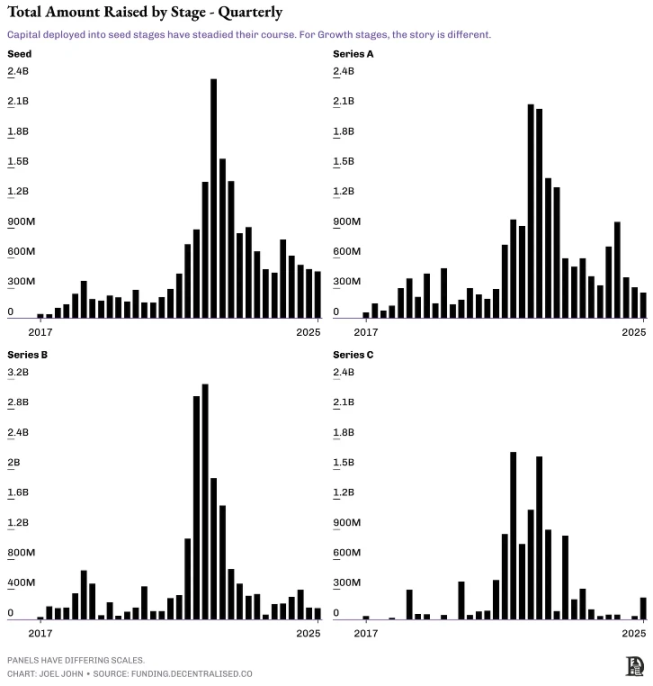
Total Funding Amount by Stage
The following data tracks the median funding amount raised in Pre-Seed and Seed rounds each quarter, showing a steady upward trend over time. Two observations are worth noting:
-
Since early 2024, the median Pre-Seed round size has increased significantly.
-
Over the years, the median Seed round size has fluctuated with macroeconomic conditions.
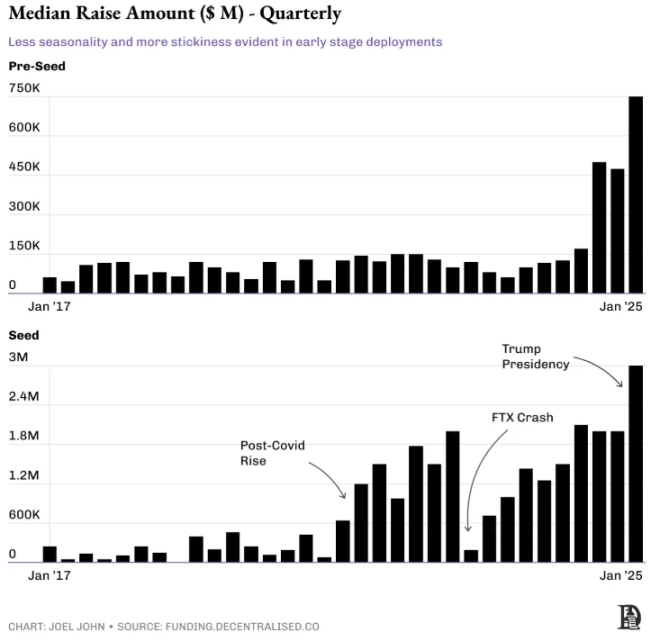
As demand for early-stage capital decreases, we see companies raising larger Pre-Seed and Seed rounds. Former "friends and family" rounds are now being filled earlier by early-stage funds. This pressure extends to Seed-stage companies as well; since 2022, Seed rounds have grown larger to offset rising labor costs and the longer time required to achieve product-market fit in the crypto industry.
Larger funding amounts mean higher valuations (or dilution) at early stages, which in turn means companies must reach even higher valuations in the future to generate returns. In the months following Trump’s election, Seed round data also showed a significant increase. My interpretation is that Trump’s inauguration changed the environment for fund GPs (General Partners) raising capital, increasing interest from LPs and more traditional allocators, translating into greater VC appetite for early-stage companies.
Funding Challenges and Concentration of Capital Among a Few Large Companies
What does this mean for founders? While there is more capital available for Web3 early-stage funding than ever before, it targets fewer founders, demands larger scale, and expects faster growth than in previous cycles.
With traditional sources of liquidity—such as token launches—now drying up, founders spend more time demonstrating credibility and proving their company's potential. The days of “50% discounts leading to high-valuation follow-on rounds within two weeks” are over. Follow-on investments no longer guarantee profits, founders can’t easily raise additional funds, and employees cannot benefit from appreciation of their vested tokens.
One way to test this argument is through the lens of capital momentum. The chart below measures the average number of days it takes startups to raise a Series A round after announcing their Seed round. Lower numbers indicate higher capital turnover. That is, investors are deploying more capital at higher valuations into new Seed-stage companies without waiting for them to mature.
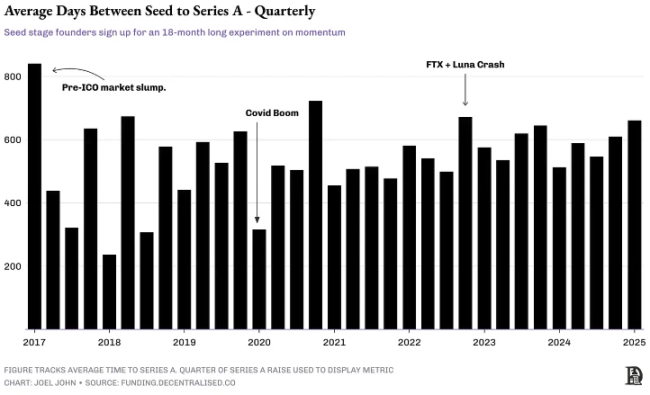
At the same time, the above chart also reveals how public market liquidity affects private markets. One way to observe this is through the concept of "safety." Whenever public markets correct, a surge in Series A funding occurs—for instance, the sharp drop in Q1 2018 and again in Q1 2020 during the onset of the pandemic. When liquidity deployment seems uncertain, investors with available capital are instead incentivized to build positions in the private market.
But why was Q4 2022—the period of FTX’s collapse—an exception? Perhaps it marked the precise moment when interest in crypto investing as an asset class was completely eroded. Several major funds lost substantial amounts in FTX’s $32 billion ecosystem, leading to diminished enthusiasm for the sector. In the subsequent quarters, capital concentrated around only a few large companies, with most LP capital flowing to those firms simply because they were the only places capable of absorbing such large investments.
In venture capital, capital scales faster than labor. You can deploy $1 billion, but you can't proportionally hire 100 people. So if you start with a team of 10 and stop hiring, you're incentivized to raise more funding. This explains why we see numerous large late-stage financings, often centered around token issuance.
What Will Future Crypto Venture Investment Look Like?
I’ve been tracking this data for six years, yet I consistently arrive at the same conclusion: raising venture funding will become increasingly difficult. Market hype initially attracts talent and accessible capital, but market efficiency ensures things become progressively harder over time. In 2018, simply being labeled “blockchain” was enough to secure funding; by 2025, the focus has shifted toward profitability and product-market fit.
The absence of easy liquidity exit opportunities means venture investors must reassess their views on liquidity and investment horizons. The days when investors expected liquidity within 18–24 months are gone. Now, employees must work harder to earn the same number of tokens, which are also valued lower. This doesn’t mean there are no profitable companies in crypto—it simply means, like in traditional economies, a small number of companies will capture the majority of the industry’s economic output.
If venture investors can make venture capital great again—by focusing on the founder’s true nature rather than the tokens they can issue—then the crypto venture capital industry can still move forward. Today, the strategy of signaling in token markets, rushing to launch a token, and hoping users will buy it on exchanges is no longer viable.
Under these constraints, capital allocators are incentivized to spend more time collaborating with founders who can capture larger market shares in evolving markets. The shift—from 2018, when VC firms primarily asked “When will you launch your token?” to today’s focus on understanding how large a market can grow—is part of the education process most capital allocators in Web3 must undergo.
But the question remains: how many founders and investors will persist in seeking answers to this challenge?
Join TechFlow official community to stay tuned
Telegram:https://t.me/TechFlowDaily
X (Twitter):https://x.com/TechFlowPost
X (Twitter) EN:https://x.com/BlockFlow_News
 @Decentralisedco


