Is the altcoin season dead? Bitcoin ETFs rewrite the rules of crypto investing
TechFlow Selected TechFlow Selected
Is the altcoin season dead? Bitcoin ETFs rewrite the rules of crypto investing
The days of easy, cyclical altcoin rallies may be replaced by an ecosystem where capital efficiency, structured financial products, and regulatory transparency determine the flow of funds.
 Navigating Web3 tides with focused insights
Author: Bryan Daugherty
Translation: Block unicorn
Bitcoin exchange-traded products (ETPs) may have fundamentally altered the concept of "altseason" in the crypto market.
For years, the crypto market followed a familiar rhythm—capital rotation was nearly predictable. Bitcoin surged, drawing mainstream attention and liquidity, followed by a wave of money flowing into altcoins. Speculative capital flooded into low-market-cap assets, driving up their value, and traders excitedly dubbed it "altseason."
Yet this cycle, once taken for granted, is now showing signs of structural breakdown.
Cash bitcoin ETFs shattered records in 2024, attracting $129 billion in inflows. These funds provided retail and institutional investors with unprecedented access to bitcoin—but also created a vacuum that siphoned capital away from speculative assets. Institutional investors now have a secure, regulated way to gain exposure to crypto without taking on the "wild west" risks of the altcoin markets. Many retail investors also find ETFs more appealing than hunting for the next 100x token. Prominent Bitcoin analyst PlanB even swapped his actual Bitcoin holdings for spot ETFs.
This shift is unfolding in real time. If capital continues to be locked into structured products, altcoins will face reduced market liquidity and correlation.
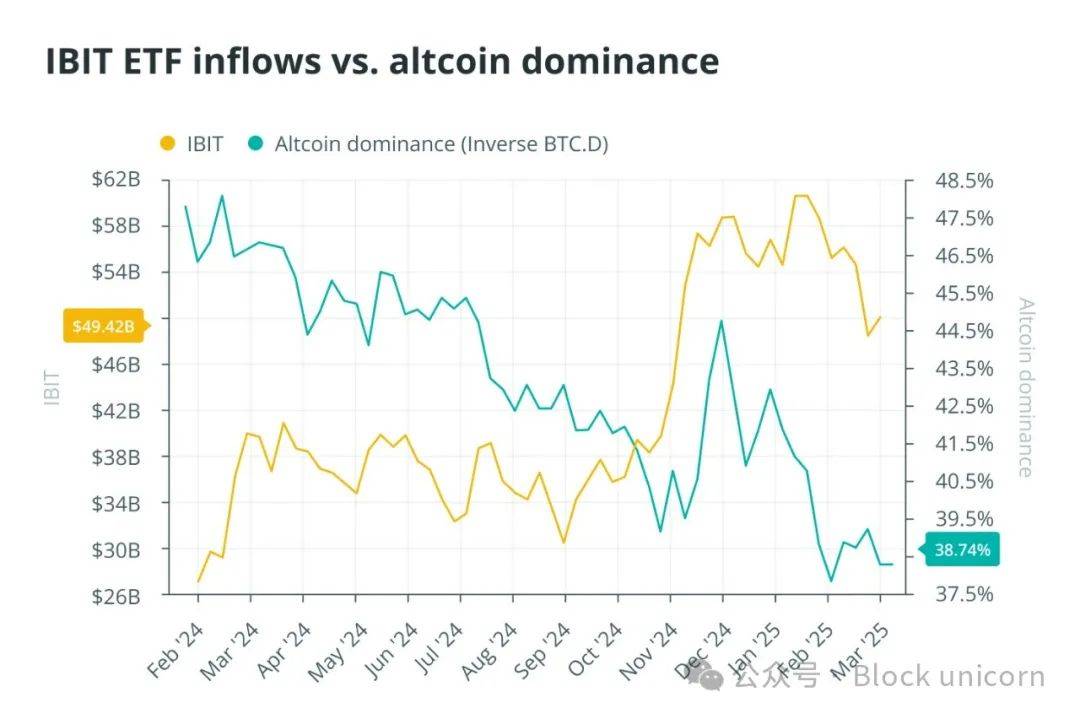
Is Altseason Dead? The Rise of Structured Crypto Investing
Bitcoin ETFs offer an alternative to chasing high-risk, low-market-cap assets, allowing investors to gain leverage, liquidity, and regulatory transparency through structured products. Retail investors—who once fueled altcoin speculation—are now able to invest directly in Bitcoin and Ethereum ETFs, tools that eliminate concerns around self-custody, reduce counterparty risk, and align with traditional investment frameworks.
Institutions have even greater incentives to avoid altcoin risks. Hedge funds and professional trading platforms that once chased higher returns in illiquid altcoins can now deploy leverage via derivatives or gain exposure through ETFs on traditional financial rails.
With improved hedging capabilities through options and futures, the motivation to speculate in low-liquidity, low-volume altcoins has significantly diminished. This trend was further reinforced in February by record outflows of $2.4 billion and arbitrage opportunities arising from ETF redemptions, forcing the crypto market into an unprecedented level of discipline.

The traditional "cycle" starts with Bitcoin, then moves into altseason. Source: Cointelegraph Research
Will Venture Capital Abandon Crypto Startups?
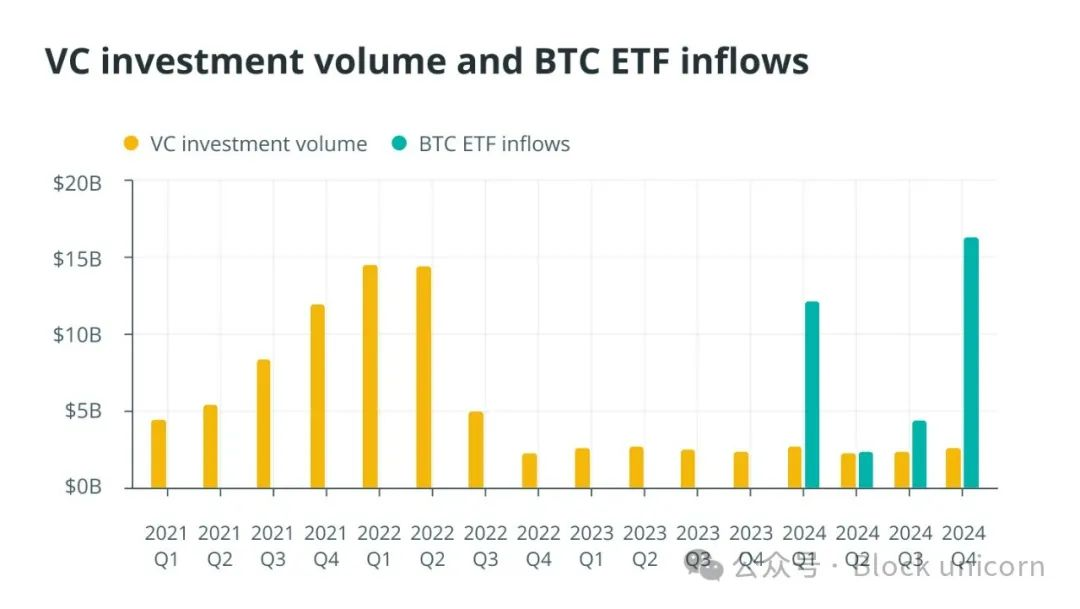
Venture capital (VC) firms have historically been the lifeline of altseason, injecting liquidity into emerging projects and crafting grand narratives around new tokens.
Yet as leverage becomes easier to obtain and capital efficiency becomes a top priority, VCs are rethinking their strategies.
VCs aim for the highest possible return on investment (ROI), typically targeting between 17% and 25%. In traditional finance, the risk-free rate serves as the benchmark for all investments, usually represented by U.S. Treasury yields.
In crypto, Bitcoin’s historical growth rate plays a similar role as the expected return benchmark—effectively serving as the industry's risk-free rate. Over the past decade, Bitcoin’s compound annual growth rate (CAGR) averaged 77%, far exceeding traditional assets like gold (8%) and the S&P 500 (11%). Even over the past five years, including both bull and bear markets, Bitcoin’s CAGR remained at 67%.
Using this as a baseline, if venture capitalists deploy capital into Bitcoin or Bitcoin-related ventures at this growth rate, the total ROI over five years would reach approximately 1,199%—meaning investments would grow nearly 12-fold.
Despite Bitcoin’s volatility, its long-term outperformance makes it a fundamental benchmark for assessing risk-adjusted returns in the crypto space. With increasing arbitrage opportunities and reduced risk, VCs may opt for safer bets.
In 2024, the number of VC deals declined by 46%, although overall investment volume rebounded somewhat in Q4. This marks a shift toward more selective, high-value projects rather than speculative funding.
Web3 and AI-driven crypto startups still attract attention, but the days of indiscriminate funding for every whitepaper-backed token may be numbered. If venture capital shifts further toward structured investments via ETFs instead of direct investments in high-risk startups, new altcoin projects could face serious consequences.
Meanwhile, the few altcoin projects that do enter institutional focus—such as Aptos, which recently filed for an ETF—are exceptions, not the norm. Even crypto index ETFs designed to provide broader exposure struggle to attract meaningful inflows, highlighting that capital is concentrating, not diversifying.
Supply Glut and the New Market Reality
The market landscape has shifted. The sheer number of altcoins competing for attention has created a saturation problem. According to Dune Analytics, there are currently over 40 million tokens in the market. An average of 1.2 million new tokens were launched each month in 2024, and over 5 million tokens have been created since early 2025.
As institutions lean toward structured investments and retail-driven speculative demand wanes, liquidity is no longer flowing into altcoins as freely as before.
This reveals a harsh reality: most altcoins will not survive. Ki Young Ju, CEO of CryptoQuant, recently warned that without a fundamental shift in market structure, the majority of these assets are unlikely to endure. "The era where everything rises is over," Ju said in a recent X post.
In an era where capital is locked in ETFs and perpetual contracts rather than freely flowing into speculative assets, the traditional strategy of waiting for Bitcoin dominance to decline before rotating into altcoins may no longer apply.
The crypto market is no longer what it once was. The easy, cyclical altcoin rallies may be replaced by an ecosystem where capital flows are dictated by capital efficiency, structured financial products, and regulatory transparency. ETFs are changing how people invest in Bitcoin—and fundamentally reshaping the entire market’s liquidity distribution.
For those operating under the assumption that every Bitcoin rally will inevitably lead to an altcoin boom, it may be time to reconsider. As the market matures, the rules may have already changed.
Join TechFlow official community to stay tuned
Telegram:https://t.me/TechFlowDaily
X (Twitter):https://x.com/TechFlowPost
X (Twitter) EN:https://x.com/BlockFlow_News
 @BlockUnicorn