Will the altcoin season still come?
TechFlow Selected TechFlow Selected
Will the altcoin season still come?
Bitcoin and Ethereum surged first because that's where liquidity initially flows.
 Navigating Web3 tides with focused insights
Written by: Dami-Defi
Compiled by: AididiaoJP, Foresight News
Bitcoin surges 20%, Ethereum follows closely, but what about your altcoin investments? Stagnant.
You scroll through Twitter, everyone is celebrating new highs, but your portfolio looks like it's stuck in 2023. Why is that?
This is the truth no one wants to hear: when Bitcoin's price soars, the market doesn't necessarily push up altcoins. To understand why, you need to abandon a dangerous assumption.
Misconception: "The Beta Rally Should Immediately Follow"
Most traders expect instant rotation. Bitcoin rises on Monday, altcoins should explode on Tuesday, right? Wrong.
The reality is that liquidity enters the crypto market in layers, not all at once. Major coins can rise for weeks while altcoins remain flat. This isn't a market structure issue; it's just how capital flows work. The sooner you accept this, the better positioned you'll be when the real rotation arrives.
Liquidity Layering: The Actual Sequence of Capital Inflow
Stop staring at altcoin charts; you're looking at false liquidity. Capital enters the crypto market sequentially through three distinct layers:
Layer 1: Spot ETFs & Major Spot (Most direct channel, largest capital)
This is where institutions, family offices, and large asset allocators participate. They buy Bitcoin and Ethereum spot through regulated products. Zero leverage, zero complexity, maximum scale. This capital isn't "exploring" altcoins; it's parked in these two assets with clear regulatory clarity.
Layer 2: Derivatives (Fastest, but typically not directional altcoin buying)
Basis trading, funding rate arbitrage, perpetual contract open interest. These activities can push up BTC/ETH prices without triggering broad risk appetite.
Layer 3: Retail & On-chain Risk (The final wave, usually the altcoin rally wave)
Altcoins only start moving when ordinary traders finally gain enough confidence to rotate out of major coins and begin seeking Beta returns. But this is the last liquidity to arrive, not the first.
Understanding this layering changes everything. When Bitcoin rises and your altcoins don't move, it simply means liquidity is still in Layer 1 or Layer 2.
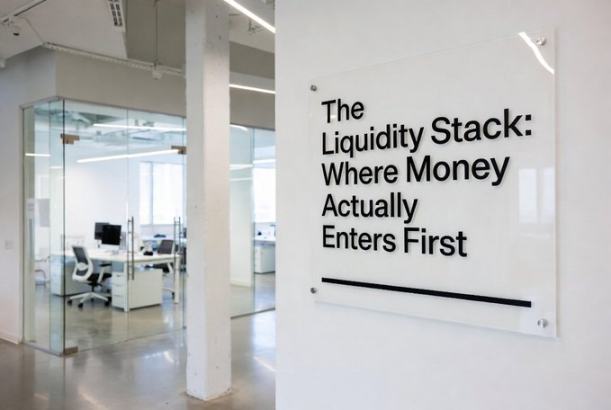
The Basis Trap: When Prices Rise But Risk Appetite Doesn't Change
Here's a brutal reality check: Bitcoin can rally strongly while actual risk appetite may remain unchanged.
How is that possible? Cash-and-carry arbitrage trades. Institutions buy spot Bitcoin, short futures, and pocket the basis. This behavior pushes up Bitcoin's price but carries zero intent to buy altcoins. Funding rates may stay high, open interest may climb, prices may grind higher, while altcoins remain completely untouched.
Healthy leverage looks like: Open interest grows gradually, funding rates are moderate, spot volume leads.
Frothy leverage looks like: Open interest grows faster than price, funding rates >0.05%/day, long/short liquidation orders pile up.
The basis trap explains why "Bitcoin is up so altcoins should follow" often fails. The leverage pushing Bitcoin higher is not the liquidity that buys altcoins.
Bitcoin Dominance Ranges: More Than Just "Up or Down"
Bitcoin dominance (BTC.D) is not a simple "up bad, down good" metric. It operates in three states:
Risk-off dominance: BTC.D rises – capital flees from altcoins to Bitcoin. Altcoin holders suffer heavy losses.
Risk-on dominance: BTC.D rises – Bitcoin rallies so strongly it "sucks the oxygen out of everything else." The market is technically bullish, but Bitcoin takes all the gains; altcoins may even fall in USD terms.
Rotation period (BTC.D falls) – Bitcoin consolidates or cools off. Traders finally start seeking Beta returns. Altcoins gain attention; this is the altseason moment you've been waiting for.
Beware of false BTC.D breakdowns. A single daily red candle does not confirm rotation has begun. You need a clear trend with multiple lower highs.
Ethereum is Not an Altcoin, It's the "Second Major Coin"
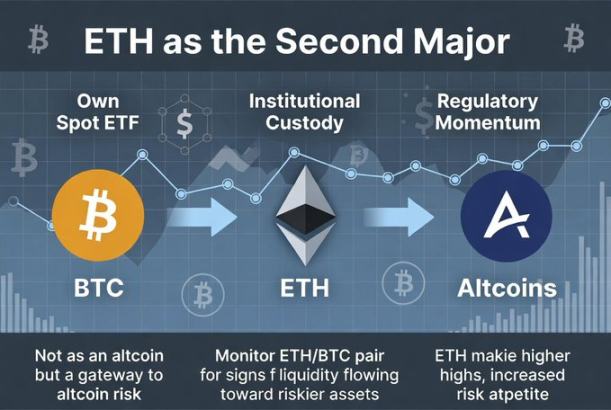
Stop lumping Ethereum with your Layer1 projects. Ethereum is the bridge between major coin and altcoin risk. When institutions want higher Beta than Bitcoin but lower risk than altcoins, they buy Ethereum.
Ethereum also has its own spot ETFs, institutional custody services, and regulatory trends. Watch the ETH/BTC ratio closely. When that ratio starts making higher highs, liquidity is finally starting to flow into riskier assets.
Why Altcoins Lag: Five Structural Headwinds No One Wants to Admit
Let's face reality. The structural problems facing altcoins weren't as severe in previous cycles as they are now:
- Dilution & Unlock Selling Pressure – Continuous supply release. Billions worth of unlocked tokens enter the market every month. Early investors and teams are selling, creating constant sell pressure.
- Fragmentation – There are now thousands of altcoins. There's no clear "altcoin index" for institutions to buy; capital is diluted.
- Narrative Dispersion – AI coins, DePIN, memecoins, gaming, RWA… each sector competes for attention. In 2017, "Ethereum killers" was the dominant narrative. Now? 47 narratives exist simultaneously.
- Lack of Clear Use Cases – Many projects still haven't proven product-market fit. Speculation is fine, but without real users, tokens struggle.
- Regulatory Uncertainty – Most altcoins have zero regulatory clarity. Institutions can't touch them even if they wanted to.
These aren't temporary headwinds; this is the new reality.
Rotation Playbook: How Altseason Actually Arrives
Forget random pumps. Real rotation follows a sequence:
- Bitcoin surges in pulses, then consolidates.
- Ethereum gains buying. ETH/BTC starts improving.
- Major coins cool off. Traders get bored and start seeking Beta.
- Altcoins rise in waves. Large-cap altcoins first, then mid-cap, finally small-cap.
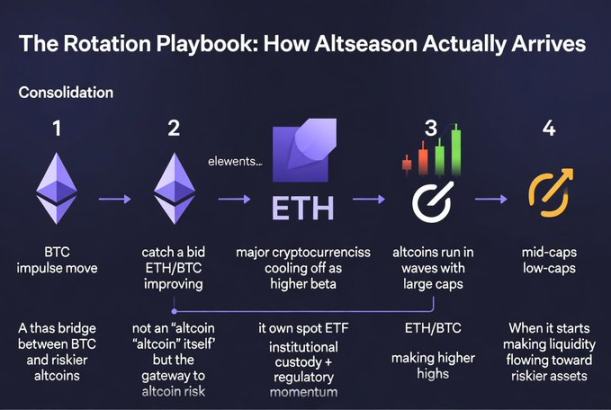
This sequence can take weeks or months. Patience pays off.
Altseason Trigger Signal Board
Here's your checklist; you need multiple signals:
- BTC.D Trend: Confirmed downtrend.
- ETH/BTC Trend: Higher highs, reclaiming key levels.
- Stablecoin Supply Growth: New capital entering the system.
- Funding Rate + Open Interest Condition: Risk appetite is on, but not overheated.
- Altcoin Breadth: Most altcoins breaking out.
Additional Signal Lights (Pro Mode):
- TOTAL2 vs. BTC: Is total altcoin market cap outperforming Bitcoin?
- Perpetual Volume Share: Are traders actually trading altcoins or just majors?
- Memecoin Frenzy Index: Retail sentiment thermometer.
When most of these signal lights turn green, the rotation is real.
False Altseason: Trap Chart
Not every pump is altseason. Beware these illusions:
- Trap 1: Isolated Pumps – Only two or three altcoins skyrocket while breadth remains dead. This isn't rotation; it's rotation theater.
- Trap 2: Memecoins Up, Real Alts Flat – When dog coins, frog coins surge, but your Layer-1 and DeFi blue-chips are flat, it's unsustainable. This is retail gambling, not institutional rotation.
- Trap 3: ETH Up But ETH/BTC Unconfirmed – If ETH rebounds but the ETH/BTC ratio remains weak, it's just Bitcoin dragging everything up. Not true ETH strength.
False altseasons trap impatient traders.
Summary
Bitcoin and Ethereum surge first because that's where liquidity enters first. Altcoins lag due to structural headwinds, dispersed narratives, and the simple fact that building risk appetite takes time.
Stop expecting instant rotation; start observing liquidity layering. When altseason arrives, the signals will be obvious. Until then? Major coins are the trade.
Altseason will come, but not on your schedule—on liquidity's schedule.
Join TechFlow official community to stay tuned
Telegram:https://t.me/TechFlowDaily
X (Twitter):https://x.com/TechFlowPost
X (Twitter) EN:https://x.com/BlockFlow_News
 @DamiDefi